 I'm not smart enough to understand this, am I?
I don't know if I've ever read anything by Steve Ditko but my brain tells me I'm a fan of his simply because my favorite series of all-time is Peter Milligan's Shade the Changing Man, a character invented by Steve Ditko. And I only picked that series up when the first issue dropped because Shade had been on Ostrander's Suicide Squad. So if we work backward from Milligan's comic, my fave, to Ostrander's comic, my mainstream DC fave, and back to Ditko's Shade, I would probably find it mediocre! I'm just using mathematical graphs to produce logical results, you know. Or, and let's assume this is really the case, I would fucking hate it because Objectivism can kiss my puckered butthole. Now, I don't know for sure that Ditko's Shade the Changing Man had any Objectivist bullshit in it, especially since it was scripted by Michael Fleisher. I have to assume that Ditko's art and plotting of the story didn't hide any of Rand's idiotic version of nihilist existentialism in it.
But this comic? I'm fucking scared, man. Do I want to read a comic book written and drawn by Steve Ditko? Didn't I get enough slop philosophy splattered across my brain when I read Rand's Anthem and when my friend Soy Rakelson in high school used to try to gotcha debate me every chance he got? He was always derailed by my answer to his set-up debate question because it was never what he thought I would say and then he had to throw out his argument script. Like the time he asked me, "Do you think animals have souls?" And I answered, "Dude, I don't even think humans have souls." And he just looked at me like a dog that had his ball fake thrown one too many times and said, "Hunh," before ending the discussion. I don't want to paint Soy as a guy who followed Objectivism or even knew who Rand was in high school but he was definitely the kind of guy who would have celebrated her ideas if he'd ever read them. Has he read them? Let me check his Goodreads!
Soy seems to have rated (but not reviewed, the lazy bugger) every book he wants people to know he's read and one of those was Atlas Shrugged. But he only gave it three stars so I'm going to have to assume that he loves the selfish ideology but hated the way it was written. Maybe I should give him the benefit of the doubt and believe he outgrew his weird white whine views of the world and his constant need to debate dumb shit as he called himself the Defender of Western Civilization (which, admittedly, sounds really fucking bad in the current climate and, I'm hoping, he doesn't do anymore. I'd ask him but he disappeared in 2016 from social media when Trump got elected, probably because he didn't want to have to defend Trump but he also pretty much was on board with President Flopsweat).
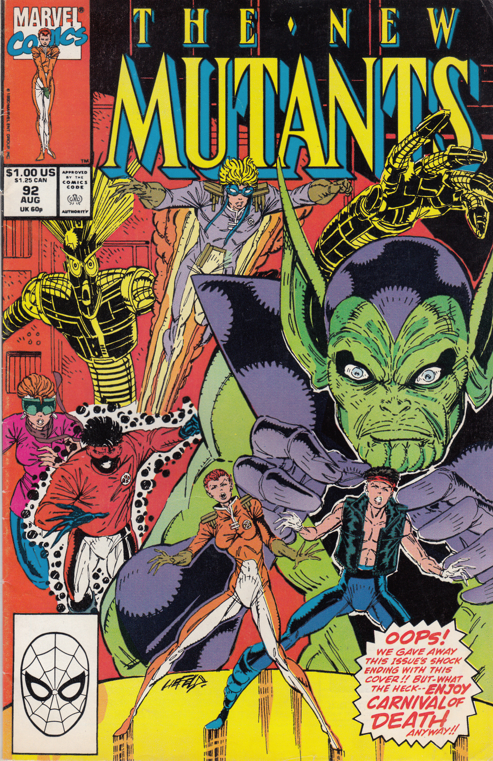
Notice I just ignored the cover? You did? Cool! It's weird, right? Am I going to elaborate? Maybe later? Anyway, I am now going to attempt to read my first Steve Ditko comic book which I picked up at a garage sale for one dollar last weekend.
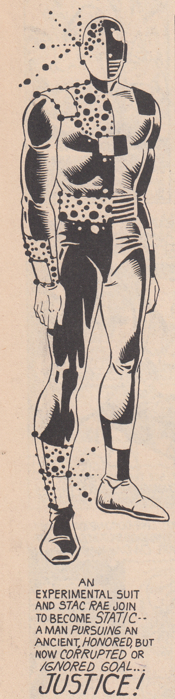 Stac Rae is an anagram of Caesar (with a leftover 'T'). This might not be notable because of the extra 'T' if not for Shade's name being Rac Shade, an anagram of Caesar (with a leftover "H" and "D").
I generally don't debate with people because communication is a sucker's game. The bit Ditko writes in the panel above is a good example of what I find so frustrating with talking to people. It sounds like Ditko and I agree: justice has become corrupted and generally ignored! But I've got a feeling we probably differ on our ideas of justice and what kinds of "justice" are being ignored. I have a feeling Ditko thinks more people should be killed for petty crimes while I think nobody should be killed for any crimes. At least not by the state, anyway! I'm not as ideologically pure as Jesus when it comes to redemption so if somebody wants to get vengeance, who am I to be all, "Don't throw that stone, you sinner," or whatever He said. Also, I've got no problem with somebody like John Wick or Daenerys Targaryen slaughtering hundreds or thousands of people because somebody killed their cute little fuzzy and/or scaly buddy.
I get it, man. I get it.
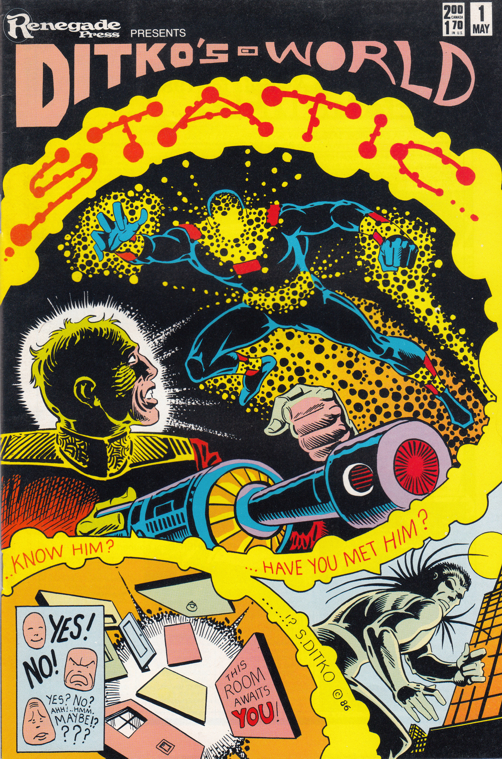
Those heads on the front cover? They're allegorical representations of people in, and I'm going out on a quite sturdy limb with this assumption, an Objectivist view. You have the wishy-washy loser who society coddles, keeping him from ever achieving the greatness he could muster if he were forced to do it on his own. The happy one represents the Objectivist who sees things clearly. The angry one is the real bad guy, the Communist who celebrates the capitalist failure of others because he wants everybody to be equal. The hero is the optimist uplifting the downtrodden by not helping them at all but also not celebrating because they're too busy making that sweet, sweet capitalist cash by their own blood, sweat, and tears and with no help of anybody at all. And don't try to mention how much help they've gotten in ways that aren't even abstract but absolutely tangible, like born to people of average or better means, or being raised in a neighborhood that's properly taken care of by local or state government using taxes, or going to schools who are well-funded because they're in the right neighborhoods, or standing on the backs of all the scientists and philosophers and inventors who came before them. If some poor piece of shit didn't want to be a poor piece of shit from birth to death, maybe he should have squirted out from between the legs of some rich lady, you know? Idiot.
Oh, I mention them because they get an occasional comic strip throughout this comic book.
 If you think this is profound and enlightening then you may have taken four or five serious blows to the head while growing up.
Most people can only argue philosophy in general terms like Ditko here because when you get down to the nitty-gritty details of reality, and actually have to speak on real subjects and how these ideas would play out in the society you live in, the philosophy doesn't hold any water. Ditko's arguing with Theoretical Strawmen here and tuning it, as best he can, to the idea of selling products in a capitalist society. So a four-times concussed adult reading this might think, "Yeah! I agree! If you sell Twinkies filled with shit, you deserve to fail! I don't want my taxes going to support your Shit Twinkies business!" But what's Objectivism is really saying is, "Oh? You were born poor from generations of poor people who had their wealth stolen from them and now you want the government to give you a hand out? No sir! I started a business with the money I received as an inheritance when my grandparents died so why don't you? Oh, too lazy, I bet!"
Okay, sure, I'm sort of doing the same thing there. Painting a general situation that portrays the world in the way that I see it. But I'm just arguing soft generalizations with soft generalizations! We can all play that shit. But at least I didn't write a book called
Anthem that was lacking any kind of detail to support my points, simply labeling certain things as bad and then saying, "The society was based on this thing which I called bad earlier so that means the society was bad even if I didn't give any proofs or reasons for why or how that thing was bad. Also the main character who does everthing on his own actually winds up living in a house built by previous generations full of books and knowledge from other people who learns about pronouns only through these ancient books (after the woman he's with comprehends them better than he does) and suddenly proclaims that he did it all himself!" Sorry! I'm really just repeating my
Anthem review now!
Back to the main story, Stac Rae works as an assistant to a Doctor Ed Serch who works at the Quest Research Lab. The story begins as the Doctor is being kidnapped by some men working for a mysterious The General. Stac and the Doctor's daughter Fera are currently on their way to the lab discussing, I don't know, Objectivism, probably.
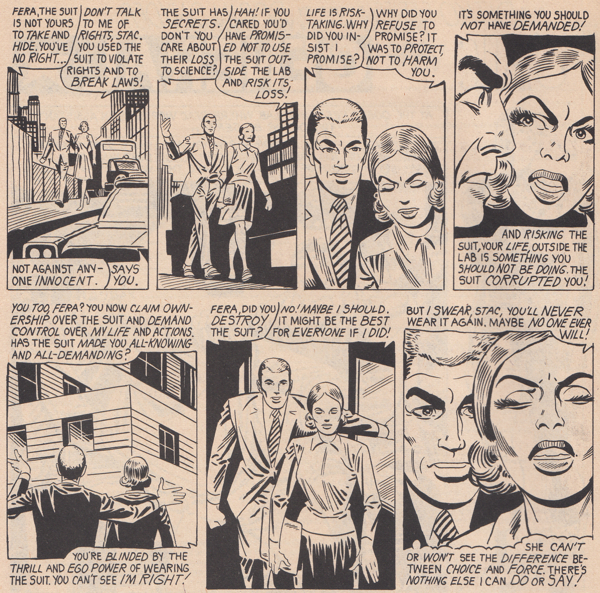 Even Rand would understand this trope where the argument made by the guy is logical and the argument made by the gal is silly and irrational.
The ownership of the suit, Stac admits, belongs to the doctor. So when Stac admonishes Fera that the suit isn't hers to take or, that by taking it, she's somehow taken control of Stac's life and actions, he's admitting that it wasn't his to take either. So why does his theft of the suit trump Fera's theft of the suit when it belongs to neither of them? Why is she taking control of his life when she takes the suit but he isn't taking control of her life and actions (trying to keep Stac and the public safe from the dangers of an experimental suit) when he takes the suit? This is the problem with Objectivism. All arguments basically come down to "I want to do something and it isn't right if somebody or some government says I can't do it" (or the opposite where they don't want to do something, like mask, but other people and/or the government are admonishing them to do it for the greater good). Objectivism's main tenant is "Fuck the greater good. I gots to gets mine!"
Fera and Stac return to the lab to find the Doctor missing. But Fera doesn't suspect anything while Stac's Static-Sense is going crazy that something isn't right. A note left by the Doctor says he'll call. But even though Stac is suspicious, he can't find any proof that anything is actually out of the ordinary. Until The General calls and says, "Don't you dare try to find the Doctor! Don't call the police! We'll release him when we're done with him!" Then The General hangs up and is all, "Well, that settles that. They now know you've been kidnapped but won't do anything about it because I threatened your life as opposed to them not knowing you were kidnapped and probably wouldn't have thought much about it for a few hours, at least."
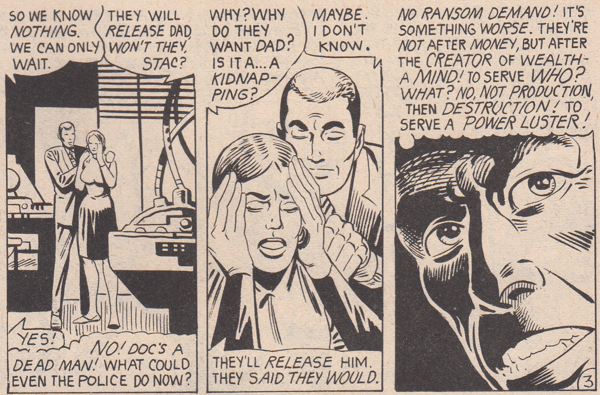 No! Not a power luster! *gasp*
It's hilarious how certain "ideologies" (in quotes because I'm actually discussing anti-ideologies) turn a person's brain into chunky gravy. Stac's entire thought process derives from believing some foundational idea and just processing everything through a veneer of the sweaty logic. "He didn't ask for money but everybody wants money so he must want the main thing that makes money which is the idea person behind it all which is how everything is produced — a smart person who definitely hasn't stolen anybody else's ideas — which means he's not capable of creating things so he must be trying to destroy things which means he wants easy power and money which means he's a DEMONrat! I mean a member of Buy Luxury Mansions! I mean a friend of hiLIARy! I mean a POWER LUSTER!" It's like they hear some shit ideology via a Rand book or FOX News which slides a cheese grater into their skull and every time they try to think, the grater jiggles up and down a bit and they just get dumber.
The General kidnapped the Doctor because The General has a sick weapon. You might think I'm being stupid but it's actually The General who's being stupid because he's really into anthropomorphizing deadly laser weapons. The first time he said it, I thought he was joking. But then he repeated it and instead of thinking he was some hack who thought his joke was so funny he had to repeat it until somebody acknowledged it, I decided he was completely insane.
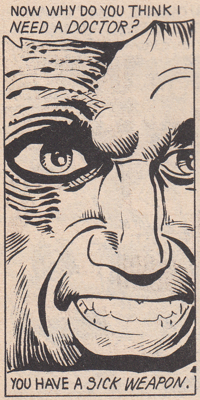
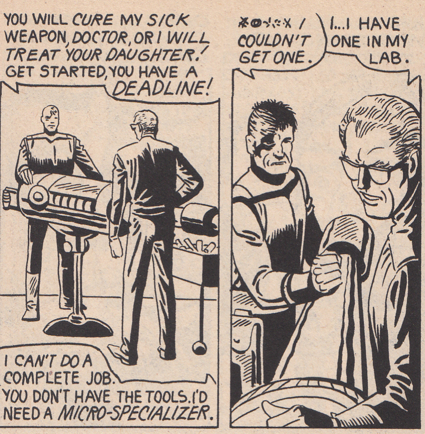 Oh wait. I forgot the Doctor was totally into this sick weapon thing. Maybe that's just the way they say something is broken in their world.
The Doctor has a micro-specializer back at the lab so The General sends one of his henchmen to grab it. Of course it's a ruse! He knows that Stac will see the need for the tool as a call for help from Static! But now he just has to convince the most irrational woman in the world to give him the suit!
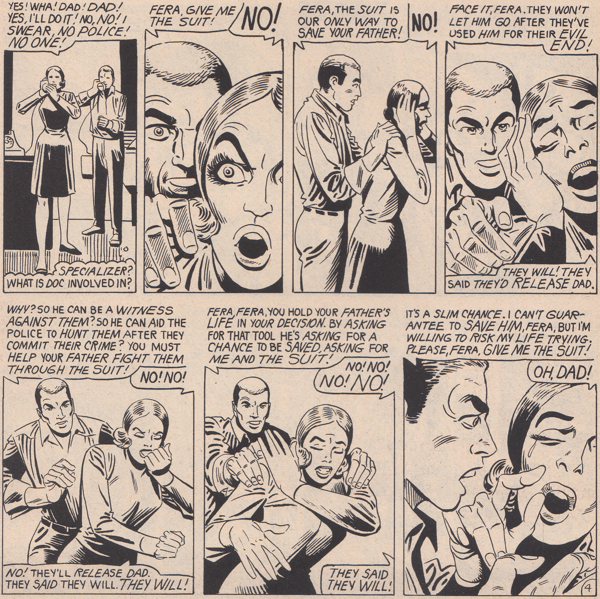 "Can't you see the logic? You're stopping me from making a decision by making your own decision and that isn't fair to me and my decisions!"
I can't wait for another "Heads" strip so I can learn why I should be so angry at taxes!
The Doctor decides to start curing the weapon while he waits for Stac to save him. Luckily, he finds several things wrong with it that The General broke himself to know whether the Doctor was being truthful. This leads the Doctor to think, "He's a master at being clever and counteracting the clever." Fuck, man, that's either the most clever thing I've ever read or the most counter-clever thing! I'm going to put it in my Bluesky bio!
I guess Fera gives in to Stac because he follows the henchman back to The General's secret lair and he's got the suit with him. While he looks for a way inside, the Doctor learns, with the Specializer he thought he didn't need, that many of the parts in the gun are defective. If he'd just done the obvious work, the gun wouldn't have worked anyway. But now he's going to have to fix it up completely, killing millions! Maybe. Or just, like, one really irritating squirrel? It's not like the Doctor knows what The General's plans for the weapon are. He might even be serious about sending the Doctor home after the sick weapon is cured! Just because some guy calls himself The General, has half of his brain showing through his skull, and kidnaps scientists while threatening the scientist's daughter with death, it doesn't intrinsically mean he's up to no good. He's just being productive!
By the time Static saves the Doctor, The General has amscrayed with the ungay. But Static knows how to find the information: torture and possibly killing! It's for justice and not because he just likes torturing and killing. And even if he did, isn't it his right to do those things?
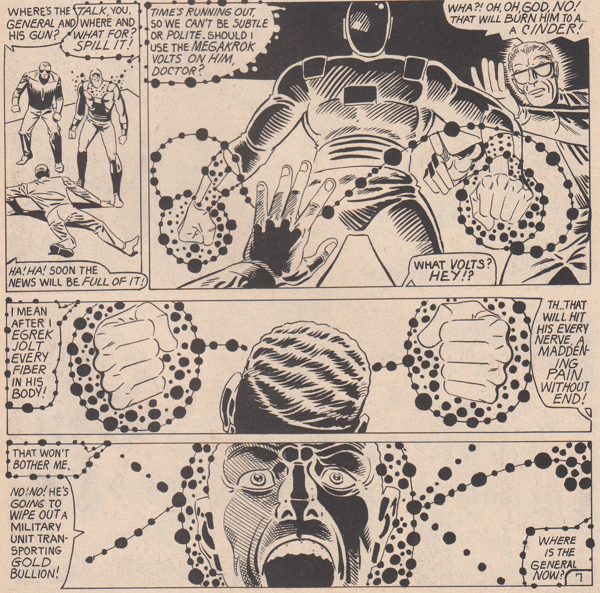 I wish the Heads were here to tell me what to think about this.
Static catches up to The General who attempts to murder Static with his newly healed gun. He fails and Static manages to turn the gun on him, ripping him in half. Static figures without the gun and their leader, his followers will just sit around unthinkingly and collect welfare. Evil but not as evil as stealing gold from wealthy people using violence. Static collects the gun and takes it back to the Doctor who will make it sick again so the world will be safe from, well, one single threat. Hooray for free will and hard work or something!
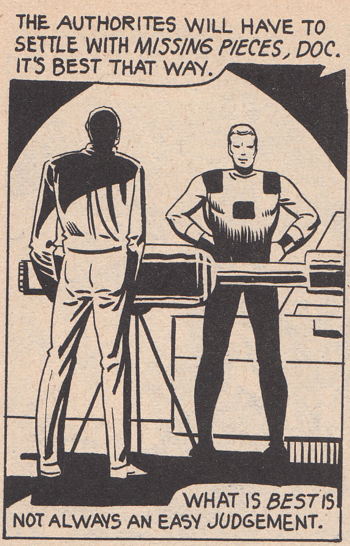 Like whether or not to put an "e" in judgment.
The denouement portrays a scene where the Doctor wonders if he shouldn't destroy the suit because, like the gun, it could be used to commit unspeakable acts of evil. But Stac, who really, really, really fucking loves wearing the suit, tries to convince him that things aren't evil and you can't stop a new-born baby from turning evil so why not just let him keep the suit? He makes sure to throw in, as a major point of his argument, "Do gun triggers pull fingers?" Oh, wow, man! I thought Steve Ditko must be some kind of genius for all the work he's done in comics but it turns out he's just another 2nd Amendment chud with the most boring, cliché arguments that they all spew because they think in bumper stickers.
The story ends with Stac asking Fera why she's so sad and she's all, "Because I fucking listened to you and went against my beliefs, you asshole!" THE END!
But that's only ten pages! Still more to come! But first, next time in Static:
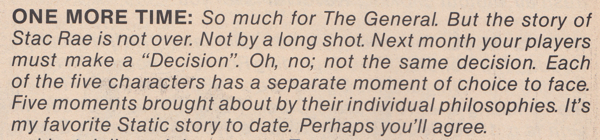 Five philosophies: 1. Objectivism; 2. A Terrible Philosophy; 3. Another Wrong One; 4. A Truly Despicable One Full of Empathy; 5. Socialism (Super Wrong).
After a one page comic strip featuring the Comic Kid who teaches us that emotion is built on logic and experience and aren't just feelings that can be fucked (is that what he said? I don't know. I didn't pay much attention to it because I distrust everything Ditko writes at the moment), the second story begins: "The Exploding Room". This one was drawn by Steve Ditko but the dialogue is by Robin Snyder. I don't know anything about Robin Snyder so I'm not going to celebrate yet.
Whew. Good thing I didn't celebrate. "The Exploding Room" was an eight page shit episode of The Twilight Zone about a hitman whose method of killing is blowing people up. As he goes about his day blowing somebody up, his path is almost crossed by a black cat, he breaks a mirror, and the man he does the job for doesn't give him the bonus he promised. What kind of idiot pays a hitman to blow somebody up and then doesn't pay them their full wage after? I guess he wanted to get blown up because that's what happens. But he survives for enough time after blowing out of the building to land at the feet of the Blow Up Hitman and express a dying curse that the hitman wind up exploding forever! And, for some reason, that's what happens. The guy falls asleep that night and just dreams of blowing up over and over again. Then the story ends and we're left to wonder if it was one night of bad dreams or he somehow entered The Mediocre Twilight Zone!
The final five page story, "Shag and the Uglies", makes absolutely zero sense. But a guy does push down a hot chick twice after she tries to slap him around. So that's cool! Or is it the opposite of cool? I'm so confused by how terrible the story was! The thrust of the story was that Jay (or "Shag" when he transforms) works security for some television variety hour. A guy in an ugly mask attacks the hot singer. Shag stops the attack but the guy gets away. Then Jay and his pals get together and go, "Let's be like Sherlock Holmes and solve this case!" And I guess they figure out who the attacker is but it doesn't fucking matter because he tries to attack the singer in studio again and is caught. So, um, what?
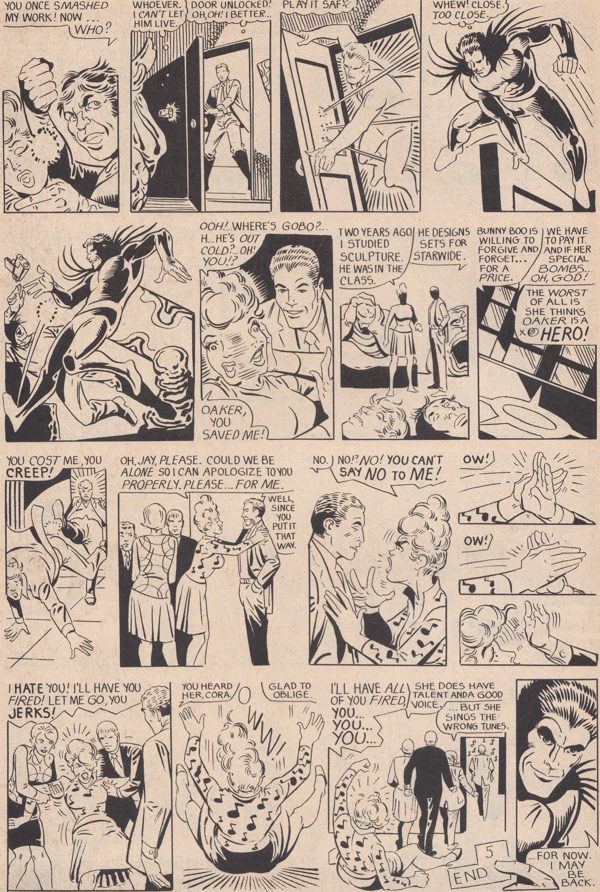 Yay! They figured out it was this guy before they caught him doing the same thing he was doing when they didn't know who he was! They're smart and it didn't matter at all! Hooray!
Ditko's World: Static #1 Rating: D+. I did not like it at all. What a waste of one dollar!