Saturday, September 26, 2026

God Bless You, Mr. Rosewater (1965) by Kurt Vonnegut


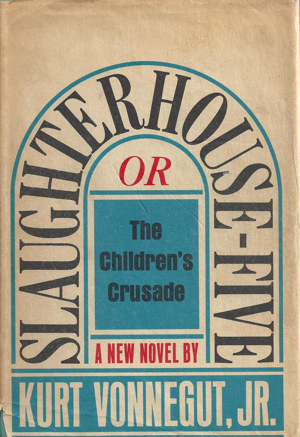
In this book, Eliot Rosewater suggests that some science fiction writer should write a science fiction book about money which is what Kurt Vonnegut has chosen to do. While Vonnegut, as always, touches upon many themes throughout the book, the overarching theme is about money, inherited wealth, and the wide gap between rich and poor created by capitalism. It's about how wealth is concentrated among so few and how those few often did nothing to accumulate that wealth except happen to be born with the correct surname. Eliot Rosewater happens to be the main protagonist although he is only one of a dozen or more characters who also think they're the main characters (which they are, all equally, no matter how many pages they're allowed, given this is a Kurt Vonnegut novel). Throughout the novel, he is driven crazy by his responsibility to do something good and decent with the money he lucked into until he ultimately finds a quite Biblical, if not Communist (neutrally used!), solution to his problem. Basically, he spreads his seeds (figuratively) and spreads the wealth (literally).

I first read all of Vonnegut's books in my twenties and am re-reading them again now that I've hit my fifties. I loved them then, and they must have informed some of who I became in their kindness and optimism and cynicism and all of what they are, but I see them much more clearly now. I was too selfish to see exactly how they reflected the world back then, to see how clear-eyed Vonnegut was viewing the world. Conservatives will accuse any liberal or progressive view as having a modern agenda and yet Vonnegut was expressing those same views in his earliest novels and stories from the late fifties and throughout the sixties.

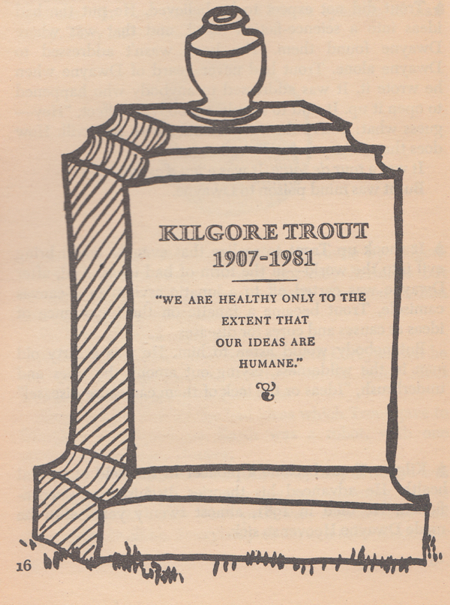
Here's a quote from the book I love where Trout is basically Vonnegut's pure sci-fi, pulp alter ego and the "He" in the quote is the manipulative lawyer Mushari trying to get his mitts on a fraction of Eliot's money by declaring Eliot insane although "He" could be any small-minded pundit or conservative today: "He didn't understand that what Trout had in common with pornography wasn't sex but fantasies of an impossibly hospitable world."

This novel has more heart than plot. That's a good thing, at times. Like the television show, Atlanta, it's more a variety of sketches depicting the pot holes scattered (purposefully!) across the American landscape and a few of the people trying to navigate around or through them.

There's maybe too much throughout this novel to write a concise review of it so I'd just like to quote Eliot's speech he was meant to give at a science fiction convention, a speech Mushari chooses to use as evidence that Eliot is insane. Apparently, according to lawyers and senators and anybody that embraces the status quo, giving a damn means you're crazy.

"I love you sons of bitches," Eliot said in Milford. "You're all I read any more. You're the only ones who'll talk about the really terrific changes going on, the only ones crazy enough to know that life is a space voyage, and not a short one, either, but one that'll last for billions of years. You're the only ones with guts enough to really care about the future, who really notice what machines do to us, what wars do to us, what cities do to us, what big, simple ideas do to us, what tremendous misunderstandings, mistakes, accidents and catastrophes do to us. You're the only ones zany enough to agonize over time and distances without limit, over mysteries that will never die, over the fact that we are right now determining whether the space voyage for the next billion years or so is going to be Heaven or Hell."

Cat's Cradle by Kurt Vonnegut (1963)


Sometimes I'll watch a television show like Star Trek: The Next Generation and think, "I wonder how many conservatives think they enjoy this show?" And sometimes I'll read a book and think, "I wonder how many conservatives think they love this book and the author in general?" I often wonder how many conservatives think they love Kurt Vonnegut specifically but that just makes me think, "They must never have read a Kurt Vonnegut novel. They just know they're supposed to appreciate his work." It's like how the best way to disbelieve The Bible is to actually read The Bible, reading a Kurt Vonnegut book is the best way to know if you're a terrible person or not. Here's a hint as to how you discover you're a terrible person: you don't agree with Kurt Vonnegut's conclusions about humanity.

I never actually wondered if any conservatives loved this book in particular because the main messages of this book, clearly stated, are "Humans are stupid and vicious," "War is terrible," "God doesn't exist," "Religion sucks," and "Life is inherently meaningless." There's a good reason for Kurt Vonnegut to believe these things and he was always quite open about it: all of his books were attempts to reconcile his surviving the carpet bombing of Dresden. What he has come up with in Cat's Cradle seems pretty succinct if not terribly well plotted or profound (at least not profound for a reader who has already reached all the conclusions Vonnegut reaches. And I'd reached them all by the first time I read this book in my twenties. And those conclusions are just more solidified in my fifties. As if my beliefs have configured themselves in a sort of ice nine molecular pattern, you might say).

Cat's Cradle has 127 chapters across 191 pages. It's an easy read, even for a Kurt Vonnegut book. It feels like Kurt was overwhelmed by things he needed to say and so he blurted them out in short vignettes within a story about the end of the world. He has a lot to say here, most of it via a made-up religion called Bokononism which embraces lies because Bokonon understood that the only meaning life has is what we give it. At one point, Newt, the son of the fictional father of the atom bomb, describes the child's game of cat's cradle, a game he points out humans have been playing for ages, teaching it to their confused kids one generation after the other. The game uses a piece of thread to create random connections, various patterns of X's. He shows the game to the narrator and says, "No damn cat, and no damn cradle." Meaninglessness abstracted into a child's game to teach children the true nature of life.

One of the greatest aspects of Vonnegut's writing is that while he may be incredibly cynical, he is never hopeless. Sure, this book ends with the end of the world and Bokonon suggesting the actual ending should be suicide while taunting God. But ultimately, Vonnegut expresses his desire for humans to be kinder, to be better. Cynically, he points out that history has proven that man will never turn away from being as violent and stupid as possible, even with (especially with?) the violent and stupid examples of how humans have acted throughout history. But he wants them to be better. He wants them to be kinder. He wants them to move past the need for meaning and find that all we have are each other and, maybe, we should stop, maybe, buying into the foma of leaders and killing each other for granfalloon reasons. When power and money become our wampeters, we are destined to ice nine our home and everybody in it.

Chapter 114 is a particularly Vonnegutian chapter and probably my favorite. The American ambassador to San Lorenzo goes off speech at a day of celebration to earnestly discuss his thoughts on war and it's absolutely heartbreaking. It feels like the heart of the book even if it doesn't really fit with the plot up to that point or beyond. But that's because it comes from that main reason Kurt was writing. It has one night in Dresden seeping from between each word. And I can't imagine anybody reading it and thinking, "I love this and I'm a conservative."

Mother Night by Kurt Vonnegut (1962)


When I first read Vonnegut's Mother Night in my twenties, I hadn't the background or experience to perceive the scope of it. I hadn't lived through anything that had prepared my mind for what Vonnegut was attempting to express. It left no great impression on my mind and I couldn't have even speculated as to the plot before picking it up again. But now that I have, and I have finished, I am aghast at how relevant this book about a Nazi propagandist is (a Nazi propagandist who claims to be a spy throughout the book, and even seems to be exonerated, but I sense too much of Pale Fire's Charles Kinbote in him. I suppose I can take him at his word, and believe the final letter he receives, although, in the end, it hardly matters. "We are who we pretend to be").

I first read this book before Fox News completely lost its mind and became not just a Republican State Media channel but an Anti-Democrat Hate Machine. The channel has no other goal than to erode the humanity of liberals and fill their audience with hatred and mistrust. Nobody could read this novel today without making the connection between Howard J. Campbell, the book's "Nazi propagandist" narrator, and most of the hosts of Fox News shows.

At one point in the novel, Howard J. Campbell writes, on meeting Adolf Eichmann in an Israeli prison while both are waiting to go on trial:

"As a friend of the court that will try Eichmann, I offer my opinion that Eichmann cannot distinguish between right and wrong—that not only right and wrong, but truth and falsehood, hope and despair, beauty and ugliness, kindness and cruelty, comedy and tragedy, are all processed by Eichmann's mind indiscriminately, like birdshot through a bugle.
     My case is different. I always know when I tell a lie, am capable of imagining the cruel consequences of anybody's believing my lies, know cruelty is wrong. I could no more lie without noticing it than I could unknowingly pass a kidney stone.
     If there is another life after this one, I would like very much, in the next one, to be the sort of person of whom it could truly be said, 'Forgive him—he knows not what he does.' This cannot be said of me now."

And thus we have to see the propagandist in one of these two ways. Do they know the harm they are spreading through their lies and deceit? Or do they believe the things they say, seeing themselves as some kind of hero . . . maybe not even believing the lies spread but believing so passionately in the result of those lies through the actions of the people who will believe them.

And which winds up being worse? They are both terrible but there's something truly cruel and inhuman about knowing you are spreading lies and knowing what kind of cruelty and chaos those lies will unleash on the world. If only there were another world after this one in which someone could judge our actions after. What would happen to Sean Hannity and Tucker Carlson and Laura Ingraham? What has happened to Rush Limbaugh and Charlie Kirk?

And Vonnegut doesn't let the people who believe the lies off the hook by simply concentrating on Howard J. Campbell. In the editor's note by Vonnegut in the beginning of the book, he discusses what the dedication should have been.

"I would prefer to dedicate it to one familiar person, male or female, widely known to have done evil while saying to himself, 'A very good me, the real me, a me made in heaven, is hidden deep inside.'"

How many Americans are currently that person? Doing real evil, making the world a worse place for so many others, while patting themselves on the back for being such a good neighbor, or good mother, or a good brother, acting so civilly and with such kindness to the people they know? How could they be a terrible person when they know so well how good they actually are?

The people who might recognize themselves in this book won't read it. And if they did, they wouldn't recognize themselves anyway. Because this book is about the type of people who are unable to engage in self-reflection.

The Sirens of Titan by Kurt Vonnegut (1959)


I've long had it in my head that Vonnegut's The Sirens of Titan was an anomaly, that it wasn't much of a "Vonnegut book." Upon re-reading it, I think I understand why. Not that it isn't as much a Vonnegut book as some of his others; it may even be more so if one considers all of Vonnegut's books were him trying to make sense of what happened to him in Dresden in World War II as a prisoner of war. It does this to a further extent than I would have expected. No, what made me think of this book differently is that it's much more a pulp sci-fi novel than some of his other sci-fi novels. If Breakfast of Champions is a Vonnegut book, The Sirens of Titan is a Kilgore Trout novel.

When reading Player Piano, I couldn't help thinking of how much it felt like a version of Mike Judge's Office Space for the 50s. This book reminded me, in quite a few major aspects, of Alan Moore's Watchmen and Douglas Adam's Mostly Harmless. One of the main characters in this book, Winston Niles Rumfoord, is a man who, through an accident, has been removed from linear time. He might not be as powerful as Dr. Manhattan, but he has the same perspective. But he's also Ozymandias in that he lives in isolation keeping tabs on everything that's happening (and has happened and will happened because remember he's also Dr. Manhattan) with his large pet Kazak (a dog rather than some exotic cat-thing). Niles also creates a plan for an invasion of Earth which will unite all humans and create a new era of peace. That's the main plot. It's Watchmen before Watchmen (not to be confused with Before Watchmen of which I'm sorry I just now reminded some of you).

The part that reminds me of Douglas Adams' Mostly Harmless is kind of the plot beneath the plot. Maybe it's sort of the theme, part of Vonnegut's working through why he survived the carpet bombing in Dresden. It's a part of the story that's only really hinted at until the final chapter and concerns an alien race from Tralfamadore (See? Kilgore Trout!). Like the new model Hitchhiker's Guide in Mostly Harmless, the Tralfamadorians can manipulate space/time so that a thing they want to happen eventually happens when it needs to happen. The entire human civilization of Earth effectively exists to deliver a part for one of their own's broken down spaceship on Titan. Everything that ever happened to Earth and the Earthlings on it was manipulated to get that part delivered. It's the same idea as everything that happens in Mostly Harmless was a manipulation by the New and Improved Hitchhiker's Guide model to make sure Earth was destroyed.

This is Vonnegut's second book and the ideas within it are as good as any Vonnegut has put forth. Maybe the writing is a little rough here but then that's probably why he came up with the idea of Kilgore Trout. He probably saw the differences in this book, and Player Piano, and what his style of writing would become. But at the heart of this book (and Player Piano) is a writer who somehow balances cynicism and earnestness to a seemingly impossible degree. You can truly feel his pain as he systematically deconstructs society's terrible beliefs, traditions, and accepted social mores which caused, and continue to cause, that pain.

Kurt Vonnegut is a genius and I can't wait to re-read everything else because it just gets better.

Player Piano by Kurt Vonnegut (1952)


When I first met the woman my father-in-law would eventually marry, she asked me what my top five favorite books were. It really wasn't until that moment, after examining the answers I gave that day (the list always changes. If you ever want to make sure I'm eventually locked out of an Internet account, make sure the security question asks what my favorite book is. Because I'll never remember the answer I gave at the time I first answered it), I realized all of my favorite books had protagonists battling against an unjust society and, when they eventually realize they can't actually win, simply escape. One Flew Over the Cuckoo's Nest. Catch-22. The Grapes of Wrath. House of Leaves. Okay, maybe not House of Leaves. But maybe House of Leaves! Just prove that it isn't! I mean, where is Navidson going anyway and is Johnny even alive?! Or was it a brother who died in birth driving Pelafina mad?!

You know what? This isn't a House of Leaves review. This is about Kurt Vonnegut's Player Piano! A book which fits the description of my other favorite books except that the main character doesn't escape at the end. So it's a bit more depressing. Also a cat dies in the first chapter which is why this book loses a star. Sorry, Vonnegut, but you know the rules. Oh wait. You don't? Well the only rule is that if an animal is killed in a book or a movie, it automatically gets downgraded in my ranking. Unless the point of the book is that we're all supposed to kill our own dogs and murder our best and only friend. Then I guess I can see the point. Who wouldn't want to learn that lesson when reading a book?!

I first read this book in my twenties and now I'm in my forties and oh boy is it a different experience. In my twenties, I probably took the whole "revolution against the status quo" for granted and then was annoyed that the powers that be won in the end. But this time, every chapter was a revelation after which I had to check, over and over, how old Vonnegut was when this book was published so I could look up from my book and say, out loud, "How was he so perceptive?!"

The only modern problem with this book is that, if you wanted to ignore the philosophical and ethical underpinnings of the story, and pretend to misread the themes and character motivations, it could be read as the story of Q-Anon leading up to the attempted American coup. I only mention this because the kind of people who would believe Q-Anon nonsense would also approach this book in the disingenuous manner which I laid out at the beginning of this paragraph.

But if you read the book correctly (Oh, do not argue that point. We all know there are correct and incorrect ways to read every book. People who think any way to read a book is "a correct way" are just lazy and narcissistic readers), you'll know this is as effective, touching, and damning of the status quo as anything written by Douglas Coupland or Joseph Heller or Kurt Vonnegut. Oh wait, it was written by Kurt Vonnegut. Well, that explains that then!

Damnit, Vonnegut. I'm still thinking about that poor cat.

Thursday, September 24, 2026

Eee! Tess Ate Chai Tea: The Newsletter #31 (First Week of July 2018)

E!TACT #31
Super Sons Love Dynomutt #1, Aquaman Loves Jabberjaw #1, Black Lightning Loves Hong Kong Phooey #1, Flash Loves Speed Buggy #1, and Letters to Me!
By Grunion Guy

COMIC BOOK REVIEWS!

Super Sons Love Dynomutt #1 (May 30th, 2018)
By Tomasi, Pasarin, Albert, and Eltaeb

I may be caught up on Batman and his lack of honeymoon cat pussy but I'm so far behind on my weekly comics that I'm considering the terrible idea of doing haiku reviews for all the comics currently in my stack. The problem with that is that haikus in English are not beautiful and rarely interesting. Any form of poetry that can be done by somebody who counts syllables on their fingers is not a form of poetry worth reading. Again, though, I'm speaking purely of haikus in English. The reason haikus in Japanese are beautiful and interesting are that all of their syllables are basically the same length.

Some people might argue with me that a syllable is a syllable is a syllable but then I'd rebut that argument with an asshole is an asshole is an asshole.

Anyway, I'm not doing the haiku thing. But I really should think of some way to shorten the amount of time it takes to review each comic book. I have done limericks before. Those are also short, like haikus, but they're tougher to write. Not because it's harder to rhyme a few words than to count to seventeen but because limericks should be witty. It could take a little time to think up a good twist in the limerick's final line whereas I can whip up a haiku in fifteen seconds. It won't be any good but then how would that differentiate it from any other haiku?!

Ha ha! I just zinged haikus! Take that, you pretentious style of poetry!

Here are a couple of classic limericks I wrote for Superman:

Jimmy Olsen was murdered last issue,
So Superman needed a tissue.
He pulled out his cock,
And jerked off in a sock,
Screaming, "Jimmy, my pal, how I miss you!"

It turned out Jim was not really dead.
"We knew it!" the fanboys all said.
Some posted smart theories,
Amidst genial queries,
But mostly they snorted and meh'd.

Those are pretty good, right? They're better than some of the classics. Like these:

There was an old man from Nantucket,
Whose cock was so long he could suck it;
He said with a grin,
As he wiped off his chin,
'If my ear was a cunt I could fuck it.'

There was an old lady from Grott,
Who lived on green apples and snot;
When she couldn't get these,
She lived on the cheese
She scraped from the end of her twat.

Gross. Anyway. I guess maybe I should just read this stupid comic book that I bought simply because really young me loved Blue Falcon and Dynomutt. I even had the boring board game. It was so boring that I almost called it a "bored" game before I thought better of that dumb joke and punished myself by punching myself in the face simply because I thought of it.

Have you ever punched yourself so hard in the face that you see stars? The trick is to surprise yourself otherwise you'll pull the punch. "But how do I do that, Grunion Guy?" you rightly ask. "Well, what you do is," I explain patiently to the obvious dum-dums who have never punched themselves so hard in the face that they've seen stars, "You agree to ride as a passenger in a convertible owned by a guy who can't drive. So when he takes an insane corner, you forget the top is down and you quickly reach up to grab the roof to steady yourself. Being that the roof isn't there, you punch yourself hard in the face! Ta da!"

The issue begins with Dynomutt's secret origin. Basically he grew old and was about to die so Blue Falcon put robot parts in him. For some reason, those parts didn't just keep him alive. They also allowed his legs to grow really long and gave him the ability to talk. I guess Blue Falcon cut him open and thought, "While I'm in here...!"

After that, Clark, Lois, and Jon go to a funeral.


Who bukkaked Archie in his casket?

I mean, "There once was a man known as Archie,
Whose dead body we all had to see,
One viewer was horny,
And not quite so mourny,
So he taught us all how to bukkake."

That might have sounded disrespectful and insulting but, in my defense, I have no idea what vitiligo is. So I couldn't have been making fun of it. Whatever it is. Who knows? Not me!

Rating: It's hard to get the entirety of one story into one limerick but I'm going to try by generalizing the plot into non-existence! Here we go:

Blue Falcon dies at the end,
But before that, the story does wend,
Not much is said,
And then Falcon is dead.
Surprise! Blue Falcon winds up on the mend!

* * * * * * * * * *

Aquaman Loves Jabberjaw #1 (May 30th, 2018)
By Abnett, Parker, Pelletier, Kolins, Hennessy, Beredo, and McCaig

Hopefully this story is about a rash of shark attack victims across landlocked states of the USA. "Who could possibly be behind these horrible atrocities?" thinks Aquaman as he watches a great white shark shred on the drums. "How the fuck does he manage that double bass?! Wicked!"

Hmm. Apparently I wasn't too far off on Aquaman's investigative technique.


The King of the Sea: "Hey, land person. Anything going on in the ocean I should know about?!"

Strange shark sightings have been reported in Amnesty Bay. They're not strange because the shark shouldn't be feeding in the bay but because the shark is super friendly and rocks people's socks off. So it sounds like it's a situation that desperately needs the attention of a member of the Justice League. You don't want too many people having a pleasant encounter with a great white shark. What if they begin to think all great whites are friendly?!

Now I'm beginning to wonder if maybe this is an allegory about the rise of white supremacy in the United States of America.

Aquaman meets up with Jabberjaw to discover he's just a big Rodney Dangerfield/Lou Costello/Curly wannabe. So maybe I was too quick to assume political commentary in a Hanna-Barbera/DC mashup comic book.


Poor white conservatives can't even read a relaxing Aquaman Loves Jabberjaw comic book without being subtly criticized!

Did I say "subtly criticized"? Apparently I'm better at reading comic books than I first realized (and, believe me, I realized I was great at it almost immediately! I ain't no humble pair of titties!) because this absolutely is a comic book about white supremacy. Man. Now I'm just depressed. I was hoping I was going to escape reality for a few minutes and just read the innocent story of a great white shark banging human groupies.

I mean, seriously, Dan Abnett. Can't you keep your liberal agenda to yourself?! This is so uncivil, criticizing Trumpers right here in a comic book that should be free of politics! How am I, an ultra-liberal tool of communism, supposed to enjoy a book that skewers racist, misogynistic, anti-sea-life bastards?! Oh wait! I just realized what I typed! This is terrific! For a second there, I thought I was a white male conservative who gets super defensive whenever somebody points out that our country is being dismantled by white male conservatives and then writes posts on Facebook like "Both sides aren't being very civil! Stop attacking people that I identify with and pointing out that maybe some of my thoughts and ideas are problematic and gross! Jerks!"

In the end, Aquaman realizes that people only respond to propaganda and mind control so he teaches Jabberjaw's band, The Neptunes, to use aqua-telepathy to brainwash the masses into being cool to each other. Wait a second. Is that a good message? Is Dan Abnett's message actually the opposite of what I thought?! Is he a conservative criticizing the entertainment industry for espousing liberal views to make the world a better place?! I'm confused!

I wish this story had just been about a shark fucking the ladies.

There's a Captain Caveman story in the end that points out how punching Nazis goes way back. Way, way, way back. So far way back that we just have to accept that Nazis need to be punched. You can't spend your life not punching Nazis?! I mean, what can you do?! It's right there in a comic book!

Rating: I think this book was so liberal that every conservative who read it immediately began boycotting DC comic books and burned their Action Comics #1 to own the libtards. Although, was it too liberal? I mean, the plot revolves around a racist Ocean Master who is obviously a stand-in for racist conservative Americans. But then his whole anti-sea-life mission is being financed by a liberal, anti-human agenda! The fucking liberals are behind it all to make white males look bad! And in the end, the only way to get the liberal message across to the world is to sink it into their brains with telepathic pop songs, essentially brainwashing them into compliance! I think this is one of those "both-sides-ism" things! Poor Jabberjaw being exploited by Dan Abnett for his confusing political agenda!

* * * * * * * * * *

Black Lightning Loves Hong Kong Phooey #1 (May 30th, 2018)
By Hill, Parker, Cowan, Sienkiewicz, Kolins, Cox, and Avina

I can't explain what it was because I was seven but I fell in love with Scatman Crothers. I couldn't get enough of him. I wanted him to be my father and my best friend. It was partially due to my weird childhood fetishization of old men. Going in Style was one of my all time favorite movies. I loved anything with Art Carney in it. I adored George Burns. I thought of my first grade speech therapy teacher, an old man, as my best friend. I used to bother my old male neighbor to go on walks around the block with me. And when I realized Scatman Crothers was a person that existed when I first saw Scavenger Hunt, it was love at first sight. Not romantic love, of course! I wasn't sexual yet! Jesus! Stop sexualizing seven year olds, you gross perv!

Anyway, what I'm trying to say is I loved Scatman Crothers (and Art Carney! But he has nothing to do with this so forget about him now!). I also loved Hong Kong Phooey. Those of you familiar with Hong Kong Phooey know where this is going. See, he was voiced by Scatman Crothers. Maybe that's why I fell in love with him. Maybe I subconsciously recognized the voice. I'm not sure when I learned Scatman gave voice to Phooey (it's not like it's hard to figure out. It's not like Scatman put on a different cartoon voice for the gig!) but I'm sure I met the realization with a heart-eyed, "Ohhhhhh!"

I also really loved Roddy McDowall. He was right around fifty at the time my old man fetish was developing, so he probably fits. He also played that aging horror host in Fright Night which played into the whole weird obsession I had. But this doesn't fit into the narrative I'm developing either. I only brought it up because I loved him so much! He was also in Scavenger Hunt. Maybe I just loved everybody in that movie because I had a bit of a thing for Richard Mulligan too.

If you're a young person, you just had to Google about ten different people and movies.

Um, anyway, what I'm trying to say is DC Comics picked the line-up of Hanna-Barbera cartoon tie-ins this month directly out of my brain. Dynomutt and Blue Falcon, Jabberjaw and the Neptunes, and Hong Kong Phooey were three of my favorite cartoons. And Black Lightning was one of my first favorite DC comic book characters thanks to Batman and the Outsiders, one of the first comic book series I began picking up when I discovered my first local comic book shop in Santa Clara, Brian's Books. So for me, this is the team up of the millennia!

Not to toot my own horn (although it would be irresponsible and gross to toot somebody else's horn without consent (also, tooting my own horn isn't a euphemism for something gross that shouldn't be done in public (but even if it was, I just stated that I wasn't tooting my own horn (even if the point of saying "not to toot my own horn" means you're just about to toot your own horn)))) but I've now forgotten what I was going to say after all those parenthetical references. Oh, I remember the toot: I spelled "millennia" correctly on the first try!

Rating: It was underwhelming. So underwhelming that I don't even want to discuss it. But I did really enjoy one panel from the Funky Phantom back-up story!


Gouverneur Morris doesn't get enough love! Glad to see my favorite founding father mentioned!

* * * * * * * * * *

Flash Loves Speed Buggy #1 (May 30th, 2018)
By Lobdell, Booth, Rapmund, Irwin, Livesay, Banning, Deering, and Dalhouse

Even though I can do a lousy Speed Buggy impression, I didn't get this comic book because of my nostalgic love of the cartoon. I got it because I hate myself and realized I hadn't read a Lobdell comic in quite some time. Plus this comic has the added bonus of Brett Booth's drawings of gigantic thighs!

Before I explain how this issue begins, I want everybody to take a deep breath. You might want to sit down. Maybe have a cool glass of water handy. I don't want you to be too shocked at how this Scott Lobdell story begins. Are you prepared to read the first line of the story? No, no! Don't try to guess what it might be! You might strain yourself! Okay, are you prepared? Here it comes...


I know, right!? You probably thought it was going to begin "My name is Superboy."

Just be thankful I didn't scan the picture of Wally West because it's 85% thigh. It's really disturbing. Maybe not as disturbing as the writing though.


Scott Lobdell is so terrible at writing that he doesn't realize that words in speech bubbles aren't read by other characters but are meant to indicate spoken words.

I know that the previous panel is supposed to be funny. We're supposed to laugh and think, "The Flash just said what I was thinking! How do you pronounce that?!" But really only awful comic book fans who have somehow been deluded into thinking Scott Lobdell writes decent comic books will not immediately think, "You just heard how he pronounces it, you stupid fuck. Also, how do you know there's a percentage sign in his name? Unless it's pronounced 'Kilgpercentagesignre.' In which case, we're back to the first point and you just learned how to pronounce it. You stupid fuck."

Speed Buggy shows up because his name is on the cover. What?! You need more reason than that? You did see Lobdell's name on the cover, right? You should know better if you saw Lobdell's name on the cover and you expected a coherent story that was entertaining for people who aren't concerned with remaking The Last Jedi.

Speed Buggy picks up The Flash and they drive up Kilg%re's asshole. I don't think I'm making that up. It's possible I'm reading too much into the story. I'd know for sure if it wasn't for Brett Booth's terrible panel layouts, his flaming raccoon turd art (that probably reads as "kinetic" for the people who enjoy this shit and who are also developmentally arrested at age twelve), and the incomprehensibility of Scott Lobdell's "I don't give a fuck about this story as long as I get paid, bitches!" storytelling ability.

Inside Kilg%re's colon, Speed Buggy and Wally West encounter the Speed Force. Luckily the Speed Force is such nonsensical bullshit that it should be right up Lobdell's plot alley.

Speed Buggy and The Flash defeat Kilg%re by saying a bunch of scientific words. It doesn't really matter because, according to Brett Booth's seizure inducing visuals, I almost died reading it. But I'm back in my chair and my head is bandaged so I'm ready to keep reading. I don't dare reread the previous bit so I'm just going to have to assume that there's a reason for Wally West to be turning against Speed Buggy's driver now. I think it might have had to do with a rail of coke and an upskirt shot.


There's so much terrible stuff to rant about in a Scott Lobdell story with Brett Booth art that I probably shouldn't stop to point out that these jerkos typed "well-intetioned." I probably shouldn't but I'm a terribly petty asshole.

It turns out the guy driving Speed Buggy is the smartest scientist in the world. That's one of three characters Scott Lobdell knows how to write. The other two are "teenager who wants to fuck the person he's beating up" and "sassy teenager that talks directly to the reader as he comments on his own story in an omnipresent manner." I almost said one of his characters was a baton twirling passerby who knows more about the plot than Green Arrow but that was one of Ann Nocenti's.

Doctor Veritas's male counterpart, Doctor Blanc, explains to Wally West that science can do whatever it wants so go fuck yourself, goody-two-shoes! He also calls the multiverse the "omniverse" which is Scott Lobdell's trademark. I can't help but wonder why editors never tell him to stop using that term since nobody in the DC Universe calls it the Omniverse. Unless they're in a Scott Lobdell story. You would think more continuity nerds would be up in arms about this but I guess they're all too busy writing terribly punctuated essays about how Tom King is ruining Batman.

The idiotic editors also allow Brett Booth to put more of those stupid fucking Pizza Fish advertisements into the story. What the fuck do Scott Lobdell and Brett Booth have on the editors at DC?! Why can't the editors tell them to knock off the junior high school shenanigans!? This is a professional field of artistic work, isn't it?!

I mean, I guess it isn't because Booth and Lobdell have been allowed careers in comic booking.

Rating: Look. I couldn't keep writing about this shit. Once again, Lobdell writes a terrible time travel story. Time travel stories are great for writers who don't understand how to write stories. Nobody needs any motivation because they get their motivation from somebody in the future changing things. Then the hero's only motivation is to return things to normal. It's like a shortcut to a plot. In this story, The Flash has to defeat Savitar who changed time to allow him to rule the world. But The Flash says, "Oh yeah?! Two can play at that game!" Then he and Speed Buggy change time back so that Savitar doesn't rule the world. Meanwhile, nobody else notices that anything happened.

Scott Lobdell is the worst.

* * * * * * * * * *

Letters to Me!

I Wrote (about Anonymous!): "But I refused to explain the magic trick and instead just continued to boggle at his inability to understand exaggeration for effect and obvious bias disguised as impartial critique."

Anonymous Replied: "It's mind-boggling that you'd try justifying the drivel that you write, especially considering it's not as clever or witty as you like to believe."

I Wrote (about Anonymous!): Not that I should be surprised by that response and then insult their learning disability that I'm sure they've been struggling with for years when the whole point of my reviews is that they're supposed to sound like an arrogant yet somewhat stupid asshole who doesn't know how to write reviews!

Anonymous Replied: "Given the state of your writing, it's odd that you of all people would make fun of learning disabilities. Even more, your argument falls flat considering the fact that you actually are biased and conceited. The fact you let crap by Steve Orlando get a pass, a guy whose JLA comics makes Cullen Bunn's Lobo series seem like Oscar-worthy material in comparison, speaks volumes. Bunn's Lobo was mediocre at best, even if it departs further than Bennet's, but Orlando's take was horrible. And the sad part is you haven't even refuted what I had said in terms of the state of Lobo within the DCU - the character's no better than how he was when the New 52 version debuted. At least when Bennet had been writing there seemed to be potential for something interesting. Hopefully Scott Snyder will do a better job."

My Reply: I wonder if Anonymous watched a magician saw a woman in half, he'd start an argument with the guy about how the guy didn't really saw the woman in half. Then when the magician explains the trick and says, "Yeah, see, it's a trick, buddy. I didn't really expect anybody to believe I could actually saw a woman in half," Anonymous would say, "Oh, nice try, pretending you didn't really want me to believe you sawed the woman in half! Your argument that you didn't really expect me to believe it falls flat because you did the trick expecting I'd believe it!" Or something like that. Maybe I'm terrible at terrible analogies because of my learning disability.

Anyway, Anonymous's problem is that he's unwilling to step away from his initial conceit about my arrogance and bias. I just told him the trick and explained the voice I use in writing my blogs and he refuses to accept it.

Me: "I'm supposed to sound like an arrogant yet somewhat stupid asshole who doesn't know how to write reviews."
Anonymous: "That argument falls flat because you're an arrogant yet somewhat stupid asshole who doesn't know how to write reviews!"

Anonymous Writes (in response to my suggestion that Rogol Zaar reminds me of Lobo): There are plenty of characters with pale skin and skull belt buckles, even outside of comics.

My Reply:


* * * * * * * * * *
And that's all I have time for! I mean, that's all the time I want to spend on this thing! Later, jerkos!

Sunday, September 20, 2026

Tangent Comics: The Atom #1 (December 1997)


This guy looks as heroic as a freshman math tutor.

Tangent Comics: The Atom #1 (October 1st, 1997)
By Dan Jurgens, Paul Ryan, Pat Garrahy, and Dave Lanphear
Cover by Dan Jurgens and Paul Ryan
Edited by Frank Berrios, Dana Kurtin, and Eddie Berganza

Some of you dimwits probably think of math tutors as heroic because you have trouble dividing things by zero but I want you to know that I meant that as an insult to The Atom. Also the dividing things by zero bit is a joke that all the math tutors reading this didn't get because they were instantly angry at me. Most of us know you can't divide things by zero because we're told that and we have to repeat it back as if we believe it but we all know that if you divide something by zero you get infinity. It's just logic, man! I didn't make the way the human brain works by refusing to learn actual things and chooses instead to believe the things it thought were right before actually being told what was right. I will go to my grave believing that dividing by zero equals infinity and Pop Rocks plus Coke will blow your stomach wide open.

Anyway, The Atom never had a chance of being good looking, hip, or cool because he was drawn and created by Dan Jurgens, an artist and writer who hasn't had an original thought since 1987. It's not his fault! That's just the last year his model received any software updates. Luckily this was written in 1997 so it's only ten years past Jurgens pop culture, fashion, and trends blind spot. But I'd be willing to bet Dan Jurgens could have written this in 2027 and not realized how spectacularly square it would be.

Do the kids still use the term "square"? I haven't had a proper software update since 1977.


"Look! Up in the sky! It's a bird! It's a plane! It's . . . ah, who cares?"

I just realized that Superman bit where people looked up amazed to see him doesn't really work. It's taken me all this time to realize it, probably because I'm the sort of person who refuses to believe my math tutor. Who walks around yelling, "Look! Up in the sky! It's a bird!"? Obviously far less people than scream, "It's a plane!" Even though screaming, "It's a plane!", at the idiot who just looked up in the sky excited to see a bird when he was really looking at a plane is absolutely understandable. The only time anybody should have been shouting excitedly while looking at the sky was when they saw Superman so they should have just yelled, "Look! Up in the sky! It's Superman!" Then it would be more understandable to have people follow up with, "It's a plane!" or "It's a bird!" The whole Superman "Up in the sky!" catchphrase was simply written backwards!

"Look! Up in the sky! It's Superman!"
"NO, it's a plane!"
"You idiot! It's a bird!"

I just described this revelation to my friend Doom Bunny who tried to then explain the concept to me as if I didn't get it before I could convince him I understand the conceit but only now realized it didn't make any realistic sense. Then I also realized: "Metropolis is a massive city. Maybe seeing a bird is exciting! And then proclaiming it's a plane and then Superman are just subsequent levels of disappointment in not seeing a bird!"

Ahem. Moving on.

The President secretly watches The Atom (who looks suspiciously like Booster Gold but with dark hair and different coloring (mostly I'm talking about how you can see every muscle under his suit but somehow can't see the outline of his dick and balls) as he searches Metropolis for The Fatal Five, the criminals who killed his father! For this is The Atom III, the most human looking Atom of them all! I guess Atom II looked like a little guy with lightning bolts for ears and Atom I looked like an ant wearing clothes.


Ignore the unrecognizable Fatal Five. Check out his crotchless crotch in the upper left corner!

The Fatal Five in the Tangent Universe are more like The Fearsome Five in that they exist in the 20th Century and they also have a little guy on their team. But instead of Gizmo, the little guy on The Fatal Five is Kid Psycho which means he's based on Doctor Psycho, I guess? This universe is confusing! Instead of Doctor Light (not to be confused with Doctor Psycho who, as far as I know, isn't a total pedo), The Fatal Five have The Shadow Thief, I guess? That sort of makes sense! I guess Deathstroke replaces Mammoth or, if you were a snarky genius, you can point out that Deathstroke replaces Gizmo since this Deathstroke has whirling blades on his wrists which are the dictionary definition of a gizmo. I suppose Count Viper replaces Psimon because they're both arrogant jerks with psychic powers (again I'm prone to assumption; I don't know for sure that this "vampire" has psychic powers). And lastly, Ice replaces Shimmer because who cares.

During this battle, we learn that The Atom III has Firestorm powers except better because he can turn organic things like Count Viper's face into another organic thing like tapioca pudding. It's pretty disgusting and somehow doesn't kill Count Viper.


I guess he's immortal and now has to live with tapioca face.

The president, concerned with Shadow Thief on the loose with some kind of teleportation technology and the dangers of The Atom III tearing everything apart to hunt him down, demands his people get to the bottom of whatever the fuck is going on. He's all, "We run this country!" Mostly he says that for the perfect segue to shift scenes to Nightwing's leaders laughing uncontrollably and slightly pissing themselves as they spy on President Schwartz. Yes, that's his name. It is. I swear it is.

Somehow, the president isn't the only one spying on The Atom III. I guess his exploits are simply being televised to everybody and the President just happened to be watching along with everyone else? This is because The Atom III, no relation to Booster Gold, has a robot flying about him streaming live video and audio via a pirate signal to everybody's television sets across the country. And it must send the feed into the past because it gives everybody who knows the real identity of Atom III the chance to get their asses to the Fatal Five's hideout and confront The Atom III as he emerges from the battle.


President Schwartz is worried about teleportation technology getting into the hands of a criminal but it looks like every Tom, Dick, and the other guy already owns the technology.

Most of this will probably be explained by Jurgens in that The Atom III just happened to make his debut in the same city where he works (probably at the newspaper) and everybody knows him and also The Fatal Five live there as well because it was a convenient locale to kill his father from. But what I'm worried he won't explain is why his grandmother is Judy Garland.

So the camera was the president's spy device but that doesn't explain how the other people saw what was happening and how they knew he had a spy camera following him (supposedly they knew because they saw the video feed. But now I have to reassess that assumption and just believe those normal jerks observed the "micro-cam" before the super hero could). The President calls up the files to find out more about The Atom III since this is the first time they've every encountered him even though they had a spy camera following him around. I suppose if I want to do Jurgens' job for him, I could fill in the blanks and believe that every city in the United States is just infested with micro-cams waiting to pick up news like this. Although then why would the bystanders believe The Atom III had a micro-cam following him to record his exploits instead of understanding that they live in a surveillance state? I guess maybe they just don't know that and only see micro-cams when they're following a hero around?

Why am I doing this?! Writing this comic book isn't my job! I'll just assume anything worth explaining will be explained later. Like how The Atom, Arthur Harrison Thompson, got his super name! My guess is that it's because he received atomic powers when he was irradiated by the first atomic bomb ever tested! Right?!


Oh fuck off.

The bigger mystery now is how was Judy Garland attracted to that?!

The president watches Nightwing's history of the events of the early '60s that led to the Cuban Missile Crisis. These doctored files and movie reels suggest that the first Atom was a hero that stopped a Soviet nuclear bombing of Florida from Cuba into devolving into a full out nuclear apocalypse. But judging by what Shadow Thief said earlier, my guess is that the real event was The A. Thom. went to help, couldn't control his powers. blew up Florida himself, and The Metal Men had to save the day. Or nobody saved the day and America just never launched their nukes because they knew A. Thom. had made a huge whoopsie. But they needed people to hate the Communists and love America so they lied about what really happened. I'm so glad this is just a fictional account of American history!


At least this answers my most pressing question: he fucked Judy costume on and rotting, irradiated dick out.

Just kidding! The A. Thom. became so popular that even Marilyn Monroe had to be caught fucking him no matter how ugly he looked or putrid he smelled! Eventually he got Judy Garland pregnant and disappeared from the public view to raise their child together on the moon. Nobody knew this until 1969 when America faked the fake moon landing and actually landed on the moon. Nobody noticed until Armstrong was halfway through his rehearsed line when he noticed the glowing yellow mansion just dozens of feet away from him. I, for one, would like to believe that NASA looked at the moon at least once before sending a bunch of humans to it. But what do I know? I read fucking comic books.


Not realizing he's a comic book character and the exposition wasn't for him but the readers, President Schwartz complains about the intel.

The Atom III goes off to pout because he blew his big debut. He cries about how bland his life was growing up in the suburbs without a father (at least after they moved from the moon). He beats himself up for letting Shadow Thief, his father's murderer, get away. But then he meets a little girl who is all, "I like reading old shit comics instead of using computers!" And Dan Jurgens, I mean The Atom III is all, "Me too! Old stuff is where it's at! New stuff is scary and I can only hold it in my RAM for a limited amount of time!" Then he flies away thinking about how to tell young children about his family life. Just in case it comes up a second time!


No, it's a plane! No wait! It's just a bird! Darn!

The Atom III sees a news report about how The Batman (or whoever he is in this universe) has been stymied while trying to find a cure for AIDS. The Atom III is all, "Man, I'd love to help with that but right now, I've got more important things to do! Like find out what Shadow Thief meant about my family being huge failures!" I know that sounds like I'm levelling some major critical side-eye at The Atom III's decision to forgo helping cure AIDS because he has his own personal shit going on but, I mean, isn't that just life? Luckily some people's personal curiosities and desires just happen to align with making the world a better place. But not mine and not The Atom III's so I can't fault him here.

I mean, obviously I'm judging the shit out of him! He fell backwards into powers that allow him to make a man live the rest of his life with tapioca face. Of course he can take a weekend to cure AIDS!

Tangent Batman's theory is that he's so smart he should have found a cure for AIDS himself but since he hasn't, it means somebody is sabotaging his efforts! And we all know Batman, even Batmen from other dimensions, is always fucking correct.


Why does he relate Red Tornado with AIDS? Was Red Tornado a sexbot meant to spread a deadly sexually transmitted disease to all commies, peaceniks, and nonconformists?

I should point out, even if it was in one of my previous scans, that The Atom III's secret identity is Adam Thompson. So we know he took the name Atom because it's his first name, Adam. And we know the first Atom took the name because of his first initial and first half of his last name: A. Thom. But how did The Atom II get his name?! It will forever remain a mystery!

The Atom III, in need of answers to his many questions like "How do I explain my dysfunctional family to a strange child?", visits his grandfather who now lives on a yacht. That's why Nightwing could never find him! Because yachts, like, mover around and shit. Really hard to track down and pinpoint! But since Nightwing are keeping an eye on The Atom III, they now know where old Gramps has been hiding. They anonymously alert Shadow Thief to A. Thom and The Adam III's location so that he'll murder them.

After some nuclear missiles are launched at the yacht by Shadow Thief breaking into an American military installation, Adam and A. Thom. fly off to confront him and end him once and for all. Except Adam doesn't want to end him just yet. First, he wants to know what the big secret is! And while Gramps refuses to confess, Shadow Thief does it for him.

The real story: A. Thom. killed the sergent in charge of keeping him locked up on base (Shadow Thief's father, of course) and then flew to Cuba. The Cubans, thinking he was a missile, launched nukes at Florida. America launched nukes at Cuba. Everybody launched nukes at everybody else. A. Thom. stopped the long ranged missiles but couldn't stop the ones that destroyed Florida and Cuba. So the official story was close enough and the only one the Americans could tell because it made other people seem like the cause of the problem. So typical American history.

The Ranking!
Why the fuck am I still calling this part "The Ranking" when I don't even rank my comic books anymore?! I haven't done that for over eight years! It probably has something to do with my grandfather whose name was ArTHEr RANKINGSberg.

When I first purchased a few Tangent comics from the Local Comic Book Store, I skipped over this one because it was written by Dan Jurgens. I'm not anti-Dan Jurgens. But I'm also not looking to read anything more than I already own by him. He doesn't do the art in this book although he did the "art layouts". Which is why the entire book looks like Dan Jurgens drew it after four beers and a shot of tequila. The art and character design are very much Dan Jurgens but there's just something sloppy about the overall finish. And that's that I've always thought a lot of Dan Jurgens' art was a bit sloppy, especially when he tries his hand at foreshortening characters legs or arms as they take up flying poses. They often just look like people born with baby limbs rather than a body looking shorter as it moves back towards the horizon or stretches out closer to the viewer. This book is not one I would have remembered if I'd read it in 1997. Other than the whole "I'm named the Atom because some military rank and file put a plaque on my door that read A. Thom." Hilarious, Mr. Jurgens.

I've just had another look at the art and I want to apologize to Paul Ryan. Some of it does look quite finished and distinctive of a style that isn't just "I'm inking Dan Jurgens' unfinished concept art." My guess is Dan, in doing "art layouts", didn't actually sketch out every panel and many of these panels have no Dan Jurgens in them at all. But then I'm not an art guy so what the fuck do I know?!