Showing posts with label Kurt Vonnegut. Show all posts

Friday, October 9, 2026

Kurt Vonnegut's Breakfast of Champions: Chapter 1


One could do worse than have a wardrobe full of t-shirts with Vonnegut quotes on them.

Chapter 1 begins like this:

This is a tale of a meeting of two lonesome, skinny, fairly old white men on a planet which was dying fast.

I don't know if mentioning the two characters are white is a tell that this book will have a little something to do with race relations in America or if it was more of a habit of writers living through the Civil Rights era. People don't often think of bias stemming from what is left out of what is said and assumed by the listener (I mean people who aren't Foucalt and Derrida). But Vonnegut could have left out the adjective "white" and most readers would have simply assumed the two characters were white being that they weren't described using a different adjective. This is a foundational part of systemic racism and also homophobia and all the other Othering that takes place in America. So to come right out and state that two of the central characters of this novel were "fairly old white men", Vonnegut's making a narrative choice and a declaration of perspective. These two characters are experiencing America through a very particular lens: white, male, and older. People didn't use the word privileged in the same way we regard it now in 1973 (or did they? What the fuck do I know?) but it's what Vonnegut's pointing out. These two men who are experiencing bad shit in America are doing so even though they're from a privileged class. They have some bad shit going down in a country Vonnegut's about to take the extreme piss out of for the rest of the chapter. The decentered point here, the unspoken bit, is, "Now imagine if you aren't male or white or older. Hoo boy!"

The Preface of this book explains some things about the book from the author's point of view. The first paragraph of the second chapter gives a tiny little synopsis of the story about to be told. I'd argue the book doesn't really start until the second section of the second chapter when Vonnegut begins with his tried and true classic method of slapping you in the face to get your attention:

Listen:

I didn't say it was a hard slap. But it's an odd thing to say in a silent medium. As a pedant, one knows it should be "Read:". But Vonnegut wants to remind us that we're being told a story in a grand oral tradition. And that we should pay attention. I'd probably have started with "Listen, Motherfucker," but then I never learned the definition of subtle. My role model for how to act out in public was Tanner from The Bad News Bears.

After the "Listen" part, Kurt Vonnegut punches America in the teeth, pushes her to the ground, and begins kicking her in the ribcage. Good for him.

I'm being hyperbolic and misogynistic. Although, to be fair to me (for once), the misogyny is only because we are raised to view America as feminine. The hyperbole, to be fair to me, is just my way. Sure, Kurt doesn't beat the shit out of America in this chapter. He just points out how fucking silly and arbitrary the things we're supposed to believe about it actually are. Kurt just wants people to realize, before he tells his story about America, that when you celebrate patriotism and all of America's trappings, you're worshiping a clown that keeps falling down and shitting itself. But it's not the country's fault! It's the people in charge who have said, "This is the way things are and these are the things you should believe, no matter how stupid we've made them!"

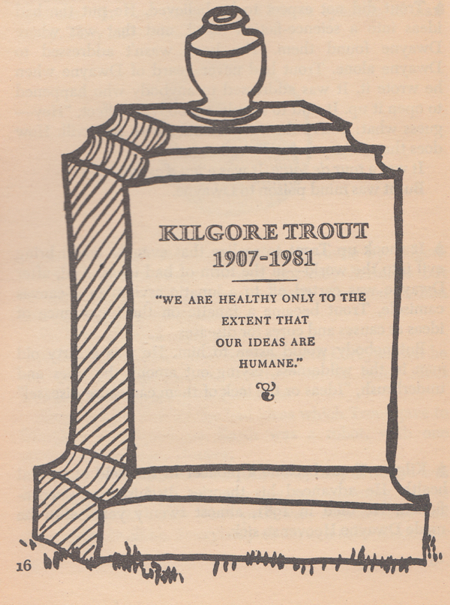
Here is another quote presented as evidence to the things I've written so far that lacked evidence. I will not tell you how the one provides evidence for the other for it is abundantly clear to me and so if you should ask me, "What does this have to do with the other?", I would sneer and believe you to be a dunderheaded illiterate.
The undippable flag was a beauty, and the anthem and the vacant motto might not have mattered much, if it weren't for this: a lot of citizens were so ignored and cheated and insulted that they thought they might be in the wrong country, or even on the wrong planet, that some terrible mistake had been made. It might have comforted them some if their anthem and their motto had mentioned fairness or brotherhood or hope or happiness, had somehow welcomed them to the society and its real estate.

Kurt concludes the bit about America being silly by suggesting the national motto may as well have been "In nonsense is strength." But he's not done putting the screws to the myths of America. He's got some pretty hefty ones to go, some that idiot conservatives in 2026 would suggest were not even considerations until the radical left logged onto tumblr and began spouting them. But they've always been known because they're Truths which people in power who want to control and manipulate the way people see the world simply want to obliterate from mass consciousness. So Kurt goes on to discuss how a lot of the nonsense we learn about America isn't just silly; it's actually evil.

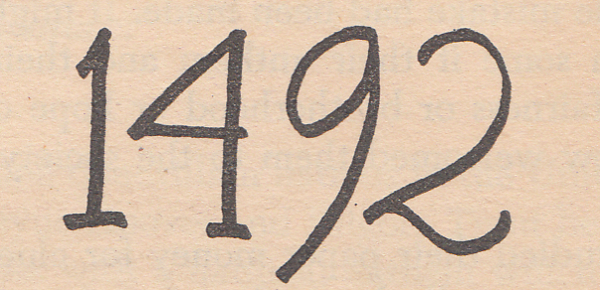
For example, teachers of children in the United States of America wrote this date on blackboards again and again, and asked the children to memorize it with pride and joy:


The teachers told the children that this was when their continent was discovered by human beings. Actually, millions of human beings were already living full and imaginative lives on the continent in 1492. That was simply the year in which sea pirates began to cheat and rob and kill them.

See? This is why conservatives cannot like Kurt Vonnegut, no matter what they might think. To belong to their tribe, they must adamantly refuse to believe actual Truths about the world. They must openly espouse only what other members of their tribe espouse lest they be discarded like, well, like somebody who won't espouse the beliefs that conservatives have determined all conservatives believe. It's telling that conservatives came up with the term "virtue signaling" since signaling their "virtues" is all they do. It's how they think everybody acts because they know that if they don't wave a flag or praise God or kiss the ass of every military member they see in public, they'll be shunned by their peers. So they simply believe everybody is faking their lives to fit into a tribe. It's a pity they can't just be themselves and enjoy what they want without the constant fear of being abandoned. I think it's also why they strive so hard to make laws that force people to live and act in Christian or Conservative ways. Because they're angry that other people actually choose to be happy and joyful, that people simply do things that they want to do without fear of being disowned or despised.

All of this is evidence leading up to Kurt's conclusion about the terrible secret of this country and the men who founded it. Listen: it's racism.

Here was another piece of evil nonsense which children were taught: that the sea pirates eventually created a government which became a beacon of freedom to human beings everywhere else.

Actually, the sea pirates who had the most to do with the creation of the new government owned human slaves.

The sea pirates were white. The people who were already on the continent when the pirates arrived were copper-colored. When slavery was introduced onto the continent, the slaves were black.
     Color was everything.

It's at this point when Kurt puts on his steel-toed boots and really gets going on America's midsection. I was wrong about my hyperbole being too hyperbolic. Kurt just begins by writing, "Look at all this nonsense! Silly America!" And then he continues to point out how all of that silly nonsense was in service to a bunch of evil, greedy, selfish sons of bitches who fucked over the entire world to line their own pockets. And how those men and that world had a direct connection to the America of 1973, no matter how many brainwashed Christian dunderheads loudly proclaimed, "America is the greatest country on Earth!"

This isn't a review for R.F. Laird's The Boomer Bible but I might as well make it one even if R.F. Laird seems to have become a typical white reactionary who lost his mind. It's hard to believe how easily some people lose the plot of reality, especially when they wrote something so cutting and truthful and heartbreaking as The Boomer Bible. Also, I never received my $10,000 for finding the secret Christian symbol in the text, Laird. I mean, it was the same secret Christian symbol that Philip K. Dick saw after the pink light scrambled his brains and the secret Christian came to his door with his fish necklace. But, you know, I still figured it out! Pay up, buddy!

I mentioned The Boomer Bible because the Old Testament of The Boomer Bible discusses the history of civilization by telling the history of each Chosen Nation as it rises to power and then falls from its perch. It does this in incredibly hilarious and vulgar ways. A good example of the humor of the book is how one of the early chapters is The Book of Greeks. Following the Book of Greeks is "The Book of Romans. Otherwise known as the Second Book of Greeks." The final "historical" chapter in the book is The Book of Yanks because, well, they were, at the time, the current Chosen Nation and seemed like they would be for some time yet (is that time still? Or did it end in 2016? Or, more probably, 2001, on a particular morning in September). Kurt plays up this whole America as the Most Chosen Nation myth by pointing out how America became the richest nation in the world by simply threatening other nations with bombs and guns and "their capacity to astonish".

Nobody else could believe, until it was much too late, how heartless and greedy they were.

And so, you know, it continues to this day. I would say fuck Trump and Hegseth and Miller but I'm really more angry with all the idiots who bought into all of their bullshit and lies. So many friends and family members I had to abandon because they simply showed themselves to be gigantic dunderheaded illiterate non-thinking assholes. Buh-bye!

That "buh-bye" was me saying goodbye to all the useless trash whose time as my friends and family members is now done. It wasn't me ending this blog post! Kurt's not done with Chapter 1 yet! Although he is done bashing America, for the most part. He explains Communism which is just a scary word that was hijacked by more evil, nonsensical people when it really should have just meant "government based on the common good; on community; on acknowledging that nobody does anything by themselves, no matter how much Ayn Rand you've read (especially when Ayn Rand's own words in her stupid boring stories actually argue against what she thinks she's making them say! Have any of the people who worship her read Anthem? Do they fucking understand it says exactly the opposite of what she and they all think it does?! God, it's wall-to-wall illiterate dunderheads up in this house of a country!)". He points out that babies were being born into poverty all over the world and still Americans refused to help them because there was no law saying they had to help and they should only help if they want to but all the people with the money to help simply didn't want to, no matter how Christian they were. Perhaps because of how Christian they were!

The point of all of this is to begin the story by stating that Dwayne Hoover, the white Pontiac dealer, was incredibly wealthy when he met the incredibly poor Kilgore Trout, the white science fiction writer. These two characters are the main protagonists of the book although, in reality, all the characters are the main protagonists of the book, what with it being a Kurt Vonnegut novel and all. Also the black Wayne Hoobler whom we have yet to meet. Or Bunny. Or the bartender. Look, man, I can't remember the names of all of the main characters! A lot of people live in Midland City, Ohio!

I think there was more about Trout's ideas making Dwayne crazy but since that's going to be shown in the story later, maybe I'll save talking about it for then!

Wednesday, October 7, 2026

Kurt Vonnegut's Breakfast of Champions: Preface


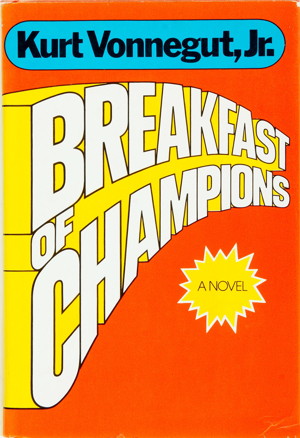
Cover design by Bob Giusti

[This is not a review of the novel. This is simply commentary as I read it. Those looking for pat answers and explications of complicated themes from an academic perspective should move along to some dry and boring Kurt Vonnegut Wiki.]

All speech is political. It can't help but be. But there are those who believe in words like faith and loyalty and patriotism who would have you believe otherwise so that only the things they believe should be spoken about are deemed civil and polite topics for conversation. Talking about heterosexual relationships isn't political; talking about gay relationships is. Discussing raising a baby isn't political; speaking about an abortion is. Bragging about your new rifle you were using at the gun range earlier that day isn't political; bringing up mass shootings is. Calling certain topics political, when all topics are actually political, is just a means of controlling what topics can be discussed openly in a mainstream, status quo environment. It's why one of the most common reactions to a book being banned is "Why the fuck was that banned?!" Most people just aren't searching for things to label as political; they're just living and reading and enjoying life. People who rely on an audience to make a living often discuss how they keep politics out of what they do because they don't want to lose half of their audience. But that's also political and will lose you half of your audience. Especially these days. Just ask Ed Sheeran.

Kurt Vonnegut begins his book entitled Breakfast of Champions with a blurb that, if this were any other author, would feel like a lawyer made them put it in.

The expression "Breakfast of Champions" is a registered trademark of General Mills, Inc, for use on a breakfast cereal product. The use of the identical expression as the title for this book is not intended to indicate an association with or sponsorship by General Mills, nor is it intended to disparage their fine products.

Vonnegut knows he's in the right to use this phrase as the title of his book (aside from how much better the slogan works for a martini than a bowl of shitty flakes) and he also knows that corporations are fucking lunatic bastards who try to squash anybody that might seem to be infringing on their trademark. So he kicks the legs out from under their lawyers and says, "This book is going to deal with things that a massive corporation that doesn't want to be associated with those things might get antsy about. They don't want you to think about race and poverty in America when you sit down to eat their stupid, boring fine product which you have to add a ton of sugar to. They don't want to be seen as political so I'll state right up front that this book doesn't have anything to do with them." Except Kurt knows that's not what he's saying at all. This has everything to do with them and all the other advertisers who don't want anybody to attach any politics to their product lest a boycott ensue.

What Kurt's doing here is making sure that the reader connects the advertising phrase to this book while explicitly saying that the book isn't connected to it. He wants the reader to understand capitalism is at the heart of what is happening to the people in this book. Capitalism and American exceptionalism. Because if an advertising phrase from corporate America had to be chosen as a National Advertising Campaign for the good old U.S. of A., "Breakfast of Champions" would be a frontrunner.

And, I mean, that phrase, "fine products". He's just kicking them in the balls at that point.

Next comes Kurt's explanation as to why he dedicated the book to a 40 year old widow he knew when he was 16, Phoebe Hurty, which — and even though I just re-read this bit a few days ago, I'd forgotten about when I began this commentary about what topics are deemed appropriate in polite conversations — reemphasizes the point in my initial thesis. Or my first paragraph blather. The bullshit my fingers typed out while showing grave disdain to my brain?

Phoebe Hurty wrote ad copy for the Indianapolis Times. Are you sensing a bit of a theme yet? I wonder how long it would have taken Kurt Vonnegut to write an entire novel that would cause a person to see Mad Men for what it truly is: a bunch of chimpanzees trying to look smart in tailored suits while getting smashed out of their gourds and fucking whatever moves. I mean, Mad Men was that to me when I watched it. But it was still great television! But it felt a bit like watching The Sopranos. I knew audiences were out there falling in love with the main character without understanding how fucking terrible the main character was. While watching Mad Men, I pretty much only liked Stan and Sally's weird neighbor friend.

Oh, sorry! Fucking digressions. Kurt gives an example of Phoebe's ad copy for a sale on straw hats: "For prices like this, you can run them through your horse and put them on your roses." Honesty in advertisement, I suppose. Also, both of these discussions Kurt begins with help to emphasize the name he uses to sign this preface. But first, more about Phoebe! Especially this bit which brings tears to my eyes whenever I read it because I love her so much for it. If one had to worship, they could do a lot worse than Phoebe Hurty.

She was funny. She was liberating. She taught us to be impolite in conversation not only about sexual matters, but about American history and famous heroes, about the distribution of wealth, about school, about everything.

It's odd that I choose to mention worshiping this excellent woman when what she teaches Vonnegut and his friends is simply this: hold nothing sacred. (Although, yes, Vonnegut mentions at the end of the Preface what he holds sacred. But he also reminds the people reading that he's terrible at being impolite the way Phoebe Hurty was.)

Some might read the idea of "holding nothing sacred" as having cynical feelings toward everything and believing in nothing. But that's not what I mean (I can't speak for what Phoebe Hurty meant, knowing her for only a scant few pages from a book written in 1973 about a woman from Kurt's memory of 1938). I mean you must even be able to see the humor in the things you hold most dear. And when I say "humor", I don't mean the schoolyard bully shenanigans that the most ignorant members of society believe constitute the bulk of humor. Humor isn't laughing because you made somebody's day worse. I mean seeing the ludicrous in the divine while still somehow embracing that which brings you awe. I mean that in as secular a way as possible, just in case you thought I suddenly found Jesus like my dumb childhood friend, Bob Henline. I guess his comedy career was getting too expensive and his most viral Instagram post caught on with religious nuts so now he's all-in on praising Jesus. This is just his fifty-five year old version of eating a moth at that Halloween party to impress us all when we were in our 20s.

Fuck me do I ramble. Christ!

Vonnegut's description of Phoebe as graceful in her impoliteness forces me into another digression about being an edgelord. I have, in my time, been accused of being an edgelord. But I think Vonnegut puts his finger on something that I've noted about being an edgelord, or as Kurt comments on it in 1973, being impolite. The difference I found in my "edgelord"ness versus an actual edgelord is that I find my way to "edgelord" topics naturally and by following a path through humor. If I become impolite in my commentary, it's at the service of thoughts that made me laugh, or got me thinking, or felt needed to be said for context of other ridiculous things I said. Actual edgelords, or those who have no grace in being impolite, begin with the thought: "How do I get people to react? How do I offend? What will get me a response?" Some people don't notice the difference between graceful impoliteness and edgelordism because they believe that their reaction is the deciding factor. If something offended them or made them angry, that thing was said purposefully to garner that reaction. Some people are not as perceptive as Kurt Vonnegut and, well, you know, um, me!

Vonnegut moves on to explain why, in this novel, he expresses a belief that human beings are machines. He provides ample evidence to back up his opinion that we are subject more to the whims of nature and chemicals and a body that we have less control of than we think we do than we are subject to the commands our brains issue. His conclusion — a conclusion of a man who saw his mother commit suicide, who suffered from depression himself, and who saw his son deal with schizophrenia — is thus:

So it is a big temptation to me, when I create a character for a novel, to say he is what he is because of faulty wiring, or because of microscopic amounts of chemicals which he ate or failed to eat on that particular day.


Here is Vonnegut's illustration of an asshole from the Preface. I don't remember when I first read this book but, like never forgetting "Out vile jelly!" after my first reading of King Lear, it has never not been at the forefront of my brain.

Kurt goes on to explain why he wrote this novel, a novel that he feels terrible about. He decided his brain needed a spring cleaning and he resolved to get out all of the useless junk that other people had shoved into it, leaving them in this novel. So here's more stuff that makes me cry.

The things other people have put into my head, at any rate, do not fit together nicely, are often useless and ugly, are out of proportion with one another, are out of proportion with life as it really is outside my head.
     I have no culture, no humane harmony in my brains. I can't live without a culture anymore.

Okay, sure, that's scarily close to the beginning of some spree killer's white supremacist manifesto! But take it in context and from the fifty year old man who is lamenting what he's grown up believing was "American culture" to only realize that none of it makes sense, none of it scales correctly, and most of it is ugly and useless. Most of what he's discarding is a product of capitalism, advertising, and systemic racism. He's writing this in 1972. I bet this Kurt Vonnegut would later love the short-lived disco culture.

So that's basically the premise. He goes on to shit on Veterans' Day because it's a lousy, self-serving version of the world's Armistice Day created after The Great War ended. And then he signs the Preface, "Philboyd Studge". That name, he explains, he got from a friend who said reading a particular book felt like it was written by somebody with that name. Maybe the friend was just pulling that name out of a forgotten corner of his head, part of his cultural detritus picked up and stored within his brain, and he only meant the book was tedious. But the name comes from a short story from The Chronicles of Clovis by Saki. "Filboid Studge" is the name of a shit cereal that becomes a wild success because of the advertising slogan.

Cereal. Advertising. A shit product.

Apparently Kurt Vonnegut recommends two kicks to the balls. Just to be fucking sure your opponent stays down.

Saturday, October 3, 2026

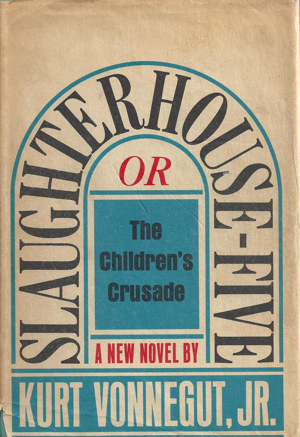
Slaugherhouse-Five, or The Children's Crusade by Kurt Vonnegut (1969)


Jacket design by Paul Bacon.

I was probably on the downhill side of a manic episode when I re-read this novel over a year ago so I never managed a review of it fresh in my noggin. I toyed with the idea of re-re-reading it but after a few pages, I knew I was just covering old familiar ground while the mortality clock continued to tick faster and faster. So I put it down and decided to just do a shit review of Vonnegut's most famous book. Which maybe that's exactly the right novel of his to do a shit review of! There's so much material out there about it, why would anybody care what I thought about it? From what I've learned about doing reviews on the Internet, many denizens of the world simply want three things out of critical writing about a piece of art: the literal point of it; all the "Easter eggs"¹ in it; and why they should give a fuck about it. I suppose that's why morons like AI and hate my line-by-line breakdowns of Pynchon texts. "Just tell me all the secrets and mathematical formulae so I can file it away as 'information' in my stupid electric fat storage system." Insight and dick jokes apparently mean nothing to them.

Slaughterhouse-Five was the first Vonnegut book I ever read. It's probably the first Vonnegut book a lot of people read if they approach Vonnegut as an author they want to read. I imagine a lot of people began reading Vonnegut because they found one of his "lesser" novels in an aunt or uncle's bookcase where they'd stuck it unread after receiving it from some dodgy '70s book club and was then intrigued enough to give it a read. But I started with Slaughterhouse-Five because it was an intentional move on my part. I was a senior at San Jose State University and had found myself in English 1B (or 102? or whatever the second standard English course is you're supposed to take as a Freshman) due to my weird history of transferring schools and skipping semesters. Somewhere along the way, my high school AP credits for the class had disappeared from my record and the school was all, "Hey, idiot. How did you get this far without taking this mandatory Freshman class? Go back and take it!" So there I was, King Shit Senior in a Freshman English class full of fresh new college students, most of whom did not give a fuck about reading and writing but had been told they must take this class. I was like a fucking Golden God in that classroom! My teacher, Aaron Malchow (who was a Graduate Student teacher. What do you call those? I fucking forget. The Non-Certified Spouse, who taught German at the University of Lincoln as one, could tell me but she's asleep!), fucking loved me. Probably. We were probably about the same age, anyway. I bet he wanted to hang out with me because I was so cool.

It's probably time for a new paragraph. Is that how writing works? Is it that arbitrary? Anyway, I had Cerebus pins on my backpack at the time so when I went to the teacher/student meeting to discuss the big essay project for the class, focusing on one author and their work, Assistant Student Near Professor Malchow suggested I do Dave Sim and Cerebus. It was a great suggestion and probably would have been a lot of fun but I was there to learn, dammit! So I wanted to read something I wasn't familiar with. That was Kurt Vonnegut. He was disappointed because I think he wanted to read smart and funny things about Dave Sim being a huge misogynist (which Dave claims he isn't and forces people to sign a petition saying he isn't if they want to have anything at all to do with him, so, um, checkmate, you jerks!). He did thank me for making my essays funny though. He kind of shit on most of his students when he pointed out they all take it so seriously that they're afraid to put any personality into their writing at all. I can't say I didn't understand that feeling that you needed to be academic and serious in your papers. But when you're a couple months away from graduating from college and you're taking a Baby Course for English Babies? It basically frees you up to write an essay that's six pages of ranting about people on campus carrying around umbrellas in the rain.

My point, which I haven't been supporting but I'll just choose to get to it now, is that I don't really need to review this book. Because if a Vonnegut book has been more written about than this one, it's Breakfast of Champions. I meant to end that statement with "I'll eat my own butthole" or something but now we're past it (and also me threatening to eat my own butthole due to being wrong about something just means I'm probably purposefully being wrong because can you imagine eating your own butthole? I'm not being gross! Obviously I mean directly after a shower!), so I'll add some evidence about Slaughterhouse-Five being the most written about Vonnegut novel: it's his magnum opus. So, yeah, of course. Just check the Wikipedia for Slaughterhouse-Five, clock how long it is, and then go look at the stub of an article for Slapstick or Deadeye Dick. If there's a question about Kurt Vonnegut on Jeopardy, the question is going to be "Who do Conservatives pretend they've read but would actually have had a massive aneurysm and be too dead to make that claim if they'd actually read anything he's ever written?" I mean, "What is Slaughterhouse-Five, or The Children's Crusade: A Duty-Dance with Death?"

This book is about the bombing of Dresden and the existential dread that settled over Vonnegut for the rest of his life having survived it. Kurt says this about Dresden on the first page of the novel and I think it might be the sentence that most explains Vonnegut's point of view: "There must be tons of human bone meal in the ground." That's his description of Dresden when he went back to visit in 1967. But isn't that just his description of life and the world humans have made? He's referencing bone meal that wouldn't be there if not for the actions of other human beings. This is how fucked up we are and this is the shit world we live in and it's because of this, because of all this human bone meal we tread upon every day, that he's so insistent that we just fucking be kind to each other.

My attempt at a theme for this novel is this: "Life is hard and it can often suck and the people in power will make it worse and the strangers around you often don't give a shit about you and we're all going to wind up bone meal paving the streets of every big city in the world so maybe don't make this finite existence worse for other people going through the same shit?" And also maybe, "Don't blame yourself for the times you didn't do your best. We're all just fucking trying and, well, free will isn't even a thing, sort of!" I remember somewhere in the beginning of this book, he tells his kids to do anything they want except go into making weapons.² Seems like good, reasonable fucking advice.

I've been to Dresden. Hanging in my living room, I have a framed picture of a barren landscape of dark trees next to the Elbe, just dozens of feet from Dresden Castle, that I took while I was there. I should label it "Human Bone Meal". I was there in 2003 or so. Sixty years after the bombing of Dresden. They were still fucking rebuilding shit.

Another line I think exemplifies Vonnegut's philosophy. This one on page 8, a quote from his father: "You know—you never wrote a story with a villain in it." And here's a phrase that I hate to read when I'm reading people's essays on the Internet, a phrase that I'm now using even though I hate it, using it because it sounds like such a Vonnegutian phrase (although I never hate it when Vonnegut uses it because he knows when to use it for good effect): "Think on that." Vonnegut doesn't write villains because life is the antagonist. Life is trying to kill us all and all we have to help defeat it—at least for as long as we can—is each other. We are villains when we refuse to be kind to others, when we let greed and stupidity and selfish violent actions overcome our empathy and compassion.

Remember: Conservatives could never like Vonnegut.

I believe the closest Vonnegut ever came to writing a villain was when he was writing a nonfiction essay about William F. Buckley, Jr.

I'm almost done with this review and I haven't even mentioned Billy Pilgrim or Tralfamadore or Montana Wildhack. Why should I?

The first chapter of Slaughterhouse-Five is what most people would have called an author's note because it's not even a prologue. Vonnegut explains how the book came to be in Chapter One and the story begins in Chapter Two. You know the novel begins in Chapter Two and not Chapter One because Vonnegut ends Chapter One by saying the novel begins with "Listen. Billy Pilgrim has become unstuck in time" and that's the line that begins Chapter Two. It's odd, isn't it?

The end of this review is this: I have just re-re-re-re-re-read (it's hard to know how many times I've read it over my 55 years) Chapter One of Slaughterhouse-Five and I've cried multiple times while doing so and my heart is broken for all the children coerced into going off to war and making the world a worse place simply because terrible men who have never found anything to love in this world forced them to (or, at the very least, manipulated them through propaganda and the mythology of what it means to be a man). I guess I'm about to read it again?

P.S. There's a lot of horseshit about the book on its Wikipedia page. Don't read that. It'll just confuse you. Read the fucking book, slacker.


__________________________________________________________________________________
¹ Those quote marks are doing a lot of mental work here. I feel like the Internet meaning of "Easter egg" has changed the pre-Internet meaning so much that it's basically unrecognizable now. There was a time when "Easter egg" truly meant something somewhat outside the work that was hidden, meant to be hard to find, and was simply a surprising, interesting, and cool find when it was. An Easter egg had no impact on the work it was hidden within. Now it just means something recognizable was referenced. "Oh! The protagonist in the opening credits of Movie X mentions truth and beauty in this bit. That's a reference to John Keats' 'Ode on a Grecian Urn'!" There was a time when audiences were expected to know things and knowing those things helped understand the overall theme and plot of a work, or the dialogue happening between generations of poets, or, in visual art, philosophical ideas communicated through the styles used or subverted. Now these are just "Easter eggs" for people to point out as endless bits of Trivia on an IMDB page or that awful TV Tropes shit that's ruined actually experiencing things with your own fucking mind. The purposeful references in a work of art are now just seen as opportunities to post an "I see what u did there" gif instead of a helpful aid in understanding the overall work of art. Internet "Easter Eggs" are noticing that the title Infinite Jest comes from "Hamlet" without understanding that David Foster Wallace is saying, "Get thee to The Complete Works of Shakespeare before reading this book because it'll, you know, fucking help."
² "I have told my sons that they are not under any circumstances to take part in massacres, and that the news of massacres of enemies is not to fill them with satisfaction or glee. I have also told them not to work for companies which make massacre machinery, and to express contempt for people who think we need machinery like that." Page 19, Slaughterhouse-Five. Amen.

Wednesday, September 30, 2026

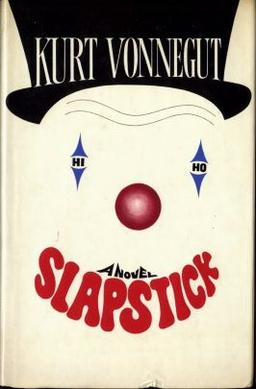
Slapstick by Kurt Vonnegut (1976)


If you feel like you only have time in your life to read 13 of Vonnegut's 14 novels, just skip this one. Although it's such an easy and quick read, it would probably be weird to tell somebody you didn't have time to read it because your super exciting and sexy life got in the way from completing a read-through of all of Vonnegut's books. I'm just giving my advice in those really marginal cases where somebody absolutely only had time to read 92% of Vonnegut's novels.

Perhaps if you simply don't read every time Vonnegut writes "Hi Ho", you can save enough time to actually read all of Vonnegut's novels anyway! But if you really are up against a mortal time crunch and you can't find any way to fit this book into your finite lifespan, you could just read Vonnegut's Playboy interview in Wampeters, Foma, and Granfalloons. He gives all the salient points of this book in that interview, even regurgitating a joke his brother told him about scientists and how messy they are.

I love Vonnegut but this book feels like he had an idea that was maybe a bit too grand and he wasn't sure how to express it. Or maybe he did know what he was doing and he was saying, "Look. We should treat each other as family. We should be able to trust each other, encourage each other, be the safety net for each other, without any ridiculous bureaucratic nonsense and simplified ideas like portrayed in this book. But importantly, and maybe the smartest thing I put down in this book, we should be able to bluntly and succinctly tell the people who stopped earning our trust to go take a flying fuck at a rolling doughnut. Go take a flying fuck at the moon."

Sorry for swearing without a warning but I was only quoting Vonnegut! But Vonnegut's right in that aspect. We need to care more about each other and we also need to easily and simply tell the people who suck that they suck. Just like a family!

Tuesday, September 29, 2026

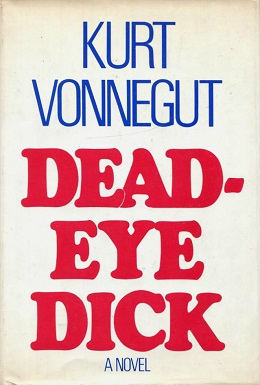
Deadeye Dick by Kurt Vonnegut (1982)


I'm sure this first edition cover layout has some inherent meaning to the theme of "epilogueness" and not just some art director being lazy.

This cover has completely thrown me for a loop. I'll have to delay my actual review of this book to review this cover now! The layout has to have some purpose to it, right?! It can't just be, "Fuck it! Just choose a couple of fonts, stick Kurt's name at the top to make it sell, and increase the title by 5000%. Bosh! Killed it!" I suppose the thing that stands out the most is how the cover literally reads, "Kurt Vonnegut Dead" which, I mean, plays into the fucking theme so well that maybe I figured it out? Also two words you can't help to read in this style are "Dead Dick" which, again, play into the fucking theme! Did some art director (or Vonnegut himself?) actually smash this thing out of the park by creating the most bland cover they could think of? Because being bland and boring and unattractive also play into the themes of this book!

Okay, enough about the cover. I wonder if I should discuss the covers more often instead of just dropping the first edition cover at the beginning of the review with an implied "This was the initial idea for selling this book!" and letting everybody come up with their own opinions on why the publisher (or Vonnegut?!) thought it was the best idea at the time. Who ever got anywhere letting other people think for themselves?! I should be telling everybody what these covers mean and why they were chosen!

Oh! I know why I didn't discuss the covers on a bunch of my past reviews! Because I wrote them for Goodreads and Goodreads chooses which cover they want to show. Which is bullshit. Also Goodreads is bullshit because they have some weird "Top 100 Reviewers" thing that tries to gamify the experience but what eventually happens is you just have a Top 100 of the most bland and reviewy reviews a bunch of people can squeeze out of their word frosting piping bags. That's my eloquent way of saying "mouths". Anyway, I write reviews for my blog first and foremost now! If I can bother, I'll eventually move them to Goodreads instead of the other way around.

What was I doing? Oh yeah! A review for Deadeye Dick!

Kurt Vonnegut was 60 when this book was published and he was 13 years past the publication of the book that was the final version of what he'd been trying to say in all the books previous (I'm talking about Slaughterhouse-Five, in case you're more ignorant than I am). In that sense, Kurt probably thought of all of his books after that as epilogue. He still had things to say, and he said them well (sometimes! I mean, did he need to write Slapstick? Or could it have simply existed as the expressed idea of a book in his Playboy interview? (On a side-note, I just realized there's a movie version of Slapstick starring Jerry Lewis, Madeline Kahn, and Marty Feldman. And it's on Tubi! I know what I'm doing after work tomorrow morning!)), but I don't think he had the same driving need to express them after releasing the Dresden bombing demons in Slaughterhouse. My main evidence of this is entirely personal in that I like Vonnegut's work much better pre-Breakfast of Champions (inclusive) than post that novel. This, of course, ignores Galapagos which I don't own but I began to re-read two years ago when a friend of mine was throwing her "20 Year Anniversary of her 30th Birthday Party" at a sex castle on the coast of Washington state. I don't think she completely realized it was a sex castle; she just wanted to throw a huge party in a castle. But when I was downstairs in the sex dungeon dropping my bags off in one of the rooms that oddly had windows from the hall looking in on the bedrooms and a hot tub surrounded by walls with actual weapons on them, I noticed the engraving on the shower door of a woman straddling a knight and I was all, "Oh. I get it." Then I went upstairs and was all, "Nice sex dungeon, Xan!" And she was all, "Oh yeah! I see it now!" My point being that the sex castle had a bunch of books on their shelves and one was Galapagos and I began re-reading it one night when I couldn't sleep and I forgot how great it was and he invented the Apple iPod and/or iPhone in it.

How can one person lose their train of thought this often? Trains are supposed to run on tracks so they easily get to their destination! Why does my thought train think it can go any-fucking-where it wants?!

The point of the point is that for nearly a decade, I've been trying to describe in my comic book reviews how exactly it feels to be living the last half of your life, when all the potential of your life has long ago gone been expended in the kinetic days of your youth. One of my own favorite quotes (if you'll excuse an old man for being intellectually masturbatory) is, "Young people are just old people who have yet to realize they've wasted their lives." Little did I know (or remember since I did read this book in my 20s), Kurt Vonnegut already expressed that feeling in Deadeye Dick. The main question in the book is this: "What do you do with the rest of your life after your story has already been told?" Technically, Vonnegut answers that question by writing this book. But, you know, that's just a glib answer that ignores everything else in the book!

Back to the cover! See how "Kurt Vonnegut Dead" expresses the idea of living out your epilogue after your story is already over? There's really nothing left but to maybe express how you felt the story went. And in Deadeye Dick, the story doesn't go great. Kurt obliterates all the characters living in his Midland City. His main character lives his entire life without ever intimately connecting with another being (literally growing old as a virgin which again references the cover's "Dead Dick"), basically living an entire life of epilogue after his story ends when he, as a child, accidentally kills a pregnant woman by firing a rifle from the roof of his family home. After taking the life of a woman and all the potential life and stories of the baby within her, he decides he doesn't deserve a life or a story himself. That isn't (again I think of the word "technically") the end of his story completely though. He does try to have a story through the encouragement of a writing teacher. So he writes a play, it's performed one time in New York and once in his home town, and then that's it. Story over. The rest is epilogue, baby.

I suppose I didn't remember much from this novel because when I first read it, my story was still happening. Potential was just jizzing and jizzing and jizzing in my face. How could I understand the utter apathetic uselessness of staring down years and years of life that feel like they don't matter? Except that's not the point! Just like Vonnegut always does, he points out the world is shit and people fucking suck and death looms on the horizon. But he also fires up an engine of hope and kindness and reminds people, "It doesn't have to be this way." In the story, it seems like Rudy Waltz (did I just now mention the main character's name? Fuck I suck at this) is having a terrible life. But he finds things he enjoys and he winds up in a place where he's content. He realizes that he loves the epilogue. He doesn't want a story. He's happy not having a story and not caring about the need for a story. He seems content.

Okay, that review was terrible. I'll admit it. But I do want to point out one striking bit that reminded me of my time in college. I was a literature major who didn't realize he was focusing on gender studies in the things he wrote until years later but who couldn't help writing papers about gender when reading so much 19th Century literature by and about women living in eras which were trying desperately not to notice them (the eras were trying, not the women). Kurt Vonnegut expresses how he realized so many women throughout his life were living epilogues and how unhappy it made so many of them and how he saw so many of them commit suicide because of it. Society told them their story was to get married and have a child. And that was it. What does that do to a person's mind when they've been told, over and over and over, that their story was virtually over before they even hit their mid-20s?! Probably earlier in many cases! Vonnegut acknowledges the weight of that, possibly thinking about his own mother (whose story, like many of Vonnegut's relations, was also hampered by mental illness. So chuck that into the mix of a life story and good luck, baby!), sort of mentions it in passing as he does with so much stuff, and moves on.

One of the things about Vonnegut's novels in his epilogue (and maybe more before that but I seem to notice it more in these later books) is that they're less focused on one major theme and just sort of express a scattershot bunch of ideas. I suppose he does this in Cat's Cradle as well so maybe I'm wrong that it's just his later stuff. It's more probably that I just wasn't old enough to truly grok the themes of Vonnegut's later novels when I was a stupid jerk in his twenties, face so covered in potential's jizz, that I just didn't understand, or want to understand, a fucking word of this thing. I probably read it and was all, "This guy don't fuck?! How can this guy not fuck?! What's wrong with this guy?! Fucking loser, man!"

Anyway. Hi ho, I guess?

Saturday, September 26, 2026

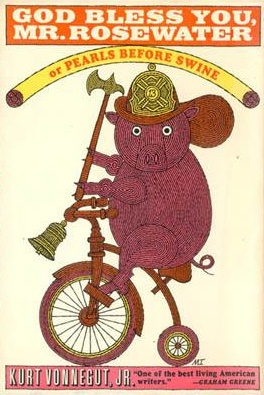
God Bless You, Mr. Rosewater by Kurt Vonnegut (1965)


In this book, Eliot Rosewater suggests that some science fiction writer should write a science fiction book about money which is what Kurt Vonnegut has chosen to do. While Vonnegut, as always, touches upon many themes throughout the book, the overarching theme is about money, inherited wealth, and the wide gap between rich and poor created by capitalism. It's about how wealth is concentrated among so few and how those few often did nothing to accumulate that wealth except happen to be born with the correct surname. Eliot Rosewater happens to be the main protagonist although he is only one of a dozen or more characters who also think they're the main characters (which they are, all equally, no matter how many pages they're allowed, given this is a Kurt Vonnegut novel). Throughout the novel, he is driven crazy by his responsibility to do something good and decent with the money he lucked into until he ultimately finds a quite Biblical, if not Communist (neutrally used!), solution to his problem. Basically, he spreads his seeds (figuratively) and spreads the wealth (literally).

I first read all of Vonnegut's books in my twenties and am re-reading them again now that I've hit my fifties. I loved them then, and they must have informed some of who I became in their kindness and optimism and cynicism and all of what they are, but I see them much more clearly now. I was too selfish to see exactly how they reflected the world back then, to see how clear-eyed Vonnegut was viewing the world. Conservatives will accuse any liberal or progressive view as having a modern agenda and yet Vonnegut was expressing those same views in his earliest novels and stories from the late fifties and throughout the sixties.

Here's a quote from the book I love where Trout is basically Vonnegut's pure sci-fi, pulp alter ego and the "He" in the quote is the manipulative lawyer Mushari trying to get his mitts on a fraction of Eliot's money by declaring Eliot insane although "He" could be any small-minded pundit or conservative today: "He didn't understand that what Trout had in common with pornography wasn't sex but fantasies of an impossibly hospitable world."

This novel has more heart than plot. That's a good thing, at times. Like the television show, Atlanta, it's more a variety of sketches depicting the pot holes scattered (purposefully!) across the American landscape and a few of the people trying to navigate around or through them.

There's maybe too much throughout this novel to write a concise review of it so I'd just like to quote Eliot's speech he was meant to give at a science fiction convention, a speech Mushari chooses to use as evidence that Eliot is insane. Apparently, according to lawyers and senators and anybody that embraces the status quo, giving a damn means you're crazy.

"I love you sons of bitches," Eliot said in Milford. "You're all I read any more. You're the only ones who'll talk about the really terrific changes going on, the only ones crazy enough to know that life is a space voyage, and not a short one, either, but one that'll last for billions of years. You're the only ones with guts enough to really care about the future, who really notice what machines do to us, what wars do to us, what cities do to us, what big, simple ideas do to us, what tremendous misunderstandings, mistakes, accidents and catastrophes do to us. You're the only ones zany enough to agonize over time and distances without limit, over mysteries that will never die, over the fact that we are right now determining whether the space voyage for the next billion years or so is going to be Heaven or Hell."

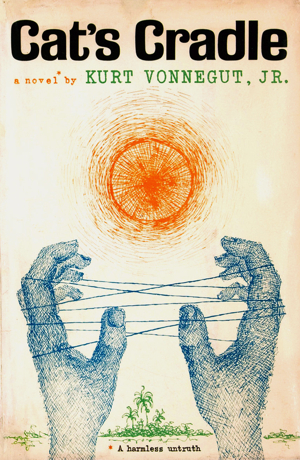
Cat's Cradle by Kurt Vonnegut (1963)


Sometimes I'll watch a television show like Star Trek: The Next Generation and think, "I wonder how many conservatives think they enjoy this show?" And sometimes I'll read a book and think, "I wonder how many conservatives think they love this book and the author in general?" I often wonder how many conservatives think they love Kurt Vonnegut specifically but that just makes me think, "They must never have read a Kurt Vonnegut novel. They just know they're supposed to appreciate his work." It's like how the best way to disbelieve The Bible is to actually read The Bible, reading a Kurt Vonnegut book is the best way to know if you're a terrible person or not. Here's a hint as to how you discover you're a terrible person: you don't agree with Kurt Vonnegut's conclusions about humanity.

I never actually wondered if any conservatives loved this book in particular because the main messages of this book, clearly stated, are "Humans are stupid and vicious," "War is terrible," "God doesn't exist," "Religion sucks," and "Life is inherently meaningless." There's a good reason for Kurt Vonnegut to believe these things and he was always quite open about it: all of his books were attempts to reconcile his surviving the carpet bombing of Dresden. What he has come up with in Cat's Cradle seems pretty succinct if not terribly well plotted or profound (at least not profound for a reader who has already reached all the conclusions Vonnegut reaches. And I'd reached them all by the first time I read this book in my twenties. And those conclusions are just more solidified in my fifties. As if my beliefs have configured themselves in a sort of ice nine molecular pattern, you might say).

Cat's Cradle has 127 chapters across 191 pages. It's an easy read, even for a Kurt Vonnegut book. It feels like Kurt was overwhelmed by things he needed to say and so he blurted them out in short vignettes within a story about the end of the world. He has a lot to say here, most of it via a made-up religion called Bokononism which embraces lies because Bokonon understood that the only meaning life has is what we give it. At one point, Newt, the son of the fictional father of the atom bomb, describes the child's game of cat's cradle, a game he points out humans have been playing for ages, teaching it to their confused kids one generation after the other. The game uses a piece of thread to create random connections, various patterns of X's. He shows the game to the narrator and says, "No damn cat, and no damn cradle." Meaninglessness abstracted into a child's game to teach children the true nature of life.

One of the greatest aspects of Vonnegut's writing is that while he may be incredibly cynical, he is never hopeless. Sure, this book ends with the end of the world and Bokonon suggesting the actual ending should be suicide while taunting God. But ultimately, Vonnegut expresses his desire for humans to be kinder, to be better. Cynically, he points out that history has proven that man will never turn away from being as violent and stupid as possible, even with (especially with?) the violent and stupid examples of how humans have acted throughout history. But he wants them to be better. He wants them to be kinder. He wants them to move past the need for meaning and find that all we have are each other and, maybe, we should stop, maybe, buying into the foma of leaders and killing each other for granfalloon reasons. When power and money become our wampeters, we are destined to ice nine our home and everybody in it.

Chapter 114 is a particularly Vonnegutian chapter and probably my favorite. The American ambassador to San Lorenzo goes off speech at a day of celebration to earnestly discuss his thoughts on war and it's absolutely heartbreaking. It feels like the heart of the book even if it doesn't really fit with the plot up to that point or beyond. But that's because it comes from that main reason Kurt was writing. It has one night in Dresden seeping from between each word. And I can't imagine anybody reading it and thinking, "I love this and I'm a conservative."

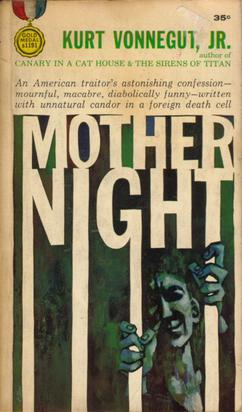
Mother Night by Kurt Vonnegut (1962)


When I first read Vonnegut's Mother Night in my twenties, I hadn't the background or experience to perceive the scope of it. I hadn't lived through anything that had prepared my mind for what Vonnegut was attempting to express. It left no great impression on my mind and I couldn't have even speculated as to the plot before picking it up again. But now that I have, and I have finished, I am aghast at how relevant this book about a Nazi propagandist is (a Nazi propagandist who claims to be a spy throughout the book, and even seems to be exonerated, but I sense too much of Pale Fire's Charles Kinbote in him. I suppose I can take him at his word, and believe the final letter he receives, although, in the end, it hardly matters. "We are who we pretend to be").

I first read this book before Fox News completely lost its mind and became not just a Republican State Media channel but an Anti-Democrat Hate Machine. The channel has no other goal than to erode the humanity of liberals and fill their audience with hatred and mistrust. Nobody could read this novel today without making the connection between Howard J. Campbell, the book's "Nazi propagandist" narrator, and most of the hosts of Fox News shows.

At one point in the novel, Howard J. Campbell writes, on meeting Adolf Eichmann in an Israeli prison while both are waiting to go on trial:

"As a friend of the court that will try Eichmann, I offer my opinion that Eichmann cannot distinguish between right and wrong—that not only right and wrong, but truth and falsehood, hope and despair, beauty and ugliness, kindness and cruelty, comedy and tragedy, are all processed by Eichmann's mind indiscriminately, like birdshot through a bugle.
     My case is different. I always know when I tell a lie, am capable of imagining the cruel consequences of anybody's believing my lies, know cruelty is wrong. I could no more lie without noticing it than I could unknowingly pass a kidney stone.
     If there is another life after this one, I would like very much, in the next one, to be the sort of person of whom it could truly be said, 'Forgive him—he knows not what he does.' This cannot be said of me now."

And thus we have to see the propagandist in one of these two ways. Do they know the harm they are spreading through their lies and deceit? Or do they believe the things they say, seeing themselves as some kind of hero . . . maybe not even believing the lies spread but believing so passionately in the result of those lies through the actions of the people who will believe them.

And which winds up being worse? They are both terrible but there's something truly cruel and inhuman about knowing you are spreading lies and knowing what kind of cruelty and chaos those lies will unleash on the world. If only there were another world after this one in which someone could judge our actions after. What would happen to Sean Hannity and Tucker Carlson and Laura Ingraham? What has happened to Rush Limbaugh and Charlie Kirk?

And Vonnegut doesn't let the people who believe the lies off the hook by simply concentrating on Howard J. Campbell. In the editor's note by Vonnegut in the beginning of the book, he discusses what the dedication should have been.

"I would prefer to dedicate it to one familiar person, male or female, widely known to have done evil while saying to himself, 'A very good me, the real me, a me made in heaven, is hidden deep inside.'"

How many Americans are currently that person? Doing real evil, making the world a worse place for so many others, while patting themselves on the back for being such a good neighbor, or good mother, or a good brother, acting so civilly and with such kindness to the people they know? How could they be a terrible person when they know so well how good they actually are?

The people who might recognize themselves in this book won't read it. And if they did, they wouldn't recognize themselves anyway. Because this book is about the type of people who are unable to engage in self-reflection.

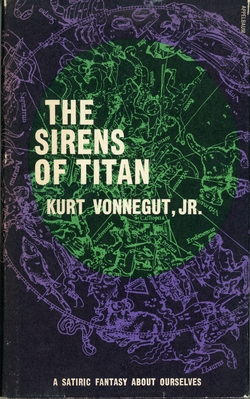
The Sirens of Titan by Kurt Vonnegut (1959)


I've long had it in my head that Vonnegut's The Sirens of Titan was an anomaly, that it wasn't much of a "Vonnegut book." Upon re-reading it, I think I understand why. Not that it isn't as much a Vonnegut book as some of his others; it may even be more so if one considers all of Vonnegut's books were him trying to make sense of what happened to him in Dresden in World War II as a prisoner of war. It does this to a further extent than I would have expected. No, what made me think of this book differently is that it's much more a pulp sci-fi novel than some of his other sci-fi novels. If Breakfast of Champions is a Vonnegut book, The Sirens of Titan is a Kilgore Trout novel.

When reading Player Piano, I couldn't help thinking of how much it felt like a version of Mike Judge's Office Space for the 50s. This book reminded me, in quite a few major aspects, of Alan Moore's Watchmen and Douglas Adam's Mostly Harmless. One of the main characters in this book, Winston Niles Rumfoord, is a man who, through an accident, has been removed from linear time. He might not be as powerful as Dr. Manhattan, but he has the same perspective. But he's also Ozymandias in that he lives in isolation keeping tabs on everything that's happening (and has happened and will happened because remember he's also Dr. Manhattan) with his large pet Kazak (a dog rather than some exotic cat-thing). Niles also creates a plan for an invasion of Earth which will unite all humans and create a new era of peace. That's the main plot. It's Watchmen before Watchmen (not to be confused with Before Watchmen of which I'm sorry I just now reminded some of you).

The part that reminds me of Douglas Adams' Mostly Harmless is kind of the plot beneath the plot. Maybe it's sort of the theme, part of Vonnegut's working through why he survived the carpet bombing in Dresden. It's a part of the story that's only really hinted at until the final chapter and concerns an alien race from Tralfamadore (See? Kilgore Trout!). Like the new model Hitchhiker's Guide in Mostly Harmless, the Tralfamadorians can manipulate space/time so that a thing they want to happen eventually happens when it needs to happen. The entire human civilization of Earth effectively exists to deliver a part for one of their own's broken down spaceship on Titan. Everything that ever happened to Earth and the Earthlings on it was manipulated to get that part delivered. It's the same idea as everything that happens in Mostly Harmless was a manipulation by the New and Improved Hitchhiker's Guide model to make sure Earth was destroyed.

This is Vonnegut's second book and the ideas within it are as good as any Vonnegut has put forth. Maybe the writing is a little rough here but then that's probably why he came up with the idea of Kilgore Trout. He probably saw the differences in this book, and Player Piano, and what his style of writing would become. But at the heart of this book (and Player Piano) is a writer who somehow balances cynicism and earnestness to a seemingly impossible degree. You can truly feel his pain as he systematically deconstructs society's terrible beliefs, traditions, and accepted social mores which caused, and continue to cause, that pain.

Kurt Vonnegut is a genius and I can't wait to re-read everything else because it just gets better.

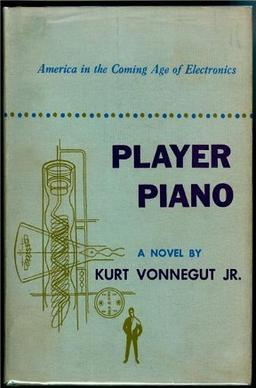
Player Piano by Kurt Vonnegut (1952)


When I first met the woman my father-in-law would eventually marry, she asked me what my top five favorite books were. It really wasn't until that moment, after examining the answers I gave that day (the list always changes. If you ever want to make sure I'm eventually locked out of an Internet account, make sure the security question asks what my favorite book is. Because I'll never remember the answer I gave at the time I first answered it), I realized all of my favorite books had protagonists battling against an unjust society and, when they eventually realize they can't actually win, simply escape. One Flew Over the Cuckoo's Nest. Catch-22. The Grapes of Wrath. House of Leaves. Okay, maybe not House of Leaves. But maybe House of Leaves! Just prove that it isn't! I mean, where is Navidson going anyway and is Johnny even alive?! Or was it a brother who died in birth driving Pelafina mad?!

You know what? This isn't a House of Leaves review. This is about Kurt Vonnegut's Player Piano! A book which fits the description of my other favorite books except that the main character doesn't escape at the end. So it's a bit more depressing. Also a cat dies in the first chapter which is why this book loses a star. Sorry, Vonnegut, but you know the rules. Oh wait. You don't? Well the only rule is that if an animal is killed in a book or a movie, it automatically gets downgraded in my ranking. Unless the point of the book is that we're all supposed to kill our own dogs and murder our best and only friend. Then I guess I can see the point. Who wouldn't want to learn that lesson when reading a book?!

I first read this book in my twenties and now I'm in my forties and oh boy is it a different experience. In my twenties, I probably took the whole "revolution against the status quo" for granted and then was annoyed that the powers that be won in the end. But this time, every chapter was a revelation after which I had to check, over and over, how old Vonnegut was when this book was published so I could look up from my book and say, out loud, "How was he so perceptive?!"

The only modern problem with this book is that, if you wanted to ignore the philosophical and ethical underpinnings of the story, and pretend to misread the themes and character motivations, it could be read as the story of Q-Anon leading up to the attempted American coup. I only mention this because the kind of people who would believe Q-Anon nonsense would also approach this book in the disingenuous manner which I laid out at the beginning of this paragraph.

But if you read the book correctly (Oh, do not argue that point. We all know there are correct and incorrect ways to read every book. People who think any way to read a book is "a correct way" are just lazy and narcissistic readers), you'll know this is as effective, touching, and damning of the status quo as anything written by Douglas Coupland or Joseph Heller or Kurt Vonnegut. Oh wait, it was written by Kurt Vonnegut. Well, that explains that then!

Damnit, Vonnegut. I'm still thinking about that poor cat.

Saturday, January 2, 2021

Player Piano: Chapter 7

Vonnegut decides to use this chapter to shit all over the American military. Now, don't start getting all red-faced and shifting uncomfortably in your seat! He doesn't shit on the soldiers themselves! A good portion of this is from the perspective of a private who, I imagine, thinks the thoughts Vonnegut probably thought quite a few times while he was serving, thoughts about the kind of venemous and disrespectful things he'd love to say directly to his commanders once he's a civilian again and they can't punish him for it.

The Shah of Bratpuhr is in the scene to, once again, point out that Americans, especially these Americans in the military, sure do act an awful lot like slaves (Takaru in his language), no matter what you call them. Halyard tries to convince him, yet again, that they aren't slaves but it only confuses the Shah.

"Niki Takaru!" he cried, exhaling a strong effluvium of Sumklish.
    "No Takaru!" said Doctor Halyard. "Sol-dee-yers."
    "No Takaru?" said the Shah in puzzlement.
    "What's he say?" said General of Armies Bromley.
    "Said they're a fine bunch of slaves," said Halyard. He turned to the Shah again and waggled his finger at the small, dark man. "No Takaru. No, no, no."
    Khashdrahr seemed baffled, too, and offered Halyard no help in clarifying the point.
    "Sim koula Takaru, akka sahn salet?" said the Shah to Khashdrahr.
    Khashdrahr shrugged and looked questioningly at Halyard. "Shah says, if these not slaves, how you get them to do what they do?"
    "Patriotism," said General of the Armies Bromly sternly. "Patriotism, damn it."
    "Love of country," said Halyard.
    Khashdrahr told the Shah, and the Shah nodded slightly, but his look of puzzlement did not disappear. "Sidi ba—" he said tentatively.
    "Eh?" said Corbett.
    "Even so—" translated Khashdrahr, and he looked as doubtful as the Shah.


What an extraordinary example of why I love Vonnegut so much. He simply and elegantly describes the truth of the situation while including the lies Americans tell themselves to obfuscate that truth. In just a few, uncomplicated lines from 1952, he exposes the virtue signaling at the heart of patriotism. The soldiers do what they're told by men they hate in a job they didn't choose (remember, the machines made it so that most people have to either be soldiers or crew for maintaining the country's infrastructure) and everybody chooses to believe it's a noble and patriotic decision. I'm certain every person on Twitter who's constantly complaining about cancel culture would fucking cancel Kurt Vonnegut in a heartbeat for being some commie socialist liberal wank just because of this short scene. In actuality, Vonnegut is a creative genius who understands fucking America.

Wednesday, December 30, 2020

Player Piano: Chapter 6

Why Paul's wife, Anita? That's the question that popped into my head during this chapter where Anita won't let Paul sleep because she's anxious that he's going to lose the promotion to Pittsburgh and he doesn't seem to care. She's seen how Finnerty's arrival has done something to her husband that she doesn't like. The sad thing is that what Finnerty has done has uplifted Paul in some way; Finnerty's allowed Paul to see that he doesn't have to live the enervating simulacrum of a life he's been living. He's given Paul a glimpse that maybe life doesn't have to be the life everybody expects from you, and maybe the life you've always felt obligated to live. And maybe that's what Anita fears most. She isn't just worried about their social standing and Paul's lack of ambition; she realizes that she is also part of that life Paul felt forced into. She's losing him.

Anita comes off as a shrew and maybe that's a stereotypical wife trope that's lived way longer than it should have. I blame the Adam and Eve myth that generally puts the wait of the sin on Eve and allows Adam to be a passive instrument in her nagging and temptation. But Vonnegut's twisting the myth somewhat here. In this case, Finnerty is the snake in the garden tempting Adam. Eve desperately doesn't want her helpmeet to lose his innocence. She wants the lie of Eden to survive. Mankind has built a sham Garden of Eden where everybody is supposedly cared for and happy and Finnerty has just slithered on in to tear it all down.

This short chapter also deals with some of Paul's father issues which crept up last chapter concerning Kroner. He's the patriarch and mentor of the organization, so much so that everybody calls his wife "Mom." Paul feels inadequate around him and has an innate need to please him. But that need is what has driven Paul's life, that need to make his own father proud. I've always said that the reason I lack ambition is that I don't give a fuck what my father thinks of me. It's apparently a pretty serious driving force in a young man's life. Anita has tried to use this against Paul (or to help him succeed which is sort of the same thing since Paul doesn't really care about the idea of "succeeding"). Early in their marriage, she framed a picture of Paul's father to place in the bedroom. This is a man she had never met. But she admired his success and his drive and projected all of that onto Paul (as has Kroner and probably everybody else in Paul's orbit). So now he has to live up to that picture of his father in the bedroom too! Ghastly!

If Paul eventually tries to embezzle from the company and smashes some of its machines and winds up being happier on the Reconstruction and Reclamation Crew, I'm going to assume Mike Judge's Office Space is the movie version of Player Piano. Except for the wife part. Even in the late 20th Century, comedies, for some reason, needed to also be romantic meet cute films so Peter needed to be single. But we still get a brief glimpse of the Anita role when the movie begins and his Anita (whose name is Anne! So close!) spends a short amount of screen time in the movie trying to get Peter to care more about success and eventually breaking up with him when he stops caring about work completely. His obligatory drive to succeed didn't need a wife anyway because he lives in America where the Garden of Eden illusion of safety and happiness is built around the capitalist idea of making more and more money, no matter how unhappy you are. In this chapter, Paul wonders at Finnerty's ability to quit his job, a quality that seems so foreign to him. How does one simply upend one's life so easily? What kind of courage must that take?

When I saw Office Space, I was like, "Yep. That's the world!" But I don't remember having the same feeling after reading Player Piano. I'm fairly certain I've read a lot of books in my life where I just enjoyed them without thinking too much about them. Or, and this is probably more true, I just forgot how much I thought about them because I just moved on to other things without writing any of my thoughts down. Which is why I've begun all these blogs in my 40s. I need to remember this crap! Office Space was so viscerally true and yet I'd never had an office job. But what I had learned and understood (thanks to my Grandfather, no doubt) was that a person in debt was never actually free. I always avoided debt (and, yes, I was privileged in many ways to be able to avoid debt, having no accidents, a strong family safety net, and a state college degree from the early 90s (so inexpensive! Sorry, Millennials and those who came after. Us Gen Xers maybe haven't been granted the resources and capital of the greedy Boomers but we, at least, lived in a world where we could be apathetic bean bag sitters and not have to worry too much overall) mostly because I wanted the freedom to say "I quit" to any job that made me feel like, and ultimately expected me to just take it because I had to, a corporate wage slave.

Again, I want to boldface this: I was lucky enough to choose to not go into debt. Many, many people simply have it forced on them because of capitalism. My grandparents, who lived three houses down from my mom's house (more privilege, really!), were instrumental in showing me how to live, and allowing me in many supportive ways, my best life. They were the best people I've ever known and I was lucky enough to be related to them.

Saturday, December 26, 2020

Player Piano: Chapter 5

The chapter begins with Paul Proteus concerned about impressing his colleagues and bosses but ends with Paul Proteus seeing Finnerty's point of view and seeing the ridiculousness of the entire system. Paul's wife, Anita, is not happy.

Paul's presentation to his co-workers is about the first and second Industrial Revolutions. The first one, he says, devalued muscle work. The machines created were much more efficient than man's muscles could ever be. They were stronger and could work longer hours. The second Industrial Revolution devalued mind-numbing, repetitive labor. Machines could now take over all the rote tasks with far fewer rejected units than a factory worker bored by the job and concerned with other aspects of their life, which left them prone to making mistakes. He doesn't get into the potential of the inevitable third Industrial Revolution because the checkers tournament against the machine at the end of the chapter puts a spotlight on that.

Paul is the Ilium Works checkers champion and it's tradition to play incoming engineers to defend his title. This year, the new recruits have brought in a checkers playing computer to beat Paul. At first Paul wants to concede, knowing that any machine built for a specific purpose will inevitably be better at that purpose than a human counterpart. But his pal Finnerty encourages him to play and makes bets with everybody there that Paul will win. Which he does because had seen, looking inside the machine, that it had a loose connection which causes it to catch fire. Finnerty's confidence wasn't that a man could beat a machine but that a machine will break down under the right conditions. I mean, a man will too! But a machine does it immediately and with lots of smoke and fire.

Everybody is upset that Finnerty didn't say anything about the loose connection but he couldn't give a shit about their concerns.

"'If Checker Charley was out to make chumps out of men, he could damn well fix his own connections. Paul looks after his own circuits; let Charley do the same. Those who live by electronics, die by electronics. Sic semper tyrannis.'"

We're going ever deeper into the philosophical question, "What is freedom?" At what point have the machines gone from freeing men to pursue their hopes, dreams, and happiness to enslaving man into roles as simple caretakers for the machines? And those who don't understand the machines? Well, they have to earn their reason for existence some other way. But since the machines are doing everything, their options are limited. Provide a reason for your existence as a citizen of your nation by either joining the army or filling potholes. An interesting note is that Vonnegut sees exactly the way America would wind up in a system where machines do all the work. It would still demand some kind of proof from everybody that they deserve to be "taken care of" by the government. Notably, Star Trek: The Next Generation bases their world in roughly the same environment but sees it differently. With machines and replicators available to do all the work, nobody needs to feel obligated to do anything they don't want to do. They are truly free to pursue any activity they want. In the Star Trek universe, everybody is taken care of when machines meet all needs. In Vonnegut's world (which is more realistic), the people in charge of the machines don't feel any obligation to provide for the people who don't own the machines and are no longer playing a part in the economic system. They're simply leeches and parasites who have to provide some service if they want any income at all. So it's the army or the Reconstruction and Reclamation Works.

Notably, there has yet to be any real discussion about artists and entertainment. Presumably, like the bartender, these careers still exist. Vonnegut still has two hundred pages to bring them up so I'm not yet going to assume they make the entire parable too messy. It's possible art has also been devalued by the efficiency of machines to the economy and it's just looked down upon as silly and a waste of time. If that's the case, I'm sure Finnerty's cohorts and revolutionaries will all be playwrights and poets.

Oh wait! I forgot this book is called Player Piano and there was that scene with the player piano! So Vonnegut has already shown how machines have, in at least some way, taken away the livelihoods of artists. And we saw that there was no connection between the artist and their audience; there was no crucial interaction or play between the art and the reaction, as you might expect with a piano player at a bar. Instead, it was just "five cents worth of joy" and the piano was done. It was a simple financial interaction; art had become a commodity.

Another theme in this chapter was how nepotism affected this new world. The guy who brought Checker Charley wasn't really smart enough to have become an engineer. But his father (who built the machine) was well known and well liked so Paul's boss went to bat for the kid, even if he was mostly a dumb jerk.

"Ordinarily, nobody would have hired him. But Kroner, who knew his bloodlines, had taken him on anyway and sent him to Ilium to be trained. The break had done anything but teach him humility. He took it as evidence that his money and name could beat the system any time and, paraphrased, he'd said as much. The hell of it was that his attitude won grudging admiration from his fellow engineers, who had got their jobs the hard way. Paul supposed, gloomily, that beaters of systems had always been admired by the conventional."

Reading something like this from 1952 by a fucking genius is depressing. This was America. This is America. This will always be America. What good is art that points out this bullshit if the "conventional" never read it, never learn from it, never fucking care? This is why all of my favorite books are the ones where the protagonists realize what Matthew Broderick realized in Wargames: the only way to win is not to play the game. You know, books like Catch-22 and One Flew Over the Cuckoo's Nest and, more recently, Gravity's Rainbow. Although nobody really wins in Gravity's Rainbow; Slothrop just sort of disappears from everybody's sight and vanishes into legend. But the sentiment is still there because Pynchon still shows how Pirate Prentice and Katje and others all realize that they're still working for the system when they choose to fight against it.

One of the things I've always believed having grown up on the West Coast is that even though we think of history as people fighting against tyranny and changing the world, what history really was was people fleeing westward instead of fighting to set up their own systems. Then the people subjugated and oppressed by those systems fled west to set up their own systems. Until there was no more west to flee to and the West Coast had all the misfits and anti-establishment revolutionaries bottled up trying to figure out the best way to live together. But this is also why, eventually, we're going to need a huge fight. Because we have nowhere left to run and we can't live with this bullshit system for much longer.

Friday, December 25, 2020

Player Piano: Chapter 4

In this chapter, we meet Finnerty. Finnerty's buzzer has recently gone off although his red light's been blinking for years. Finnerty's only friend is Paul Proteus and, I think, Paul's only friend is Finnerty. Finnerty's friendly interest in Paul was stemmed by his ability to see Paul's red light flashing so many years ago, even when Paul couldn't rightly see it. Paul's need to fit in and live a normal life has finally worn away and he's beginning to see the cracks in the system and how he's always been a bit on the outside. It was the cat. The cat totally did it. Especially since it was his fault the cat died. He was just trying to give it a normal life inside the normal confines of society's normality by taking it out of the alley and putting it inside a warehouse full of machines. But the cat didn't belong there and the machines killed it. Just like they've been killing Paul; he just didn't see it until that damn cat.

But Paul is still not sure. He rebuffs Finnerty's call to skip the work conference and discuss what's next. Finnerty just quit his job and he's ready to change everything. But Paul's a bit too invested in his life yet. He's got the wife, Anita, who desperately wants him to rise in the ranks of his career and needs her peers to see how well they're doing. She is his ambition since Paul really doesn't seem to care. And Paul's got his job and his standing and the obligation to his father and his intelligence and to the rest of society. Plus this is just Chapter 4! He's just not ready yet! But the cat and Finnerty have spoken and Paul's red light is blinking a little bit faster and that buzzer is just dying to let people know Paul Proteus is finally broken.

Finnerty's ready to see the world burn. But Paul has dismissed him. For now.

Wednesday, December 23, 2020

Player Piano: Chapter 3

Should we discuss the name of the protagonist, Paul Proteus? And by "we" I mean "I" and by "discuss" I mean "soliloquize." So protean means able to change easily or to transform. That's a pretty good name for a protagonist in a dystopian world, right?! Although this world isn't dystopian at first glance; we've been told it's efficient and perfect! By Paul himself! So I guess that's the change that's going to have to occur. Paul Proteus is going to transform the way he sees the world. And then he probably won't be able to accept the status quo anymore and he'll either rise up to bring it all down with an army of mice or he'll hang himself in a lonely motel room in New Mexico.

I've read this before but I can't remember which one he chooses!

Oh, I didn't discuss his first name, Paul. It probably has something to do with the apostle. And by "probably" I mean . . . wait, am I doing this tired joke again? I fucking hate myself. Anybody who knows anything about Saul of Tarsus gets why Paul Proteus is called Paul. He's all "These Roman machines are great and all these Luddites following that Messiah are nincompoops!" And then he'll be driving home from work one day and crash into a tree due to sudden onset blindness. Afterward, he'll be all, "Tear down the machines! They're vile temptresses destroying our souls!" That's the "I'm a total moron" take. Somebody with more ambition and a higher intelligence could probably make a nice academic paper out of this (and probably already has!).

In this chapter, we learn that Paul is as responsible a gun owner as modern day gun owners.

"He had had the car at the time of the riots, and among the bits of junk in the glove compartment—match cards, registration, flashlight, and face tissues—was the rusty pistol he had been issued then. Having a pistol where some unauthorized person might get at it was very much against the law. [. . .] Paul didn't want the pistol but was forever forgetting to turn it in. Over the years, as it had accumulated a patina of rust, he'd come to regard it as a harmless antique. The glove compartment wouldn't lock, so Paul covered the pistol with tissues."

I bet that pistol kills somebody before this is over! For maximum drama, maybe it'll be a young person, or a dog!

Paul is the most highly paid man in Ilium and yet he continues to drive an old clunker of a car. That means he's connected to the past and, in some deeper way, refuses to truly accept this newfangled future. His wife makes excuses for him and his car to her peers so as to not feel embarrassed by this outward sign of poverty, or his lack of caring about the accoutrements of their social and financial standing. Paul does not seem to care about impressing the other wealthy people. But when he goes across the river to purchase whisky, he changes into an old leather jacket. He seems embarrassed not by some old car driven in a wealthy neighborhood but by any show of wealth among those who don't have as much. Probably because he and his machines are a big part of the reason they don't have as much.

Paul stops at a bar on the way home to pick up a bottle of whisky for an old friend. While in the bar, the reader gets a glimpse of another profession that hasn't been taken over by machines: the bartender. Besides managers and engineers, a few other professions have remained because they're just not economical enough to be done by machines. Or, as almost certainly is the case of the bartender (evidenced by a short memory from Paul about trying to set up an automated bar and failing), people just can't seem to make the transition to dealing with machines in certain venues. Who wants to lose the camaraderie of a neutral participant in their mostly monologued conversation when out drinking alone? How is a machine going to play lightweight psychiatrist to the lost and the damned? It's just not the same.

Paul is recognized by one of the clientele. It's Rudy Hertz, the man whose lathing skills were translated to tape to be used by the Ilium Works machines. Rudy is a man whose skills were needed and so a corporation took those skills and disposed of Rudy. Rudy doesn't seem to be filled with resentment though; those years are far distant in his past and he's maybe grown a bit senile. He makes a big deal of knowing the great Doctor Paul Proteus which attracts the attention, and resentment, of the other clientele. Most of them are old enough to remember their lives before the machines took over; most of them see in Paul the reason they lost their livelihoods and their passions, their stability and income.

One man raises a toast to their sons and speaks directly to Paul. His son just turned eighteen and was not able to secure one of twenty-seven places available at the college. His future choice is now that of simply the army or government work in the Reconstruction and Reclamation Corps. Basically no decision at all. He wants more for his son but, with the machines and limited space for engineers and thinkers, there isn't any. The machines have taken all the more there was.

The punctuation of the chapter comes with Rudy Hertz playing a tune, in celebration of meeting his old friend Doctor Paul Proteus, on the player piano.

"'See—see them two go up and down, Doctor! Just the way the feller hit 'em. Look at 'em go!"
    The music stopped abruptly, with the air of having delivered exactly five cents worth of joy. Rudy still shouted. 'Makes you feel kind of creepy, don't it, Doctor, watching them keys go up and down? You can almost see a ghost sitting there playing their heart out.'"

And that's the book! Twenty-eight pages in and we've got it, Kurt! Thanks! Do I need to read the other 270 pages?! You blew your load with the scene that suggested the title way too early! I mean, most of us got the idea from Paul checking out the tape on the lathe machine in the first chapter. But that was just a hint at the idea! This is just pulling your dick out and showing us!

That's okay though. I trust Kurt Vonnegut to tell me lots of other things I should be angry about in an entertaining way that makes me cry while asking, "Am I happy? Sad? Angry? Why are these tears happening?!"

Tuesday, December 22, 2020

Player Piano: Chapter 2

If somebody were curious about Kurt Vonnegut and had never read anything by him before, I'd probably have them read Chapter 2 of Player Piano to decide if maybe they'd want to read more. It's like mainlining Vonnegut. For those ideological conservative thinkers, it stands as a stark warning that the things they believe will be brutally and effectively criticized. Do they want more of that? They probably think they don't but I'd say they damn well do need more of it.

The scene consists of Doctor Halyard, a member of the U.S. State Department, showing the Shah of Bratpuhr around New York in a limousine. The Shah is described as rich and fat, almost certainly off the backs of the six million people he's said to be leader of. They pass by a road crew and the Shah asks whose slaves they are. Halyard proceeds to explain capitalism to him and merely winds up convincing the Shah that "citizen" means "slave" and that capitalism is communism. The only differences are the words used to describe the machinery of it all.

To me, the only problem with the Shah thinking Halyard's U.S. is communism is that capitalism actually does communism's job much better. Convince people they're free to choose their jobs and to do what you choose and they'll fight like hell to keep up the illusion. Convince them that a mortgage and kids are the American dream and now they need the constant stream of income that only the great and miraculous job providers can promise them. Maybe tie their health care to the job so they can't leave the job without putting risk to their family and their family's finances. And then maybe, when you've convinced them that taxes are out of control so that they support the highest tax brackets dropping to almost nothing which then makes more sense for business owners and management to give themselves even more of the profit in personal salaries and bonuses instead of putting that money back into the company, you can even take away the free healthcare and the pension and every other promise of a middle class capitalist life. Next, convince them that all of these things were unearned benefits that people shouldn't expect to get by constantly using manipulative language and calling those things entitlements. Get the media to use your language so that it just becomes another fact of life. Pensions, health care, and living wages all become things you have to work hard and fight for (yet again because fighting for them the first time, well, that was ancient history and probably it was an un-American thing to do at the time. Damn anarchists!). But don't fight the corporations and the government! Fight your fellow workers as you struggle to keep your shitty job so charitably given to you by the great and magnificent job provider. As corporations take control of the government, the most important thing is to keep people dependent on the ever shittier jobs offered to them. Every program which the government might have in place as a safety net against poverty or as a means to make life better for everybody must be shut down because if they exist, people will actually feel free enough to not accept work contracts on the worst terms. Corporations need citizens working without a safety net or else the citizen might actually have the ability to choose jobs that offer a real chance at living.

Predatory college tuition has wound up working the same way. If you can't control the educated masses in the same way you control the non-college working class, you just come up with basically the same system! Saddle them with debt so they're forced into the labor force on your terms. They don't come out with a leg up because of their education. They begin life loaded with debt. Yes, a percentage of them will find the exchange worth it. But what can you do? You can't funnel everybody into the slave-labor class! Some are going to get away and get actual jobs they love that provide them with everything they need in every sense. But just label them the elite and "other" the fuck out of them so the working class people think of them as the enemy. How dare they feel fulfilled in their easy ivory tower cushioned offices where they, I don't know, make money by reading Tolstoy or some shit? Have they ever actually had a callous?! Probably not! So un-American! But the others who don't come out of college with a well-paying job are your real targets! The ones who go to college, get loads of debt, and then come out the other side without any real prospects for a lengthy and fulfilling career. You'll have them by the balls, by gum!

A college education is something I think everybody should have, for loads of various reasons. But at this point in time . . . with this cost? I'm no longer sure. Maybe we should just hand out a syllabus of mandatory reading to all graduating high school students and say, "Take a year off. Live at home (like you'd probably do anyway!). Read all of these. Take them in. Absorb them. Don't think of them as a means of escape and entertainment. These are your training manuals. Digest the fuck out of them and learn to fight. Because America isn't giving you shit anymore. America sees its citizens as parasites. If you don't have the money to establish a lobbying firm, America sees you as nothing put a pest in its garden. So take these books and read them, learn from them, and be angry."

America has not been what it purports to be for some time. No longer are we the land of the free and the home of the brave. Now, America is where we signal our virtue while not actually doing anything to make the country better. We praise our troops while not actually caring for them or avoiding unnecessary wars. We praise our economy and laud stock market growth while letting people fall into poverty and starve. We celebrate a (not really but a lot of people think it's true) Christian nature while putting our hand on Jesus's face as we push him back and mutter, "Not now, Messiah." For anybody wondering what America actually is, we should simply remind them that our government decided to start calling French fries "Freedom Fries" when they got annoyed with France for not doing what they wanted them to do. That's about the extent of our bipartisanship ability to get things done.

In the world of Player Piano, those whose jobs have been taken over by machines now must either work for government labor crews or join the armed forces. That's the freedom allowed by privatization of everything. Although that's still a better world than what America is becoming because at least in Vonnegut's world, the machines and the incomes of the wealthy are taxed enough to pay the salaries of everybody else. In our current America, it's nearly the same thing except the wealthy aren't taxed and the poor are told they're lazy fuckers who feel entitled to life, liberty, and happiness which, according to the part of the Declaration of Independence that apparently never gets read, is only for those who work hard at shitty jobs and shut the fuck up about maybe making things better for everybody.