
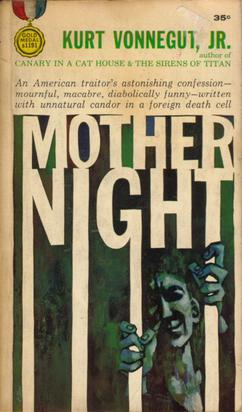
When I first read Vonnegut's Mother Night in my twenties, I hadn't the background or experience to perceive the scope of it. I hadn't lived through anything that had prepared my mind for what Vonnegut was attempting to express. It left no great impression on my mind and I couldn't have even speculated as to the plot before picking it up again. But now that I have, and I have finished, I am aghast at how relevant this book about a Nazi propagandist is (a Nazi propagandist who claims to be a spy throughout the book, and even seems to be exonerated, but I sense too much of Pale Fire's Charles Kinbote in him. I suppose I can take him at his word, and believe the final letter he receives, although, in the end, it hardly matters. "We are who we pretend to be").
I first read this book before Fox News completely lost its mind and became not just a Republican State Media channel but an Anti-Democrat Hate Machine. The channel has no other goal than to erode the humanity of liberals and fill their audience with hatred and mistrust. Nobody could read this novel today without making the connection between Howard J. Campbell, the book's "Nazi propagandist" narrator, and most of the hosts of Fox News shows.
At one point in the novel, Howard J. Campbell writes, on meeting Adolf Eichmann in an Israeli prison while both are waiting to go on trial:
And which winds up being worse? They are both terrible but there's something truly cruel and inhuman about knowing you are spreading lies and knowing what kind of cruelty and chaos those lies will unleash on the world. If only there were another world after this one in which someone could judge our actions after. What would happen to Sean Hannity and Tucker Carlson and Laura Ingraham? What has happened to Rush Limbaugh and Charlie Kirk?
And Vonnegut doesn't let the people who believe the lies off the hook by simply concentrating on Howard J. Campbell. In the editor's note by Vonnegut in the beginning of the book, he discusses what the dedication should have been.
The people who might recognize themselves in this book won't read it. And if they did, they wouldn't recognize themselves anyway. Because this book is about the type of people who are unable to engage in self-reflection.
I first read this book before Fox News completely lost its mind and became not just a Republican State Media channel but an Anti-Democrat Hate Machine. The channel has no other goal than to erode the humanity of liberals and fill their audience with hatred and mistrust. Nobody could read this novel today without making the connection between Howard J. Campbell, the book's "Nazi propagandist" narrator, and most of the hosts of Fox News shows.
At one point in the novel, Howard J. Campbell writes, on meeting Adolf Eichmann in an Israeli prison while both are waiting to go on trial:
"As a friend of the court that will try Eichmann, I offer my opinion that Eichmann cannot distinguish between right and wrong—that not only right and wrong, but truth and falsehood, hope and despair, beauty and ugliness, kindness and cruelty, comedy and tragedy, are all processed by Eichmann's mind indiscriminately, like birdshot through a bugle.And thus we have to see the propagandist in one of these two ways. Do they know the harm they are spreading through their lies and deceit? Or do they believe the things they say, seeing themselves as some kind of hero . . . maybe not even believing the lies spread but believing so passionately in the result of those lies through the actions of the people who will believe them.
My case is different. I always know when I tell a lie, am capable of imagining the cruel consequences of anybody's believing my lies, know cruelty is wrong. I could no more lie without noticing it than I could unknowingly pass a kidney stone.
If there is another life after this one, I would like very much, in the next one, to be the sort of person of whom it could truly be said, 'Forgive him—he knows not what he does.' This cannot be said of me now."
And which winds up being worse? They are both terrible but there's something truly cruel and inhuman about knowing you are spreading lies and knowing what kind of cruelty and chaos those lies will unleash on the world. If only there were another world after this one in which someone could judge our actions after. What would happen to Sean Hannity and Tucker Carlson and Laura Ingraham? What has happened to Rush Limbaugh and Charlie Kirk?
And Vonnegut doesn't let the people who believe the lies off the hook by simply concentrating on Howard J. Campbell. In the editor's note by Vonnegut in the beginning of the book, he discusses what the dedication should have been.
"I would prefer to dedicate it to one familiar person, male or female, widely known to have done evil while saying to himself, 'A very good me, the real me, a me made in heaven, is hidden deep inside.'"How many Americans are currently that person? Doing real evil, making the world a worse place for so many others, while patting themselves on the back for being such a good neighbor, or good mother, or a good brother, acting so civilly and with such kindness to the people they know? How could they be a terrible person when they know so well how good they actually are?
The people who might recognize themselves in this book won't read it. And if they did, they wouldn't recognize themselves anyway. Because this book is about the type of people who are unable to engage in self-reflection.
