
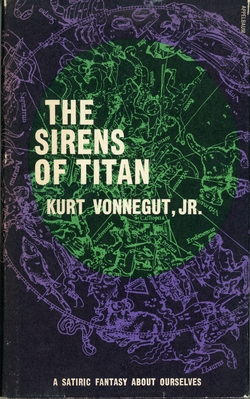
I've long had it in my head that Vonnegut's The Sirens of Titan was an anomaly, that it wasn't much of a "Vonnegut book." Upon re-reading it, I think I understand why. Not that it isn't as much a Vonnegut book as some of his others; it may even be more so if one considers all of Vonnegut's books were him trying to make sense of what happened to him in Dresden in World War II as a prisoner of war. It does this to a further extent than I would have expected. No, what made me think of this book differently is that it's much more a pulp sci-fi novel than some of his other sci-fi novels. If Breakfast of Champions is a Vonnegut book, The Sirens of Titan is a Kilgore Trout novel.
When reading Player Piano, I couldn't help thinking of how much it felt like a version of Mike Judge's Office Space for the 50s. This book reminded me, in quite a few major aspects, of Alan Moore's Watchmen and Douglas Adam's Mostly Harmless. One of the main characters in this book, Winston Niles Rumfoord, is a man who, through an accident, has been removed from linear time. He might not be as powerful as Dr. Manhattan, but he has the same perspective. But he's also Ozymandias in that he lives in isolation keeping tabs on everything that's happening (and has happened and will happened because remember he's also Dr. Manhattan) with his large pet Kazak (a dog rather than some exotic cat-thing). Niles also creates a plan for an invasion of Earth which will unite all humans and create a new era of peace. That's the main plot. It's Watchmen before Watchmen (not to be confused with Before Watchmen of which I'm sorry I just now reminded some of you).
The part that reminds me of Douglas Adams' Mostly Harmless is kind of the plot beneath the plot. Maybe it's sort of the theme, part of Vonnegut's working through why he survived the carpet bombing in Dresden. It's a part of the story that's only really hinted at until the final chapter and concerns an alien race from Tralfamadore (See? Kilgore Trout!). Like the new model Hitchhiker's Guide in Mostly Harmless, the Tralfamadorians can manipulate space/time so that a thing they want to happen eventually happens when it needs to happen. The entire human civilization of Earth effectively exists to deliver a part for one of their own's broken down spaceship on Titan. Everything that ever happened to Earth and the Earthlings on it was manipulated to get that part delivered. It's the same idea as everything that happens in Mostly Harmless was a manipulation by the New and Improved Hitchhiker's Guide model to make sure Earth was destroyed.
This is Vonnegut's second book and the ideas within it are as good as any Vonnegut has put forth. Maybe the writing is a little rough here but then that's probably why he came up with the idea of Kilgore Trout. He probably saw the differences in this book, and Player Piano, and what his style of writing would become. But at the heart of this book (and Player Piano) is a writer who somehow balances cynicism and earnestness to a seemingly impossible degree. You can truly feel his pain as he systematically deconstructs society's terrible beliefs, traditions, and accepted social mores which caused, and continue to cause, that pain.
Kurt Vonnegut is a genius and I can't wait to re-read everything else because it just gets better.
When reading Player Piano, I couldn't help thinking of how much it felt like a version of Mike Judge's Office Space for the 50s. This book reminded me, in quite a few major aspects, of Alan Moore's Watchmen and Douglas Adam's Mostly Harmless. One of the main characters in this book, Winston Niles Rumfoord, is a man who, through an accident, has been removed from linear time. He might not be as powerful as Dr. Manhattan, but he has the same perspective. But he's also Ozymandias in that he lives in isolation keeping tabs on everything that's happening (and has happened and will happened because remember he's also Dr. Manhattan) with his large pet Kazak (a dog rather than some exotic cat-thing). Niles also creates a plan for an invasion of Earth which will unite all humans and create a new era of peace. That's the main plot. It's Watchmen before Watchmen (not to be confused with Before Watchmen of which I'm sorry I just now reminded some of you).
The part that reminds me of Douglas Adams' Mostly Harmless is kind of the plot beneath the plot. Maybe it's sort of the theme, part of Vonnegut's working through why he survived the carpet bombing in Dresden. It's a part of the story that's only really hinted at until the final chapter and concerns an alien race from Tralfamadore (See? Kilgore Trout!). Like the new model Hitchhiker's Guide in Mostly Harmless, the Tralfamadorians can manipulate space/time so that a thing they want to happen eventually happens when it needs to happen. The entire human civilization of Earth effectively exists to deliver a part for one of their own's broken down spaceship on Titan. Everything that ever happened to Earth and the Earthlings on it was manipulated to get that part delivered. It's the same idea as everything that happens in Mostly Harmless was a manipulation by the New and Improved Hitchhiker's Guide model to make sure Earth was destroyed.
This is Vonnegut's second book and the ideas within it are as good as any Vonnegut has put forth. Maybe the writing is a little rough here but then that's probably why he came up with the idea of Kilgore Trout. He probably saw the differences in this book, and Player Piano, and what his style of writing would become. But at the heart of this book (and Player Piano) is a writer who somehow balances cynicism and earnestness to a seemingly impossible degree. You can truly feel his pain as he systematically deconstructs society's terrible beliefs, traditions, and accepted social mores which caused, and continue to cause, that pain.
Kurt Vonnegut is a genius and I can't wait to re-read everything else because it just gets better.
