
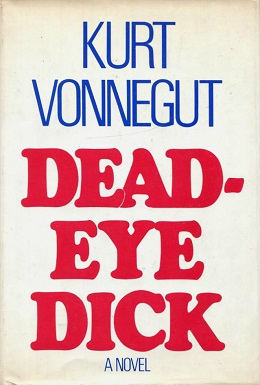
I'm sure this first edition cover layout has some inherent meaning to the theme of "epilogueness" and not just some art director being lazy.
This cover has completely thrown me for a loop. I'll have to delay my actual review of this book to review this cover now! The layout has to have some purpose to it, right?! It can't just be, "Fuck it! Just choose a couple of fonts, stick Kurt's name at the top to make it sell, and increase the title by 5000%. Bosh! Killed it!" I suppose the thing that stands out the most is how the cover literally reads, "Kurt Vonnegut Dead" which, I mean, plays into the fucking theme so well that maybe I figured it out? Also two words you can't help to read in this style are "Dead Dick" which, again, play into the fucking theme! Did some art director (or Vonnegut himself?) actually smash this thing out of the park by creating the most bland cover they could think of? Because being bland and boring and unattractive also play into the themes of this book!
Okay, enough about the cover. I wonder if I should discuss the covers more often instead of just dropping the first edition cover at the beginning of the review with an implied "This was the initial idea for selling this book!" and letting everybody come up with their own opinions on why the publisher (or Vonnegut?!) thought it was the best idea at the time. Who ever got anywhere letting other people think for themselves?! I should be telling everybody what these covers mean and why they were chosen!
Oh! I know why I didn't discuss the covers on a bunch of my past reviews! Because I wrote them for Goodreads and Goodreads chooses which cover they want to show. Which is bullshit. Also Goodreads is bullshit because they have some weird "Top 100 Reviewers" thing that tries to gamify the experience but what eventually happens is you just have a Top 100 of the most bland and reviewy reviews a bunch of people can squeeze out of their word frosting piping bags. That's my eloquent way of saying "mouths". Anyway, I write reviews for my blog first and foremost now! If I can bother, I'll eventually move them to Goodreads instead of the other way around.
What was I doing? Oh yeah! A review for Deadeye Dick!
Kurt Vonnegut was 60 when this book was published and he was 13 years past the publication of the book that was the final version of what he'd been trying to say in all the books previous (I'm talking about Slaughterhouse-Five, in case you're more ignorant than I am). In that sense, Kurt probably thought of all of his books after that as epilogue. He still had things to say, and he said them well (sometimes! I mean, did he need to write Slapstick? Or could it have simply existed as the expressed idea of a book in his Playboy interview? (On a side-note, I just realized there's a movie version of Slapstick starring Jerry Lewis, Madeline Kahn, and Marty Feldman. And it's on Tubi! I know what I'm doing after work tomorrow morning!)), but I don't think he had the same driving need to express them after releasing the Dresden bombing demons in Slaughterhouse. My main evidence of this is entirely personal in that I like Vonnegut's work much better pre-Breakfast of Champions (inclusive) than post that novel. This, of course, ignores Galapagos which I don't own but I began to re-read two years ago when a friend of mine was throwing her "20 Year Anniversary of her 30th Birthday Party" at a sex castle on the coast of Washington state. I don't think she completely realized it was a sex castle; she just wanted to throw a huge party in a castle. But when I was downstairs in the sex dungeon dropping my bags off in one of the rooms that oddly had windows from the hall looking in on the bedrooms and a hot tub surrounded by walls with actual weapons on them, I noticed the engraving on the shower door of a woman straddling a knight and I was all, "Oh. I get it." Then I went upstairs and was all, "Nice sex dungeon, Xan!" And she was all, "Oh yeah! I see it now!" My point being that the sex castle had a bunch of books on their shelves and one was Galapagos and I began re-reading it one night when I couldn't sleep and I forgot how great it was and he invented the Apple iPod and/or iPhone in it.
How can one person lose their train of thought this often? Trains are supposed to run on tracks so they easily get to their destination! Why does my thought train think it can go any-fucking-where it wants?!
The point of the point is that for nearly a decade, I've been trying to describe in my comic book reviews how exactly it feels to be living the last half of your life, when all the potential of your life has long ago gone been expended in the kinetic days of your youth. One of my own favorite quotes (if you'll excuse an old man for being intellectually masturbatory) is, "Young people are just old people who have yet to realize they've wasted their lives." Little did I know (or remember since I did read this book in my 20s), Kurt Vonnegut already expressed that feeling in Deadeye Dick. The main question in the book is this: "What do you do with the rest of your life after your story has already been told?" Technically, Vonnegut answers that question by writing this book. But, you know, that's just a glib answer that ignores everything else in the book!
Back to the cover! See how "Kurt Vonnegut Dead" expresses the idea of living out your epilogue after your story is already over? There's really nothing left but to maybe express how you felt the story went. And in Deadeye Dick, the story doesn't go great. Kurt obliterates all the characters living in his Midland City. His main character lives his entire life without ever intimately connecting with another being (literally growing old as a virgin which again references the cover's "Dead Dick"), basically living an entire life of epilogue after his story ends when he, as a child, accidentally kills a pregnant woman by firing a rifle from the roof of his family home. After taking the life of a woman and all the potential life and stories of the baby within her, he decides he doesn't deserve a life or a story himself. That isn't (again I think of the word "technically") the end of his story completely though. He does try to have a story through the encouragement of a writing teacher. So he writes a play, it's performed one time in New York and once in his home town, and then that's it. Story over. The rest is epilogue, baby.
I suppose I didn't remember much from this novel because when I first read it, my story was still happening. Potential was just jizzing and jizzing and jizzing in my face. How could I understand the utter apathetic uselessness of staring down years and years of life that feel like they don't matter? Except that's not the point! Just like Vonnegut always does, he points out the world is shit and people fucking suck and death looms on the horizon. But he also fires up an engine of hope and kindness and reminds people, "It doesn't have to be this way." In the story, it seems like Rudy Waltz (did I just now mention the main character's name? Fuck I suck at this) is having a terrible life. But he finds things he enjoys and he winds up in a place where he's content. He realizes that he loves the epilogue. He doesn't want a story. He's happy not having a story and not caring about the need for a story. He seems content.
Okay, that review was terrible. I'll admit it. But I do want to point out one striking bit that reminded me of my time in college. I was a literature major who didn't realize he was focusing on gender studies in the things he wrote until years later but who couldn't help writing papers about gender when reading so much 19th Century literature by and about women living in eras which were trying desperately not to notice them (the eras were trying, not the women). Kurt Vonnegut expresses how he realized so many women throughout his life were living epilogues and how unhappy it made so many of them and how he saw so many of them commit suicide because of it. Society told them their story was to get married and have a child. And that was it. What does that do to a person's mind when they've been told, over and over and over, that their story was virtually over before they even hit their mid-20s?! Probably earlier in many cases! Vonnegut acknowledges the weight of that, possibly thinking about his own mother (whose story, like many of Vonnegut's relations, was also hampered by mental illness. So chuck that into the mix of a life story and good luck, baby!), sort of mentions it in passing as he does with so much stuff, and moves on.
One of the things about Vonnegut's novels in his epilogue (and maybe more before that but I seem to notice it more in these later books) is that they're less focused on one major theme and just sort of express a scattershot bunch of ideas. I suppose he does this in Cat's Cradle as well so maybe I'm wrong that it's just his later stuff. It's more probably that I just wasn't old enough to truly grok the themes of Vonnegut's later novels when I was a stupid jerk in his twenties, face so covered in potential's jizz, that I just didn't understand, or want to understand, a fucking word of this thing. I probably read it and was all, "This guy don't fuck?! How can this guy not fuck?! What's wrong with this guy?! Fucking loser, man!"
Anyway. Hi ho, I guess?
Okay, enough about the cover. I wonder if I should discuss the covers more often instead of just dropping the first edition cover at the beginning of the review with an implied "This was the initial idea for selling this book!" and letting everybody come up with their own opinions on why the publisher (or Vonnegut?!) thought it was the best idea at the time. Who ever got anywhere letting other people think for themselves?! I should be telling everybody what these covers mean and why they were chosen!
Oh! I know why I didn't discuss the covers on a bunch of my past reviews! Because I wrote them for Goodreads and Goodreads chooses which cover they want to show. Which is bullshit. Also Goodreads is bullshit because they have some weird "Top 100 Reviewers" thing that tries to gamify the experience but what eventually happens is you just have a Top 100 of the most bland and reviewy reviews a bunch of people can squeeze out of their word frosting piping bags. That's my eloquent way of saying "mouths". Anyway, I write reviews for my blog first and foremost now! If I can bother, I'll eventually move them to Goodreads instead of the other way around.
What was I doing? Oh yeah! A review for Deadeye Dick!
Kurt Vonnegut was 60 when this book was published and he was 13 years past the publication of the book that was the final version of what he'd been trying to say in all the books previous (I'm talking about Slaughterhouse-Five, in case you're more ignorant than I am). In that sense, Kurt probably thought of all of his books after that as epilogue. He still had things to say, and he said them well (sometimes! I mean, did he need to write Slapstick? Or could it have simply existed as the expressed idea of a book in his Playboy interview? (On a side-note, I just realized there's a movie version of Slapstick starring Jerry Lewis, Madeline Kahn, and Marty Feldman. And it's on Tubi! I know what I'm doing after work tomorrow morning!)), but I don't think he had the same driving need to express them after releasing the Dresden bombing demons in Slaughterhouse. My main evidence of this is entirely personal in that I like Vonnegut's work much better pre-Breakfast of Champions (inclusive) than post that novel. This, of course, ignores Galapagos which I don't own but I began to re-read two years ago when a friend of mine was throwing her "20 Year Anniversary of her 30th Birthday Party" at a sex castle on the coast of Washington state. I don't think she completely realized it was a sex castle; she just wanted to throw a huge party in a castle. But when I was downstairs in the sex dungeon dropping my bags off in one of the rooms that oddly had windows from the hall looking in on the bedrooms and a hot tub surrounded by walls with actual weapons on them, I noticed the engraving on the shower door of a woman straddling a knight and I was all, "Oh. I get it." Then I went upstairs and was all, "Nice sex dungeon, Xan!" And she was all, "Oh yeah! I see it now!" My point being that the sex castle had a bunch of books on their shelves and one was Galapagos and I began re-reading it one night when I couldn't sleep and I forgot how great it was and he invented the Apple iPod and/or iPhone in it.
How can one person lose their train of thought this often? Trains are supposed to run on tracks so they easily get to their destination! Why does my thought train think it can go any-fucking-where it wants?!
The point of the point is that for nearly a decade, I've been trying to describe in my comic book reviews how exactly it feels to be living the last half of your life, when all the potential of your life has long ago gone been expended in the kinetic days of your youth. One of my own favorite quotes (if you'll excuse an old man for being intellectually masturbatory) is, "Young people are just old people who have yet to realize they've wasted their lives." Little did I know (or remember since I did read this book in my 20s), Kurt Vonnegut already expressed that feeling in Deadeye Dick. The main question in the book is this: "What do you do with the rest of your life after your story has already been told?" Technically, Vonnegut answers that question by writing this book. But, you know, that's just a glib answer that ignores everything else in the book!
Back to the cover! See how "Kurt Vonnegut Dead" expresses the idea of living out your epilogue after your story is already over? There's really nothing left but to maybe express how you felt the story went. And in Deadeye Dick, the story doesn't go great. Kurt obliterates all the characters living in his Midland City. His main character lives his entire life without ever intimately connecting with another being (literally growing old as a virgin which again references the cover's "Dead Dick"), basically living an entire life of epilogue after his story ends when he, as a child, accidentally kills a pregnant woman by firing a rifle from the roof of his family home. After taking the life of a woman and all the potential life and stories of the baby within her, he decides he doesn't deserve a life or a story himself. That isn't (again I think of the word "technically") the end of his story completely though. He does try to have a story through the encouragement of a writing teacher. So he writes a play, it's performed one time in New York and once in his home town, and then that's it. Story over. The rest is epilogue, baby.
I suppose I didn't remember much from this novel because when I first read it, my story was still happening. Potential was just jizzing and jizzing and jizzing in my face. How could I understand the utter apathetic uselessness of staring down years and years of life that feel like they don't matter? Except that's not the point! Just like Vonnegut always does, he points out the world is shit and people fucking suck and death looms on the horizon. But he also fires up an engine of hope and kindness and reminds people, "It doesn't have to be this way." In the story, it seems like Rudy Waltz (did I just now mention the main character's name? Fuck I suck at this) is having a terrible life. But he finds things he enjoys and he winds up in a place where he's content. He realizes that he loves the epilogue. He doesn't want a story. He's happy not having a story and not caring about the need for a story. He seems content.
Okay, that review was terrible. I'll admit it. But I do want to point out one striking bit that reminded me of my time in college. I was a literature major who didn't realize he was focusing on gender studies in the things he wrote until years later but who couldn't help writing papers about gender when reading so much 19th Century literature by and about women living in eras which were trying desperately not to notice them (the eras were trying, not the women). Kurt Vonnegut expresses how he realized so many women throughout his life were living epilogues and how unhappy it made so many of them and how he saw so many of them commit suicide because of it. Society told them their story was to get married and have a child. And that was it. What does that do to a person's mind when they've been told, over and over and over, that their story was virtually over before they even hit their mid-20s?! Probably earlier in many cases! Vonnegut acknowledges the weight of that, possibly thinking about his own mother (whose story, like many of Vonnegut's relations, was also hampered by mental illness. So chuck that into the mix of a life story and good luck, baby!), sort of mentions it in passing as he does with so much stuff, and moves on.
One of the things about Vonnegut's novels in his epilogue (and maybe more before that but I seem to notice it more in these later books) is that they're less focused on one major theme and just sort of express a scattershot bunch of ideas. I suppose he does this in Cat's Cradle as well so maybe I'm wrong that it's just his later stuff. It's more probably that I just wasn't old enough to truly grok the themes of Vonnegut's later novels when I was a stupid jerk in his twenties, face so covered in potential's jizz, that I just didn't understand, or want to understand, a fucking word of this thing. I probably read it and was all, "This guy don't fuck?! How can this guy not fuck?! What's wrong with this guy?! Fucking loser, man!"
Anyway. Hi ho, I guess?
