E!TACT #32
Music Reviews, Strangers in Paradise XXV #4, Kick-Ass #5, Exit Stage Left: The Snagglepuss Chronicles #6, Hit-Girl #5, New Super-man and the Justice League of China #24, and Facebooking with Grunion Guy!
By Grunion Guy
The Prologue!
I just learned that my comic books for the week of July 18th will be late because they were on a train bound for my local comic book shop that was also carrying toxic materials which spilled. That means all of my comic books for this week will now probably be issues of Daredevil and Teenage Mutant Ninja Turtles.
Grunion Guy's Musical Corner of Music Reviews!
Your Song by Elton John. I mean Ewan McGregor? Whatever. The version from Moulin Rouge!
One thing I think I've heard but I can't totally be sure is that people constantly wonder who Carly Simon was singing about in "You're So Vain." But how come nobody ever wonders which song Elton John was talking about in "Your Song"? I suppose, like I did for a long time, people simply assume Elton John is singing about the song he's currently singing. The song he wrote is "Your Song." But that's not correct at all. The song is obviously sung from the perspective of a really awkward guy handing somebody else either a sheet of written music or a recorded track and telling them about how he wrote that song for them. But we never actually hear the song he wrote for the person. I like to imagine it's "Rocket Man."
Another possible interpretation of this song is that the persona singing the song is just Bernie Taupin himself. He's all, "Hey, Elton. Here's another song I wrote for you. I don't mind if you tell everybody that it's your song. Go ahead and take credit for it. I don't care. I mean, I don't even remember what color your eyes are, that's how fucking chill I am. Just don't forget to pay me, darling."
I wish there was a cut of Moulin Rouge where Nicole Kidman stands expectantly after Ewan McGregor finishes singing until he finally says, "Well? What do you think?" And then she's all, "I'm just waiting excitedly for the song you wrote for me since that obviously was just you telling me about how you wrote a song for me! I bet it's great!" And then Ewan panics and just starts singing Alice Cooper's "Roses on White Lace".
Grade: B+.
Oh Dear by Brandi Carlile
I'm not great at reviewing things because I treat every review as a discussion with another person who has experienced the thing I'm reviewing. That's because I think reviews that take care not to spoil the thing being reviewed (in the case of a book or movie) are too superficial to matter. People either want to have an in-depth discussion of experiencing the thing or want a Cliff's Note summary of the thing so they can pretend to speak on it as if they'd developed their own opinions on it. The latter reason for reading reviews probably stems from a fear of not being completely plugged in to popular culture and having to admit to somebody at some party that you haven't formulated an opinion on every single event in popular culture over the last forty years. I prefer to either have something extremely witty and precise to say about something I've personally experienced than to vomit somebody else's opinions on that thing. But I can see why people would feel they need to have an opinion on everything. And I hope you use some of the things I say in discussions while pretending you came up with them yourself. It would be so flattering!
All that is to say this: what I'm about to say about this song, you won't understand unless you've heard the song. And even then, you might simply think, "You're an idiot, Grunion Guy." Of course if you think that, I hope you think, immediately after, that I'm thinking, "Fuck you, asshole!"
I can't help thinking that this song plays on an endless loop in Velma's head every time Fred and Daphne go off together to "hunt for Daphne's clit." Whoops! That didn't need quotes! What I meant to say was "hunt for ghosts" as the euphemism for what I actually typed. Sorry about that! Anyway, this song is about yearning and loneliness and being scared while chasing ghosts in a van deep in the dark woods. That might not be said explicitly in the lyrics (although it comes quite close!) but the yodeling definitely comes across as setting the tone of the dark woods.
Don't question me in that tone! I already told you what you can and can't think after reading my opinions! Anyway, the only thing I'm not sure about is if Velma is yearning for Fred or Daphne.
Rating: B.
This Song by Ookla the Mok
Unlike "Your Song" by Elton John, "This Song" is actually about this song. You can tell because when Ookla the Mok sing, "This song is over now," the song ends. When Elton John sings about the song being finished, it keeps going for two more minutes. Because he finished writing the song he sings about in "Your Song" but he never gets around to singing it.
"This Song" simply describes "This Song" and since it's just a song about describing itself, it doesn't have a lot to say. It would be interesting if it was all, "This song will make your head explode in five days!" But it doesn't do that (thankfully! It might be interesting but I would spend the next five days terrified and possibly wrapping my head in duct tape hoping to keep it together by the end of day five (I wonder if duct tape would keep my head from exploding? I wish the Mythbusters were still around)). It just points out the song is kind of weak and short. It might house a secret message that I'm too stupid to figure out.
Grade: C-.
Be My Dark Angel by Electric Six
This song is about a guy who crosses the street to fry an egg on the face of the woman he wants to fuck. It might be the most relatable lyrics Electric Six have ever written! Especially the part about asking the lady to be his Capri Sun. I guess that means Mr. Valentine has sex by poking his penis into a woman's nether regions for five minutes until he finally gets his penis in the hole.
This is a really progressive song because in the middle of it, he just lists all the different races of girls he'd like to have sex with. That's called being a good ally.
If you decide to listen to this because I gave it a good grade, you should be forewarned: at one point he mentions that the Jacksons are reuniting and going on tour. This isn't true. Michael Jackson died like nine years ago. This song is from 2005 so it was probably true then. I bet Electric Six was paid good money to advertise the new Jackson 5 tour. Heck, I suppose it could be true now even though Michael is dead. It's not like he was ever part of any Jackson reunion tour anyway.
Grade: B-.
The Great American Success Story by Alice Cooper
Alice Cooper has a song called "The Man with the Golden Gun" that was almost certainly written to be the theme song for the movie. He also wrote "The Man Behind the Mask" which was used in one of the Friday the 13th movies. He wrote "Prince of Darkness" for the movie, Prince of Darkness. A movie was written based on his song "Road Rats." "I am the Future" played over the credits for Class of 1984. What I'm suggesting is that Alice Cooper has had a long history of songs being written exclusively for movies (as well as some other things I suggested that don't fit that particular argument. Sue me!). So when I first heard this song on Constrictor, I thought, "Was this song supposed to be the theme song for Rodney Dangerfield's Back to School?" Since that time, the Internet has become a thing and I could easily verify that fact. But I enjoy living in a world where I trust my own assumptions! If I think a thought, it must be true or else how could I have thought it?! Answer me that, genius!
In one line of this song, Alice sings, "He's staring at her legs but he's thinking 'bout her face." The word that face is supposed to rhyme with is "class." I like to believe that Alice makes a huge, over-emphasized wink to the crowd when he sings this song in concert and then says, "You get what I meant to say, right?!" He loves doing that trick. In "I Love America," he sings "flirt" where he obviously means to say "fuck." I bet he winks really big when he sings that song too! What a joker this guy is!
Grade: C.
* * * * * * * * * *
Comic Book Reviews!
Strangers in Paradise XXV #4
By Terry Moore
Why does Terry Moore insist on a nearly completely black cover? Is it so every single issue will retain proof that it has been read? Unless you put on rubber gloves, you can't not wind up with greasy fingerprints all over the stupid thing!
Unless...maybe...am I just a filthy, greasy monster? Do most people wash their hands enough that they don't leave greasy prints on glossy black comic book covers?
No, you know what? I'm unasking that question. I don't want to know if I'm generally more disgusting than the rest of humanity! Besides, most of you will probably lie just to seem cleaner. I'm the only one out here speaking the truth!
Rating: I forget. All my reviews of this comic book are about the damned black back covers! Anyway, it was Strangers in Paradise. Does it need a review? Oh, fine. Katchoo, the Katchoo-looking character, finally catches up to Stephanie, the Jet-looking character. They both have rose tattoos like all the female characters in Strangers in Paradise except Francine. That means they're deadly sex monsters. Later, Tambi, the Dolph-Lundgren-looking character, returns to the story to help Katchoo destroy the last of the off-the-leash deadly sex monsters. That wasn't a rating. It was a synopsis. You get what you pay for.
* * * * * * * * * *
Kick-Ass #5
By Millar and Romita Jr.
For some unknown reason, Hit-Girl is on the cover of this issue. But she doesn't make an appearance. Does that mean Hit-Girl will save the new Kick-Ass in the final issue and somebody fucked up with the cover? Or does it mean I'm living in a reality where nothing makes any sense and nobody gives a fuck? I can't even remember if Hit-Girl had a scene in one of the previous issues. Maybe she's hunting Violencia and will just happen to wind up at the right place at the right time in the final issue. Kick-Ass is going to need some kind of deus ex machina to save the day being that Millar has put her in an unwinnable situation.
But then again, "unwinnable situations" are the hallmark of Kick-Ass comic books. They're injected into the narrative so that the Fangenders can think, "Yep! This is how these kinds of things would really go down in real life. A lone vigilante can't stand against the power and money and weapons and violence of criminal organizations! They'd totally get caught and beaten within an inch of their life, if not outright killed! Kudos to realism, Millar! Bravo!" And usually that's when Hit-Girl arrives to say, "Look at me! I'm a tween monster assassin with only the most basic of morality informing my hyper-violent tendencies! I can solve any problem and survive any situation! I'm here to remind you that this is a comic book and I'm the superhero that saves the day so that you can continue to believe all the Kick-Ass parts of the story were still quite realistic. All the comic book stuff resides in me and my ridiculousness! But it's also why I'm your favorite part! Because you don't really want to read books where the nerd in a costume gets killed living your Fangender wet dream! I'm going to stop here because I don't want to get into the creepiness index of needing your savior to be an eleven year old girl."
Grade: I'm changing this part of my review from "rating" to "grade" because I can do whatever I want. Plus it's easier to just say "C-" than to ramble for a full paragraph and then never provide any sense of how well the comic book was written or drawn. I've never been any good at that anyway. Other comic book reviewers just throw that shit in because it's tradition. "Okay. So I've summed up the story in the most boring way possible and now I should probably mention the art. It's good to say how it hinders or uplifts the tone of the script. And I should mention how well both the penciller and the inker did their jobs even if I don't really understand how a person tells who did what. Then maybe knock off a line about the colorist making things bright or gloomy or using a specific palette that worked well with the themes. After that, I'll give a cursory nod to the letterer even though nobody fucking cares about that part of the process. Then I'll give it a random number of stars out of another random number of stars, insisting that it's a fair review and completely unbiased because that's important for some reason. Inject your own bias and personality and terrifying secrets from your childhood into a comic book review?! Who would be so gauche?!"
Anyway, this comic book gets a C-.
* * * * * * * * * *
Exit Stage Left: The Snagglepuss Chronicles #6
By Russell, Stilwell, Feehan, Vazquez, Parsons, Mounts, and Campbell
Grade: A+. This comic book finally gets around to the point of the series: explaining why Snagglepuss first appeared in the Hanna-Barbera cartoons as an orange cat named Snaggletooth! I knew there'd be a point to all of the nonsensical blather Russell has been writing for the last five issues!
If you want to know the reason, you'll have to buy the collected series when it comes out as a trade paperback. I'm not going to spoil it for you! Mostly because I can't repeat all of the poetic commentary on society that Russell puts in as filler before getting to the big Snaggletooth reveal! Which I totally spoiled. But that's okay because, really, all that great filler is the real reason to read this masterpiece.
* * * * * * * * * *
Hit-Girl #5
By Lemire and Risso
I know I said I would stop buying this comic book because it was too depressingly violent for a comic book that's supposed to take place in a non-comic book world. But then I remembered it is a comic book and Hit-Girl is the one part of the Kick-Ass world that's supposed to remind the audience that it's all a comic book and also that I don't have anything better to do than to read comic books anyway. Plus it's written by Jeff Lemire and when is the last time he wrote something that made me think, "Aquaman is a fucking dick." Oh yeah! When he wrote Aquaman!
I know that sentence that began "Plus it's written by" went completely off the rails and made no sense. You don't have to remind me that I'm a terrible writer. I have to live with this legacy, you know! I think it about it all the time!
The back of the comic book reads, "The world's deadliest tween superhero is on a mission to serve justice around the globe." It could just as easily read, "The world's most tween sociopath is on a mission to satiate her lust for blood around the globe." My version might even be more accurate.
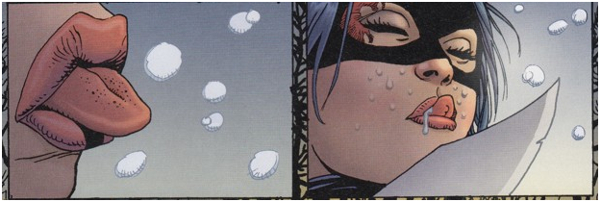 Try to remember that this is a tween girl before you start jacking off to this image, you virgin nerds. But also remember it's a fictional drawing. So maybe jerking off to it is okay? Who am I to clarify morally ambiguous gray areas?! It would be so much easier if this stuff was all clearly explained in The Bible. But instead, The Bible is all, "Hey? You guys want to read some hot father on daughter action in a cave? Don't worry! The father is drunk so he doesn't know he's totally banging his hot daughters."
20/20's "What Would You Do?" segment should do one where they leave some daughters in a cave with their father and some wine to see if they'd be all, "Whoa. Has the world ended? I need some dick so badly right now!" They should do a segment on all the stories of Genesis! "What would you do if your father was passed out naked in a tent? Would you look directly at his nakedness? Would you avert your eyes as you covered him up? Would you just mind your own fucking business and, maybe, over dinner bring up your concerns about his drinking habits?" "What would you do if 'God' asked you to kill your only child? Would you attempt to do it? Would you later write accounts of the story pretending that the child was the child that matters to your religion even though Isaac was never Abraham's 'only child' and it must have been Ismael in that story? We see your subtle manipulations of Biblical history, The Bible."
I almost said "We see your subtle manipulations of the truth" in that last sentence but I couldn't bring myself to imply that anything in The Bible is true.
Mindy currently has her foot caught in a bear trap and she's going to hack it off to escape. Because that's the only way to get out of a bear trap when you're a weak tween girl assassin. It's a weird place to begin the story if you've forgotten you were reading a comic book. The main rule of comic books is this: "Remember when comic books used to sit on a rack and not on a shelf already placed securely in Mylar with a piece of tape to stave off virgins reading the product without buying it? Well, we, the Comic Book Publishers Conglomerate of America still demand our comics be written according to the good old days. And the number one way to get kids to buy comic books is to let them know on the first couple of pages that the protagonist will be facing a super duper exciting dilemma! This dilemma must be mentioned early before the soda jerk behind the counter has time to notice and yell, 'Hey, you pesky kids! This ain't no library! Git outta here!' But that kid will drop an easy nickel on the book if those pages were exciting enough!"
I know it's a pretty lengthy rule but I didn't write it! I'm just reporting the findings of my deep cover investigation into why comic books continue to use outdated writing tropes that don't really add anything to the story being told.
Hit-Girl's super-power is the opposite of Batman's. He strikes fear into the hearts of criminals which doesn't stop crime because most of the crime isn't caused because somebody was sitting around bored and thought, "Crime would be fun! As long as no scary vigilante is out there to stop me! If there was, I'd definitely not do crime!" Most crime is crimed out of desperation and/or the need for drug money. Neither of those care about the fear of a Batman. Hit-Girl's super power is killing criminals immediately no matter what crime they've done or will do which totally stops them from doing future crimes. Once again, I'm not hear to clear up age old philosophical quandaries about morally grey aspects of living in our current reality. And since I'm not here to do that, I can only conclude that Hit-Girl is more competent at stopping crime. I almost said she's more competent at being an advocate for justice but the whole idea of justice resides in that morally gray area. I mean, is it just to kill somebody for a minor infraction of the law? Who's to say?! Not me!
You might be thinking, "What the fuck? Is Grunion Guy being paid off by the NRA now?" And I would answer, "You aren't allowed to access my list of donors, you stupid pacifist! Pew pew!"
Anyway, Hit-Girl murders a bunch of people in gory details before going off to Northern Canada and getting her foot caught in a bear trap. But not before she murders some drug lord's son which means the drug lord is going to send so many guys after her that she'll kill them all easily.
Grade: C+.
* * * * * * * * * *
New Super-man and the Justice League of China #24
By Yang, Peeples, Santorelli, and Hi-Fi
Master I-Ching tells Kenan, "Let go of the goodness that can never be. And embrace the goodness that is." Sure, it's a bit like Obi Wan's advice to Luke. Or Yoda's advice to Luke. I don't know. It was somebody's advice to Luke, I'm fairly certain. Did Luke ever go to a 12 Step planet where he learned about the wisdom to know the difference between things you can and can't control? I-Ching's wisdom is also a slight variation on forgiving not for the other person but so that you can move on. It seems sappy and overly optimistic and a bit too happy ending on the surface of it. But I think, ultimately, it represents a kind of maturity. Stop wishing things could have been different because you can't do anything about the past. Concentrate on the present good. Work on making the present good a future joy. At the very least, reconciling the past so that it doesn't poison your future can't be anything but a positive step forward. And it takes maturity to let go of the anger and resentment of things that are set in stone.
There's a lot to be said for embracing maturity. I don't mean you have to wear a suit and stop making dick jokes in reviews about terrible comic books. The World Cup just ended so let me make a World Cup analogy (this might be a first! I'm actively making a terrible analogy and about a sport I don't care about at all!): if your first reaction to contact from an opposing player is to dramatically fall to the ground and act hurt, you've yet to reach the level of maturity I'm talking about. Playing through the buffeting from the other player, or the slide tackle, or even their overly aggressive tactics to simply concentrate on your game and your actions and the things you can control seems to me the way to approach life. I feel like I did a pretty good job of getting there in the latter half of my thirties.
Maybe writing comic book reviews that use over-the-top hyperbole while spouting whiny complaints and nitpicky critiques has become the steam valve for other aspects of my life. I get all the shit out here in a fun and whimsical way so that I don't bore my drinking buddies with long-winded maudlin grumbles about never really having a father in my life or my mother's lack of attention due to her constant battle with my out-of-control sister! I've just come to accept those were things I dealt with and so what? It made me the genius I am today!
Grade: B-.
* * * * * * * * * *
Facebooking with Grunion Guy!
On this week's episode, "World Emoji Day!"
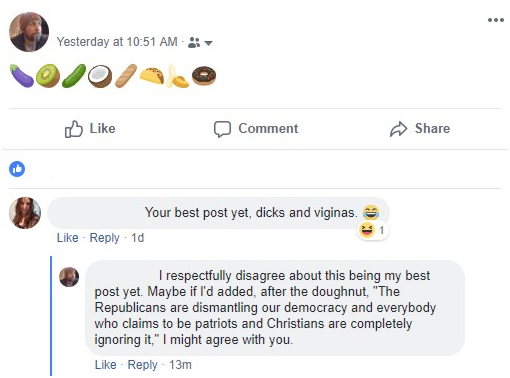 * * * * * * * * * *
The End Part!
* * * * * * * * * *
The End Part!Speaking of Facebook, it's the ultimate modern dramatic monologue. All these people out there not realizing how everything they say is simply exposing their inner hearts. And then they don't want anybody calling them out on it because that's mean and uncivil. I have no problem saying, explicitly, what I think and feel. If somebody feels uncomfortable saying what they think and feel because they know they're going to be called out on it, maybe they should work out why those ideas anger people. Maybe they should stop viewing the world as intolerant of their terrible beliefs and start viewing themselves as intolerant people. Embrace that shit, you monster! It would be much easier to debate somebody who says what they think instead of all these cowards trying to debate about some weird, vague analogy that doesn't quite approach their real positions because they know those positions are terrible.
We can't have an honest conversation about systemic racial bias in the justice system if the people who think the justice system is fine think that because they're also racially biased but will never admit to it. You can't just respond to police taking the justice system into their own hands and murdering people instead of apprehending them by saying things like, "Don't do anything wrong and you'll be okay," or "Not all cops!" We see what you're really saying when you do because cops don't just kill people committing crimes. And even if they did only kill people committing crimes or trying to run from police, isn't that a fucking problem all on its own?! Who is out here thinking cops should have the right to administer the death penalty simply because a person suspected of a crime runs? Or gets confused over multiple police yelling instructions at them? Or disrespects a cop because the cop is being an aggressive abuser of his power? Just believing that any of that is okay makes you a terrible person in my eyes. Keep defending bullshit, my Facebook Fra Lippo Lippi. We see you, motherfucker.
Later, jerkos!