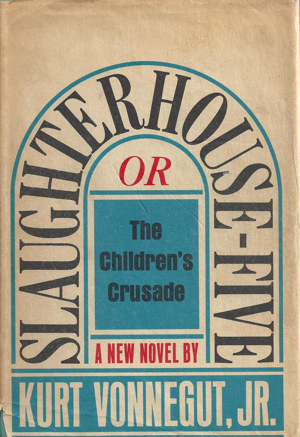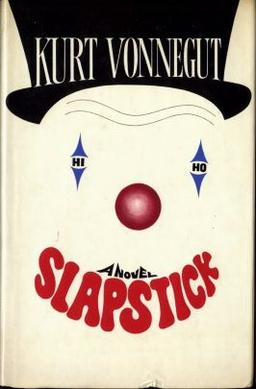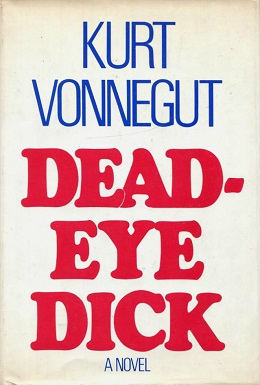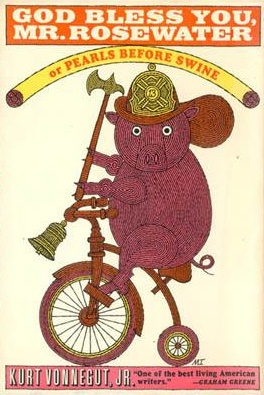
One could do worse than have a wardrobe full of t-shirts with Vonnegut quotes on them.
Chapter 1 begins like this:
The Preface of this book explains some things about the book from the author's point of view. The first paragraph of the second chapter gives a tiny little synopsis of the story about to be told. I'd argue the book doesn't really start until the second section of the second chapter when Vonnegut begins with his tried and true classic method of slapping you in the face to get your attention:
After the "Listen" part, Kurt Vonnegut punches America in the teeth, pushes her to the ground, and begins kicking her in the ribcage. Good for him.
I'm being hyperbolic and misogynistic. Although, to be fair to me (for once), the misogyny is only because we are raised to view America as feminine. The hyperbole, to be fair to me, is just my way. Sure, Kurt doesn't beat the shit out of America in this chapter. He just points out how fucking silly and arbitrary the things we're supposed to believe about it actually are. Kurt just wants people to realize, before he tells his story about America, that when you celebrate patriotism and all of America's trappings, you're worshiping a clown that keeps falling down and shitting itself. But it's not the country's fault! It's the people in charge who have said, "This is the way things are and these are the things you should believe, no matter how stupid we've made them!"
Here is another quote presented as evidence to the things I've written so far that lacked evidence. I will not tell you how the one provides evidence for the other for it is abundantly clear to me and so if you should ask me, "What does this have to do with the other?", I would sneer and believe you to be a dunderheaded illiterate.
All of this is evidence leading up to Kurt's conclusion about the terrible secret of this country and the men who founded it. Listen: it's racism.
This isn't a review for R.F. Laird's The Boomer Bible but I might as well make it one even if R.F. Laird seems to have become a typical white reactionary who lost his mind. It's hard to believe how easily some people lose the plot of reality, especially when they wrote something so cutting and truthful and heartbreaking as The Boomer Bible. Also, I never received my $10,000 for finding the secret Christian symbol in the text, Laird. I mean, it was the same secret Christian symbol that Philip K. Dick saw after the pink light scrambled his brains and the secret Christian came to his door with his fish necklace. But, you know, I still figured it out! Pay up, buddy!
I mentioned The Boomer Bible because the Old Testament of The Boomer Bible discusses the history of civilization by telling the history of each Chosen Nation as it rises to power and then falls from its perch. It does this in incredibly hilarious and vulgar ways. A good example of the humor of the book is how one of the early chapters is The Book of Greeks. Following the Book of Greeks is "The Book of Romans. Otherwise known as the Second Book of Greeks." The final "historical" chapter in the book is The Book of Yanks because, well, they were, at the time, the current Chosen Nation and seemed like they would be for some time yet (is that time still? Or did it end in 2016? Or, more probably, 2001, on a particular morning in September). Kurt plays up this whole America as the Most Chosen Nation myth by pointing out how America became the richest nation in the world by simply threatening other nations with bombs and guns and "their capacity to astonish".
That "buh-bye" was me saying goodbye to all the useless trash whose time as my friends and family members is now done. It wasn't me ending this blog post! Kurt's not done with Chapter 1 yet! Although he is done bashing America, for the most part. He explains Communism which is just a scary word that was hijacked by more evil, nonsensical people when it really should have just meant "government based on the common good; on community; on acknowledging that nobody does anything by themselves, no matter how much Ayn Rand you've read (especially when Ayn Rand's own words in her stupid boring stories actually argue against what she thinks she's making them say! Have any of the people who worship her read Anthem? Do they fucking understand it says exactly the opposite of what she and they all think it does?! God, it's wall-to-wall illiterate dunderheads up in this house of a country!)". He points out that babies were being born into poverty all over the world and still Americans refused to help them because there was no law saying they had to help and they should only help if they want to but all the people with the money to help simply didn't want to, no matter how Christian they were. Perhaps because of how Christian they were!
The point of all of this is to begin the story by stating that Dwayne Hoover, the white Pontiac dealer, was incredibly wealthy when he met the incredibly poor Kilgore Trout, the white science fiction writer. These two characters are the main protagonists of the book although, in reality, all the characters are the main protagonists of the book, what with it being a Kurt Vonnegut novel and all. Also the black Wayne Hoobler whom we have yet to meet. Or Bunny. Or the bartender. Look, man, I can't remember the names of all of the main characters! A lot of people live in Midland City, Ohio!
I think there was more about Trout's ideas making Dwayne crazy but since that's going to be shown in the story later, maybe I'll save talking about it for then!
This is a tale of a meeting of two lonesome, skinny, fairly old white men on a planet which was dying fast.I don't know if mentioning the two characters are white is a tell that this book will have a little something to do with race relations in America or if it was more of a habit of writers living through the Civil Rights era. People don't often think of bias stemming from what is left out of what is said and assumed by the listener (I mean people who aren't Foucalt and Derrida). But Vonnegut could have left out the adjective "white" and most readers would have simply assumed the two characters were white being that they weren't described using a different adjective. This is a foundational part of systemic racism and also homophobia and all the other Othering that takes place in America. So to come right out and state that two of the central characters of this novel were "fairly old white men", Vonnegut's making a narrative choice and a declaration of perspective. These two characters are experiencing America through a very particular lens: white, male, and older. People didn't use the word privileged in the same way we regard it now in 1973 (or did they? What the fuck do I know?) but it's what Vonnegut's pointing out. These two men who are experiencing bad shit in America are doing so even though they're from a privileged class. They have some bad shit going down in a country Vonnegut's about to take the extreme piss out of for the rest of the chapter. The decentered point here, the unspoken bit, is, "Now imagine if you aren't male or white or older. Hoo boy!"
The Preface of this book explains some things about the book from the author's point of view. The first paragraph of the second chapter gives a tiny little synopsis of the story about to be told. I'd argue the book doesn't really start until the second section of the second chapter when Vonnegut begins with his tried and true classic method of slapping you in the face to get your attention:
Listen:I didn't say it was a hard slap. But it's an odd thing to say in a silent medium. As a pedant, one knows it should be "Read:". But Vonnegut wants to remind us that we're being told a story in a grand oral tradition. And that we should pay attention. I'd probably have started with "Listen, Motherfucker," but then I never learned the definition of subtle. My role model for how to act out in public was Tanner from The Bad News Bears.
After the "Listen" part, Kurt Vonnegut punches America in the teeth, pushes her to the ground, and begins kicking her in the ribcage. Good for him.
I'm being hyperbolic and misogynistic. Although, to be fair to me (for once), the misogyny is only because we are raised to view America as feminine. The hyperbole, to be fair to me, is just my way. Sure, Kurt doesn't beat the shit out of America in this chapter. He just points out how fucking silly and arbitrary the things we're supposed to believe about it actually are. Kurt just wants people to realize, before he tells his story about America, that when you celebrate patriotism and all of America's trappings, you're worshiping a clown that keeps falling down and shitting itself. But it's not the country's fault! It's the people in charge who have said, "This is the way things are and these are the things you should believe, no matter how stupid we've made them!"
Here is another quote presented as evidence to the things I've written so far that lacked evidence. I will not tell you how the one provides evidence for the other for it is abundantly clear to me and so if you should ask me, "What does this have to do with the other?", I would sneer and believe you to be a dunderheaded illiterate.
The undippable flag was a beauty, and the anthem and the vacant motto might not have mattered much, if it weren't for this: a lot of citizens were so ignored and cheated and insulted that they thought they might be in the wrong country, or even on the wrong planet, that some terrible mistake had been made. It might have comforted them some if their anthem and their motto had mentioned fairness or brotherhood or hope or happiness, had somehow welcomed them to the society and its real estate.Kurt concludes the bit about America being silly by suggesting the national motto may as well have been "In nonsense is strength." But he's not done putting the screws to the myths of America. He's got some pretty hefty ones to go, some that idiot conservatives in 2026 would suggest were not even considerations until the radical left logged onto tumblr and began spouting them. But they've always been known because they're Truths which people in power who want to control and manipulate the way people see the world simply want to obliterate from mass consciousness. So Kurt goes on to discuss how a lot of the nonsense we learn about America isn't just silly; it's actually evil.
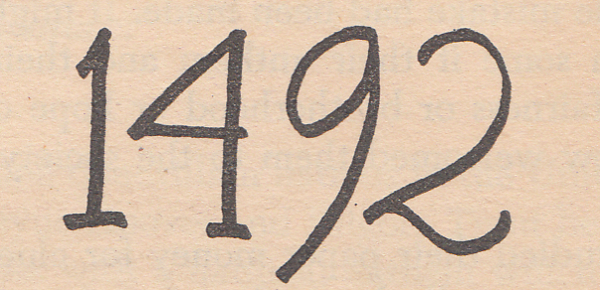
For example, teachers of children in the United States of America wrote this date on blackboards again and again, and asked the children to memorize it with pride and joy:
The teachers told the children that this was when their continent was discovered by human beings. Actually, millions of human beings were already living full and imaginative lives on the continent in 1492. That was simply the year in which sea pirates began to cheat and rob and kill them.See? This is why conservatives cannot like Kurt Vonnegut, no matter what they might think. To belong to their tribe, they must adamantly refuse to believe actual Truths about the world. They must openly espouse only what other members of their tribe espouse lest they be discarded like, well, like somebody who won't espouse the beliefs that conservatives have determined all conservatives believe. It's telling that conservatives came up with the term "virtue signaling" since signaling their "virtues" is all they do. It's how they think everybody acts because they know that if they don't wave a flag or praise God or kiss the ass of every military member they see in public, they'll be shunned by their peers. So they simply believe everybody is faking their lives to fit into a tribe. It's a pity they can't just be themselves and enjoy what they want without the constant fear of being abandoned. I think it's also why they strive so hard to make laws that force people to live and act in Christian or Conservative ways. Because they're angry that other people actually choose to be happy and joyful, that people simply do things that they want to do without fear of being disowned or despised.
All of this is evidence leading up to Kurt's conclusion about the terrible secret of this country and the men who founded it. Listen: it's racism.
Here was another piece of evil nonsense which children were taught: that the sea pirates eventually created a government which became a beacon of freedom to human beings everywhere else.
Actually, the sea pirates who had the most to do with the creation of the new government owned human slaves.
The sea pirates were white. The people who were already on the continent when the pirates arrived were copper-colored. When slavery was introduced onto the continent, the slaves were black.It's at this point when Kurt puts on his steel-toed boots and really gets going on America's midsection. I was wrong about my hyperbole being too hyperbolic. Kurt just begins by writing, "Look at all this nonsense! Silly America!" And then he continues to point out how all of that silly nonsense was in service to a bunch of evil, greedy, selfish sons of bitches who fucked over the entire world to line their own pockets. And how those men and that world had a direct connection to the America of 1973, no matter how many brainwashed Christian dunderheads loudly proclaimed, "America is the greatest country on Earth!"
Color was everything.
This isn't a review for R.F. Laird's The Boomer Bible but I might as well make it one even if R.F. Laird seems to have become a typical white reactionary who lost his mind. It's hard to believe how easily some people lose the plot of reality, especially when they wrote something so cutting and truthful and heartbreaking as The Boomer Bible. Also, I never received my $10,000 for finding the secret Christian symbol in the text, Laird. I mean, it was the same secret Christian symbol that Philip K. Dick saw after the pink light scrambled his brains and the secret Christian came to his door with his fish necklace. But, you know, I still figured it out! Pay up, buddy!
I mentioned The Boomer Bible because the Old Testament of The Boomer Bible discusses the history of civilization by telling the history of each Chosen Nation as it rises to power and then falls from its perch. It does this in incredibly hilarious and vulgar ways. A good example of the humor of the book is how one of the early chapters is The Book of Greeks. Following the Book of Greeks is "The Book of Romans. Otherwise known as the Second Book of Greeks." The final "historical" chapter in the book is The Book of Yanks because, well, they were, at the time, the current Chosen Nation and seemed like they would be for some time yet (is that time still? Or did it end in 2016? Or, more probably, 2001, on a particular morning in September). Kurt plays up this whole America as the Most Chosen Nation myth by pointing out how America became the richest nation in the world by simply threatening other nations with bombs and guns and "their capacity to astonish".
Nobody else could believe, until it was much too late, how heartless and greedy they were.And so, you know, it continues to this day. I would say fuck Trump and Hegseth and Miller but I'm really more angry with all the idiots who bought into all of their bullshit and lies. So many friends and family members I had to abandon because they simply showed themselves to be gigantic dunderheaded illiterate non-thinking assholes. Buh-bye!
That "buh-bye" was me saying goodbye to all the useless trash whose time as my friends and family members is now done. It wasn't me ending this blog post! Kurt's not done with Chapter 1 yet! Although he is done bashing America, for the most part. He explains Communism which is just a scary word that was hijacked by more evil, nonsensical people when it really should have just meant "government based on the common good; on community; on acknowledging that nobody does anything by themselves, no matter how much Ayn Rand you've read (especially when Ayn Rand's own words in her stupid boring stories actually argue against what she thinks she's making them say! Have any of the people who worship her read Anthem? Do they fucking understand it says exactly the opposite of what she and they all think it does?! God, it's wall-to-wall illiterate dunderheads up in this house of a country!)". He points out that babies were being born into poverty all over the world and still Americans refused to help them because there was no law saying they had to help and they should only help if they want to but all the people with the money to help simply didn't want to, no matter how Christian they were. Perhaps because of how Christian they were!
The point of all of this is to begin the story by stating that Dwayne Hoover, the white Pontiac dealer, was incredibly wealthy when he met the incredibly poor Kilgore Trout, the white science fiction writer. These two characters are the main protagonists of the book although, in reality, all the characters are the main protagonists of the book, what with it being a Kurt Vonnegut novel and all. Also the black Wayne Hoobler whom we have yet to meet. Or Bunny. Or the bartender. Look, man, I can't remember the names of all of the main characters! A lot of people live in Midland City, Ohio!
I think there was more about Trout's ideas making Dwayne crazy but since that's going to be shown in the story later, maybe I'll save talking about it for then!