
When I first met the woman my father-in-law would eventually marry, she asked me what my top five favorite books were. It really wasn't until that moment, after examining the answers I gave that day (the list always changes. If you ever want to make sure I'm eventually locked out of an Internet account, make sure the security question asks what my favorite book is. Because I'll never remember the answer I gave at the time I first answered it), I realized all of my favorite books had protagonists battling against an unjust society and, when they eventually realize they can't actually win, simply escape. One Flew Over the Cuckoo's Nest. Catch-22. The Grapes of Wrath. House of Leaves. Okay, maybe not House of Leaves. But maybe House of Leaves! Just prove that it isn't! I mean, where is Navidson going anyway and is Johnny even alive?! Or was it a brother who died in birth driving Pelafina mad?!
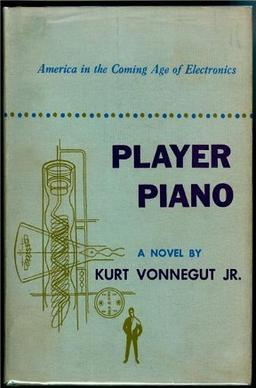
You know what? This isn't a House of Leaves review. This is about Kurt Vonnegut's Player Piano! A book which fits the description of my other favorite books except that the main character doesn't escape at the end. So it's a bit more depressing. Also a cat dies in the first chapter which is why this book loses a star. Sorry, Vonnegut, but you know the rules. Oh wait. You don't? Well the only rule is that if an animal is killed in a book or a movie, it automatically gets downgraded in my ranking. Unless the point of the book is that we're all supposed to kill our own dogs and murder our best and only friend. Then I guess I can see the point. Who wouldn't want to learn that lesson when reading a book?!
I first read this book in my twenties and now I'm in my forties and oh boy is it a different experience. In my twenties, I probably took the whole "revolution against the status quo" for granted and then was annoyed that the powers that be won in the end. But this time, every chapter was a revelation after which I had to check, over and over, how old Vonnegut was when this book was published so I could look up from my book and say, out loud, "How was he so perceptive?!"
The only modern problem with this book is that, if you wanted to ignore the philosophical and ethical underpinnings of the story, and pretend to misread the themes and character motivations, it could be read as the story of Q-Anon leading up to the attempted American coup. I only mention this because the kind of people who would believe Q-Anon nonsense would also approach this book in the disingenuous manner which I laid out at the beginning of this paragraph.
But if you read the book correctly (Oh, do not argue that point. We all know there are correct and incorrect ways to read every book. People who think any way to read a book is "a correct way" are just lazy and narcissistic readers), you'll know this is as effective, touching, and damning of the status quo as anything written by Douglas Coupland or Joseph Heller or Kurt Vonnegut. Oh wait, it was written by Kurt Vonnegut. Well, that explains that then!
Damnit, Vonnegut. I'm still thinking about that poor cat.
You know what? This isn't a House of Leaves review. This is about Kurt Vonnegut's Player Piano! A book which fits the description of my other favorite books except that the main character doesn't escape at the end. So it's a bit more depressing. Also a cat dies in the first chapter which is why this book loses a star. Sorry, Vonnegut, but you know the rules. Oh wait. You don't? Well the only rule is that if an animal is killed in a book or a movie, it automatically gets downgraded in my ranking. Unless the point of the book is that we're all supposed to kill our own dogs and murder our best and only friend. Then I guess I can see the point. Who wouldn't want to learn that lesson when reading a book?!
I first read this book in my twenties and now I'm in my forties and oh boy is it a different experience. In my twenties, I probably took the whole "revolution against the status quo" for granted and then was annoyed that the powers that be won in the end. But this time, every chapter was a revelation after which I had to check, over and over, how old Vonnegut was when this book was published so I could look up from my book and say, out loud, "How was he so perceptive?!"
The only modern problem with this book is that, if you wanted to ignore the philosophical and ethical underpinnings of the story, and pretend to misread the themes and character motivations, it could be read as the story of Q-Anon leading up to the attempted American coup. I only mention this because the kind of people who would believe Q-Anon nonsense would also approach this book in the disingenuous manner which I laid out at the beginning of this paragraph.
But if you read the book correctly (Oh, do not argue that point. We all know there are correct and incorrect ways to read every book. People who think any way to read a book is "a correct way" are just lazy and narcissistic readers), you'll know this is as effective, touching, and damning of the status quo as anything written by Douglas Coupland or Joseph Heller or Kurt Vonnegut. Oh wait, it was written by Kurt Vonnegut. Well, that explains that then!
Damnit, Vonnegut. I'm still thinking about that poor cat.

No comments:
Post a Comment