
Sometimes I'll watch a television show like Star Trek: The Next Generation and think, "I wonder how many conservatives think they enjoy this show?" And sometimes I'll read a book and think, "I wonder how many conservatives think they love this book and the author in general?" I often wonder how many conservatives think they love Kurt Vonnegut specifically but that just makes me think, "They must never have read a Kurt Vonnegut novel. They just know they're supposed to appreciate his work." It's like how the best way to disbelieve The Bible is to actually read The Bible, reading a Kurt Vonnegut book is the best way to know if you're a terrible person or not. Here's a hint as to how you discover you're a terrible person: you don't agree with Kurt Vonnegut's conclusions about humanity.
I never actually wondered if any conservatives loved this book in particular because the main messages of this book, clearly stated, are "Humans are stupid and vicious," "War is terrible," "God doesn't exist," "Religion sucks," and "Life is inherently meaningless." There's a good reason for Kurt Vonnegut to believe these things and he was always quite open about it: all of his books were attempts to reconcile his surviving the carpet bombing of Dresden. What he has come up with in Cat's Cradle seems pretty succinct if not terribly well plotted or profound (at least not profound for a reader who has already reached all the conclusions Vonnegut reaches. And I'd reached them all by the first time I read this book in my twenties. And those conclusions are just more solidified in my fifties. As if my beliefs have configured themselves in a sort of ice nine molecular pattern, you might say).
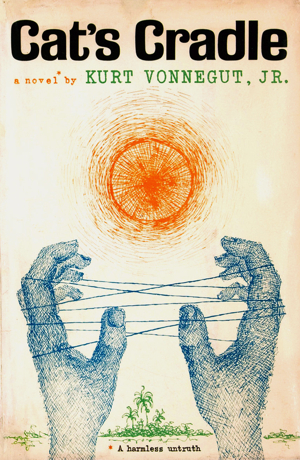
Cat's Cradle has 127 chapters across 191 pages. It's an easy read, even for a Kurt Vonnegut book. It feels like Kurt was overwhelmed by things he needed to say and so he blurted them out in short vignettes within a story about the end of the world. He has a lot to say here, most of it via a made-up religion called Bokononism which embraces lies because Bokonon understood that the only meaning life has is what we give it. At one point, Newt, the son of the fictional father of the atom bomb, describes the child's game of cat's cradle, a game he points out humans have been playing for ages, teaching it to their confused kids one generation after the other. The game uses a piece of thread to create random connections, various patterns of X's. He shows the game to the narrator and says, "No damn cat, and no damn cradle." Meaninglessness abstracted into a child's game to teach children the true nature of life.
One of the greatest aspects of Vonnegut's writing is that while he may be incredibly cynical, he is never hopeless. Sure, this book ends with the end of the world and Bokonon suggesting the actual ending should be suicide while taunting God. But ultimately, Vonnegut expresses his desire for humans to be kinder, to be better. Cynically, he points out that history has proven that man will never turn away from being as violent and stupid as possible, even with (especially with?) the violent and stupid examples of how humans have acted throughout history. But he wants them to be better. He wants them to be kinder. He wants them to move past the need for meaning and find that all we have are each other and, maybe, we should stop, maybe, buying into the foma of leaders and killing each other for granfalloon reasons. When power and money become our wampeters, we are destined to ice nine our home and everybody in it.
Chapter 114 is a particularly Vonnegutian chapter and probably my favorite. The American ambassador to San Lorenzo goes off speech at a day of celebration to earnestly discuss his thoughts on war and it's absolutely heartbreaking. It feels like the heart of the book even if it doesn't really fit with the plot up to that point or beyond. But that's because it comes from that main reason Kurt was writing. It has one night in Dresden seeping from between each word. And I can't imagine anybody reading it and thinking, "I love this and I'm a conservative."
I never actually wondered if any conservatives loved this book in particular because the main messages of this book, clearly stated, are "Humans are stupid and vicious," "War is terrible," "God doesn't exist," "Religion sucks," and "Life is inherently meaningless." There's a good reason for Kurt Vonnegut to believe these things and he was always quite open about it: all of his books were attempts to reconcile his surviving the carpet bombing of Dresden. What he has come up with in Cat's Cradle seems pretty succinct if not terribly well plotted or profound (at least not profound for a reader who has already reached all the conclusions Vonnegut reaches. And I'd reached them all by the first time I read this book in my twenties. And those conclusions are just more solidified in my fifties. As if my beliefs have configured themselves in a sort of ice nine molecular pattern, you might say).
Cat's Cradle has 127 chapters across 191 pages. It's an easy read, even for a Kurt Vonnegut book. It feels like Kurt was overwhelmed by things he needed to say and so he blurted them out in short vignettes within a story about the end of the world. He has a lot to say here, most of it via a made-up religion called Bokononism which embraces lies because Bokonon understood that the only meaning life has is what we give it. At one point, Newt, the son of the fictional father of the atom bomb, describes the child's game of cat's cradle, a game he points out humans have been playing for ages, teaching it to their confused kids one generation after the other. The game uses a piece of thread to create random connections, various patterns of X's. He shows the game to the narrator and says, "No damn cat, and no damn cradle." Meaninglessness abstracted into a child's game to teach children the true nature of life.
One of the greatest aspects of Vonnegut's writing is that while he may be incredibly cynical, he is never hopeless. Sure, this book ends with the end of the world and Bokonon suggesting the actual ending should be suicide while taunting God. But ultimately, Vonnegut expresses his desire for humans to be kinder, to be better. Cynically, he points out that history has proven that man will never turn away from being as violent and stupid as possible, even with (especially with?) the violent and stupid examples of how humans have acted throughout history. But he wants them to be better. He wants them to be kinder. He wants them to move past the need for meaning and find that all we have are each other and, maybe, we should stop, maybe, buying into the foma of leaders and killing each other for granfalloon reasons. When power and money become our wampeters, we are destined to ice nine our home and everybody in it.
Chapter 114 is a particularly Vonnegutian chapter and probably my favorite. The American ambassador to San Lorenzo goes off speech at a day of celebration to earnestly discuss his thoughts on war and it's absolutely heartbreaking. It feels like the heart of the book even if it doesn't really fit with the plot up to that point or beyond. But that's because it comes from that main reason Kurt was writing. It has one night in Dresden seeping from between each word. And I can't imagine anybody reading it and thinking, "I love this and I'm a conservative."
