
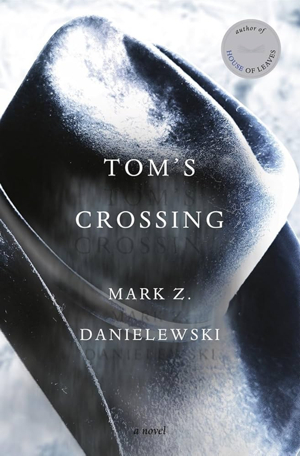
I forgot to talk about the title of the book! Is it important? Maybe, especially since E.L.M. deliberates on the appropriate title near the end. So, um, let's go?
Tom's Crossing (the crossing and not the name of the book which is why it's not italicized there!) is the destination where Kalin plans to free the horses. In many ways, it's just an arbitrary point on a map. It's two old posts at the boundary between the Porch property and the Bureau of Land Management acres. The posts used to be a barrier with a gate between them and a fence continuing on. Now it's a passage. But it's also a funnel of sorts in that Kalin specifically wants to take the horses through those two posts. In that way, it sort of becomes not just a point in space but a point in time. It's both the place where the horses will be free and the place where the inevitable confrontation between Kalin and the Porches will take place. On one side of Tom's Crossing sits civilization and rules and the Mormon Church and horses are saddled and reined and every word in the book takes place. On that side, everything is constrained. On the other side, everything is free: the horses, the ghosts, the mountain, the land, and Danielewski's story. The posts are like the covers of the book. Within the book, the story is constrained. The words have been set. This is how things happen. Once past Tom's Crossing, once the story is over, the story becomes free of constraint, free of typesetting, free of, say, the author's explicit control over it. Past Tom's Crossing, once the story is over, once the book is done, that's where all of the art projects based on the story live. Okay, sure, they live in the story. But they're examples of how the story becomes free and becomes everybody's and nobody's and it's own body.
One piece of evidence that this isn't just speculation and this is indeed what Mark was thinking about, during the 2031 art show, he has a visitor to the gallery speculate on the meaning of the name Tom used for the crossing. She explains that Tom backwards is "Mot", the French word for "word". Not just the horses are running free but the words, or the story, as well. In a lot of ways, this book felt like Danielewski talking about House of Leaves and how it generated such a long life of discussion after it was published. I think he knows this book won't cause that same kind of discussion. Many of the things "the audience" discusses within the book are things nearly nobody would pick up on as important bits of the story. He plays up mundane plot points as moments of intense scrutiny by those who know the story. It's gobsmacking if you take this story as merely the story being told. But if Danielewski's discussing what happened with House of Leaves (and, of course, other stories; all stories), it feels absolutely spot on how people reacted across the years to this story that took place in 1982. Also, House of Leaves was published March 7, 2000. The first art gallery exhibition of the Tom's Crossing art took place one week before that on February 29th. Coincidence? Well, if this were actual life, I'd say yes. But this was written by a person so, um, obviously not!
You can apply this theory of what Tom's Crossing means to many other themes in the book. Like, taking the quote from my review, Art with a capital A. The crossing is the passport to beyond the stars. It's knowledge and freedom and expression. It's also guarded by those who want to subjugate and control and kill. Often for the pettiest of reasons. The unimaginative and joyless will use any reason to keep other people (and horses!) from freedom. That freedom, as seen by the "Some of What Happened After" bit, doesn't even have to be anything spectacular. It can be the most mundane life. As long as it's your life.
Tom's Crossing (the crossing and not the name of the book which is why it's not italicized there!) is the destination where Kalin plans to free the horses. In many ways, it's just an arbitrary point on a map. It's two old posts at the boundary between the Porch property and the Bureau of Land Management acres. The posts used to be a barrier with a gate between them and a fence continuing on. Now it's a passage. But it's also a funnel of sorts in that Kalin specifically wants to take the horses through those two posts. In that way, it sort of becomes not just a point in space but a point in time. It's both the place where the horses will be free and the place where the inevitable confrontation between Kalin and the Porches will take place. On one side of Tom's Crossing sits civilization and rules and the Mormon Church and horses are saddled and reined and every word in the book takes place. On that side, everything is constrained. On the other side, everything is free: the horses, the ghosts, the mountain, the land, and Danielewski's story. The posts are like the covers of the book. Within the book, the story is constrained. The words have been set. This is how things happen. Once past Tom's Crossing, once the story is over, the story becomes free of constraint, free of typesetting, free of, say, the author's explicit control over it. Past Tom's Crossing, once the story is over, once the book is done, that's where all of the art projects based on the story live. Okay, sure, they live in the story. But they're examples of how the story becomes free and becomes everybody's and nobody's and it's own body.
One piece of evidence that this isn't just speculation and this is indeed what Mark was thinking about, during the 2031 art show, he has a visitor to the gallery speculate on the meaning of the name Tom used for the crossing. She explains that Tom backwards is "Mot", the French word for "word". Not just the horses are running free but the words, or the story, as well. In a lot of ways, this book felt like Danielewski talking about House of Leaves and how it generated such a long life of discussion after it was published. I think he knows this book won't cause that same kind of discussion. Many of the things "the audience" discusses within the book are things nearly nobody would pick up on as important bits of the story. He plays up mundane plot points as moments of intense scrutiny by those who know the story. It's gobsmacking if you take this story as merely the story being told. But if Danielewski's discussing what happened with House of Leaves (and, of course, other stories; all stories), it feels absolutely spot on how people reacted across the years to this story that took place in 1982. Also, House of Leaves was published March 7, 2000. The first art gallery exhibition of the Tom's Crossing art took place one week before that on February 29th. Coincidence? Well, if this were actual life, I'd say yes. But this was written by a person so, um, obviously not!
You can apply this theory of what Tom's Crossing means to many other themes in the book. Like, taking the quote from my review, Art with a capital A. The crossing is the passport to beyond the stars. It's knowledge and freedom and expression. It's also guarded by those who want to subjugate and control and kill. Often for the pettiest of reasons. The unimaginative and joyless will use any reason to keep other people (and horses!) from freedom. That freedom, as seen by the "Some of What Happened After" bit, doesn't even have to be anything spectacular. It can be the most mundane life. As long as it's your life.

Nice push for this one, which I'd not heard of. The last Danielewski I read was 'the Fifty-Year Sword', which I actually enjoyed... Even knowing the actual performance of the piece-- because it was written to be a performance piece, with all the actors finishing one another's lines like a greek chorus operating on a hive mind --I quite liked reading it in book form because the differently coloured text forced me to disengage with the book as a Reader and interact with it as a conscripted Performer, changing the "voices" I was reading even while working through the same sentence. It's an intriguing conceit for a novel, and I have to wonder how it was to write...
ReplyDeleteAnyway. Nice review. I'll check it out. I tried leafing through a couple volumes of Only Revolutions but I just couldn't. House of Leaves, for all its formal innovation, left me kinda cold. This sounds more in my lane.