
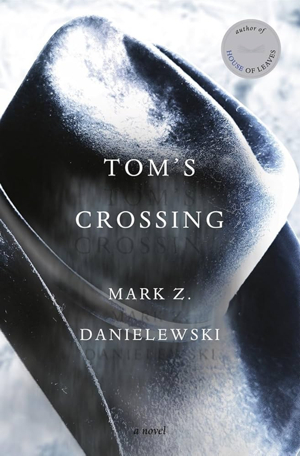
This is a story about a horse. Probably two horses. Maybe four. Okay, fine, all horses. It's about the Ur-Horse, probably. But seeing that it's so obviously about horses, it's definitely not about horses at all. That's called being incisive! You can't fool me, Mark Z. Danielewski! I mean, you can't fool me more than once. Or maybe not at all? I'm pretty sure I figured out House of Leaves a long time ago. Also, I don't have to print the word "house" in blue when I'm discussing it because I'm not the obsessive author who's really making life hard for himself book after book. He has to constantly print "house" in blue and alternate orange and green every time he types an "O" and I think he has to print "familiar" in pink and now he's added "ash" to the group by printing that in light gray. I'm sure I missed some. Like isn't "Minotaur" supposed to be red in early editions of House of Leaves? This guy is a maniac. I'm surprised publishing houses are still willing to print his novels. I guess after he agreed to stop his The Familiar series at five books instead of going the full thirty or thirty one like he planned, the publishing houses knew they broke him. Oh! Like a horse! Is that why he wrote a book about horses?
This is a story about stories. Probably two stories. Maybe four. Okay, fine, all stories. It's about the Ur-Story, probably. But seeing that it's so obviously about stories, it's definitely not about stories at all. That's called being incisive! You can't fool me, Mark Z. Danielewski! I mean, you can't fool me more than twice. Or maybe not at all? I'm pretty sure I figured out Only Revolutions a long time ago. Also, I don't have to print the letters "O" in alternating orange and green when I'm discussing it because I'm not the obsessive author who's really making life hard for himself book after book. Or is he just making life hard for his publishers? No wonder they balked at doing thirty or thirty-one versions of The Familiar just because Mark wanted to make each one look like the day on the calendar of the day the story takes place. He probably had so many more stories to tell in that world but the publishers were all, "Dude. You're killing us. Just tell a straight story." Oh! Is that why he wrote a book about stories?
This is a story about life. You can tell because when he mentions the various people who subsequently made art based on the story of Tom's Crossing, he introduces them based on what part of the story you're currently reading. At the beginning of the story, he describes each person by where they were born or how they knew Tom or Kalin in school. Later, as their lives move on, they're described by the various parts of the world they've moved to. Then as the story reaches the climax, every "audience" member, or "reader", or "hearer of the story", is introduced by how they died. And finally, in the denouement, they're described by where their bodies were buried, if at all.
This is a story about The Iliad which, being about horses, you might have guessed. I'm not calling Helen a horse! It's just Troy was a horse loving city! So, you know, you should bone up on The Iliad before reading it. Or not. The "audience" discuss the parallels enough for the actual reader. Maybe!
This is a story about art. You can tell because so much art was produced by third parties who heard the story that two major art exhibits were held for the people whom the story impacted and felt the need to share their feelings through art depicting various aspects of the story. It's a lot like Alan Moore's Jerusalem in that way although in Moore's book, only one person does all the art. But also like in Moore's book, the gallery burns down with all the art inside. It's also during the second art exhibit that this book does something that I have yet to fully investigate and understand. It has something to do with VEM which is never defined (or maybe is defined but I'd need to discover it on a re-read (which I'm not doing any time soon)). Maybe something like Virtual Emotional Memory? Something to do with how the art lost in a fire thirty years previously had been resurrected for the 2031 art show, now in digital recreations, many with Tom's ghost added. This "technology" only mentioned this one time by Cassandra Gatestone in 2031 probably also explains who transcribed the book by the mysterious author "E.L.M." Don't worry! That's pretty much explained by the end of the book!
Oh, on things explained within the book, I'd have to say that Danielewski goes a little too far in offering up answers to mysteries discovered within the reading of the text. Unlike David Foster Wallace in Infinite Jest, Danielewski (or E.L.M., I suppose I should say) explicitly states things that you've figured out as you've been reading, if reading closely. Not all the mysteries, of course! So many mysteries! But enough that I felt a little bit cheated in that I discovered things early on that, by the end, are explicitly revealed.
E.L.M. points out at the end that their choices of words were purposeful at every turn, even when they seemed like typos. Which is really fucking confusing when there are definitely at least a couple of actual typos in this first edition. But one thing that really fucking destroyed my mind while reading this, and which almost certainly isn't a mistake, takes place at a point when the "audience" are being described by how they died. One person in particular is said to have died a certain way and then on the very next page, the facing page, they're said to have died a completely different way. What?! What is going on?! Is this some error in VEM?!
Ultimately, it's a fucking terrific book and possibly the most intense read of my life. Danielewski and/or E.L.M. set up the climactic moment in the slowest, ambling horse's walk they can, that story horse dropping manure of foreshadowing at a steady pace, never quite allowing the reader to hope for the best, never quite leaving the reader in total despair. Just fucking fantastic.
I just want to leave this review with a small excerpt from the 2031 art show where Cal explains some of his thoughts on art to the very, very old woman.
This is a story about stories. Probably two stories. Maybe four. Okay, fine, all stories. It's about the Ur-Story, probably. But seeing that it's so obviously about stories, it's definitely not about stories at all. That's called being incisive! You can't fool me, Mark Z. Danielewski! I mean, you can't fool me more than twice. Or maybe not at all? I'm pretty sure I figured out Only Revolutions a long time ago. Also, I don't have to print the letters "O" in alternating orange and green when I'm discussing it because I'm not the obsessive author who's really making life hard for himself book after book. Or is he just making life hard for his publishers? No wonder they balked at doing thirty or thirty-one versions of The Familiar just because Mark wanted to make each one look like the day on the calendar of the day the story takes place. He probably had so many more stories to tell in that world but the publishers were all, "Dude. You're killing us. Just tell a straight story." Oh! Is that why he wrote a book about stories?
This is a story about life. You can tell because when he mentions the various people who subsequently made art based on the story of Tom's Crossing, he introduces them based on what part of the story you're currently reading. At the beginning of the story, he describes each person by where they were born or how they knew Tom or Kalin in school. Later, as their lives move on, they're described by the various parts of the world they've moved to. Then as the story reaches the climax, every "audience" member, or "reader", or "hearer of the story", is introduced by how they died. And finally, in the denouement, they're described by where their bodies were buried, if at all.
This is a story about The Iliad which, being about horses, you might have guessed. I'm not calling Helen a horse! It's just Troy was a horse loving city! So, you know, you should bone up on The Iliad before reading it. Or not. The "audience" discuss the parallels enough for the actual reader. Maybe!
This is a story about art. You can tell because so much art was produced by third parties who heard the story that two major art exhibits were held for the people whom the story impacted and felt the need to share their feelings through art depicting various aspects of the story. It's a lot like Alan Moore's Jerusalem in that way although in Moore's book, only one person does all the art. But also like in Moore's book, the gallery burns down with all the art inside. It's also during the second art exhibit that this book does something that I have yet to fully investigate and understand. It has something to do with VEM which is never defined (or maybe is defined but I'd need to discover it on a re-read (which I'm not doing any time soon)). Maybe something like Virtual Emotional Memory? Something to do with how the art lost in a fire thirty years previously had been resurrected for the 2031 art show, now in digital recreations, many with Tom's ghost added. This "technology" only mentioned this one time by Cassandra Gatestone in 2031 probably also explains who transcribed the book by the mysterious author "E.L.M." Don't worry! That's pretty much explained by the end of the book!
Oh, on things explained within the book, I'd have to say that Danielewski goes a little too far in offering up answers to mysteries discovered within the reading of the text. Unlike David Foster Wallace in Infinite Jest, Danielewski (or E.L.M., I suppose I should say) explicitly states things that you've figured out as you've been reading, if reading closely. Not all the mysteries, of course! So many mysteries! But enough that I felt a little bit cheated in that I discovered things early on that, by the end, are explicitly revealed.
E.L.M. points out at the end that their choices of words were purposeful at every turn, even when they seemed like typos. Which is really fucking confusing when there are definitely at least a couple of actual typos in this first edition. But one thing that really fucking destroyed my mind while reading this, and which almost certainly isn't a mistake, takes place at a point when the "audience" are being described by how they died. One person in particular is said to have died a certain way and then on the very next page, the facing page, they're said to have died a completely different way. What?! What is going on?! Is this some error in VEM?!
Ultimately, it's a fucking terrific book and possibly the most intense read of my life. Danielewski and/or E.L.M. set up the climactic moment in the slowest, ambling horse's walk they can, that story horse dropping manure of foreshadowing at a steady pace, never quite allowing the reader to hope for the best, never quite leaving the reader in total despair. Just fucking fantastic.
I just want to leave this review with a small excerpt from the 2031 art show where Cal explains some of his thoughts on art to the very, very old woman.
You know what I always said when I was in the art business and people asked me why I wasn't sellin mattresses? Cal asked.Oh, I guess I won't just leave it at that. I want to point out that this book is also political. Not political in an actual political way. But in a way where terrible people have decided things that make them seem like dicks, things like compassion and equality and diversity and community, are political. It's just another piece of art that makes me think, "Can conservatives enjoy any actual art at all? Ever? Without being judged?" I guess the answer to that question is "No!" which is why they love Fox News and any comedian whose jokes amount to calling a liberal a slur.
You never had any interest in puttin people to sleep?
That's very good, Cal said, pattin her arm now. He was gettin to like this very, very old woman. Art awakens. That's what I'd tell them.
That gets my attention.
It was just somethin glib I came up with to sound fancy, but now I'm wonderin here, with you, if what I was sayin was that Art, capital A, awakens us not just to the possibility of the whole but, more importantly, to the sensation of the whole, what we can't ever know but maybe now and then can get a glimpse of by how we're made to feel. Our passport to the stars, beyond the stars.

No comments:
Post a Comment