Friday, June 27, 2025

Let's Read Infinite Jest
4. Year of Glad (Part Three of Five)

Characters
Hal Incandenza, Apparent Monster.
The Three Deans of the University of Arizona: Head, Hand, and Heart.
Coach White.
Aubrey deLint.
Mysterious Young Hispanic Woman.

Characters Mentioned
The Virgin Mary, Mother of Jesus.
God, God.
The Anti-Christ, Not-God.
Søren Kierkegaard, Philosopher.
Albert Camus, Philosopher.
Dennis Gabor, Physicist.
Thomas Hobbes, Dark Mirror.
Jean-Jacques Rousseau, Mirror.
Georg Wilhelm Friedrich Hegel, Philosopher.

Scene: the Dean's office at the University of Arizona.

While trying to express his inner self (his subjective self, Kierkegaard might say), Hal is seen as a raving, monstrous lunatic and subdued by the Deans of the University. One of the first philosophers mentioned in his defense of his intelligence is Kierkegaard which is probably important. Hal's trying to relate the person he is on the inside that differs from the person they see from the outside: "a boy who plays tennis." The objective truth of him is less important than the subjective truth of him. And his own inner subjective truth cannot be understood by the inner subjective truth of the others as it's walled off by their objective Deannesses and his objective Boy Who Plays Tennis. It's a chasm that we as interior beings can rarely, if, arguably, ever, find our way across, one to another. Kierkegaard maintains that ones subjective truth is more important than their objective truth. Could this be a statement of Infinite Jest as a whole? Not that it expresses David Foster Wallace's subjective truth — that would be impossible as we'd just see him as a raving lunatic ala Hal — but the reader's subjective truth and their relationship to the book. Is Wallace immediately telling the reader that they don't need to "understand" the novel; they simply need to experience it and let their subjective self react and feel to Wallace's best attempt at his own subjective self? Is this why the experience of reading this book feels so much more important than understanding it?

Just glancing through the themes of Kierkegaard's works on his Wikipedia page, one cannot help but imagine it as a list of themes of Infinite Jest. Alienation which Hal felt as a child when his father couldn't communicate with him and his mother who viewed him as a walking OED, and which Hal continues to feel in the structured halls of institutional life at Enfield Tennis Academy. Even among his peers, he finds he cannot be honest with them about his dope habit, hiding himself in the subterranean tunnel system of vents and storage and Prorector's rooms beneath the Academy. Abstraction which defines the method Hal's father used to try to communicate with his son by making strange and often incomprehensible films. Hal studies these films religiously, trying to view them through the lens of authorial intention in an effort to become closer to his father. Death of which James Incandenza's literally (ha ha! Literature!) haunts the entire book, so much so that his ghost appears to Don Gately near the end and heavily implies that he has the ability to possess others, directing their performances and editing their scripts from beyond the grave. Dread or Anxiety which, I mean, yeah. All over the fucking place. In every character. I should add it as a main character in every scene. Plus all the rest and shit. I have other people to discuss here!

I don't know enough about these philosophers to discuss Hal's assertions here; I can only dig a little at why they may have been mentioned by reading Wikipedia which anybody can do. But do they? I don't know. But I am! I skimmed Camus because I want to get to the next sentence about the Anti-Christ! Here's a bit from Wikipedia that made me think of Wallace and setting this novel so heavily in the Tennis Academy: "Camus later drew parallels between football, human existence, morality, and personal identity. For him, the simplistic morality of football contradicted the complicated morality imposed by authorities such as the state and church." One aspect of Infinite Jest is the geography of Boston and its environs. The Enfield Tennis Academy notably sits upon a hill above the rest of the city, perhaps meant as a city on a hill metaphor, a shining example of possible moral clarity. But the hill was also sheered down to a flat surface so is that commentary that it could have been a beacon to be looked upon but was flattened by human intervention? Anyway, it sits above Ennet House, the drug and alcohol recovery site. I mention this because while both sites are regimented and contain people who don't necessarily want to be there but try to find meaning there anyway, Tennis would be the "simplistic morality of football" while the Ennet House could be the "more complicated morality imposed by authorities."

Amid the smattering of obvious Philosopher mentions, Hal throws in this line about the physicist Dennis Gabor possibly being the Anti-Christ. What the fuck? That's quite the accusation! What did this guy even do that could label him with the title of "Creature That Will Destroy All of Mankind"? What's that? He invented Holograms? Oh fuck. Okay. Yeah, dude's the Anti-Christ of Infinite Jest. Because James Incandenza's experimental use of lenses and his knowledge of light and optics, following Gabor's work, I'm sure, led him to create a special holographic lens which he used to film his final entertainment, Infinite Jest, which, you know, probably brings about the end of the world. So Hal's probably spot on here.

Someone smarter than me should work out how the dichotomy between Hobbes belief in authority driving moral clarity and Rousseau's belief that moral clarity existed only before that guy who first put up a fence existed expresses itself in Infinite Jest. Is this a theme seen in the examination of Enfield Tennis Academy and its Dark Mirror, Ennet House? Or is Rousseau's beliefs in natural moral clarity expressed in characters like Poor Tony and his crew who never experience the structure and authority of a place like Ennet House? Do the teens at Enfield who break every rule in the place have a greater moral clarity than the adults who break their own rules, such as Avril doing sexy cosplay with student John "No Relation" Wayne? I don't know! I'm too stupid for this. Let's move on!

The final philosopher Hal mentions is Georg Wilhelm Friedrich Hegel and since Georg couldn't be bothered to add the "e" to his name, I can't be bothered to read about his philosophies. Also because, even when Wikipedia tries to sum them for dolts like me, Wikipedia expressly states how hard his philosophy is to understand. Also he looked at me like this:


Eeep! I'm scared!

What I should discuss, briefly because this has gotten out of hand already, is Hal's claim that "transcendence is absorption." Transcendence is defined as "existence or experience beyond the normal or physical level." Absorption is defined as "the act of being absorbed." I mean, "the fact or state of being engrossed in something." The discussion of what it means to be human and what brings meaning to human lives is one that concerns all the philosophers mentioned and, well, all those not mentioned too, really. Wallace's Infinite Jest is his part in that dialectic. One of the themes is this idea that Hal is putting forward: our lives become something more when we have something to be engrossed in. Wallace seems to argue that addiction and obsession actually provide needed meaning to our lives. Sure, they can be destructive! But a maintained obsession or addiction is arguably needed to even give a shit about life at all. James Incandenza's Infinite Jest is the ultimate end point of this idea: something so engrossing that the viewer gives up everything to it. They transcend reality via the absorption of the material and no longer have any need for anything else. In other words, meaning can be dangerous.

Hal ends his unintelligible speech with "Please don't think I don't care," a plaintive and heart-breaking statement. Possibly something a person who commits suicide might want others to think. And even though this is all about Hamlet (though I haven't even mentioned it in this entry), this moment speaks more of Othello's final speech: "I pray you, in your letters, when you shall these unlucky deeds relate, speak of me as I am; nothing extenuate, nor set down in malice. Then must you speak of one that loved not wisely but too well; of one not easily jealous but, being wrought, perplexed in the extreme; of one whose hand, like the base Indian, threw a pearl away richer than all his tribe; of one whose subdued eyes, albeit unused to the melting mood, drops tears as fast as the Arabian trees their medicinable gum." Okay, maybe not all of that, explicitly. But the sense of asking people to please be aware that what they see was not what was intended. The subjective was misconstrued by the objective.

After Hal ends his speech, he is tackled to the floor amid gasps of horror and shock. I don't know if the shocked Hispanic woman who witnesses the end of the melee is somebody who should be recognized from later descriptions of characters (this book makes you paranoid about not recognizing characters in passing!) or if she's just meant to be an independent witness to Hal's monstrosity.

That's enough of that, no?

Piecing Together the November, DAU, to November, Glad, Timeline

The February after the end of the novel, Coach White, via correspondence, recruited Hal to the University of Phoenix tennis program after Hal's graduation from Enfield later that same year (a December graduation, it seems).

Wednesday, June 25, 2025

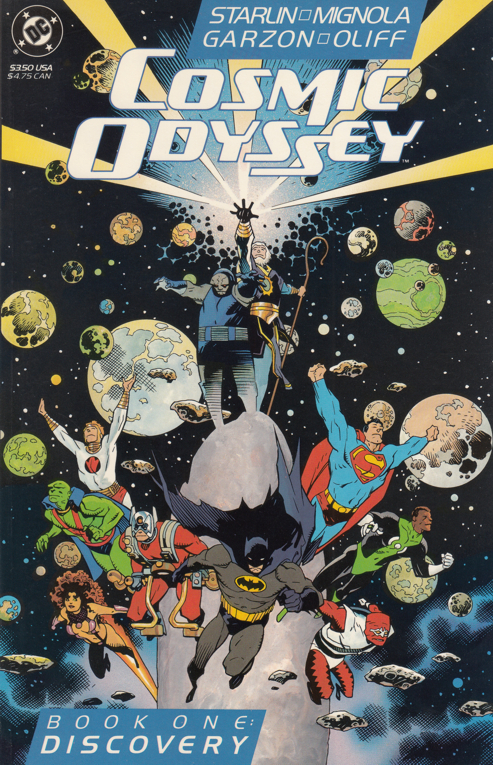
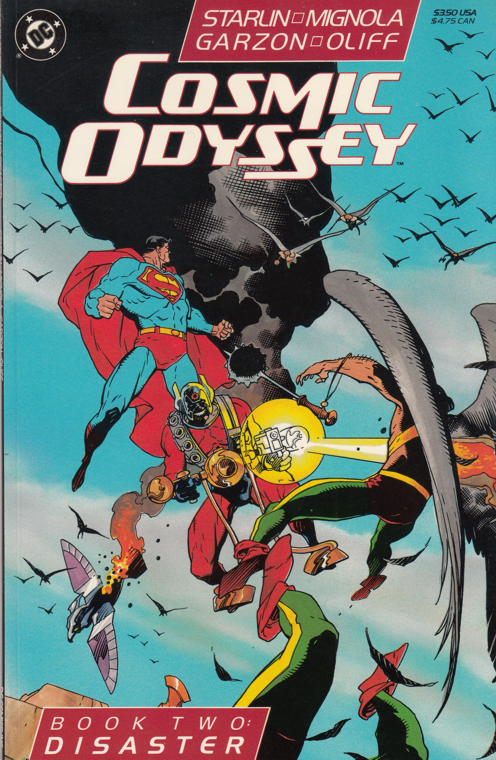
Cosmic Odyssey
Book Two: Disaster (January 1989)


How did it take me this long to realize why I've always hated Hawkman? Because he's a fucking cop!

You might read the title of this issue, "Disaster", and think it has something to do with the cover depicting Orion going full ACAB on Thanagar while Superman "stands" around thinking, "Should we be killing this many hawk cops?" (The answer, by the way, is yes.) But the real disaster of the issue is hinted on the back cover where Martian Manhunter pulls out his shame penis and scold pisses all over John Stewart's arrogant face.


I'm glad I never glanced at this back cover while on LSD because holy fuck this is the most intense thing I've ever seen.

So if the disaster is John Stewart getting an entire planet of cannibal aliens blown to shit then we have to surmise that killing hawk cops is good. Don't we? Is that not how logic works? It's hard for me to think logically anymore because I once watched Pig and I cried so hard that I wept some of my brains out of my eyes and nose.

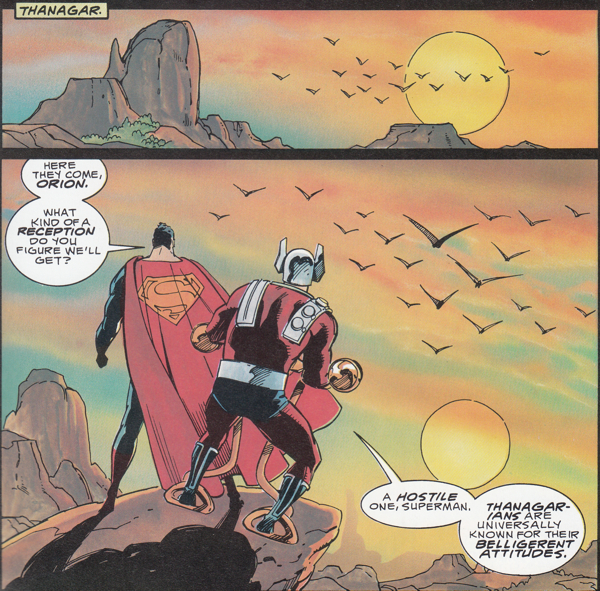
The issue begins with Orion and Superman watching a full fleet of hawk cops flying toward them out of the sunset (or sunrise. It's not like Mike Mignola drew a compass on the page. And even if he did, they're on Thanagar and I don't know if it's rotation got knocked wonky by some random asteroid or planetoid early in its development). It feels like a moment in a Spaghetti Western where the protagonist, whom we, the viewer, understand did nothing wrong in his slaughter of eighteen ranchers who were just the worst people and probably raped and killed the protagonist's horse, stands majestically as a posse of corrupt lawmen ride towards him, the music growing louder and more tense as the stage is set for the final shootout where the protagonist, after putting up the best fight he can, eventually succumbs to a hail of gunfire and the credits roll and the audience is left to stew in a dank miasma of existential despair at the idea that the universe does not prefer actual justice and we can only fight the good fight and be true to ourselves and can never overcome the tipped scales full of corrupt assholes who don't actually give a shit about anything at all. Except this time Superman is one of the silent gunman and we know he can't lose so I'm guessing a lot of hawk cops are going to lose a lot of teeth pretty soon.


Woo eee woo eee wooooo. Bom bom bom.

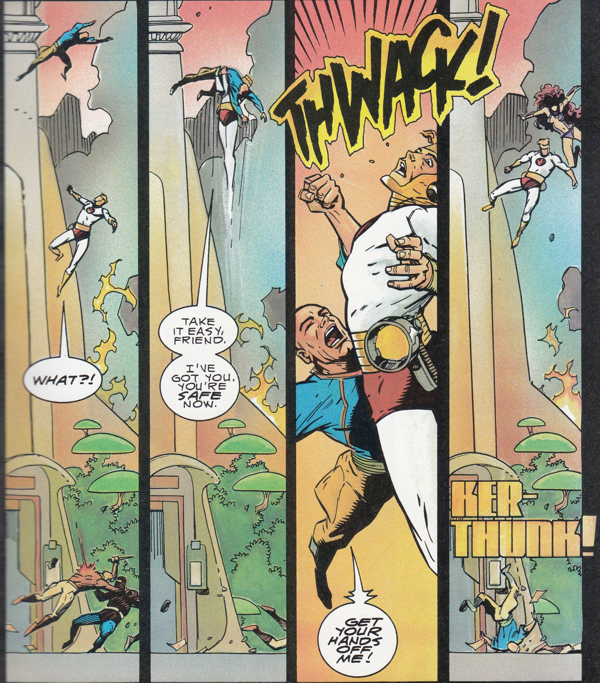
Orion believes the Anti-Life Entity has taken mental control of the hawk cops even though he admits they're known to be aggressive and "belligerent". The hawk cops attack without any warning so it's hard to know if that's because they've been mind-controlled or because they're just acting like normal cops. It's that The Office meme about both pictures being the same! Superman subdues them, probably by giving them minor traumatic brain injuries that cause them to lose consciousness but doesn't kill them. At least not immediately. Should Superman have to come to terms with how many cases of post-concussion syndrome he's caused and how many villains and henchmen's lives he's ruined in the long term? Probably not because this was written in 1989! Helmet-to-helmet tackles were cheered wildly in those days! Hooray for violent entertainments!

Whatever damage Superman is causing hardly matters though when we see how Orion just doesn't give a fuck about ruining the lives of the hawk cops immediately. Fuck in the long term. Where's the fun of violence that you can't see the horrible results of immediately?!


Hooray for state-sponsored violence getting some of its own in return!

Superman, while not showing the levels of pissitude, gets pissed at Orion and reminds him that these hawk cops are most likely being mind controlled and aren't their real enemies. He asks Orion to moderate his use of force against them. Superman doesn't realize Orion is the son of Darkseid so he can't comprehend how stupid an ask that is. It's like asking Batman to be a team player. It just can't happen (unless, of course, Batman is in complete control of every aspect of the team. Like when he put together The Outsiders. But even that fell apart when he realized how much trouble it was to get them all to do exactly what he asked. Also it was often hurtful when Metamorpho made dumb jokes about him. Good thing the mask could hide his tears).


This is Orion's response to Superman's suggestion to moderate the violence. An uncomprehending, silent stare.

At the same time, J'onn J'onzz and John Stewart explore Xanshi. They discover the population beset by an airborne disease that attacks the blood and the respiratory system. AT THE SAME TIME! Since John categorized these aliens as cannibals earlier, this must be some kind of Mad Cow Disease. Except airborne because maybe it comes out in cow farts. It looks like the Anti-Life Entity has a sense of humor, using the native populations' inherent attributes against them. Or I could be reaching. But you never discover anything if you don't reach and simply take everything, plots to comics included, at face value! Do you think we would have ever discovered time travel if we, as a species, hadn't kept reaching and listened to the boring bores who said it wasn't possible? I mean, that'll probably happen, I bet. Yeah.

J'onn's initial reaction to the disease ravaging everybody on the planet is, "Well, it sucks to be them! Let's find the Anti-Life Creature!" But John takes a moment to help create a cure for the disease by using his magic ring that can do anything with the correct prompt. Or at least that's what The Guardians have told him. John doesn't put the cure through any kind of trials. He just tells some guy to drink it up and then use his blood for transfusions on everybody else on the planet. Or maybe one other person and then they can both do transfusions on two other people and then those four can do transfusions on four other people and well you get it, right? Doubling rice on each square on the chessboard and all that.

J'onn marvels at the power of the Green Lantern ring and John is all, "Yeah, no big deal, I fuckin' save lives all by myself all the time. I'm sure I'll save more lives all by myself a few more times before this is all over." Just like the aggressive cops on Thanagar, I'm not sure the disease was the fault of the Anti-Life Entity at all! That's because John Stewart discovers that the Anti-Life Entity has tapped into the power of the planet through their power grid. I think the disease really was just a coincidence and the cow farts got there first.


Wow! Seems like John definitely has everything under control. I'm not even certain why J'onzz was sent with him! Embarrassing, really.

On Earth, Batman and Forager stand around discussing Orion's bigotry and The Forager's costume's lame color combination. The Forager wonders why they don't get to work looking for the Anti-Life Entity and Batman is all, "We are working on it! I turned on my Batcomputer. It'll figure it out!" Boy, these heroes really do depend on their gadgets and gizmos. It doesn't take long for Batman to figure out how the Anti-Life Entity will attack Earth based on the data the other teams have reported back.


I disagree, Batman. 1989? My guess is it's taking over Daytime Talk Shows or MTv.

Lightray and Starfire discover that the residents of Rann have developed Non-Space Space Madness. Everybody is involved in killing everybody else or themselves. I don't know enough about Rann to understand why they'd be open to this kind of attack by the Anti-Life Entity. Are they overly arrogant and trying to prove their individual greatness to each other? Are they so science-minded that the only way to prove who is best is by running a bunch of murder experiments? Will Adam Strange be affected since he's an Earthling and not a Rannling. Rannian? Rannlander?


Was this supposed to be shocking because I was merely tickled by it? Yes, I tittered. I think I really enjoyed the tiny little Moritat-esque figures.

The duo find Adam Strange having tied up Alanna and her father to keep them from killing everything. His alien nature has made him immune to the Non-Space Space Madness. After Lightray and Starfire explain what's happening, Adam Strange believes he knows the way the Anti-Life Entity will attack Rann: through its automated factories! That means the four technologies dooming the planets and the galaxy itself are Military Weaponry, Weather Control Systems, Computers, and Automated Manufacturing. Has this become a Cautionary Tale? Being that Jim Starlin wrote this, I'm surprised each planet isn't just being threatened by a Warworld.


This is a dire situation, Starfire. Can you please stop stretching seductively at every Earthling in a finned helmet?

On New Genesis, we discover why Jason Blood was dragged along: Etrigan's power will be needed to strengthen the boundary between the Anti-Life Universe and the Pro-Life (Sorry!) Universe. While Darkseid didn't initially know about Bob, the Anti-Life Entity because that information was revealed by Martian Manhunter's telepathic scan, he still somehow knew that he was going to need the power of Hell to keep the universe from being destroyed. Sounds fishy to me! I think Darkseid just wants the power of Hell for his own devious reasons! But he shows Highfather some calculations and Highfather looks at those calculations and is too embarrassed to admit he sucks at maths and Jason Blood agrees to merge once again with Etrigan since it's the only way to ensure the universe will be saved. See, Bob the Anti-Life Entity is clawing his way into the DC Universe without the help of his four fingertips and only Etrigan's power can stop it. I guess if the Anti-Life Fingertips succeed, it'll just destroy the universe faster. Or, as I said, Darkseid's a lying liar and manipulating Jason Blood so that Darkseid can have a personal pet demon.

Quick check-in on Thanagar:


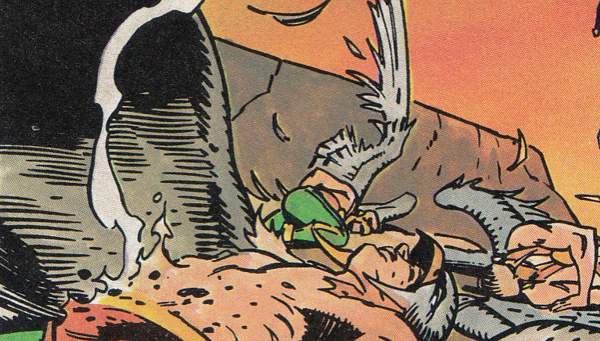
I guess Superman knows how to disable the wings of the hawk cops so that they crash to the ground in slow, looping, safe spirals.

Superman knows a job needs to be done and he does it even though he knows he's going to have to give Orion a super scolding at the end of it and explain how disappointed he is that Orion killed so many innocent people. I'm sure Orion will consider Superman's words in a rational and logical manner.

On Xanshi, we learn the Anti-Life Entity seems to have figured out that the real threat to its plans aren't the heroes themselves but the Ghostbusters-style Anti-Life Trap given to them by Highfather. Of course we garner this information from speculation by J'onn rather than actual facts. But then again, I've learned that you should just trust the speculation and gut instincts of heroes in comic books because without their spot-on observations, writers would have to add a lot of boring pages to their comic books to show what took just one or two speech bubbles to tell. So when the Anti-Life Entity Controlled Weather Station's lightning bolt smashes into J'onn, it barely fazes him but does destroy the Ghostbuster trap. Oh no! Now how will they defeat the Anti-Life's Fingertip?!


At this time, John Stewart was really well read, practically a philosopher. But I guess part of knowing that "Pride cometh before a fall" is that the pride doesn't let you remember that saying.

Martian Manhunter and a Green Lantern, on paper, looks like one of the most powerful team-ups somebody could put together in the DC Universe. But I'm pretty sure all it would take to defeat these two is a flamethrower and a can of gold spray paint. Or would that be my pride speaking before my downfall? The ring would be all, "You don't think I can tell the difference between yellow and gold, you stupid motherfucker?!", before it put a green ice pick through the thin layer of gold paint on my head and the barely thicker layer of skull right into my brain.

Batman and Forager continue to save the Earth by not leaving the Batcave. Sure, Batman's doing the research. But the real reason they're spending such a long time in the dank cave is that Batman refuses to be seen in public with Forager until Alfred sews him a new outfit. It's weird that Batman's main complaint with Forager's outfit is that it's red and white and too noticeable in the dark. But he's telling him this Jason Todd's bright red and green costume in a memorial case just over his shoulder.

I would have scanned that but that panel doesn't actually exist. That was just me making connections and speculating as to how to make Batman look like an unthinking moronic jerk with control issues.

Batman discovers the Anti-Life Entity seems to be working out of Moose Jaw, Saskatchewan. Um, no, wait. Moosejaw, Arizona! Because you know how Arizona is known for its meese! Anyway, that's where they're headed! Doesn't Batman feel stupid now because Forager's red and white outfit would look great in Arizona! Maybe throw on some turquoise highlights! He could become their State Hero!

Oh, Batman also learns that a bunch of parts for a Doomsday Bomb were to be delivered to Joe Bester, the dead cop whose body disappeared! Lucky for Batman, if he has to kill to stop this bomb, killing a man who is already dead doesn't count as killing!

Back on Rann, Adam Strange leads Starfire and Lightray on a really fucking suspicious trail.


This is all too easy and weird.

Adam Strange leads them into some simplistic pulp sci-fi narrative with all the clichés. "Too normal." The parts were "shipped" to the basement of the same facility they were manufactured in. Like, um, what? And they're in "Vault #666"! This whole story couldn't be fishier if Aquaman were on the case.

The trio find a Doomsday Bomb in Vault #666 that could blow Rann out of orbit and into the sun leading to the destabilization of the Milky Way! It's not currently armed so Lightray is all, "Let's not dismantle it!" Everybody agrees and they go in search of the Anti-Life Entity. But it finds them first, beats the shit out of Adam Strange, and then disappears into a wall grate. Or maybe it was possessing Adam Strange and forced him to make up all that bullshit earlier and then left his body to find a new victim while Lightray and Starfire scratch their heads confused.

Back on Xanshi, the heart of this issue takes place. Seventeen pages with no interruption to tell the tale of the downfall of John Stewart. I don't know if, before this, John Stewart was portrayed as arrogant and proud. If so then these seventeen pages are heartrending and tragic. But if Starlin just thought to himself, "This highly educated dude just rubs me the wrong way. Thinks he's so smart. I'll show him," then the story is, well, I guess it's still heartrending and tragic because I shouldn't be trying to read the story through the glass of authorial intent, especially when I'm just making up the authorial intent for no good reason. The bad reason that I'm making up things Jim Starlin might have thought is that I'm mad that he didn't throw in a Warworld or two in this series. What good is a Jim Starlin book without Warworld? I was also going to say without a Thanos or Mongul insert but I guess Darkseid's doing that heavy lifting.

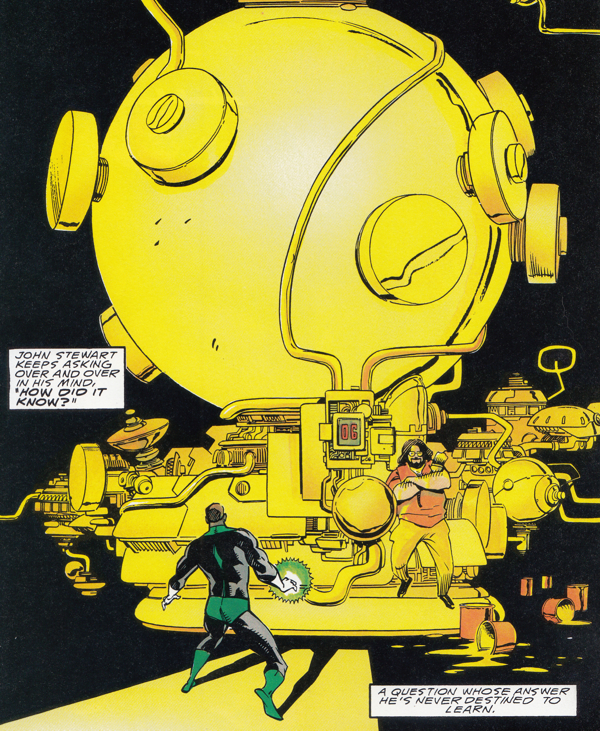
What happens is John Stewart, having shown his ring is pretty fucking great over and over again during his journey with J'onn, decides that having to protect J'onn from all the fire hazards is a pain in the ass. So he ditches J'onn in a green bubble with a "So sorry, you suck" and flies off to save the day. He crashes into the weather station ready to defuse the bomb and destroy the Anti-Life Fingertip only to find the Anti-Life Fingertip has been busy painting everything yellow.


Who the fuck is this guy?! He's not even Xanshian!

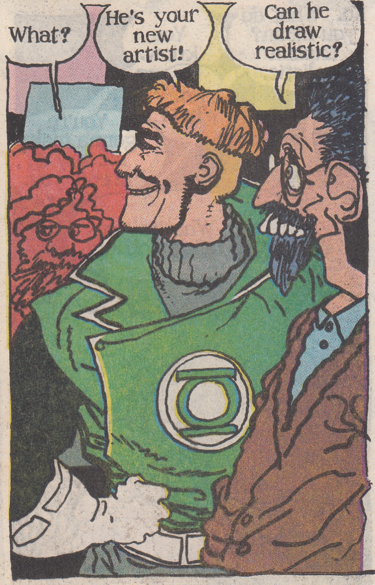
I totally recognize that guy because he's obviously an insert of some employee at DC so I had to look it up. At first I tried a reverse image search on Mignola's rendering but that turned up nothing. Then I found a Reddit Thread that linked to Comic Book Legends Revealed #279 which casually mentions it was Andy Helfer while discussing whether Stewart was initially meant to be Gardner or not (they conclude: not). It took me a bit to remember why Andy Helfer's image was familiar and where I saw him before and what issue it was because my brain doesn't like to put down its beer and get up from the recliner to go do research in my memory files. But I did remember it was a back-up story in a Justice League comic book where Guy Gardner tries to get a comic book made, maybe of General Glory? I knew it was the back-up story in an issue by somebody whom I always associated more with independent comics than mainstream (for some reason. Possibly because I first knew about him from Alternative Press Expos?): Kyle Baker. So that's that: the person with the paint is Andy Helfer. You can see him in this story drawn by Baker in Justice League #50!


That other guy is so obviously Keith Giffen!

Why was Andy Helfer the guy to screw John Stewart? Did he give the command from up above to fuck Stewart's shit up in this story? Did Mike Mignola do it on a whim? Was Andy Helfer known for painting things yellow around the office? Maybe I shouldn't be so concerned about the guy with the paint brush! Thanks to Batman's revelation about Joe Bester (and possibly the Adam Strange weirdness), we know that the Anti-Life Entity can possess people. It's not really important what skin it's wearing although it is kind of distracting to see that the Anti-Life Entity chose a human looking person to hand paint this massive bomb. And then it didn't even cover up the entire bomb! Couldn't John have used his ring to get at the machinery of the bomb through the screen with the red numbers? Maybe that wasn't actually part of the bomb and just a clock set up to keep track of when the thing was going to blow.

The bomb explodes, incinerating everybody on the planet and turning the core of the planet into anti-matter. This causes a massive explosion which sends the planet, now fully anti-matter, into the heart of its non-anti-matter star. The Milky Way rocks on its, um, whatever keeps it in place, now just one more explosion away from being permeable to Bob the Anti-Life Entity.

Martian Manhunter, having survived with the help of John's ring, finds John so he can shit all over him while he's feeling down. He calls him arrogant. He calls him stupid. He says he can never forgive him. And then he just tells John to shut up before flying off. And just like that, Jim Starlin and Mike Mignola redefined John Stewart for a modern audience. It might be shitty that this defined John for so long but I'd still say it's better than The New 52 redefining John as a Marine more than a philosophical architect.

Back on New Genesis, after receiving word that John Stewart has failed, Darkseid and Highfather rush to get Plan B into action by making Jason Blood and Etrigan hug it out. They merge once again and, although Jason Blood doesn't think so, everything is right again with the universe. If not for this, we would never have had Alan Grant and Val Semeiks' The Demon run!


My boy is back!

Cosmic Odyssey: Book Two: Disaster Rating: A. Maybe this time I'll remember that this was the comic book where John Stewart fucked up and began hating himself, especially since I'll definitely be reading Mosaic at some point in the near future. This comic book continues to be a lot of fun. Not only did it give us this seminal moment in John Stewart's history but it also reunited Jason Blood with Etrigan. I have no idea why they had been split or where that happened but since I didn't remember that I had this book where Stewart fucks up, I'll probably learn sometime in the future that I also own the book where Blood and Etrigan are separated. Or I can look it up online right now and discover it was in a four issue mini-series written by Grendel and Mage writer and artist Matt Wagner. So, um, yeah! I do have that series somewhere!

Monday, June 23, 2025

Let's Read Infinite Jest
3. Year of Glad (Part Two of Five)

Characters
Avril Incandenza, Mother of Hal Incandenza. Widow to James Orin Incandenza. Administrator at Enfield Tennis Academy. Strict grammarian.
Orin Incandenza. Brother of Hal Incandenza. Son of James and Avril.
Hal Incandena. Out little mold eating Hamlet.

Characters Mentioned
Winnie the Pooh. Hal's pajamas.

Scene: Weston, a suburb of Boston, Massachusetts. The backyard garden of the Incandenza family home in Spring of the year 1997?/1998? before Subsidized Time.

This section is a flashback to a seminal moment in Hal's life. Possibly! It's not exactly Hal's memory but Hal's retelling of his brother Orin's memory. Told as it is after Hal blames his strange condition in the Year of Glad on something he ate, it's easy to assume that his problems stem from this moment in his childhood when he took a bite of a disgusting mass of mold and fungus from their moist and mildewy basement. The question becomes, "Did eating basement fungus actually do anything to Hal at all? Or is it just an easy unknown to blame all of one's problems on? Or is his mother's reaction the point of the story?"

Avril panics when she comprehends what her son was done and begins screaming, "Help! My son ate this!", while running laps around the small garden. Hal does not remember this so it's hard to think that his mother's reaction could have left an impression on him while, possibly, eating something toxic could have had a lasting effect. More probably, this memory, and Avril's "hysterical" reaction (Hal's wording via Orin's relating of the memory) would have had a significant impact on Orin, as he's the one who experienced and retained the memory.

Later in the novel, we get a slightly more descriptive and thorough retelling of this memory from Orin's point of view. I believe it mostly differs in going slightly past Avril and Hal running around in a blind panic to suggest that a neighbor, or possibly Orin's father, arrived to help.

Later in the novel, much of the action centers around the culture of Alcoholics Anonymous. One of the things members of AA begin to catapult from their lives like garbage into the concavity are the excuses for why they do and think the things they do. There can be stories and facts and memories that may, at times, sound like excuses but as one spends more time in AA, you begin to Identify who's using their stories as excuses and who's just painting the picture of what the fuck they did. Does Hal hold the story of eating fungus-covered mold as an excuse for what's happened to him by the beginning of the novel? It's hard not to think this being that he basically blames his current condition on "something I ate" and then flashes back to this, his brother's, memory. Or does the remembrance just happen to come to the forefront of his mind when he thinks of having et something, possibly the military-grade hallucinogen?

It's also still possible that he watched Infinite Jest! But, as you may quickly be sussing out, all I currently have are questions because this is just my second time reading this thing! I feel like, after this, I'll have a much better handle on it and then I could do a third read-through where I could be all, "Oh, and Hal's all fucked up here because he watched that movie with the naked, disfigured woman apologizing to her baby for thirty full minutes for, presumably, having brought it into this shit world? And is that why people find pleasure in it and want to view it over and over again? Because, ultimately, the reason we're all living out this fucking painful bullshit reality is because two narcissistic horndogs decided to fuck and now we're being punished? So viewing a movie using a special visual technology that basically puts the viewer back into the body of an infant while our mother apologizes over and over again for bringing us into this world (and ultimately killing us because all life dies and that's part of the movie too, sort of (and not just any mother! The Prettiest Girl of All Time! Even if her face is a ravaged mess from having a jar of acid smashed across it!))? I mean, I was near weeping when I explained the premise of the Infinite Jest entertainment to the Non-Certified Wife!"

Anyway, Hal eats some nasty shit at five years old and it might have caused him long-term harm that doesn't manifest until he's seventeen is what this section details.


Piecing Together the November, DAU, to November, Glad, Timeline

The February after the end of the novel, Coach White, via correspondence, recruited Hal to the University of Phoenix tennis program after Hal's graduation from Enfield later that same year (a December graduation, it seems).

Sunday, June 22, 2025

Cosmic Odyssey
Book One: Discovery (December 1988)


Maybe things were way more different than I remember in 1988 because how the fuck does Forager make this cover?

I don't remember all the young dudes hanging out with their souped-up hot rods down at the malt shop while listening to the Big Bopper handing around this comic book saying things like, "Can you believe Forager made the cover of a big time $3.95 fancy lad comic book?! I'm so cranked! Ay, give it back before you get your hair grease all over it, twerp!" And then one of the dudes noticed John Stewart on the cover and, yeesh, I can't repeat what that guy would have said. This isn't Twitter!

Wait a second. Am I older than I thought I was?

You know what else I don't remember? Anything at all about this comic book. It came out in December of 1988 so I was 17 and my mind was definitely on other things. Like Warhammer and Blood Bowl and Axis and Allies. Sometimes I think I was never really a big fan of comic books because I barely remember a lot of them. But then I have also never been much for revisiting things I've already read or seen. Maybe some people think those two statement didn't need the "but" between them since most people who are huge fans of something repeatedly enjoy that thing over and over again. The only comic book series I remember re-reading while they were still being published were Giffen and DeMatteis's Justice League America, John Ostrander's Suicide Squad, and Wendy and Richard Pini's Elfquest (that one, over and over and over again. I was a sappy teenager! (Never mind if I'm a sappy adult!)). I guess, being young and having a healthy memory, I simply assumed that one reading or viewing of any piece of art or media would last me until the day I died. Doing this project where I'm re-reading a lot of my old comic books has proven me quite wrong. My memories of non-tragic or non-sexual events seem to have a shelf life of about 20 years, give or take how much of an impact the piece had on me. Take some of the literature I read in college about 30 years ago. I can't even be sure of every title I read back then, let alone give a synopsis of the novel. Vanity Fair? Wieland? Bleak House? I mean, sure, I remember the spontaneous combustion in Bleak House and Jarndyce v Jarndyce. And didn't Wieland hinge on the fascination with ventriloquism? And Vanity Fair was about, like, a fair of, um, vain, uh, French people?

If my brain's this fully of mushy memories, does it even mean any of it was worth living? Oh wait! All the cats I've lived with! Yeah, they've totally made it worthwhile. Good on them!

This issue begins six months in the story's past where Darkseid has sent a legion of his Dog Soldiers to invade Earth via BOOM Tube. They're met and easily repelled by Superman and Lightray.


Superman looks just like my high school best friend here. Jealous, ladies and gays?

During the Dog Soldier's retreat, one of their radio operators was left behind. I feel really sad for him because he has the word "dog" in his name and he looks so scared and lost now.


If this were a Garth Ennis story, this guy would be lead singer of a famous rock band when the story resumes six months later.

Luckily this poor little dog soldier has been left in Gotham City. If people like Two-Face and The Penguin can make names for themselves running casinos and practicing law despite their deformations, this little guy should find himself living the good life in no time.

Later, if time has any corresponding meaning as the scene shifts to a small planetoid at the edge of Alpha Centauri, Metron exits a BOOM Tube and crashes his chair on the planetoid's surface. He looks like he's been through some serious shit and his chair is fucked. Speaking of Metron's chair, what the fuck was going on with comic book artists and writers when they were coming up with strange alien conveyances through space? A chair? Skis? A surfboard? A motorcycle? I mean, at least Lobo's space hawg is phat cool, ya dig, Daddio? But a fucking chair? Apparently one of Jack Kirby's big dreams was to just sit back in a comfortable recliner and know shit.

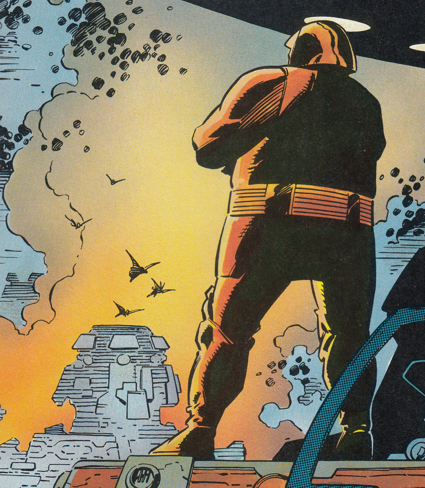
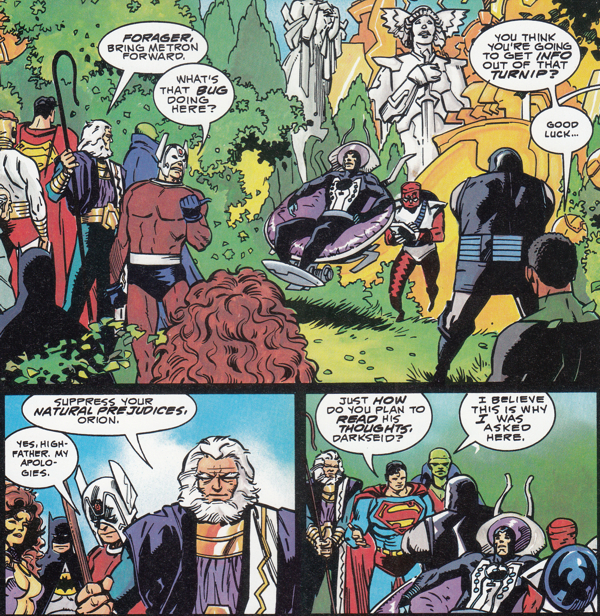
Another BOOM Tube opens up and out steps Darkseid and his Chief Science Officers who are all identified by various Roman numerals on their chests and helmets. Was Zeus/Jupiter based on Darkseid during his teenage years where he'd BOOM Tube down to Earth to fuck Greek and Roman chicks? Did he give them the idea for Roman numerals or did he cadge them for himself? Darkseid has been keeping an eye on Metron in the hopes that Metron might find the Anti-Life Equation for Darkseid. Or he's been keeping an eye on Metron because he really fucking wants that big comfy space chair for himself. Based on Darkseid's sudden appearance in people's houses where he's just parked in their recliners as they come through the door, we know Darkseid does love to have a good sit.


Darkseid Is . . . tired of standing.

Darkseid analyzes Metron's chair's data to discover that Metron encountered an existential threat to the universe that he and his Dog Soldiers and his Mantis People and his Granny Armies and his Female Furies won't be enough to stop by themselves. He's going to have to seek help from people he despises: New Gods and Earth heroes and, um, Forager.

Back in Gotham, Commissioner Gordon informs Batman that a cop has recently disappeared on patrol. Only after the cop disappears does Gordon inform Batman that like ten other people have disappeared in the same area. I guess those people were houseless and minorities? Batman decides he needs to go undercover to lure out the kidnapper. So is it Matches Malone time?! Um, no.


I think this counts as a hat on a hat.

Batman, unrecognizable in a fedora and trench coat (I'm assuming this was a hilarious joke that the creative team came up with, having a guy who wears a disguise to hide his secret identity wear a disguise over that disguise to hide his secret identity. I mean, it is funny!), discovers, through the use of his ears, that the person and/or Dog Soldier of Apokolips kidnapping Gothamites has been squatting in the sewers. His ears hear a manhole clink and Batman exclaims, "Of course! Why didn't I think of that?! Half of my rogue's gallery hide out in the sewers!" The fedora and trench coat having served their purpose of, um, keeping people from knowing it was Batman walking around, are ditched in the street so that Batman can continue his investigation without hiding his identity. Batman probably wouldn't have heard the manhole cover fall into place if he hadn't been in disguise because the Dog Soldier would have known better than to peak out of the manhole to see who was walking on the streets above him if he could see it was Batman.

Batman follows the creatures trail realizing he's after a massive humanoid. I appreciate that Jim Starlin made Batman vulnerable in this scene. Far too often, writers simply decide Batman is a stoic tough guy who shows no fear and is incapable of any negative human emotion. But Starlin's Batman could give Kevin Smith's pissing-his-pants Batman a run for his money. He begins to feel a bit nervous when he realizes he's after a gigantic alien creature. And then he stumbles upon the Dog Soldier's victims, slaughtered and hung from hooks, bones and decaying meat strewn about the room. Batman almost throws up as he flees from the scene. He even contemplates going to get back-up rather than confronting the monster himself.


Jim Starlin's Batman is into upskirts.

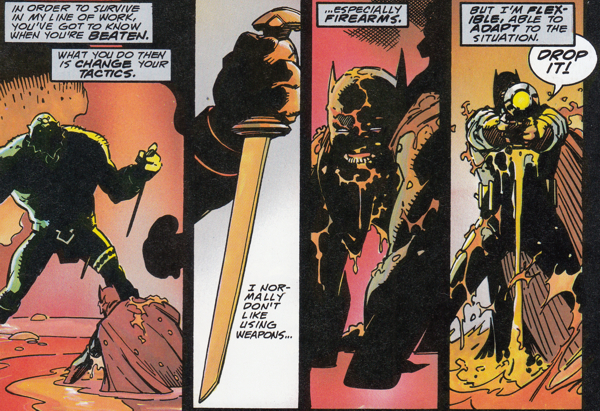
Before Batman realizes he's doing it, he attacks the Dog Soldier in retaliation for its victims. Batman gets his ass beat pretty handily and realizes he can't beat the creature in a fist fight. So after Batman's head gets dunked upside down in the sewer forcing him to smell shit for the next three weeks, he chooses to do something he rarely ever does and probably wouldn't do if he didn't think there were any witnesses deep down in the Gotham sewers.


The "firearm" is the Dog Soldier's weapon that Batman kicked out of his hands earlier and not some secret gun Batman keeps on him for emergencies like this where he knows there are no witnesses. Don't be absurd!

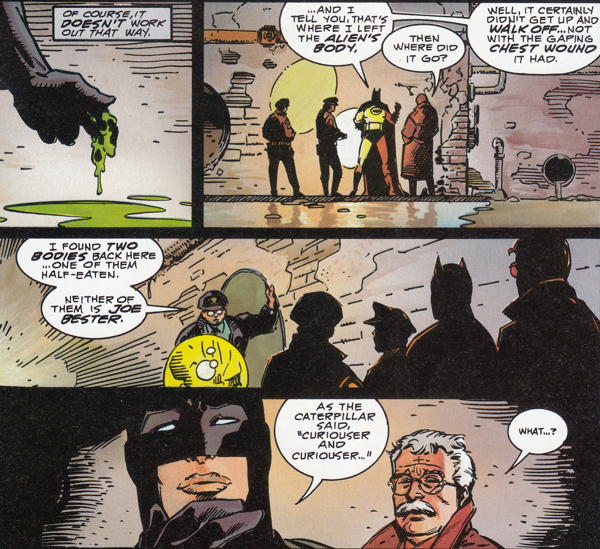
Batman shoots the Dog Soldier in the chest as it attacks him, felling it with a massive hole in its body. It falls against the wall, mutters, "Darkseid," and dies. I'm not sure if Batman doesn't worry too much about killing it because it was an alien or because Batman's life actually hinged on killing it or because it muttered "Darkseid" after he'd already chosen to kill it. But he doesn't worry about his choice at all. He heads up to find Commissioner Gordon to report what he found and lead the police down to the body and the scene of the murders.


The caterpillar never said that, asshole!

How smart can Batman be if he doesn't even know every single fucking detail of Alice's Adventures in Wonderland? Alice says that and she only ever says it once even! Some fucking detective. Plus he's all, "No big deal. I killed that thing. It shouldn't have walked away, dude." I guess Batman's "No Kill" stance only applies to humans? Maybe even just Americans?!

The "curiouser" part of the mystery is that Batman saw Joe Bester's body hanging from a hook earlier and now it seems to be gone. Also maybe Batman's talking about how badly his fills turned out. He should sue whoever gave him those lip injections.

The story nearly catches up to the current date as the following scene begins with "Yesterday". Yesterday, New Genesis residents, Lonar and his horse Thunderer, have arrived on Earth and found their way into the Oval Office presenting themselves as ambassadors from New Genesis. Well, Lonar has, anyway. I just got stuck with third person plural pronouns by adding Thunderer into the whole scene even though he's only mentioned as "a flying horse" by the president. Lonar has demanded to meet with the Earth ambassadors to New Genesis. He understands that Earth probably doesn't have one which is why he brought a list of people he is sort of demanding take the job. The president is all, "How do I get in touch with these people?!" And his staff are all, "Well, we can call Superman. We'll just tell him to bring the others." And so pretty soon, the Oval Office is full of New Gods, super heroes, and horse farts.


If I hadn't already known Etrigan was going to be in this story, I'd be off changing my underwear right now.

I bet I would have gotten laid more often if I didn't insist on yelling, "Gone, gone, form of man! Arise, my penis, Etrigan!", every time I took my pants off around a lady.

The heroes and Lonar BOOM Tube out of the Oval Office, leaving the president to realize just how unimportant he really is. Later he would learn that he would only serve one term and discover how really, really unimportant he was.

Waiting on the other side of the BOOM Tube on New Genesis are Highfather, Orion, and Lightray. Waiting a little bit further back in the shadows is Darkseid. When he steps out to declare that it was his idea to get all these people together, Superman instantly attacks him. And this was immediately following Superman scoffing about Batman being an ambassador! At least Batman didn't put a hole in Darkseid's chest immediately even though we know he could have and wouldn't really hesitate to and maybe would kill everybody else on New Genesis as well being that they're not human and don't fall under the umbrella of his No Kill Policy.


That cheeky grin is killing me.

How come Darkseid looks so short? I always picture him as towering over everybody. But I guess his body is choad-shaped.

In order to explain why Darkseid and Highfather called these heroes for help, Highfather first explains the origins of New Genesis and Apokolips. It seems many billions of years ago, a race existed that thought themselves better and smarter than every other race in the universe. They believed that their shit never stank while everybody's else's shit stank like a phobey cat protecting its phobey young. One group of aliens would not bow down before these smarmy jerks and so war began. The arrogant race of beings eventually came up with a weapon of such destruction that they could easily put an end to the war: the Anti-Life Equation.


Was this race called "Americans"?

Once released, the Anti-Life Equation destroyed the planet it was fired from. It raced across space in all directions, destroying every thing with which it came into contact. But it's reach wasn't infinite. At some point, it turned back in on itself and imploded, leaving a section of the universe cut off from the rest of it. The only thing remaining in this pocket universe were a single sun and two planets, New Genesis and Apokolips. One planet's residences decided not to be assholes and the other planet's residences decided to be the biggest bunch of assholes ever. The end.

That story needed to be told so that Earth's heroes would understand how dangerous the Anti-Life Equation was, if they couldn't figure it out by its name. It appears that Metron had finally discovered it and while tinkering with it, set it in motion! But studying Metron's data from his chair wasn't enough to tell Darkseid how to stop this looming crisis of anti-lifing everything in the universe. He needed help! He needed to delve into Metron's mind! So Batman steps forward and is all, "That's why I'm here, I take it. My uncanny intuition and nearly paranormal detective abilities should enable me to figure out what Metron did and how to stop it." But then Martian Manhunter stepped forward and was all, "Get the fuck out of my way, you idiot."


I chose to edit out the Batman stuff but I assure you it was in there!

I'm surprised Batman didn't rush forward, shove Metron out of the chair, hop in, and ask, "Who is the Joker?!" Then he'd be all, "No way!" And I would be all, "There's no way Batman got the answer. It's just not possible. The Joker's actual identity can never be known for it would ruin his entire metaphoric existence." But then some kid on tumblr would be all, "How dare you say that! Of course Batman got the answer, you stupid old prick! Your a moron!" And then DC revealed that Batman did not learn the name of the Joker but learned that there were three Jokers. Which, actually, is kind of stupid in itself. How did that turn out, by the way? Was The One Who Laughs one of the three? And the usual one was one, obvs. But who was the third then? Was it, um, Batman himself?!

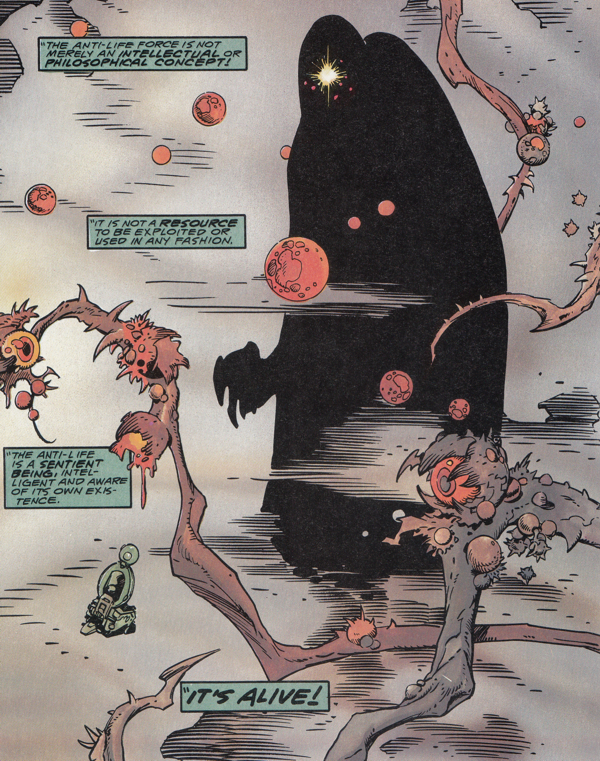
Martian Manhunter reads Metron's mind and projects the thoughts and images to all those around him. They learn of Metron's search for the equation. They learn he found it. They learn that before experimenting with it, Metron flew out to a remote, uninhabited patch of space. He then dug down into another dimension as a cushion for anything that might go wrong. Then, when he entered the equation into his chair, he programmed it so that the energy would not be produced but that he would be transported to the place where the energy came from. And once there, so many dimensions away from Metron's usual reality, he discovered the true secret of the Anti-Life Equation.


It was just, you know, some guy.

Is this story still canon? Was it ever canon or was this later remanded into Elseworld's custody? I really love the idea of the Anti-Life Equation being a dark God of immense power locked away in a secret pocket dimension that can only be found by some curious and evil genius. Sort of like the fifth Chaos God in Warhammer, Malice! Oh man, I shouldn't even mention him just in case Doom Bunny reads this since Malice is a huge part of the Dungeons & Dragons campaign I'm supposed to be working on!

As Metron flees, he tries to close down the portals as he goes to keep Bob the Anti-Life God from following him. He's mostly successful except for the four fingertips of Bob that get cut off as the portals close behind Metron. These four pieces of Anti-Life zip off to who the fuck knows where as Metron loses his fucking mind and crashes on a barren planet to be found later by Darkseid and his Roman Numeral Gang.

Metron's story was the last piece of the puzzle Darkseid needed to understand Bob the Anti-Life God's plan. Bob cannot survive in our Pro-Life (forgive me the phrase!) Universe. But his smaller aspects can survive for a limited amount of time. These aspects need to destabilize and destroy a galaxy to change the conditions enough for Bob to survive in this universe and have a base for conquering the entire thing. To do this, each aspect have flown to a one of four different planets in the Milky Way. These planets are gravitational linchpins holding the Milky Way together. And Darkseid has a bummer of a conclusion for everybody and Forager.


Jason Blood must have fallen asleep. His reaction was just, "Byu byu byu byu."

The four planets in danger are Earth, Rann, Thanagar, and Xanshi. I'm not sure what Xanshi is so my guess is that one winds up getting destroyed for tension's sake! Also, I guess this story is canon because isn't this where John Stewart gets an entire planet killed? If that's from this series then I actually do remember some of this series!

Darkseid puts his plan into motion. Orion and Superman will save Thanagar because Hawkpeople are aggressive and Orion is aggressive and Superman, when he sees Darkseid, is super aggressive. Lightray and Starfire will save Rann because, I don't know, light powers or something? Batman and Forager will save Earth because Darkseid actually hopes Earth gets destroyed. That's why he sends the two people he sees as the weakest links. And he sends Martian Manhunter and John Stewart to fail to save Xanshi which will cause John Stewart to spiral into a really fucking dark place for a really fucking long time.

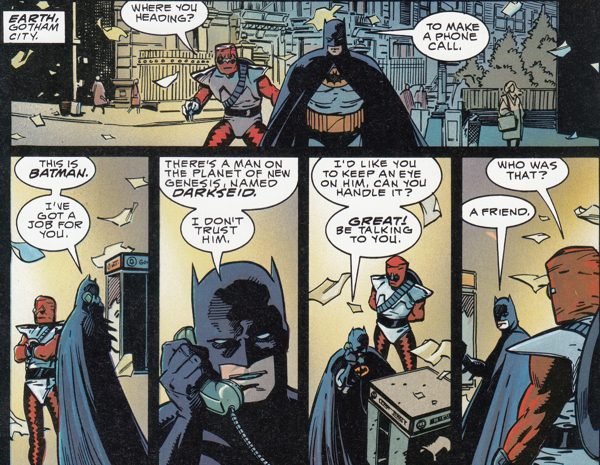
On Earth, Batman doesn't put Forager in a fedora and trench coat.


So unbelievable. No way even Batman could find a working pay phone in Gotham.

My first guess as to who Batman could be calling to spy on some guy on another world in a pocket dimension in deep space was Madame Xanadu. But Doctor Fate is on the cover of the fourth issue so it's probably him.

Meanwhile on New Genesis, Jason Blood is all, "Why the fuck am I here?" And Darkseid raises a curtain in the back of the room and is all, "Jason Blood! This is your life!"


Ha ha! Etrigan is old!

Cosmic Odyssey: Book One: Discovery Rating: A. I often enjoy songs and know things about the songs and can sing all the lyrics but then not remember who sang it or what album it's on or maybe even what the title of the song is. But I still know the song and it's in my head and I have access to it. I think my knowledge of comic books exists somewhere in that same kind of space. I actually remember a lot more of this book than I realized because I just didn't know that the things within this book that are still in my head were from this book. Which, ultimately, is pretty much okey-dokey with me. I'm not one of those people who needs to know all the details of some shit that I enjoyed. I just enjoy something, come to terms with it in my head, and put it up on a mind-shelf, hopefully within easy reach when I need it. Of course now, in the second half of my life, I've just decided to re-organize my mind shelves, see what was on them, have some good old memories over them, and then, I guess, fucking die? Maybe I'll try to throw in a few new experiences too, just so I don't completely feel like life is mostly over! Like take a strap-on right up the poop chute or take way more LSD than I ever have before! Maybe both at the same time! Man, I can't wait! My best years are still ahead of me!

Friday, June 20, 2025

Lets Read Infinite Jest!
2. Year of Glad (Part One of Five)

Characters
Hal Incandenza. Student and tennis player at Enfield Tennis Academy (ETA). Son of James and Avril Incandenza. Brothers: Orin (older), Mario (younger). Hamlet insert.
Charles Tavis. Hal's Uncle. Avril's step-brother. Mario's father. Headmaster at Enfield Tennis Academy.
Aubrey DeLint. Prorector at Enfield Tennis Academy.
Coach Kirk White. Tennis coach at University of Arizona trying to recruit Hal Incandenza to the school's team for Hal's college years.
UA Dean of Admissions.
UA Dean of Academic Affairs.
UA Dean of Athletic Affairs.
UA Director of Composition.

Characters Mentioned
Maurly Klamkin. Predecessor to Coach White.
James Orin Incandenza. Founder of the Enfield Tennis Academy. Hal's father.
Orin Incandenza. Hal's brother.
Gerherdt Schtitt. Tennis Coach at Enfield Tennis Academy.

Scene: the Dean's office at the University of Arizona. Also inside Hal's head. We are in there.

This first chapter is the only chapter clearly stated as taking place in the final year of Subsidized Time, the Year of Glad (Is it the final year because the world ends? Subsidized Time gets shitcanned? Or simply because it's the ultimate year mentioned in the book? Or did I read the part wrong where it's mentioned that it's the final year of Subsidized Time? Did I make it up? This is why I'm re-reading this book!). That means that the first chapter is the final chronological scene in the story. It's told in first person perspective from Hal's point of view which is odd being that the rest of the book remains third person perspective from various characters' points of view (except for the final chapter which reverts to Hal's first person narration. It's probably important that from a specific point in time, possibly when Hal stops doing drugs, we begin to see the world directly through Hal's eyes when the story's told from his perspective as opposed to a third person view from Hal's perspective). Hal has been playing at this year's Whataburger Classic, a major tournament of the youth tennis scene. We never actually see the previous year's tournament or its results even though it's a major plot point, a weekend when Hal and Michael Pemulis plan on taking a military grade hallucinogenic. We're never even quite sure if Michael Pemulis makes it to the tournament before being kicked out of Enfield for accidentally getting John "No Relation" Wayne high on speed. Neither do we find out if they take the drug.

We discover Hal has been doing quite well at this year's tournament even though there seems to be something incredibly wrong with Hal. He seems to have lost the ability to communicate at all and to control his facial expressions and bodily movements. His ability to still play tennis at a professional level must be a result of the training at Enfield where the boys spend so much time training that their abilities are no longer thought-based, just pure reflex. So something's critically wrong with Hal and only his tennis remains unaffected. What has happened to Hal is either hidden somewhere in the text or simply supposed to be gleaned from following the projection of the end of the story. Did Hal watch his father's deadly entertainment, Infinite Jest? Or did he lose his mind from the military grade hallucinogen, as suggested by his "Call it something I ate"? Which also suggests that it could have been a latent effect of having eaten the strange mossy, mildewed fungus when he was a child? We're never explicitly told what caused Hal's current affliction.

The second paragraph of the book is simply, "I am in here." The suggestion could be that all the victims of James Incandenza's entertainment still retain their rational minds locked deep inside themselves. The suggestion is that we all exist at a level within ourselves that can never be properly communicated to anybody else which causes communication with others to always break down at some level. Context cannot be gleaned by those listening. The context of one's entire history of existence cannot be communicated in any simple statement but which adds to the nuance of every one of anybody's statements.

I am in here. It could also be David Foster Wallace reminding the reader that he is in and cannot be separated from his writing. He is here. He is always here. He will always be here.

Charles Tavis is introduced as Hal's mother's half-brother. Most people believe the half-brother claim to be true but it seems apparent that when Avril's father remarried, the woman was already pregnant by a man with deformities or other traits that manifested in Avril's son (and all but plainly stated, Charles's son), Mario. Much like Gwendolyn, Hamlet's mother, immediately took up with Hamlet's father's brother in Hamlet, it seems Avril and Charles did some technical incest.

Charles Tavis awkwardly does all the talking in the interview. Hal sits silently but observing everything perceptively and intelligently. Hal's uncertainty about his body movements and facial expressions are evidence of some terrible problem extant within Hal. As David Bevington puts it in his discussion about Hamlet in The Complete Works Shakespeare (Fourth Edition), "A recurring motif in Hamlet is of a seemingly healthy exterior concealing an interior sickness." Eventually, Hal tries to smile and all of the Deans become intensely worried, seeing it as some kind of painful grimace.

During the interview, we get hints at Hal's Johnny-Truant-level knowledge of the Oxford English Dictionary. While Hal has specific reason for knowing loads and loads of big words, being able to memorize the dictionary and beginning at a young age to impress his mother, other characters, most notably Don Gately at the end of the book during his encounter with the ghost of Hal's father, manage to use words seemingly out of their vocabulary range. Could this be a clue that James Incandenza, even in death, continues to direct and write script for various people living out Found Dramas finally produced by James Incandenza within the scope of the novel? Evidence to this being a possibility resides in the encounter between James's ghost and Don near the end of the novel. So I'll be discussing that in, um, probably ten years or something.

After all the praise for Hal is exchanged between the parties, the Deans get down to the actual business of Hal's being called in: his academic record has tanked in the last year of his schooling. Whatever has happened to Hal has been affecting him for quite some time now. So much so that he couldn't write an essay for admission into the University of Arizona and a bunch of his old essays from his earlier years at Enfield Tennis Academy were used instead, at least one of which we'll get to read later! Ultimately, the deans want to hear from Hal himself. They send Tavis and DeLint from the office so they will stop interrupting and speaking for Hal.

During the debate about Hal's possibly problematic academic work, Hal thinks, "The familiar panic at feeling misperceived is rising, and my chest bumps and thuds." Miscommunication being a theme birthed in this insane first chapter where we discover Hal literally cannot communicate verbally, we find, via that line, that this is something that happens to Hal frequently. And while it's easy to believe it's just part of his recent loss of verbal ability, we must understand that this is a lifelong issue of not just Hal's but probably David Foster Wallace and all of us as well, just another turd heaped in the works of the human condition.

Alone in the office, the deans attempt to encourage Hal to speak up and defend his academic career and give them a good reason to accept him into the university. Hal thinks, "I'd tell you all you want and more, if the sounds I made could be what you hear." Prior to that, he thinks about bolting from the room but decides against it because he's not sure that what the deans would see was him bolting for the room. Hal has slipped into some kind of dissociative relationship with reality. He cannot know that the people around him will hear the words he believes he's speaking or see the actions he tries to take. He has lost all control of any task he tries to perform except for the reflexive, reactionary, and rote mechanics of a professional game of tennis. And that's the mystery. How, at the end of the story which is the beginning of the novel, did Hal wind up like this? What has taken place in the undescribed time from the end of the novel to this opening scene? Is it even in the book? Can I find it?

The scene ends with Hal beginning to try to communicate how he has come to this place. He explains, or thinks he does, "I cannot make myself understood, now." And then, in explanation of how this came to be, he says, "Call it something I ate." And that's the end of the scene as the next scene is a flashback to something he ate. It's fucking gross.

Piecing Together the November, DAU, to November, Glad, Timeline

This section mentions that in the February after the end of the novel, Coach White, via correspondence, recruited Hal to the University of Phoenix tennis program after Hal's graduation from Enfield later that same year (a December graduation, it seems).
Batman: Run, Riddler, Run #3 (August 1992)


Somebody got into the chocolate pudding again.

Occasionally, Batman winds up working with one of his nemeses. It might even be more than occasionally because his nemeses aren't run of the mill criminals; they're people full of odd compulsions and weird obsessions. The Riddler doesn't necessarily have to be a villain just because he loves riddles and puzzles. He could have been the next Mark Goodson or Bill Todman if he'd just gotten an agent at an earlier age. But life being what it is, and meaning being something we need to graft onto life, and how the circumstances of our upbringing are completely out of our control, sometimes the only way to satisfy the addiction or compulsion that makes life worth living is to become a criminal mastermind. Also sometimes you get bit by a rat and you wind up almost killing your boy even though all you ever wanted to be was a good dog. Life is fucked, man.

Luckily for the Batman, this time The Riddler sees the forest while Batman is super obsessed over the crime-free trees. The Riddler needs to show Batman the error of his ways in backing this New Gotham project because backing it would be the wrong thing to do and Batman wouldn't want to do the wrong thing, would he? It's quite possible that this series marks the exact point in Batman's life where he veered away from becoming the fascist everybody figured he was going to wind up being anyway. And we have The Riddler to thank for it!

This issue is called "With Good Intentions" so I was wrong. Or was Gerard Jones wrong for adding the "with"? I think you're smart enough to know who was actually wrong. And if you say I was wrong, remember that you're siding with a convicted sex pest. Gerard Jones is the convicted sex pest! Not me! I only add that because most people on the Internet have a serious lack of reading comprehension. It's like they don't know how to read words to ferret out what's being said and instead read words and then don't comprehend them and then come up with whatever stupid thought was already in their head.


The issue begins with Groucho Marx learning how to give squatters brain damage with air rifles.

Hmm. I think he's actually killing them. But the whole point of the air rifle was just to disable them so they couldn't testify against Fritz and the other Armored Goons! Also so that they'd stop squatting on valuable territory and hassling the capitalists. I guess killing them works just as well, if not better, than giving them brain damage.

Fritz has captured Ms. Diforza and the squatters, chased The Riddler away, blackmailed the mayor, threatened the commissioner, and saw Batman get creamed by a train. So now he thinks he runs the city. Too bad he forgot about the Court of Owls! They probably saved Batman and secretly nursed him back to health without anybody being any wiser. Because if they were wiser, they'd be on the Court.

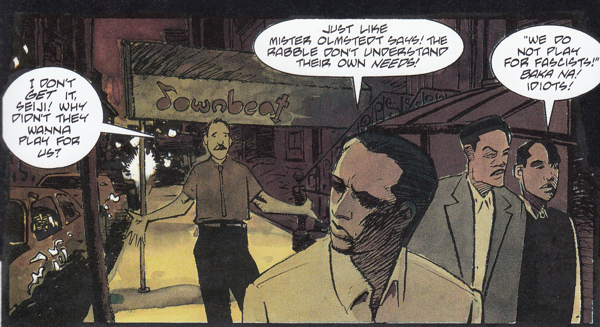
Fritz shadows Diforza at her next fundraising gala while his Armored Goons take the night off to go to a jazz club. But things don't turn out too good for them, being Baddies.


This is a prime example of how we must treat our fellow Americans who have chosen the fascist route. Give them zero succor! Let them steep in their hatred and bigotry!

A few days go by without any sign of Bruce or Batman. Fritz and his Armored Goons grow more confident believing they are in complete control of Gotham. Right up until spray-painted Bat logos begin appearing all over the city. Could it be? Did Batman survive?! Maybe this is one of those Elseworld books where The Riddler must take over the role of Batman. From now on, the city will be saved by a man who confuses the shit out of criminals with stupid riddles and puzzles. Who can ever rob a bank if you have to solve a series of shit Gollumesque riddles just to get the money? To solve a cryptic crossword just to snatch a purse? To figure out how to get that nail out of that bottle just to run some kind of confidence scheme?

Batman finally shows up just as the Armored Goons begin cracking down on the squatters, beating and arresting anybody they come across near the buildings they want to demolish, and all with the backing of the mayor (who's just as dumb and credulous as any IRL mayors Americans might be familiar with).
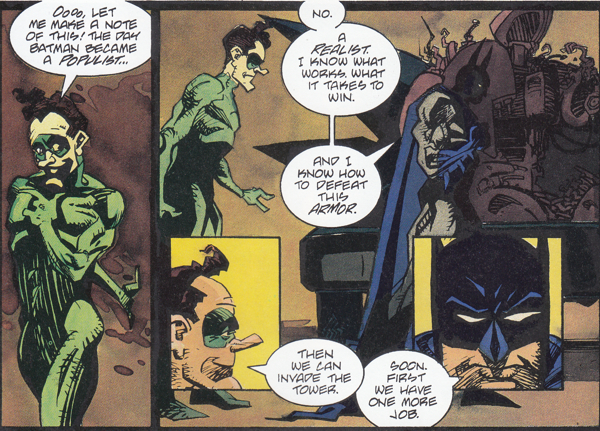

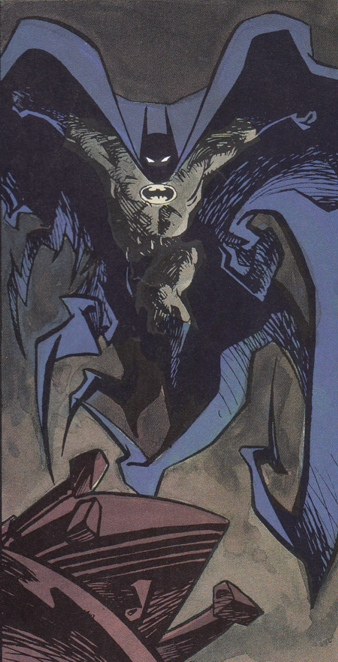
God I wish Batman were real simply so this is the last thing fascist motherfuckers like Trump, Miller, Hegseth, and even Mother Night sounding ass Sean Hannity would ever see.
Other people I'd also hope Batman would appear to like this? Chuck Schumer and Nancy Pelosi. Maybe send those useless assholes off with heart attacks and get some new, hopefully progressive blood in there. Oh, and forget Batman. I'd just straight up send Deathstroke to take care of Fetterman. Fuck that asshole with a million barbed wire dildos.

As Batman battles the Armored Goons in the Gotham Subway, he knocks one into the third rail with a rush of broken sewer line, electrocuting him. Batman thinks maybe he's killed another until the guy speaks up, telling his compatriots to leave him and to keep after Batman. That's when Batman realizes The Riddler has been trying to tell him that Batman didn't kill the first guy either. How could he have killed one with a little old explosive Batarang when a tidal wave of shit water on an electric rail couldn't kill one?

Batman leads the Armored Goons out to the boardwalk, downing one with a tank of compressed liquid nitrogen (which probably didn't kill him because Batman doesn't care about accidentally killing them anymore. The armor's just too tough!). And since Batman can't defeat them while they're in the armor, he figures out a way to get them out of it quick as fuck.

Fucks are quick, right? It's not just me?


The seldom utilized Batsnake.

Batman didn't actually have that snake in his utility belt. He stole it off of a guy at the boardwalk whom I can only assume was one of Batman's other villains on his day off. Who carries a fucking boa around their neck while playing carnival games?

Batman steals the suit after knocking the Non-Armored Goon out with a kick to his throat. Now he just has to affect a ninja accent and pretend to like jazz music and he can infiltrate Fritz's gang!

Instead of using the armor himself, he takes it back to The Riddler to investigate its weaknesses. The Riddler doesn't help at all because he's only interested in badgering Batman. But Batman figures out a weakness in the armor and also doesn't tell The Riddler how he survived being run over by a train. Pshaw! You can't have a cliffhanger ending without showing the audience how the person hanged onto the cliff! This is outrageously poor form, Gerard Jones! Also, I won't apologize for calling your writing poor form when you ultimately reveal how Batman survived.


Of course! God forbid Batman be a populist! That would make him naïve! To think that common people deserve a chance to live the lives they want to lead without interference by money-grubbing politicians who've forgotten what life should be about in their pursuit of money and power!

I understand that Batman is a huge control freak but I don't understand why you'd have Batman instantly deny the idea that he's a populist. What the fuck is his entire mission for if it isn't to make the lives of everyday people safer and more secure? And not in a fascist way! As we saw in Frank Miller's cautionary tale, The Dark Knight Returns, Batman doesn't work as a fascist. Wait. Was that a cautionary tale? Oh shit. I need to re-read that, don't I?! Fucking Frank Miller!

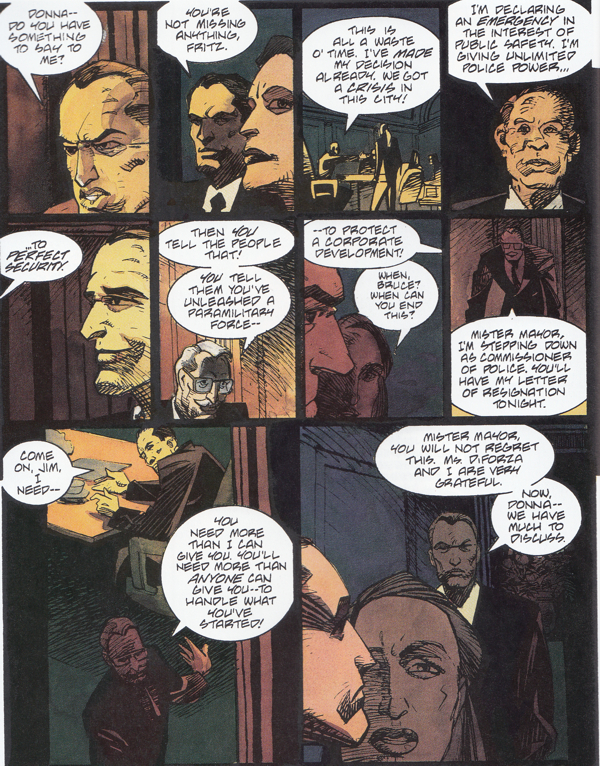
Later the mayor holds a meeting with Commissioner Gordon, Fritz, Donna, and, um, Bruce Wayne? to discuss the future of the city and what's happening with New Gotham. His decision is that he's believed enough lies to declare a state of emergency so that police can beat the fucking shit out of anybody they want.


Judas Priest, comic book from 1992, can you stop with all the modern day commentary?!

Eventually everybody in Gotham works together to stop Fritz because, um, he's a communist? Man, why did Gerard Jones have to add that bit? You don't need a communist to overstep and become a fascist asshole in a capitalist society! Every fucker with too much money and power and not enough whimsy and happiness who has never once read an actual book that didn't have "sigma" in the title would do the same thing Fritz did if it meant they could pay 1% less taxes every year. But in 1992, bad guys could still overreach causing everybody else to band together and bring them down.

In the end, one of The Riddler's sharks eats Fritz. The Riddler lures him into the trap even though Batman's standing right there and would definitely have been able to save him if Batman had wanted to save him. So Batman kind of kills in his own way. A kind of subtractive murder where his inaction causes a death. And you can't be convicted in court of not doing something! I mean, you can because the American justice system is shit. But you probably won't be.


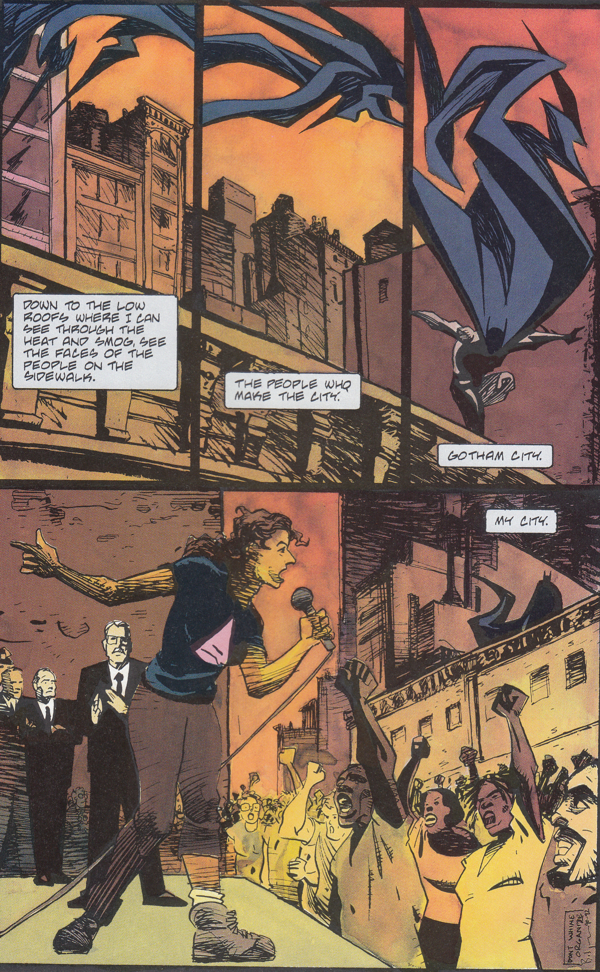
Everything works out in the end because Batman just learned a little something about social justice and community. Although he's still calling Gotham "my city" so maybe he's still a huge selfish billionaire prick.

Batman: Run, Riddler, Run #3 Rating: A. I don't have much memory of reading this book in 1992 but then I read so many comic books that my mind had no chance at containing memories of everything I read. The ones I most remember are the ones I talked about with my friends but that meant we all had to be reading the same books and that didn't happen as much as you'd think. Plus we were so busy playing Warhammer we didn't have time to discuss anything else! But I enjoyed this series so much now that I'm surprised I didn't even remember some guy being eaten by a shark. Maybe I was so young and male that I was all, "Pshaw! Women and minorities fighting for their rights? Haven't we already sorted that out to a point where I don't have to hear about it anymore? Bah! I'm a Nazi now!" No, you know what? I was never that young or male.

Thursday, June 19, 2025

Let's Read Infinite Jest!
1. Introduction: Title, Plot, and Themes

TITLE/CHARACTERS

Whenever I begin reading a book, I try to understand why the author chose the title of the book. Usually it's not until you're well into the book that you begin to figure out how the title fully relates to the material within. But I try to get a bit of a handle on it before then so it's at least at the back of my mind. It's nice when it's something like Infinite Jest because, right from the starter pistol, you know to keep an eye out for dead clowns, suicidal emo boys, drowned love interests, and incestuous hanky-panky! Those are all things in Shakespeare's Hamlet. If you're wondering why I mentioned them, the phrase Infinite Jest is taken from Hamlet's speech in the graveyard where he's contemplating skull fucking Yorick. Look, I read the comic book version of Hamlet drawn by Simon Bisley so I might have a misguided understanding of some of it.

Sorry to get your hopes up. There is no comic book version of Hamlet drawn by Simon Bisley. I love to make shit up and lie. It's the only way to hide really earnest and sincere truths about myself on the Internet. I can be as honest as I want when I've surrounded my inner truths with absolute bullshit. Good luck figuring out what's what!

I'm actually doing a re-read of Infinite Jest (which I just finished reading) so I can speak a little bit more as to why the book is called Infinite Jest without merely wild speculation. One of the "mainest" characters is Hal Incandenza, the son of James Incandenza. Hal takes on the role of Hamlet in a number of ways, like when the janitors call him Prince Hal, and being sad, and having a dead father who appears as a ghost, and digging up the skull of his father, James, and having a mother who seems to be in an incestuous relationship with her brother (referred to as her half-brother but almost certainly a step-brother). James Incandenza is both Hamlet's dead father's ghost but also, and more importantly, Yorick, the clown full of infinite jest (that's why Hal digs up his skull (which he doesn't actually do in the chronological telling of the book. It happens in the secret part of the book that I suspect exists but I need to find on the re-read). Hal's father sees his son disappearing into sadness and depression (this may be because Hal is doing that or it might be because James is delusional. We'll see which is more probable on the re-read!) and only wants to make him happy. His father works with light and energy (his last name is Incandenza for literary reasons!) and begins to make movies in an attempt to create the ultimate entertainment which can cheer up his son. Ultimately this entertainment probably destroys the world but that wasn't the point of it! The point was to make Hal happy. Also, just for transparency's sake, when I described what the actual entertainment depicted, called Infinite Jest by James in the book, to the Non-Certified Spouse, I was on the verge of tears. But we'll get to that!

Hal has a younger brother (almost certainly his half-brother whose parents are Hal's mom, Avril, and Hal's Uncle Charles Tavis, Avril's probable step and not half brother) named Mario who is almost certainly a representation of Horatio, Hamlet's school friend and basically the only character to survive the play. Mario has the best relationship with James Incandenza and acts as a sort of human camera lens, seeing things others cannot see, viewing things without judging, and needing a tripod to stand up straight.

The worst part about this book being named after a quote from Hamlet is that I need to re-read Hamlet now too! Good thing I still have David Bevington's The Complete Works of Shakespeare (4th Edition) which I've hauled around since college even though it's probably seven pounds. I don't mean I took it with me everywhere the way I almost always had a copy of Selected Writings of Gertrude Stein on me in my late 20s and 30s. I had that book on me so often that all of the contacts in that time of my life have their phones and addresses scrawled on the inside covers.

The book has a load of other characters but we'll get to them as they crop up. The other "mainest" characters are probably Don Gately, Joelle Van Dyne, and Orin Incandenza. Maybe throw in Remy Marathe and Hugh/Helen Steeply too. But that's it! Nobody else gets to be a "mainest" character! Not even Avril Incandenza and Michael Pemulis! I have to draw the line somewhere!

Plot

The plot doesn't really matter. If you think the plot matters, you're going to be fucking livid with the way the book "ends". Just out of your mind cataleptic. That's not the word I wanted to use but then I don't have the ghost of James Incandenza feeding me OED words directly into my brain. Ostensibly, though, the plot has to do with the people who orbit the creators and actors within the entertainment Infinite Jest and those in search of this video entertainment that fires the pleasures senses of the brain so hard that people die while watching and rewinding and watching it again. If they're taken away from the entertainment (once again, called Infinite Jest, filmed by James Incandenza), they supposedly become useless, having taken the greatest source of pleasure they've ever experienced away from them and being driven to continue that experience. I'd say more about that but I've forgotten how Remy Marathe put it, how a person's eyes looked after they've seen the entertainment and had it taken away from them. It's really important the way he describes it but I've forgotten! Stupid reader! I'm the worst!

The way David Foster Wallace writes the book is all explained in the filmography of James Incandenza, specifically his use of anti-confluential plots and his "joke" films of Found Dramas. To understand the plot, you just need to understand those two things. Anti-confluential plots are stories that run in parallel but never come into any real meaningful contact with each other. Now, you might be telling me to hold on at this point, and I get what you're about to say. Yes, everybody's plots in Infinite Jest intertwine with many other people's plots in Infinite Jest. But they do so in a way that bolsters one of the themes and doesn't help to explain the plot. As a reader, you very much want all of these disparate threads to come together to explain what the fuck is going on. But you do not get that. What you get is a sense of connection without any of the characters realizing this connection. Is it a kind of dramatic irony, I guess, where we, as the readers, see how the characters connect while the characters themselves remain blind to it? The Found Dramas are a joke where James Incandenza described the idea of picking a random name out of a phone book and then following an hour and a half of their life (or something. Again, my memory on the actual way it's stated in the book is vague) without their knowledge but then realizing that they don't even need to film these people's lives. In a sense, James' "found drama" exists without James having to record it in any way. This book is fecund with Found Drama.

Themes

I'm sure there are more and we'll be delving into them as we read but I figure three main themes really stand out: the inability to communicate with others, addiction/obsession/compulsion, and suicide.

1. Inability to Communicate with Others.
The book begins with Hal Incandenza trying to communicate to the Dean of a college he's attempting to get into but failing so miserably that they believe he's acting wildly and aggressively and they need to wrestle him to the floor and keep him pinned in the toilet while he calms down. Not long after that scene, readers see a young Hal speaking with his father in a terrible disguise as his father laments that Hal will not talk to him. While they're talking past each other. Various moments are given to how technology hampers the way in which we communicate. And, of course, Hal's father's attempt to communicate with his son which destroys (or will destroy) the world. Many, many more examples will be seen as we read, ending in Don Gateley's long-ass hospital stay where he's got a tube down his throat making him incapable of communicating with anybody at all (except, you know, for the ghost).

2. Addiction/Compulsion/Obsession.
If you think David Foster Wallace is simply talking about alcohol and narcotics, you've missed a driving theme of the novel. Wallace seems to believe that addiction, obsession, and compulsion are not just attributes that drive human behavior but are also what make our lives worth living. A well-repeated concept throughout the Alcoholics Anonymous sections of the book are how addicts coming into AA are just trading their Substance addiction for the addiction of AA's rules, community, and hokey sayings. Hal and the other teenagers at the Enfield Tennis Academy are obsessed with getting so good at tennis that they can become professionals and enter The Show. Someone's father (stupid memory!) becomes addicted to the television show M*A*S*H to the point that it basically kills him. James Incandenza is addicted to alcohol and tries AA but doesn't find meaning in it. What we see when people lose the thing that matters most in their life is that they either eventually go on to find a new addiction or they die, usually by their own hands. James sticks his head in a microwave after he promises to stop drinking. Remy Marathe, without his legs and ability to dodge trains, tries to wheel himself over a cliff multiple times and cannot do it, right up until he saves a woman from certain death on a highway, a woman who is barely functional, barely even alive, but he becomes obsessed with saving. She, in essence, becomes his AA God and reason for living. Joelle has radio and cocaine and AA and, eventually, Don Gately. Joelle's mother loses her beautiful daughter and her denial that her husband was fucking their daughter (in his case, just eye fucking and mentally fucking) and jams her arms down some garbage disposals. Wallace attempts to show that life is meaningless without the meaning we give it, and we must make that meaning intense, no matter what it is. And that intensity is absolutely a driving compulsion, a mind-altering obsession, and an addiction to keep on living.

3. Suicide.
To sleep, perchance to dream, you know? Oh that this too too sullied flesh would melt, thaw, and resolve itself into a dew, you know? Or that the Everlasting had not fixed his canon 'gainst self-slaughter! Oh God, God, how weary, stale, flat, and unprofitable seem to me all the uses of this world! You get me? It's fucking Hamlet, man!

So those are the things to look out for as we read! Oh! I almost forgot the most important thing to watch out for as we read! The story of what happens between the last chapter (November 20th, Year of the Depend Adult Undergarment) and the first chapter (November, Year of Glad (the year following the Year of the Depend Adult Undergarment)). I think that's the secret story within the main story. Why does Hal lose the ability to communicate? How come he cannot regulate his facial expressions? Or express his feelings coherently to others (the only real, earnest feelings he seems to express throughout the entire book!)? We know part of the story right from the start: at some point, Hal Incandenza meets Don Gateley (probably in Gately's hospital room as a bed is being prepared next to him and soon after, as described in this first chapter, Hal winds up in the hospital for psychiatric reasons) and they wind up in the Concavity digging up his father's grave with John "No Relation" Wayne standing nearby "in a mask" (presumably a gas mask). When this is first described in the first chapter, we do not know enough to mark the single sentence about Gately and Hal's father's skull. But after reading, we know that Hal's father was buried in a part of the country that becomes the Concavity, a cut-out of the map of America (the area given to Canada) that had become radioactive and unlivable and where all the trash is catapulted. We also know Hal's father was probably buried with the master copy of Infinite Jest. So this one sentence suggests that Hal, after meeting Gately, and presumably with help from Joelle, decide to acquire this master copy. Hal is obsessed with his father's movies and what his father was trying to say so if they acquired this copy, it is certain Hal watched it. Hal in the first chapter is only one of two spots in the book which uses a first person perspective (later, near the end of the book, we see the world from Hal's point of view too). We have places that describe how other people see the people who have viewed the Entertainment. Is this first chapter so we, the readers, can experience the mind of somebody who has watched The Entertainment, and how they are still in there, trying to cope? Maybe Hal just didn't go as crazy as others because the message was for him. But we also learn John "No Relation" Wayne didn't make this tournament which he was sure to win. I suspect he watched it as well and is insane?

Man, okay, enough with the speculation before we even get into it! There might not even be any more evidence for the secret story because didn't I basically just figure it all out from re-reading the first chapter of the book after finishing the book? Maybe! I am a genius, after all! I'd love to say that my mother told me I was but she thinks I'm kind of dumb. So I'll just have to take my 1st Grade teacher's word for it. Thanks, Mrs. Nelson! I always knew I was super smart!

*ADDITIONAL EDIT*
Oh man! I can't believe I forgot to mention this one silly thing that I wanted to mention in connection with Hal and Hamlet: they both exist within courts! Hamlet in the royal court and Hal on the tennis court. I don't know. I thought it was amusing and cool!