Once upon a time, people who were told stories listened carefully, sat in rapt attention at the twists and turns of the plot, and felt empathy for the protagonists. In this way, audiences generally became wiser and more compassionate. They heard stories about people different from them and their scope of the world grew. By journeying, even metaphorically, with another person on their trials and tribulations against a harsh and uncaring world full of people ready to manipulate and take advantage of whomever they could, we grew stronger in our ties. We built up the muscles of empathy and compassion. We were taught to root for those standing up against injustice and to boo and mock those who would cynically destroy other people for their own advantage. Once upon a time, stories could weave beneficent magic. But now in this all too current time, when hearing stories of goodness and justice and equality and underdogs against those who would use their selfishness and greed to advance their own cynical and dangerous desires, people simply see a critique of their own terrible flaws of character and they erupt in anger at the storyteller. We learn nothing. And we're proud of our defensiveness and our ignorance.
If you'll listen — listen in the old ways — I would like to tell you a story.
Once upon a time, there was a boy who claimed he loved ambiguity and subtlety in storytelling. "Why must the writer tell me right up front which character I should cheer and which character I should boo and hiss? Can I not be allowed to make up my own mind?" he would say to anybody who would listen (which was apparently about two dozen total strangers and not one family member (which was probably a good thing because how could he be honest about his life if he knew the people whom he was venting about were listening to his stories that didn't exactly portray them in a decent light?)). He believed a story that presented itself as a puzzle was the greatest kind of story a storyteller could tell. "If the story is intriguing enough, people will put in the effort to understand it!" he once claimed to a friend he knew was smart but who absolutely missed the entire point of John Barth's story "Night-sea Journey" from Lost in the Funhouse. That friend insisted that authors had a duty to their audience to make their message plain and simple. And yet he claimed to love "Night-sea Journey" while never realizing that the narrator of the story was a spermatozoa. But without that knowledge, without making the mental "A-ha!" leap of understanding while reading it, the story cannot be understood as it was meant to be understood. When the boy saw his friend do an existential double-take over learning the truth of "Night-sea Journey" not two minutes after declaring David Lynch failed his audience with Lost Highway, the boy nearly traded philosophical positions with his friend. Maybe his friend was right. Maybe subtlety and ambiguity were too much for even intelligent people to discern. Perhaps truth was too important to risk being misunderstood by the audience.
The boy did not change his opinion of complicated and not easily decoded stories. He continued to read Barth and Pynchon, Danielweski and Dick, Stein and DeLillo and Nabokov and Heller. And yet he also read comic books — so many comic books! Something in him demanded stories that were easily digestible. Stories so obviously about right and wrong that they took no brain power at all. Unambiguous stories not meant to say anything too deep or disturbing or existentially terrifying. Stories simply meant to inspire and to say, "Hey! Look, kids! We can defeat the bad guys if we just give it the old college try! Not the new college try because is beating evil worth the debt incurred? No, wait, never mind! That's getting too ambiguous!" Stories so simple that the boy could not help but mock them ceaselessly at every opportunity.
But one day, even comic books began to believe that ambiguity was more important than truth and inspiration. Writers began to ask, "What would happen if the good guys weren't as good as we thought they were?" And suddenly comic books themselves had changed their nature so much as to be unrecognizable. Where once the stories were about how we, as humans, could aspire to be like these flawless heroes who would sacrifice their own lives to make the world a better place, they were now stories about how they, as superheroes, were actually entirely too human and no better than the rest of humanity. And the boy thought, "Wait. What the hell is happening?"
But the boy could not change his nature. He might have noticed how comic book heroes were changing but he also loved stories full of ambiguity and subtlety. He liked stories about characters who couldn't claim to be either good or evil but were just people trying to navigate the maze of artificial social constructs on which civilization is based. Surely the audience, being intrigued by the high level of effort put into these stories, would ferret out the message and learn a little something about truth or maybe courage or possibly even the American Way (not the real American Way but the ideal American Way that has never really actually existed). Obviously a large portion of storytelling's audience would not have the patience or intelligence or will to read Somebody the Sailor or Gravity's Rainbow or House of Leaves or The Three Stigmata of Palmer Eldritch or "Melanctha" or White Noise or Pale Fire or Catch-22. But they would absolutely be able to read Watchmen or Sandman or Animal Man, being that their ideas and ambiguities and questions were somewhat camouflaged by all of the pretty pictures. So the boy was pleased with this turn of events where lots and lots of people were learning that stories could convey important ideas through complex and hard-to-navigate narratives. At least for awhile.
Eventually, perhaps even too late, the boy realized that the heart within a story so well hidden by intellectual contortions of storytelling might as well not even exist. If the audience can't find their way to the heart, the story has failed the audience. The boy realized his friend Soy Rakelson may have had an accidental point. Audiences would not be intrigued by a complex story. Audiences could not be trusted to put any work into their role. If the heart were too well hidden, the audience would never find it. They would barely even try to look. Instead, the audience would simply be angry and feel mocked. The audience would grow defensive. The audience would not just turn against the particular storyteller but against all storytellers. They would call the storytellers to task and demand stories that were not complex. They would demand stories that didn't point fingers at their flaws. They would demand stories about nothing at all. If the stories being told were important but the importance couldn't be ferreted out, well, why not just tell unimportant stories that simply state, "This person is good. This person is bad. By the end, the bad guy will be punched in the nose. And, don't worry, nobody will be upset by what makes the bad guy bad. He's just bad, okay? He's not a reflection of you, the audience! You're the good guy! Now calm down already and go read more garbage."
The boy thought, "How did we come to this? If important stories are too complex for their audience, that doesn't mean stories shouldn't still be important. Perhaps there was something to stories being simple and still important." Thinking to himself, he clarified his position: "Don't get me wrong! Don't take me halfway up to heaven without letting me swing down on my birch or whatever this allusion to a Frost poem was meant to say while also letting the audience know I'm well read! I still want complex, ambiguous, subtle stories about existential dilemmas without any real answers! But I could probably do with a lot more simple morality tales as well!" And it was with that statement, that the boy decided to discuss The Twilight Zone episode, "What You Need."
"What You Need" is a story of two men. One man is the protagonist. One man is the antagonist. One man, you are supposed to root for. One man, you are supposed to boo and hiss. Rod Serling tells you right up front which guy you should boo and hiss. After being introduced to Fred Renard barking at the bartender, Rod Serling interrupts the scene with his opening narration: "You're looking at a Mister Fred Renard who carries on his shoulder a chip the size of the national debt. This is a sour man, a friendless man, a lonely man, a grasping, compulsive, nervous man. This is a man who has lived thirty-six undistinguished, meaningless, pointless, failure-laden years and who at this moment looks for an escape, any escape, any way, anything, anybody, to get out of the rut." Basically, Serling calls the guy a loser. In a more complicated, late-twentieth century story, I would forgive the audience for thinking that maybe Serling's narration was describing the type of person who might wind up being the underdog hero. But this was the fifties and the audience knew that a statement declaring that a thirty-six year old was a directionless, lost failure of a human being meant that person was the antagonist. That person was lower than fleas on amoebas. That person was practically a rebellious youth except worse because that person was thirty-six and hadn't matured. This Fred Renard is the bad guy.
What happens in the story is that Fred meets a man with psychic gifts and decides to manipulate that man so that Fred can get whatever he desires. His greed and selfishness are writ big to be mocked by the storyteller. The audience cannot mistake that his attributes are not attributes to be admired. And the audience of the time would not have scoffed and been upset and made stupid statements about virtue signaling and social justice. They would watch the story and think, "That guy's a dick. Why would anybody want to be like that guy? What a jerk."
By the end of the story, the old man uses his psychic gifts to kill Fred Renard. He does so in self defense because he foresaw that Renard was going to kill him. In a modern story, that might be played ambiguously. Who is the real hero if the psychic killed the down-on-his-luck man just trying to turn his life around? The subtleties of the story would be ignored for a quick hot take where the person making the hot take, wanting to be thought of as intelligent and critical, simply thinks, "What's the opposite conclusion that any normal, sane, intelligent person would reach after watching this story? I'll pretend I believe that and everybody will be amazed by my insight and ability to deconstruct the story, even if I'm completely misunderstanding deconstruction in the same way New Age misfits misunderstand Quantum Physics!" And, yes, a story simply told can include subtleties. Because the beauty of this story lies within the subtleties.
Upon watching "What You Need," an audience would need not be forgiven for asking this question ("need not be forgiven" for it's the first and most important question to be asked by an audience trying to understand the character of Pidott, the old psychic man): "Why does the old man give Renard the scissors that save his life? If the old man saw that Renard was going to kill him, why not just let Renard die in the elevator accident?" And here is the heart of this story, not entirely hidden, but maybe needing some minor archaeology to uncover the entire thing (archaeology? That probably should have been a medical analogy!). The old man is the protagonist because he is a decent person. He doesn't want to be the architect of harm to any person, even Renard. He only wants to help people. If he doesn't give Renard the scissors, he is the cause of Renard's death. He saw it and could have prevented it. But even more subtle, he's giving Renard a chance to become a better person. He's Jesus allowing Renard the chance at redemption. The scissors are Pidott's way of saying, "Let he who is without sin cast the first stone." Perhaps if he saves Renard's life, Renard will see his life in a new light and change his ways. But he doesn't. So Pidott gives Renard another chance: he gives Renard the opportunity to win money gambling. But that's not enough either. Finally, Renard becomes the architect of his own destruction by jumping to the conclusion that a pair of slippery shoes are what he needs next. The big twist is that the slippery shoes are what Pidott needs. Renard's inability to change or to see past his own selfish desires become his undoing and he's comically hit by a car. I don't think it was meant to be comical. Maybe that was just the juxtaposition of my love of terrible old special effects and my love of people being hit by cars.
Renard isn't even portrayed as an evil or terribly bad person which is another slight subtlety that I love about the story. In its simple way, it's obvious who the audience should cheer and who they should boo. But it isn't simply because Pidott is preternaturally good and Renard is preternaturally evil. At one point, Pidott tells Renard exactly what he needs and they're things Pidott can't give him: serenity, peace of mind, humor, the ability to laugh at oneself, and patience. I don't know if this moment is in the original short story by Lewis Padgett or it was added by Serling in the teleplay but it's a tactical nuclear strike against terrible people in any decade. It's saying, "Renard, you aren't evil because Evil with a capital 'E' exists and some people are just bad and we need to destroy them." It's saying, "Renard, you've got some serious flaws that cause you to act horribly. They are things you can work on, if you choose to. You can be redeemed." To an audience that is willing to listen to a story, and consider the story, and reflect on its message, the story would have easily accessible heart and value and meaning.
Once upon a time today, the audience would simply see their flaws reflected back at them, and they would be angry. Because the audience today has no patience. It has no ability to laugh at itself. It has no serenity and no peace of mind. And while they all think they have humor because they still laugh at racist jokes, they are sorely lacking in truly understanding comedy. They can't even properly parse tragedy. Why should they? It might lead to a terrible bout of self-reflection.

Friday, January 3, 2020

Friday, December 13, 2019
Review of The Twilight Zone, Season 1, Episode 11: "Three Unnecessary Characters"
From early on in the story, you can feel something different about The Twilight Zone episode, "When the Sky Was Opened." It's not because the main character is so sweaty that it causes the viewer to feel uncomfortable, anxious, and sexually satisfied. Something about the existential dread felt by the characters in this episode reaches a level only hinted at in previous episodes. So it was absolutely no surprise to see that while Rod Serling wrote the teleplay, Richard Matheson, sci-fi/horror legend (wordplay!), wrote the story this episode was based on. I knew his name would be showing up in the credits eventually but wasn't expecting it so soon. In a way, it's a bit disappointing because I was thinking, "Wow! Rod really began hitting his writing stride earlier than I realized!"
This is a story about three test pilots who wind up in one of existence's subplots that Somebody ultimately realized wasn't needed. They return to Earth after crashing an experimental craft, begin to feel an undefined existential dread, and then disappear from existence entirely one by one. My theory is that God has a higher power which we should call The Editor. The Editor looks upon God's creation and, occasionally, says, "Do we really need this story about this experimental craft? I mean, it's 1960. Are people going to believe this crap? Maybe wait until later in the decade for this kind of thing. And now that you've got me looking closely at the three pilots, do we even need them? Just excise their entire existences. But don't mess with that nurse! I've always loved Miss Landers!" Although Sue Randall (Miss Landers) died at 49 which I guess is either proof that God's Editor loved her too much or not enough. It's hard to tell when you're dealing with omnipotent beings like Gods and editors.
Maybe Rod Serling learns something from his experience writing the teleplay of this story. Maybe he learns you don't need a compelling and definitive explanation for the cause of the main character or characters' existential dread. You don't need the U-boat first officer explicating the first two-thirds of the story during the final third. You don't need the accidental time-traveler's father patiently explaining to his time traveling son how maybe he should stop time traveling, literally and daydreamily. You don't need the man full of existential dread to dream the reason for his existential dread before he flings himself out of the window to die on the couch. You can just present a situation to which the protagonist can react with fear, paranoia, and anxiousness until that fear, paranoia, and anxiousness is ultimately proven true and the protagonist disappears without a hint of a reason why. Oh, sure, this story isn't perfect in that regard. But the theories as to why these men are disappearing come straight from the men trying to figure out why they're disappearing. Which is the entire point of this episode and The Twilight Zone in general and life in super general.
We're all eventually going to die and be forgotten. If that doesn't make you, at least occasionally, sweat like an anxious and terrified protagonist of a 1960s television show, you might not understand life at all.
I realize that I would only make every story I review worse with my suggestions but here's my suggestion to make this story better: instead of the main protagonist going back to the third astronaut after the first one disappears in his need for somebody to understand his terror of how reality has warped before him and his need to find some meaning behind it and possibly a way to fix it, he should just stay in the hotel fucking his girlfriend until he disappears mid-thrust. Some people might think I'm a pervert for coming up with that story change and, while I am a pervert who still thinks about Maya the Cat Girl's sexy dance (but with Sue Randall in the original actress's place), it would also be a pretty good metaphor for life. We're all just here to fuck until we wink out of existence because fucking is the only way to ensure that you're not the only one who has to suffer existing. Fuck you, future generations! You need to experience this terror too! Because if there is one thing more powerful than the drive to produce offspring, it's the drive to make people suffer as much as you've suffered. I could point to politics but I'd rather point to goat.se and Ringu and Bill Cosby (in three different examples. I don't have an overarching theory that combines them all). I feel when most people see goat.se, there's a biological need to show somebody else. Maybe even a gleeful need to make somebody else experience the shock and pain you've just experienced. In the novel, Ringu, the only way to keep from dying after watching a movie full of existential dread and terrifying images is to make another person watch the video as well (and to make a copy! Which only bolsters what I'm saying since Ringu really just asks the question, "What are memes?" I mean, it asks the question, "What is the biological imperative of every living thing and can inanimate objects somehow have the same viral drive to replicate?" Okay, maybe it doesn't ask that exactly but what am I? A critic? I mean an actual critic that is smart and does research and actually understands things like plot and character development and why movies hardly ever show boobies anymore). My third example doesn't have anything to do with Bill Cosby drugging and raping people. It's about his comedy which is still pretty good even if it now makes you think, "I'm laughing hysterically at a guy who raped people!" In whatever album it is where he talks about Fat Albert, he tells the story of being scared by a friend with a Frankenstein mask. After getting scared, the first thing Bill wants to do is scare somebody else. It's just the way we're fucking programmed, man!
Does that make my perverted story idea sound better when I add a bunch of bullshit 7th Grade argumentative reasons for it? I suppose the other reason is that I just want to see two people fuck for ten minutes but nobody wants to agree to that one! At least not out loud.
This is a story about three test pilots who wind up in one of existence's subplots that Somebody ultimately realized wasn't needed. They return to Earth after crashing an experimental craft, begin to feel an undefined existential dread, and then disappear from existence entirely one by one. My theory is that God has a higher power which we should call The Editor. The Editor looks upon God's creation and, occasionally, says, "Do we really need this story about this experimental craft? I mean, it's 1960. Are people going to believe this crap? Maybe wait until later in the decade for this kind of thing. And now that you've got me looking closely at the three pilots, do we even need them? Just excise their entire existences. But don't mess with that nurse! I've always loved Miss Landers!" Although Sue Randall (Miss Landers) died at 49 which I guess is either proof that God's Editor loved her too much or not enough. It's hard to tell when you're dealing with omnipotent beings like Gods and editors.
Maybe Rod Serling learns something from his experience writing the teleplay of this story. Maybe he learns you don't need a compelling and definitive explanation for the cause of the main character or characters' existential dread. You don't need the U-boat first officer explicating the first two-thirds of the story during the final third. You don't need the accidental time-traveler's father patiently explaining to his time traveling son how maybe he should stop time traveling, literally and daydreamily. You don't need the man full of existential dread to dream the reason for his existential dread before he flings himself out of the window to die on the couch. You can just present a situation to which the protagonist can react with fear, paranoia, and anxiousness until that fear, paranoia, and anxiousness is ultimately proven true and the protagonist disappears without a hint of a reason why. Oh, sure, this story isn't perfect in that regard. But the theories as to why these men are disappearing come straight from the men trying to figure out why they're disappearing. Which is the entire point of this episode and The Twilight Zone in general and life in super general.
We're all eventually going to die and be forgotten. If that doesn't make you, at least occasionally, sweat like an anxious and terrified protagonist of a 1960s television show, you might not understand life at all.
I realize that I would only make every story I review worse with my suggestions but here's my suggestion to make this story better: instead of the main protagonist going back to the third astronaut after the first one disappears in his need for somebody to understand his terror of how reality has warped before him and his need to find some meaning behind it and possibly a way to fix it, he should just stay in the hotel fucking his girlfriend until he disappears mid-thrust. Some people might think I'm a pervert for coming up with that story change and, while I am a pervert who still thinks about Maya the Cat Girl's sexy dance (but with Sue Randall in the original actress's place), it would also be a pretty good metaphor for life. We're all just here to fuck until we wink out of existence because fucking is the only way to ensure that you're not the only one who has to suffer existing. Fuck you, future generations! You need to experience this terror too! Because if there is one thing more powerful than the drive to produce offspring, it's the drive to make people suffer as much as you've suffered. I could point to politics but I'd rather point to goat.se and Ringu and Bill Cosby (in three different examples. I don't have an overarching theory that combines them all). I feel when most people see goat.se, there's a biological need to show somebody else. Maybe even a gleeful need to make somebody else experience the shock and pain you've just experienced. In the novel, Ringu, the only way to keep from dying after watching a movie full of existential dread and terrifying images is to make another person watch the video as well (and to make a copy! Which only bolsters what I'm saying since Ringu really just asks the question, "What are memes?" I mean, it asks the question, "What is the biological imperative of every living thing and can inanimate objects somehow have the same viral drive to replicate?" Okay, maybe it doesn't ask that exactly but what am I? A critic? I mean an actual critic that is smart and does research and actually understands things like plot and character development and why movies hardly ever show boobies anymore). My third example doesn't have anything to do with Bill Cosby drugging and raping people. It's about his comedy which is still pretty good even if it now makes you think, "I'm laughing hysterically at a guy who raped people!" In whatever album it is where he talks about Fat Albert, he tells the story of being scared by a friend with a Frankenstein mask. After getting scared, the first thing Bill wants to do is scare somebody else. It's just the way we're fucking programmed, man!
Does that make my perverted story idea sound better when I add a bunch of bullshit 7th Grade argumentative reasons for it? I suppose the other reason is that I just want to see two people fuck for ten minutes but nobody wants to agree to that one! At least not out loud.
Friday, December 6, 2019
Review of The Twilight Zone, S1, E10: "You-Boat"
Back in 2011 or so, I was re-watching Spielberg's Amazing Stories on Netflix and this was one of my thoughts on the show: "I think Spielberg filled a notebook with 2-3 sentence story ideas and told a bunch of other writers to flesh them out." I'd forgotten that but my brain reused the same basic theory for The Twilight Zone and Rod Serling. Apparently my view on sci-fi anthology shows is that they tend to feel like one simple idea taffy-pulled out into an extended story. Sometimes the character presented in the story fleshes it out in a way that makes the story more appealing and less like a one-note concept. The best ones, I believe, are ideas like "What if a person with X personality found themselves in Y situation." Because then the story doesn't have to rely on one twist moment or one speculative plot point. And then there's episodes like Episode 10 of Season 1 of The Twilight Zone, "Judgment Night."
This episode tells the story of an amnesiac German man aboard a British ocean liner. He only knows who he is and that something terrible is about to happen. Eventually he realizes the boat will be sunk by a U-boat at 1:15 in the morning and he freaks the fuck out more and more as time goes on. Nobody will listen to him and then the U-boat's spotlight hits the boat! They're all going to die! He gets out some binoculars and looks at the U-boat, seeing the captain of the U-boat standing on top directing fire when he realizes: the captain is him! Then the boat sinks and he drowns.
If that were the entire story, audiences would have discussed this episode for decades. What does it mean? How could he have been in both places? What sort of spooky nonsense took place here?! But, alas, Rod Serling decided the story needed to be explained explicitly in a short epilogue that takes place on the U-boat. Based on the beginning narration by Serling which seems inordinately long for a typical The Twilight Zone episode, it didn't surprise me that the end was just another long monologue to explain the point of the story.
Just when the audience is most confused by what happened, they're met with a scene where the main character, now acting as the German U-boat commander, sits in his submarine office proud of the murder he's just done. The first officer comes aboard sweaty and upset and full of pangs of conscious. He's all, "Are we the baddies?" And the commander is all, "We're at war! We had to kill everybody on board! Even the stupid kid with the stupid doll! Heil Hitler!" But the first officer isn't convinced. He's all, "Shouldn't we have at least warned them we were going to kill them?" And the commander is all, "Ah ha ha! You naive dolt!" And then the first officer looks at the camera and winks and says, "Don't worry! I'm going to explain my view of the universe and the afterlife right now and it's going to be spot on, according to the story you just watched! Because I believe the afterlife is where we have to reenact the terrible things we did in life but as the victims of those terrible things! Over and over and over again! That's what I think!" And you know what? The kid was right! He was like that one character in The Good Place whose image hangs in Ted Danson's office because he's the only person to ever figure out how it all actually works. Or like the woman in the coffee shop in The Hitchhiker's Guide to the Galaxy (unless it was one of the sequels!) who suddenly figures it all out and knows her plan to fix everything will work and then she is vaporized as the Vogon's destroy Earth to make way for a hyperspace bypass.
I'm not going to complain too much about the tacked on explanation of the story. Did Rod Serling even know in 1959 that a writer and director could be Lynchian?! You know what I mean! I know he didn't "literally" know he could be Lynchian because what was David Lynch doing in 1959? Getting his eagle scout masturbation badge? You know what I meant was, "Did Rod Serling even know he could write a story that didn't explicitly tell the audience exactly what was going on and just leave it a mystery for them to philosophize and theorize on?" Maybe in later seasons! But he was still finding his Twilight Zone legs by episode ten.
This episode wasn't terrible but it loses something in the tension it tries to build because there's no mystery to what's going to happen. The ship is going to be sunk by a submarine. Why everybody isn't as paranoid as the German guy is the bigger mystery! They should be running around flipping the fuck out the way everybody does in Airplane when they realize they're out of coffee and the "Okay, panic" light goes on. And the tacked on explanation at the end just seems like a CBS executive saw Serling's episode and was all, "What the fuck was that?" And Serling was all, "Pretty evocative, right? So crazy! What's going on?!" And the producer was all, "In your show notes, you wrote, 'German U-boat commander punished for all eternity to be victim of his own surprise murder.' Can you just stick that in there at the end explaining it?"
Maybe I'm being too hard on television executives and not hard enough on Serling! He just didn't work the script long enough to come up with a natural way of portraying that this night was just one of an endless string of identical nights in the U-boat commander's eternal Hell. He probably had a few packs of cigarettes to smoke and couldn't be bothered with it.
This episode tells the story of an amnesiac German man aboard a British ocean liner. He only knows who he is and that something terrible is about to happen. Eventually he realizes the boat will be sunk by a U-boat at 1:15 in the morning and he freaks the fuck out more and more as time goes on. Nobody will listen to him and then the U-boat's spotlight hits the boat! They're all going to die! He gets out some binoculars and looks at the U-boat, seeing the captain of the U-boat standing on top directing fire when he realizes: the captain is him! Then the boat sinks and he drowns.
If that were the entire story, audiences would have discussed this episode for decades. What does it mean? How could he have been in both places? What sort of spooky nonsense took place here?! But, alas, Rod Serling decided the story needed to be explained explicitly in a short epilogue that takes place on the U-boat. Based on the beginning narration by Serling which seems inordinately long for a typical The Twilight Zone episode, it didn't surprise me that the end was just another long monologue to explain the point of the story.
Just when the audience is most confused by what happened, they're met with a scene where the main character, now acting as the German U-boat commander, sits in his submarine office proud of the murder he's just done. The first officer comes aboard sweaty and upset and full of pangs of conscious. He's all, "Are we the baddies?" And the commander is all, "We're at war! We had to kill everybody on board! Even the stupid kid with the stupid doll! Heil Hitler!" But the first officer isn't convinced. He's all, "Shouldn't we have at least warned them we were going to kill them?" And the commander is all, "Ah ha ha! You naive dolt!" And then the first officer looks at the camera and winks and says, "Don't worry! I'm going to explain my view of the universe and the afterlife right now and it's going to be spot on, according to the story you just watched! Because I believe the afterlife is where we have to reenact the terrible things we did in life but as the victims of those terrible things! Over and over and over again! That's what I think!" And you know what? The kid was right! He was like that one character in The Good Place whose image hangs in Ted Danson's office because he's the only person to ever figure out how it all actually works. Or like the woman in the coffee shop in The Hitchhiker's Guide to the Galaxy (unless it was one of the sequels!) who suddenly figures it all out and knows her plan to fix everything will work and then she is vaporized as the Vogon's destroy Earth to make way for a hyperspace bypass.
I'm not going to complain too much about the tacked on explanation of the story. Did Rod Serling even know in 1959 that a writer and director could be Lynchian?! You know what I mean! I know he didn't "literally" know he could be Lynchian because what was David Lynch doing in 1959? Getting his eagle scout masturbation badge? You know what I meant was, "Did Rod Serling even know he could write a story that didn't explicitly tell the audience exactly what was going on and just leave it a mystery for them to philosophize and theorize on?" Maybe in later seasons! But he was still finding his Twilight Zone legs by episode ten.
This episode wasn't terrible but it loses something in the tension it tries to build because there's no mystery to what's going to happen. The ship is going to be sunk by a submarine. Why everybody isn't as paranoid as the German guy is the bigger mystery! They should be running around flipping the fuck out the way everybody does in Airplane when they realize they're out of coffee and the "Okay, panic" light goes on. And the tacked on explanation at the end just seems like a CBS executive saw Serling's episode and was all, "What the fuck was that?" And Serling was all, "Pretty evocative, right? So crazy! What's going on?!" And the producer was all, "In your show notes, you wrote, 'German U-boat commander punished for all eternity to be victim of his own surprise murder.' Can you just stick that in there at the end explaining it?"
Maybe I'm being too hard on television executives and not hard enough on Serling! He just didn't work the script long enough to come up with a natural way of portraying that this night was just one of an endless string of identical nights in the U-boat commander's eternal Hell. He probably had a few packs of cigarettes to smoke and couldn't be bothered with it.
Friday, November 29, 2019
Review of The Twilight Zone, S1, E9, "To Be or Not To Be"
In this episode, "Perchance to Dream," a man barges into a psychiatrist's office, lies down, and dies. That's it! That's everything that happens! At least to the people who are not Edward Hall, the man who dies. He manages to have a minor Jacob's Ladder episode before he dies. Or, more aptly I should say he has "An Occurrence at Owl Creek Bridge" moment. The majority of the episode is just the man's last dream before he dies from "a romantic heart." I think that means syphilis.
I would love to say this fits perfectly in the "Rod Serling just made a list of ideas to turn into stories" theory that I mentioned in an earlier review except this is the first episode that wasn't either an original work by Rod Serling or a teleplay by Rod Serling from another person's story. This story was written by Charles Beaumont who is not the actor who played Beaver's dad. That was Hugh! But this story idea is so simple I could see Rod jotting down "dying in your sleep ain't as cool as people seem to think it is" for his list of The Twilight Zone story ideas. Stupid reality not making my theory perfect.
I really enjoyed this episode because there was a sexy lady in it named Maya the Cat Lady. She even does a 1959 striptease which isn't as sexy as a 1960 striptease although they're probably pretty close. I don't think stripteases got really sexy until around 1973. I mean stripteases put to film for mass consumption! Real stripteases in 1959 were probably disgusting and humiliating and ended with loads of semen stained Dacron or wool flannel pants.
Edward Hall, the main character, explains to the psychiatrist what's been happening to him and why he won't let himself fall asleep. Remember though, that explanation is just given in the dream before he dies. We never really know the real reason why he went to see this psychiatrist! Sure, Edward explains it in the dream but why should the audience take dream Edward at his word? If he were speaking the truth about how his dreams continue a linear story from night to night then this dream is an aberration that disproves his theory! His next dream is supposed to be jumping from a roller coaster but instead he jumps from the window of a skyscraper. Anyway, Edward explains that if he goes to sleep, he knows he'll die because the dream story is getting really scary and less sexy than when it started. And since his dreams keep telling the same story, the next chapter was going to be so scary that his "romantic heart" couldn't take the strain. Of course, staying up for four days straight is also putting a strain on his heart so, basically, he's a dead man either way.
Or is he? Did he die in the psychiatrist's office because he strained his heart by staying awake for four days even though he probably would have been fine if he just got some fucking sleep? Who knows?! We don't even really know if he'd been awake for four days straight when he entered the office because that was just information from Dream Edward! Maybe he just had really bad gas pains when we see him stumbling into the office at the beginning of the episode.
I love the conceit of this episode because I've thought about this for decades. People always seem consoled by the idea of peacefully dying in their sleep. But I've always thought, "Have you forgotten about dreams?! I bet the dream you have when you die in your sleep is fucking terrifying!" Apparently Charles Beaumont thought so too!
Fifteen years ago, I worked at a place called Academic Book Center. We had a new employee named Kara Zander whom I was training. She was working out really well (which was the opposite of what usually happened with new hires there) until she suddenly didn't show up for work the day before Thanksgiving. My manager, who was mostly a selfish narcissist, was getting pretty upset (because, remember, most new employees turned out to suck and suddenly it seemed maybe Kara sucked (spoiler: she didn't. She was just dead)). And then, suddenly, my manager was super fucking upset because she found out Kara had died overnight from carbon monoxide poisoning. Mostly she was upset that she was being such a fucking jerk judging Kara and then realized she was judging a poor dead woman who never gave my manager any reason to suspect she wasn't anything but a bright and caring and upbeat and competent employee. Right up until she died and didn't phone in to tell my manager, "Hey! I'm dead! Won't be coming in today!" Fucking Barb. I mean, fucking anonymous Academic Book Center manager!
Being that I've always had this thought in my head about how fucking terrifying dying in your sleep probably actually is, I couldn't get Kara out of my head. People said the comforting things about her death and how she probably drifted off and I held my tongue because nobody wants to hear somebody, at that moment, say, "Can you imagine what it must have been like? As the carbon monoxide filled her system, she probably began dreaming she was drowning, unable to breathe. Gasping and struggling to claw her way back to the surface but sinking ever downward, choking with fear. Until finally, just as she was thinking, 'It's all a dream! It must be a dream! I'll wake up any second now!', she simply winked out of existence." Then, jaws agape and tears frozen on their faces, half of the people I'd just spoken to would wander off to kill themselves while the others simply began their new hobby of cutting.
Since Thanksgiving was yesterday, and I watched this episode a few days before that, I suppose I couldn't help but think of Kara. I quit the job fairly soon after that, partly because the whole incident just made me lose any lasting respect I had of my manager (which wasn't much seeing as how she treated some of her work "friends" so shittily while at work and also because she cried during one of my performance reviews because I wasn't "being her friend" and then denied me a raise. I could have complained to HR but her sister was head of HR so why the fuck would I even bother?!) and partly because I couldn't stop thinking, "I don't want to fucking die at this job." Kara, at least, seemed to have an upbeat and joyous attitude about life (while also comforted by her religion), so she probably wouldn't have minded dying at that job. That sounds like I'm being critical but it's a compliment! I'm saying, "I'm a miserable and cynical beast who can't fucking cope with life or death or work," and Kara was somebody who seemed to look on the bright side of everything. Hell, maybe her dying dream was of her running joyously down a dark tunnel to the light of Jesus and his open arms! Man, maybe I need to suck it up and just force myself to believe in all that religious bullshit!
Kara has a fancy grave with one of her journal entries carved into the back of her gravestone (I know this because I looked her up online and found her grave at FindaGrave.com which isn't morbid at all). The quote is this (and I promise not to make fun of it because she's being earnest and vulnerable and young and religious and I should be so lucky to be any of those things): "Knocking on doors before entering is always a smart thing to do. This is not just for the privacy of the owner of the room, but also for the person who wants to enter. What if someone was creating a surprise for another person and 'hid' in a room to prepare it, and the other one barged in? The surprise and fun would be ruined. God is preparing a room for me up in heaven. The door is shut now, but when it is time for my soul to move, I will knock and discover a glorious surprise beyond description. Lord, thank you for surprises and the fun associated with them. I am faithfully sure that yours will be awesome beyond words...like they always are. Amen."
If there is a fucking God, fuck Him. Did you think he read this entry and chuckled and rubbed his hands together and muttered, "Oh, have I got an awesome beyond words surprise for you, Kara. Do I! Ha ha ha ha ha ha!" God's maniacal laugh then rings throughout eternity, both ways, forever. What a prick.
I would love to say this fits perfectly in the "Rod Serling just made a list of ideas to turn into stories" theory that I mentioned in an earlier review except this is the first episode that wasn't either an original work by Rod Serling or a teleplay by Rod Serling from another person's story. This story was written by Charles Beaumont who is not the actor who played Beaver's dad. That was Hugh! But this story idea is so simple I could see Rod jotting down "dying in your sleep ain't as cool as people seem to think it is" for his list of The Twilight Zone story ideas. Stupid reality not making my theory perfect.
I really enjoyed this episode because there was a sexy lady in it named Maya the Cat Lady. She even does a 1959 striptease which isn't as sexy as a 1960 striptease although they're probably pretty close. I don't think stripteases got really sexy until around 1973. I mean stripteases put to film for mass consumption! Real stripteases in 1959 were probably disgusting and humiliating and ended with loads of semen stained Dacron or wool flannel pants.
Edward Hall, the main character, explains to the psychiatrist what's been happening to him and why he won't let himself fall asleep. Remember though, that explanation is just given in the dream before he dies. We never really know the real reason why he went to see this psychiatrist! Sure, Edward explains it in the dream but why should the audience take dream Edward at his word? If he were speaking the truth about how his dreams continue a linear story from night to night then this dream is an aberration that disproves his theory! His next dream is supposed to be jumping from a roller coaster but instead he jumps from the window of a skyscraper. Anyway, Edward explains that if he goes to sleep, he knows he'll die because the dream story is getting really scary and less sexy than when it started. And since his dreams keep telling the same story, the next chapter was going to be so scary that his "romantic heart" couldn't take the strain. Of course, staying up for four days straight is also putting a strain on his heart so, basically, he's a dead man either way.
Or is he? Did he die in the psychiatrist's office because he strained his heart by staying awake for four days even though he probably would have been fine if he just got some fucking sleep? Who knows?! We don't even really know if he'd been awake for four days straight when he entered the office because that was just information from Dream Edward! Maybe he just had really bad gas pains when we see him stumbling into the office at the beginning of the episode.
I love the conceit of this episode because I've thought about this for decades. People always seem consoled by the idea of peacefully dying in their sleep. But I've always thought, "Have you forgotten about dreams?! I bet the dream you have when you die in your sleep is fucking terrifying!" Apparently Charles Beaumont thought so too!
Fifteen years ago, I worked at a place called Academic Book Center. We had a new employee named Kara Zander whom I was training. She was working out really well (which was the opposite of what usually happened with new hires there) until she suddenly didn't show up for work the day before Thanksgiving. My manager, who was mostly a selfish narcissist, was getting pretty upset (because, remember, most new employees turned out to suck and suddenly it seemed maybe Kara sucked (spoiler: she didn't. She was just dead)). And then, suddenly, my manager was super fucking upset because she found out Kara had died overnight from carbon monoxide poisoning. Mostly she was upset that she was being such a fucking jerk judging Kara and then realized she was judging a poor dead woman who never gave my manager any reason to suspect she wasn't anything but a bright and caring and upbeat and competent employee. Right up until she died and didn't phone in to tell my manager, "Hey! I'm dead! Won't be coming in today!" Fucking Barb. I mean, fucking anonymous Academic Book Center manager!
Being that I've always had this thought in my head about how fucking terrifying dying in your sleep probably actually is, I couldn't get Kara out of my head. People said the comforting things about her death and how she probably drifted off and I held my tongue because nobody wants to hear somebody, at that moment, say, "Can you imagine what it must have been like? As the carbon monoxide filled her system, she probably began dreaming she was drowning, unable to breathe. Gasping and struggling to claw her way back to the surface but sinking ever downward, choking with fear. Until finally, just as she was thinking, 'It's all a dream! It must be a dream! I'll wake up any second now!', she simply winked out of existence." Then, jaws agape and tears frozen on their faces, half of the people I'd just spoken to would wander off to kill themselves while the others simply began their new hobby of cutting.
Since Thanksgiving was yesterday, and I watched this episode a few days before that, I suppose I couldn't help but think of Kara. I quit the job fairly soon after that, partly because the whole incident just made me lose any lasting respect I had of my manager (which wasn't much seeing as how she treated some of her work "friends" so shittily while at work and also because she cried during one of my performance reviews because I wasn't "being her friend" and then denied me a raise. I could have complained to HR but her sister was head of HR so why the fuck would I even bother?!) and partly because I couldn't stop thinking, "I don't want to fucking die at this job." Kara, at least, seemed to have an upbeat and joyous attitude about life (while also comforted by her religion), so she probably wouldn't have minded dying at that job. That sounds like I'm being critical but it's a compliment! I'm saying, "I'm a miserable and cynical beast who can't fucking cope with life or death or work," and Kara was somebody who seemed to look on the bright side of everything. Hell, maybe her dying dream was of her running joyously down a dark tunnel to the light of Jesus and his open arms! Man, maybe I need to suck it up and just force myself to believe in all that religious bullshit!
Kara has a fancy grave with one of her journal entries carved into the back of her gravestone (I know this because I looked her up online and found her grave at FindaGrave.com which isn't morbid at all). The quote is this (and I promise not to make fun of it because she's being earnest and vulnerable and young and religious and I should be so lucky to be any of those things): "Knocking on doors before entering is always a smart thing to do. This is not just for the privacy of the owner of the room, but also for the person who wants to enter. What if someone was creating a surprise for another person and 'hid' in a room to prepare it, and the other one barged in? The surprise and fun would be ruined. God is preparing a room for me up in heaven. The door is shut now, but when it is time for my soul to move, I will knock and discover a glorious surprise beyond description. Lord, thank you for surprises and the fun associated with them. I am faithfully sure that yours will be awesome beyond words...like they always are. Amen."
If there is a fucking God, fuck Him. Did you think he read this entry and chuckled and rubbed his hands together and muttered, "Oh, have I got an awesome beyond words surprise for you, Kara. Do I! Ha ha ha ha ha ha!" God's maniacal laugh then rings throughout eternity, both ways, forever. What a prick.
Tuesday, November 26, 2019
Grendel: Devil's Odyssey #2
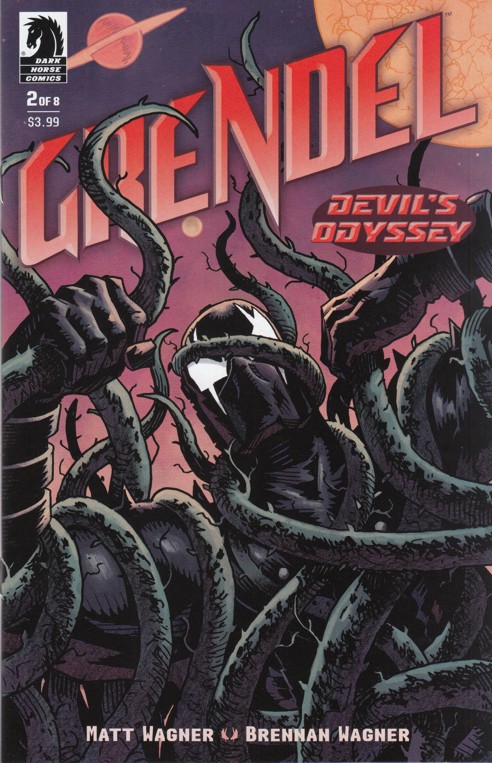
Yay! Grendel hentai!
I would absolutely love this comic book if I gave a shit about Grendel or was twelve years old again and into space stories. So close to my demographic! At this point in my life, I'm into stories about too much ass-play and economic equality for everyone (including horny octopuses). But since this story is about Grendel and space, I'll try to psyche myself up for it. Whee.
I just realized something: I didn't have to purchase this comic book! I'm dizzy from that revelation!
Grendel has found a planet that could have become Earth-2 if it weren't infested with a sentient race called the Gyks. I'd suggest Grendel could easily solve that problem but there must be thousands of them. And I don't think even Grendel could manage to slaughter that many innocent beings without feeling slightly troubled by a nervous, guilty bowel and having to break from the fight to shit where he'll be overpowered and fed to the Gyk children.
Man, if that's what happens, I won't call myself a Grandmaster Comic Book Reader. I'll just call Matt Wagner a weird freak.
I just realized something: I didn't have to purchase this comic book! I'm dizzy from that revelation!
Grendel has found a planet that could have become Earth-2 if it weren't infested with a sentient race called the Gyks. I'd suggest Grendel could easily solve that problem but there must be thousands of them. And I don't think even Grendel could manage to slaughter that many innocent beings without feeling slightly troubled by a nervous, guilty bowel and having to break from the fight to shit where he'll be overpowered and fed to the Gyk children.
Man, if that's what happens, I won't call myself a Grandmaster Comic Book Reader. I'll just call Matt Wagner a weird freak.
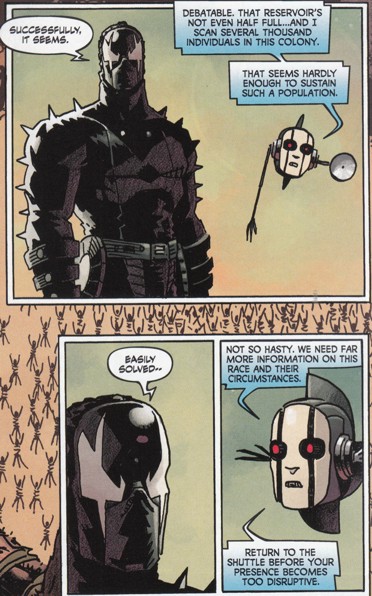
Well it seems like Grendel wants to attempt to slaughter them. So maybe we'll get the "Grendel shits himself to death" story I was pretending would be weird but secretly want to read.
I guess Dark Horse doesn't have a rating system for their comic books because I just checked the cover and there isn't a "Suggested for Mature Readers" note of any kind. "Why do you bring that up, Tess?" you're probably asking. By which I answer, "My name isn't Tess." But, um, this is why I bring it up:
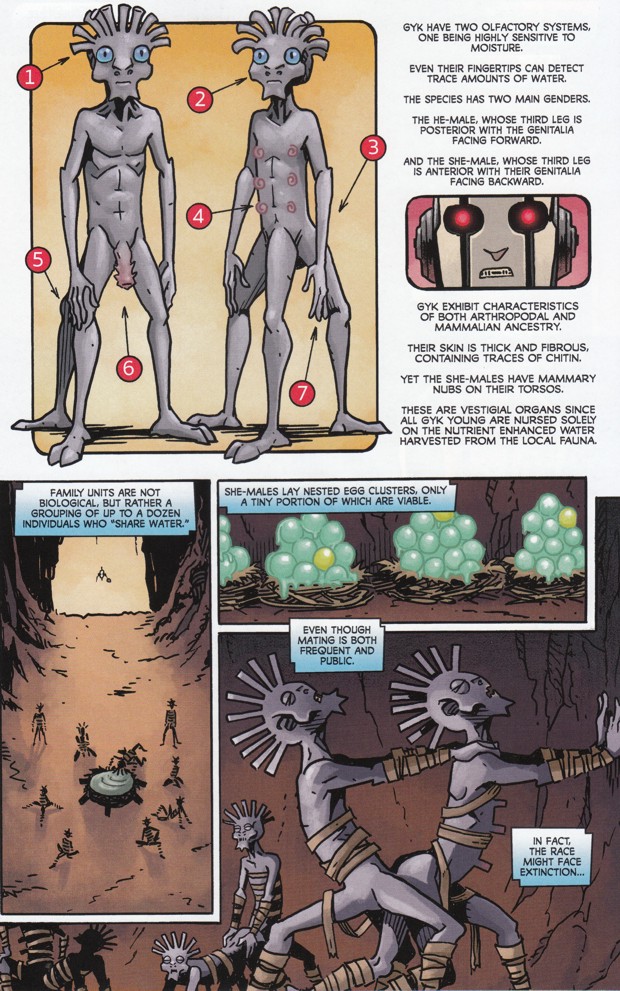
Matt Wagner is a weird freak.
I just realized that the previous scan will probably get this review tagged as adult content on Tumblr. Oh well. Fuck you, Tumblr. You've fucked up the layout of my blog anyway by inserting all of your own weird fucking code into the HTML so that now nothing centers and the captions don't sit snugly under the scanned panels. At least Blogger hasn't fucked up their entire platform yet.
Grendel's floating science head reports to him that the Gyk will probably kill him on sight if he interacts with them again. That's because their Queen Priest King has declared he's a cursed Gyk and will bring ruin to the entire hive. Hey! That's what I was hoping would happen! I guess Grendel will just have to find another planet.
Grendel decides to not listen to his science head. He'd rather take his chances on the Gyk than head back into space to find another suitable planet for Earth life. He decides to befriend the Gyk by bringing them water. It doesn't go as well as Grendel thought it would although it goes exactly as Science Head warned (I can't remember the science head's name so it is now Science Head). Grendel winds up incinerating the Queen and dozens of other Gyk as well as destroying their mushroom homes. Grendel says, "Oops! Sorry!", and then heads back to the ship to find another planet.
Grendel: Devil's Odyssey #2 Final Thoughts: It's an adventure in space story. Too bad twelve year old me is long dead. Forty eight year old me hasn't retained the sense of wonder twelve year old me had so he was sort of bored by this. It even had naked alien cock and I was all, "Hmph. I've seen it before." Wouldn't it be great if we, as a species, got more excited about everything and our sense of wonder simply increased as we got older? I don't like the way it really works where the world just beats us down and chips at our optimism until we're cynical husks full of weariness and pain. Maybe I just haven't found enough new things to keep me interested in living another forty years! No wonder there are so many stories about billionaires owning secret islands where they hunt men. Now that sounds like something that could get my heart pumping! Too bad I'm not a billionaire and I'd almost certainly just wind up as one of the hunted. I bet that would still be exciting though!
Grendel's floating science head reports to him that the Gyk will probably kill him on sight if he interacts with them again. That's because their Queen Priest King has declared he's a cursed Gyk and will bring ruin to the entire hive. Hey! That's what I was hoping would happen! I guess Grendel will just have to find another planet.
Grendel decides to not listen to his science head. He'd rather take his chances on the Gyk than head back into space to find another suitable planet for Earth life. He decides to befriend the Gyk by bringing them water. It doesn't go as well as Grendel thought it would although it goes exactly as Science Head warned (I can't remember the science head's name so it is now Science Head). Grendel winds up incinerating the Queen and dozens of other Gyk as well as destroying their mushroom homes. Grendel says, "Oops! Sorry!", and then heads back to the ship to find another planet.
Grendel: Devil's Odyssey #2 Final Thoughts: It's an adventure in space story. Too bad twelve year old me is long dead. Forty eight year old me hasn't retained the sense of wonder twelve year old me had so he was sort of bored by this. It even had naked alien cock and I was all, "Hmph. I've seen it before." Wouldn't it be great if we, as a species, got more excited about everything and our sense of wonder simply increased as we got older? I don't like the way it really works where the world just beats us down and chips at our optimism until we're cynical husks full of weariness and pain. Maybe I just haven't found enough new things to keep me interested in living another forty years! No wonder there are so many stories about billionaires owning secret islands where they hunt men. Now that sounds like something that could get my heart pumping! Too bad I'm not a billionaire and I'd almost certainly just wind up as one of the hunted. I bet that would still be exciting though!
Monday, November 25, 2019
The Sandman Universe Presents: Hellblazer #1
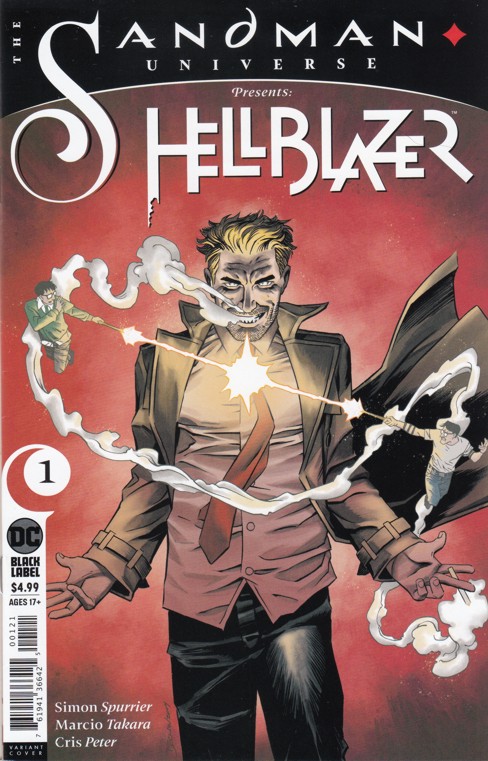
I just want to see Constantine enter a Magic the Gathering tournament.
Holding this comic book in my hand, it would feel like being on the ground floor of an exciting and comic book changing series if not for the fact that it was written by Simon Spurrier. I'm just kidding (I'm not)! I'm sure he can do a great job (he won't). That Suicide Squad story that he wrote where the narrator was a nobody who figured he would die but then he saved the day. Unless he died. Fuck it, who can remember everything they've ever read! I'm certainly glad that I can't or else I'd have to deal with the whole of Ann Nocenti's Katana comics until the day I die (which hopefully will be soon). On the flip side, I've ready every single thing Kurt Vonnegut has ever written and I'm sure I barely remember ten percent of it. And who has time to reread it just so I can get a few pages into each chapter and say, out loud to the cat, "Oh yeah! I remember this part! This is where the humans who evolved to be more like seals still laugh at farts!"
Aw, don't take this personally, Si! I totally have faith in you! Notice I didn't put in a parenthetical reference there disagreeing with myself! That's a good sign that I'm now being earnest, right?! I've given up on being cynical because where does that get you? Partying all the time with a bunch of people who desperately want to be friends with such a cool guy as myself, really. But who has time for all that! I'm a vulnerable weeper now! I'm going to let this story touch me in ways I haven't been touched since my father first took me to see The Rescuers when I was six years old. That was not a molestation joke, you fucking perverts. My father sucked in a lot of ways but he wasn't a Goddamned fiddler of kids! That Rescuers revelation was me being sincere again! That movie made me cry my fucking eyes out and not just when I watched it for the first time. Every time I thought about Penny being so lonely, I couldn't help losing my shit. And then my mom got me a Rescuers lunch box because, I don't know, maybe she loves torturing small children with their intense feelings that they've yet to bury so deep within them that they lose the ability to wonder at the world and the last thing left to give them joy is shuffling ever faster toward the grave and thinking about the cold comfort of that destination.
What my existential dread and inability to see a vulnerable story through to the end without some kind of cynical disruption is that the original Hellblazer was a tour de force of adult story telling and this one probably won't be. But reality aside, I feel like it could possibly be and I'm starting at Issue #1 and I have to say (despite Spurrier writing it (sorry! Sorry! Won't happen again!)) I'm actually kind of excited! Oh for one wish granted that I could transport myself to the side of a Grecian Urn and retain this feeling! But I am a real life person and, so, I must accept the bitter disappointment that nothing in life is ever as good as we think it's going to be. Except for Sour Patch Kids.
But before I start! Here's a thing I hope Simon Spurrier decided not to inherit from so many past writers of Constantine: magic has a cost. Sure, make being a magician dangerous because other magicians and demons from Hell and avenging angels and cursed items used in rituals are all fucking dangerous. But enough of this bullshit "Let's think this through because magic has such a high cost I'd rather not do the magic until we are forced into a corner!" That whole "Magic has a cost!" thing is just the DC magic-user equivalent of a Green Lantern ring running low on battery power. It's a limiter to make the writer's job of telling a tense story easier. "A Green Lantern has the most powerful weapon in the universe! They can do anything with it! But, oh no, the ring has only got five percent juice left! I'm on the edge of my seat!" Just let Green Lanterns (and Constantine!) be bad-ass motherfuckers with their bad-ass motherfucking weapons! Stop writing easy and start writing well, writers!
The issue begins with Constantine lighting up a fag. That's a good sign, right?! He's allowed to smoke in Black Label comic books! Sure, he was allowed to smoke in all the other comic books he was in as well. But not in the television show! Although they always showed him exhaling smoke or in a haze of smoke whenever anybody came up on him, while he maybe mimed putting out a cigarette. Some executive may have not wanted him to smoke in the show but the writers and producers and directors and actors and grips and cameramen and lighting operators and Crafts services were all, "Let's make sure the audience knows this motherfucker smoooOOoooOOookes!"
Aw, don't take this personally, Si! I totally have faith in you! Notice I didn't put in a parenthetical reference there disagreeing with myself! That's a good sign that I'm now being earnest, right?! I've given up on being cynical because where does that get you? Partying all the time with a bunch of people who desperately want to be friends with such a cool guy as myself, really. But who has time for all that! I'm a vulnerable weeper now! I'm going to let this story touch me in ways I haven't been touched since my father first took me to see The Rescuers when I was six years old. That was not a molestation joke, you fucking perverts. My father sucked in a lot of ways but he wasn't a Goddamned fiddler of kids! That Rescuers revelation was me being sincere again! That movie made me cry my fucking eyes out and not just when I watched it for the first time. Every time I thought about Penny being so lonely, I couldn't help losing my shit. And then my mom got me a Rescuers lunch box because, I don't know, maybe she loves torturing small children with their intense feelings that they've yet to bury so deep within them that they lose the ability to wonder at the world and the last thing left to give them joy is shuffling ever faster toward the grave and thinking about the cold comfort of that destination.
What my existential dread and inability to see a vulnerable story through to the end without some kind of cynical disruption is that the original Hellblazer was a tour de force of adult story telling and this one probably won't be. But reality aside, I feel like it could possibly be and I'm starting at Issue #1 and I have to say (despite Spurrier writing it (sorry! Sorry! Won't happen again!)) I'm actually kind of excited! Oh for one wish granted that I could transport myself to the side of a Grecian Urn and retain this feeling! But I am a real life person and, so, I must accept the bitter disappointment that nothing in life is ever as good as we think it's going to be. Except for Sour Patch Kids.
But before I start! Here's a thing I hope Simon Spurrier decided not to inherit from so many past writers of Constantine: magic has a cost. Sure, make being a magician dangerous because other magicians and demons from Hell and avenging angels and cursed items used in rituals are all fucking dangerous. But enough of this bullshit "Let's think this through because magic has such a high cost I'd rather not do the magic until we are forced into a corner!" That whole "Magic has a cost!" thing is just the DC magic-user equivalent of a Green Lantern ring running low on battery power. It's a limiter to make the writer's job of telling a tense story easier. "A Green Lantern has the most powerful weapon in the universe! They can do anything with it! But, oh no, the ring has only got five percent juice left! I'm on the edge of my seat!" Just let Green Lanterns (and Constantine!) be bad-ass motherfuckers with their bad-ass motherfucking weapons! Stop writing easy and start writing well, writers!
The issue begins with Constantine lighting up a fag. That's a good sign, right?! He's allowed to smoke in Black Label comic books! Sure, he was allowed to smoke in all the other comic books he was in as well. But not in the television show! Although they always showed him exhaling smoke or in a haze of smoke whenever anybody came up on him, while he maybe mimed putting out a cigarette. Some executive may have not wanted him to smoke in the show but the writers and producers and directors and actors and grips and cameramen and lighting operators and Crafts services were all, "Let's make sure the audience knows this motherfucker smoooOOoooOOookes!"
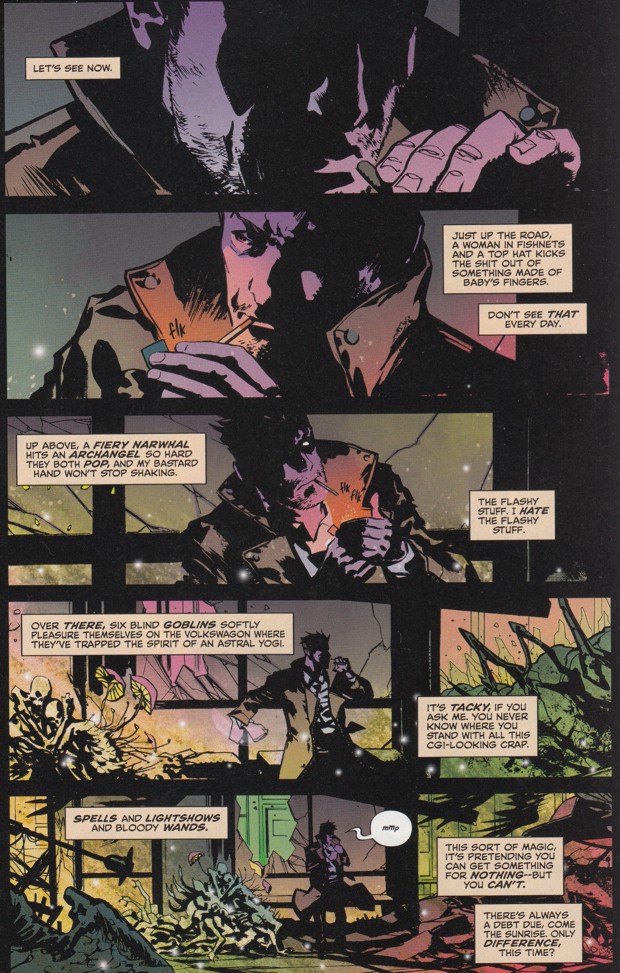
Bah! Always a debt do! PTUI!
Years of DC magic-users casting backwards spells and magicking up solutions to problems without a hint of "always a debt do" and then, suddenly, nobody can cast a fucking cantrip without paying out of pocket somehow. I get the "always a debt due" when you're dealing with demons or devils or some other kind of help from a summoned or black magic creature. But why the fuck must all magic cost something insane?! Just let Constantine do magic but occasionally he's got to deal with more powerful creatures or magicians who want something in return. Don't make him need to pay for every little thing he does.
Something has eaten the sun so Constantine writes the word "Fuck" all over a decapitated pig's head. Can a head be described as decapitated? Isn't that the adjective for the body? Or does it only refer to both parts after separation? Anyway, you probably knew what I meant! I mean about the pig's head being separated from its body and not about how Constantine writing "Fuck" all over it will help return the sun.
Something has eaten the sun so Constantine writes the word "Fuck" all over a decapitated pig's head. Can a head be described as decapitated? Isn't that the adjective for the body? Or does it only refer to both parts after separation? Anyway, you probably knew what I meant! I mean about the pig's head being separated from its body and not about how Constantine writing "Fuck" all over it will help return the sun.
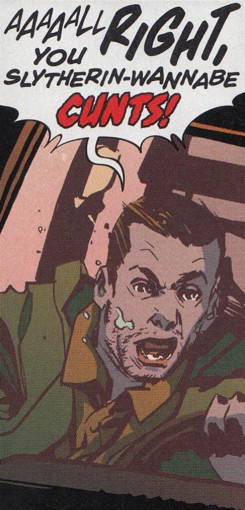
Wouldn't be Hellblazer without the C-word. Although is it appropriate? I'm reading this prior to the watershed.
That's Chas's brief cameo in this new series. You might wonder how I know it's brief. Well, I read the next page where Chas dies distracting the evil monsters so that the super heroes can get the sun back. It's the quickest way for Simon to let the audience know that Constantine will do anything to save the world, even betray his friends. Plus he makes sure to say, "I've done worse for less," just to drive the point home. It's one of those revelations that would have greater impact over a long run of multiple different story arcs. But modern comic books don't understand that kind of accrued history anymore. Things have to happen quickly and in comic book shorthand, before the comic is cancelled. Plus, who wants to wait five years for sixty issues worth of history and characterization?! Spurrier knows Constantine has years of characterization and history already built up! Why not shove all of that into the first few pages of this new series and move on from there?!
Constantine takes a bit of Chas's taxi cab shrapnel in the side and now he's probably dying. Sure, he could probably save himself by casting a spell that sends five babies to Hell. But first he has to find five babies! Instead, he just runs into young Tim Hunter from the past. John is all, "Oh, hey! Tim! Remember The Books of Magic? Remember Fairie? Remember how we all hated your stupid prat face? Anyway, this is your future and the bad guy ending the world is grown up you. Jerk." Tim Hunter is all, "That's me?! I wonder if I've been laid yet! Man, just think how much my older self's dick stinks!"
Tim Hunter goes off to, I don't know, sue J.K. Rowling or something, leaving Constantine to die. But before Constantine dies, he's visited by old man Constantine. If things seem a bit crazy, it's because Constantine kept mentioning something about the world going mad or everything leading to madness or something that I didn't mention. But now I'm mentioning it so that all of this weirdness makes sense.
Old Man Constantine wants John's soul in exchange for saving him. That's a pretty good deal, really! I'd totally go for it! Give up your soul to yourself way in the future? It's like putting it away for safe keeping! How the hell do you pass up that deal?!
Constantine takes a bit of Chas's taxi cab shrapnel in the side and now he's probably dying. Sure, he could probably save himself by casting a spell that sends five babies to Hell. But first he has to find five babies! Instead, he just runs into young Tim Hunter from the past. John is all, "Oh, hey! Tim! Remember The Books of Magic? Remember Fairie? Remember how we all hated your stupid prat face? Anyway, this is your future and the bad guy ending the world is grown up you. Jerk." Tim Hunter is all, "That's me?! I wonder if I've been laid yet! Man, just think how much my older self's dick stinks!"
Tim Hunter goes off to, I don't know, sue J.K. Rowling or something, leaving Constantine to die. But before Constantine dies, he's visited by old man Constantine. If things seem a bit crazy, it's because Constantine kept mentioning something about the world going mad or everything leading to madness or something that I didn't mention. But now I'm mentioning it so that all of this weirdness makes sense.
Old Man Constantine wants John's soul in exchange for saving him. That's a pretty good deal, really! I'd totally go for it! Give up your soul to yourself way in the future? It's like putting it away for safe keeping! How the hell do you pass up that deal?!
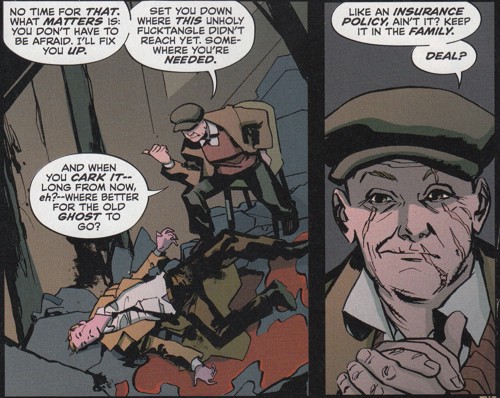
That was my point! Take the deal, mate!
Constantine thinks Old Man Constantine is probably a Constantine from another universe and that there'll be some kind of catch. But he's dying and he doesn't have much time to decide so he takes the deal. That'll probably be important later!
Old Man Constantine heals John, tells him to be the best John he can be, and then transports Constantine to some mental ward somewhere. Another universe without the sun being eaten? Maybe that was just the prologue to describe how Constantine leaped from the main DC Universe to the Black Label DC Universe. And now we can forget all of that Tim Hunter ending the world stuff that was so 1990s DC Vertigo weirdness. Now it's time for Constantine Unplugged! That just means he can say cunt again.
Constantine manages to talk his way out of Ravenscar psychiatric hospital and discovers he's in modern London where Brexit is happening. Or not happening. Or not not happening? I guess we'll find out the next chapter of Brexit after the special elections. Go Labour!
Old Man Constantine heals John, tells him to be the best John he can be, and then transports Constantine to some mental ward somewhere. Another universe without the sun being eaten? Maybe that was just the prologue to describe how Constantine leaped from the main DC Universe to the Black Label DC Universe. And now we can forget all of that Tim Hunter ending the world stuff that was so 1990s DC Vertigo weirdness. Now it's time for Constantine Unplugged! That just means he can say cunt again.
Constantine manages to talk his way out of Ravenscar psychiatric hospital and discovers he's in modern London where Brexit is happening. Or not happening. Or not not happening? I guess we'll find out the next chapter of Brexit after the special elections. Go Labour!
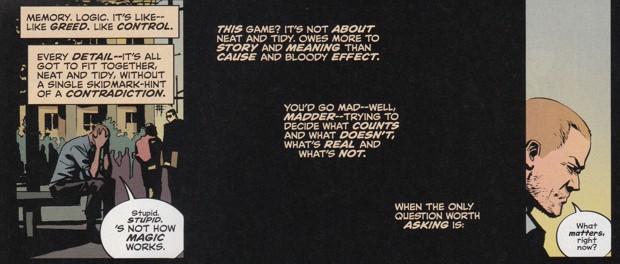
Constantine having a bit of a philosophical thought about his own entanglement in a comic book ret-con.
I feel bad for comic book fans who need a moment like the panels above to justify comic book continuity. Who dreams of having some kind of solid, historical timeline without any errors throughout? Especially when your main characters never age. What the fuck do they want? Magic?! Anyway, I think Spurrier does the best he can here dealing with the audience he knows he need to fucking explain every little thing to. He's just putting it right out front: "Yeah, Constantine has a bunch of memories that don't mesh at all and he's now in 2019 and he's in his thirties or something and yes he was heavily involved in the 70s punk scene and maybe just get over it, okay? You're reading a funny book about magic. Grow the fuck up."
Constantine finds Chas possessed by all the demons that meant to kill him years ago. He's dying of cancer from second-hand smoke and tells Constantine to fuck off and ruin somebody else's life. So John fucks off to go ruin somebody else's life. Or maybe to be a better version of himself. Or just to go drink himself into retirement.
Sandman Universe Presents: Hellblazer #1 Final Thoughts: I guess this is the Hellblazer #1 prologue introducing the new series starting this week in Hellblazer #1. That's going to be really confusing for my image tags if I forget that I labeled these images "Hellblazer1.jpg" and such. If the scans in this review don't seem to make any sense, it's because you're reading this a few months on and I forgot about the image tags and reused the same tags for John Constantine, Hellblazer #1 coming out this Wednesday (but which I won't probably review for another week or two). Sorry!
Constantine finds Chas possessed by all the demons that meant to kill him years ago. He's dying of cancer from second-hand smoke and tells Constantine to fuck off and ruin somebody else's life. So John fucks off to go ruin somebody else's life. Or maybe to be a better version of himself. Or just to go drink himself into retirement.
Sandman Universe Presents: Hellblazer #1 Final Thoughts: I guess this is the Hellblazer #1 prologue introducing the new series starting this week in Hellblazer #1. That's going to be really confusing for my image tags if I forget that I labeled these images "Hellblazer1.jpg" and such. If the scans in this review don't seem to make any sense, it's because you're reading this a few months on and I forgot about the image tags and reused the same tags for John Constantine, Hellblazer #1 coming out this Wednesday (but which I won't probably review for another week or two). Sorry!
Sunday, November 24, 2019
Batman Loves Superman #3
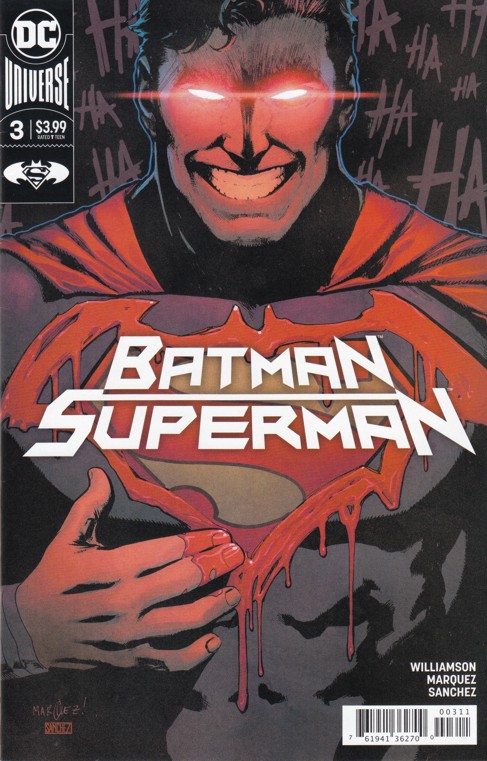
Superman rubbing his nipples raw.
Maybe in this issue, Batman will figure out who the infected super heroes are by looking at the Batarang molds. But then again, probably not. Or he could just look at the solicits in Previews to see what special one-shot Infected comic books are being released in the near future.
On the first page, Batman explains to the reader why he's an asshole.
On the first page, Batman explains to the reader why he's an asshole.
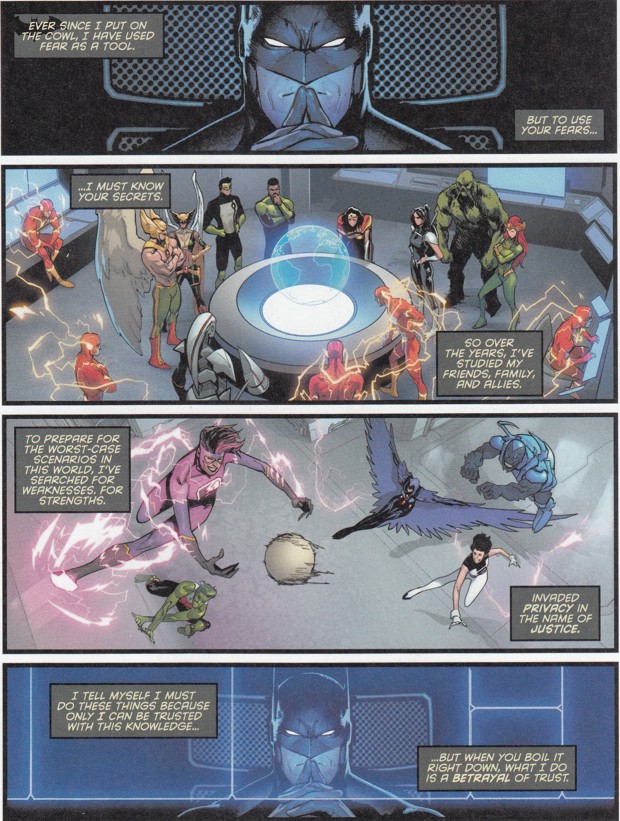
This is why writers should stay out of the heads of the heroes they write. Because they suck at understanding them and can't help projecting their own beliefs onto the heroes.
Have I mentioned that I don't care for Joshua Williamson's writing style?
In this scene, we see Batman explaining (to himself, I guess?) how trying to protect the world has led him down a dark path of invasion of privacy and broken trust. It's not totally Williamson's fault that he believes this is Batman. At some point, Batman became the greatest hero in the DC Universe because fangenders couldn't stop jerking themselves off about how he's just this normal man, you know, but he can defeat Superman! And to believe that, they had to believe that Batman is prepared to destroy every single hero in the DC Universe if it should come to that. Instead of just being this guy who is protecting Gotham and trying to serve justice, he's now this paranoid asshole who thinks he's the only person who can save the world. And being responsible for that means allowing yourself great latitude with your ethical and moral rationalizations. I'd argue that's not Batman though. That's what Batman has become as writers continually try to make sense of the character other writers have fucked up by trying to make sense of him.
The logic goes like this: Batman was just a guy with loads of money and no super powers. That made him pretty bad-ass. Fans loved him and he made DC a lot of money. Fans believed Batman was smart enough to defeat any hero with super powers and that's what made him so great. So writers began portraying him as being so prepared for any situation that he could defeat any hero gone rogue. DC loved to make heroes go rogue because they don't understand the point of their own heroes. But Batman was always there to stop them! Unless it was Batman who went rogue. But that hardly ever happens because who could stop Batman?! Once it was established that Batman was prepared to defeat any hero, writers began thinking, "Wait. That means Batman has a whole arsenal of weapons to use the heroes' weaknesses against them. Who does that?! A big jerk, that's who!" Which means now writers felt they had to deal with the side of Batman that was betraying the trust of his friends by constantly plotting against them. And the next step? To show Batman himself being aware of what a huge asshole he is and dealing with it!
Although if he saves the world, Batman doesn't really need to deal with the implications of his machinations, does he? He can just gloat and say, "I was right all along! Suck it!"
Last issue, I thought Superman had put on some Bat-Make-Up and gone undercover as a fake Joker version of himself. It turns out, he actually poisoned himself to do it because the risk was worth it, I guess? What a great plan! Have the most dangerous man in the world struggle against turning evil! Hey, why not? It's not like anything bad can happen because this is a story written by a writer who can decide, "Superman is stronger than the poison and what makes him so great is his will to do the right thing!" It's not like it's written by a writer who might think, "Why would Superman and Batman choose this course of action? It's way too fucking risky!"
Man, I wish this comic book were written by that writer.
Superman thinks, "Batman hates this plan. Too risky." But Superman was all in on this plan? Well, I'm glad to know Superman is a bigger asshole than Batman in this comic book. Fucking arrogant bastard is willing to risk the entire world because, as Batman states as his reason to go along with this plan, "We're out of options." Are you though? Are you really? The Joker Who Laughs was captured and the only option was to free him? What about looking at the fucking molds to see what other symbols were carved on the Batarangs-That-Laugh?
Okay fine. I guess I'll just accept that the symbols were carved onto the Batarangs-That-Laugh after they were molded. Although I'm absolutely certain that Josh Williamson never even considered it and he actually just fucked up the entire mystery by putting those symbols on the stupid things.
Of course, The Batman Who Laughs knows they're trying to play him because he's an evil genius and that's the only way a mediocre writer knows how to write one. Wouldn't it have been nice to see the plan actually work for once and they get some information they can use out of him and The Batman Who Laughs says, "What?! No! How dare you?!" And then he escapes to try to escalate his plan because now the good guys know some of the extent of it? No? You'd rather have this trite, overdone bullshit? Okay, okay! I guess I'm wrong! Calm down!
Continuing with this intriguing story that has me so intrigued my butthole has been clenched for the last ten minutes, Batman figures out another person infected by the Batman Who Laughs toxin is Commissioner Gordon. He figures this out from a clue given to him by The Batman Who Laughs. I figured it out two issues ago when Gordon laughed. Jeez, Batman. Take a detective course at Gotham Night College.
In this scene, we see Batman explaining (to himself, I guess?) how trying to protect the world has led him down a dark path of invasion of privacy and broken trust. It's not totally Williamson's fault that he believes this is Batman. At some point, Batman became the greatest hero in the DC Universe because fangenders couldn't stop jerking themselves off about how he's just this normal man, you know, but he can defeat Superman! And to believe that, they had to believe that Batman is prepared to destroy every single hero in the DC Universe if it should come to that. Instead of just being this guy who is protecting Gotham and trying to serve justice, he's now this paranoid asshole who thinks he's the only person who can save the world. And being responsible for that means allowing yourself great latitude with your ethical and moral rationalizations. I'd argue that's not Batman though. That's what Batman has become as writers continually try to make sense of the character other writers have fucked up by trying to make sense of him.
The logic goes like this: Batman was just a guy with loads of money and no super powers. That made him pretty bad-ass. Fans loved him and he made DC a lot of money. Fans believed Batman was smart enough to defeat any hero with super powers and that's what made him so great. So writers began portraying him as being so prepared for any situation that he could defeat any hero gone rogue. DC loved to make heroes go rogue because they don't understand the point of their own heroes. But Batman was always there to stop them! Unless it was Batman who went rogue. But that hardly ever happens because who could stop Batman?! Once it was established that Batman was prepared to defeat any hero, writers began thinking, "Wait. That means Batman has a whole arsenal of weapons to use the heroes' weaknesses against them. Who does that?! A big jerk, that's who!" Which means now writers felt they had to deal with the side of Batman that was betraying the trust of his friends by constantly plotting against them. And the next step? To show Batman himself being aware of what a huge asshole he is and dealing with it!
Although if he saves the world, Batman doesn't really need to deal with the implications of his machinations, does he? He can just gloat and say, "I was right all along! Suck it!"
Last issue, I thought Superman had put on some Bat-Make-Up and gone undercover as a fake Joker version of himself. It turns out, he actually poisoned himself to do it because the risk was worth it, I guess? What a great plan! Have the most dangerous man in the world struggle against turning evil! Hey, why not? It's not like anything bad can happen because this is a story written by a writer who can decide, "Superman is stronger than the poison and what makes him so great is his will to do the right thing!" It's not like it's written by a writer who might think, "Why would Superman and Batman choose this course of action? It's way too fucking risky!"
Man, I wish this comic book were written by that writer.
Superman thinks, "Batman hates this plan. Too risky." But Superman was all in on this plan? Well, I'm glad to know Superman is a bigger asshole than Batman in this comic book. Fucking arrogant bastard is willing to risk the entire world because, as Batman states as his reason to go along with this plan, "We're out of options." Are you though? Are you really? The Joker Who Laughs was captured and the only option was to free him? What about looking at the fucking molds to see what other symbols were carved on the Batarangs-That-Laugh?
Okay fine. I guess I'll just accept that the symbols were carved onto the Batarangs-That-Laugh after they were molded. Although I'm absolutely certain that Josh Williamson never even considered it and he actually just fucked up the entire mystery by putting those symbols on the stupid things.
Of course, The Batman Who Laughs knows they're trying to play him because he's an evil genius and that's the only way a mediocre writer knows how to write one. Wouldn't it have been nice to see the plan actually work for once and they get some information they can use out of him and The Batman Who Laughs says, "What?! No! How dare you?!" And then he escapes to try to escalate his plan because now the good guys know some of the extent of it? No? You'd rather have this trite, overdone bullshit? Okay, okay! I guess I'm wrong! Calm down!
Continuing with this intriguing story that has me so intrigued my butthole has been clenched for the last ten minutes, Batman figures out another person infected by the Batman Who Laughs toxin is Commissioner Gordon. He figures this out from a clue given to him by The Batman Who Laughs. I figured it out two issues ago when Gordon laughed. Jeez, Batman. Take a detective course at Gotham Night College.
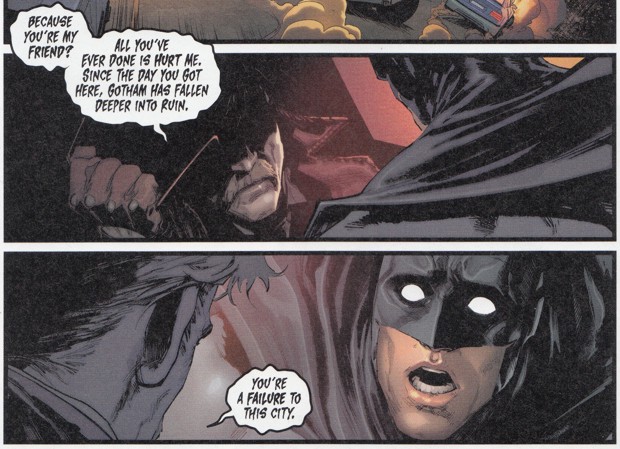
Batman is shocked — SHOCKED! — to discover somebody on the Batman Who Laughs toxin can be so darn mean.
The size of the above image, when I first scanned it, was 1776 pixels. That made me realize how crippling it must be for all those people who call into shows like Coast to Coast radio who see meaning in every fucking number they come across. I guess the above image was patriotic. Right up until I resized it down to 620 pixels! I know that statement would have had more impact if I resized it to a number that actually meant something (aside from the founding of Cholula, Mexico, of course).
Gordon's stupid argument (it's also crazy because he's on stupid crazy toxin) is that Batman is the cause of all the chaos in Gotham. Obviously that's wrong but Batman's defense composed of jumping on Gordon's van and causing him to careen wildly about the streets and running people off the road before he yanks Gordon out of the van to send it crashing into a small pile of children isn't great. I mean, I don't know if the van hit a small pile of children or not. The point is, Batman doesn't fucking know what it crashed into either. This scene shows why writers blame Batman for causing all of the chaos in Gotham. It's because idiot fucking writers write him causing fucking chaos in Gotham. Then they blame the character they made do those things! Fucking fuckers!
Gordon's stupid argument (it's also crazy because he's on stupid crazy toxin) is that Batman is the cause of all the chaos in Gotham. Obviously that's wrong but Batman's defense composed of jumping on Gordon's van and causing him to careen wildly about the streets and running people off the road before he yanks Gordon out of the van to send it crashing into a small pile of children isn't great. I mean, I don't know if the van hit a small pile of children or not. The point is, Batman doesn't fucking know what it crashed into either. This scene shows why writers blame Batman for causing all of the chaos in Gotham. It's because idiot fucking writers write him causing fucking chaos in Gotham. Then they blame the character they made do those things! Fucking fuckers!
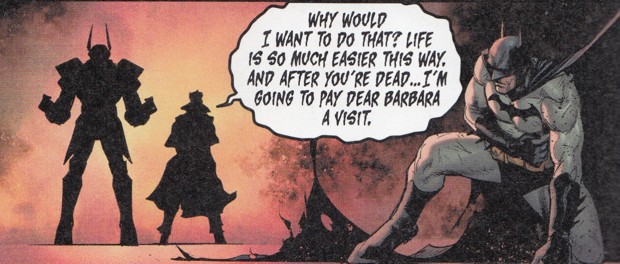
Is this a reference to The Killing Joke? Is Gordon threatening to shoot his daughter in the back, take naked torture Polaroids of her, and then God knows what else? Is Joshua Williamson that disturbing of a human being? Hmm, maybe I finally respect him.
Superman arrives to help by destroying Gordon's Batsuit and Batman is all, "I'd rather die than get help from you!" But even though he says that, he remains alive so I suspect he actually kind of likes getting help from Superman. Gordon reveals his main complaint about Batman is the way Batman leaves in the middle of every conversation. It's an obvious joke to make but I'd suggest maybe this particular moment isn't the time for jokes! No wait. It's exactly the right time for jokes! Man, The Joker is confusing. Am I supposed to be scared and tense or doubled over in laughter? Maybe if Batman just laughed at a few of The Joker's jokes once in a while, The Joker would calm the fuck down.
Instead of throwing Gordon's Batsuit into the bin behind the police station, Superman and Batman decide to overthink it. "Why would Gordon get out his Batsuit?" they wonder instead of thinking, "I guess Gordon needed extra fire power to battle us. But since Superman turned the Batsuit into a pile of metal, who cares? Get rid of it." Instead of assuming the obvious, they decide to take the suit back to the Fortress of Solitude to examine it. Examine it for what? Gordon was infected and he used his suit because he's a powerless old man. And guess what? That's just what the Batman Who Laughs wanted them to do! His plan was to realize that Superman and Batman would think the armor meant more than it does. And because of that, it does! Because hiding inside of it is Infected Blue Beetle! Ha ha! They fell right into his trap! What dumbies!
Don't think I'm infected because I typed "Ha ha." I assure you, I wasn't really laughing. Or amused in the slightest. I was more sort of exasperated and angry that Williamson wrote such an unbelievable plot point just to get Blue Beetle inside the Fortress of Solitude to take it over.
Batman Loves Superman #3 Final Thoughts: I hate myself because I'm going to keep reading this comic book. It is not well thought out at all. Sort of like my life which is maybe why I'm so intrigued by how it makes me feel (which is a kind of mix between self-loathing and horniness).
Instead of throwing Gordon's Batsuit into the bin behind the police station, Superman and Batman decide to overthink it. "Why would Gordon get out his Batsuit?" they wonder instead of thinking, "I guess Gordon needed extra fire power to battle us. But since Superman turned the Batsuit into a pile of metal, who cares? Get rid of it." Instead of assuming the obvious, they decide to take the suit back to the Fortress of Solitude to examine it. Examine it for what? Gordon was infected and he used his suit because he's a powerless old man. And guess what? That's just what the Batman Who Laughs wanted them to do! His plan was to realize that Superman and Batman would think the armor meant more than it does. And because of that, it does! Because hiding inside of it is Infected Blue Beetle! Ha ha! They fell right into his trap! What dumbies!
Don't think I'm infected because I typed "Ha ha." I assure you, I wasn't really laughing. Or amused in the slightest. I was more sort of exasperated and angry that Williamson wrote such an unbelievable plot point just to get Blue Beetle inside the Fortress of Solitude to take it over.
Batman Loves Superman #3 Final Thoughts: I hate myself because I'm going to keep reading this comic book. It is not well thought out at all. Sort of like my life which is maybe why I'm so intrigued by how it makes me feel (which is a kind of mix between self-loathing and horniness).
Subscribe to:
Posts (Atom)