Monday, August 4, 2025

The Stand (Complete and Uncut (Hee hee!) Edition) by Stephen King (1978/1990)


I just finished re-reading The Stand after more than 30 years of having not read it again. If I were Stephen King, I would have called the book The Long Walk but I guess he couldn't because his alter ego was busy on a story with that same exact title at the time. Maybe A Long Walk with a Dog?

The first time I read The Stand, I remember thinking, "What the fuck? The good guys didn't do shit but take a long hike with their dog. Randal Flagg and all his cronies fucked up a bunch and then Trash Can Man took them all out himself." The heroes of The Stand were the most passive yet horny heroes of any book where good faces off against evil. But this time, I realized that their strength was simply in their resistance (and possibly their horniness). Was The Stand a novel about the success of passive and non-violent resistance movements? Because the only actions the heroes take against Flagg are being killed by him and his goons in ways that make Flagg mad and make his people less confident in him. I suppose if I were gullible, naïve, or earnest-minded, maybe I wouldn't sneer at the thought that God was the real hero of the book. Maybe The Turtle from It was the real hero of The Stand? Was The Turtle still alive at this time? Or had it already choked on its own sick?

Anyway, my favorite part was when the nerd got to have butt sex with the hot older kindergarten teacher. Although later he tried to shoot her in the face and I just want to make it known that I didn't think that was cool at all.

Thursday, July 31, 2025

The Shining by Stephen King (1977)


First and foremost in Stephen King's mind must be this thought: "Psychic powers are terrifying!" Carrie is about a psychic girl who burns down her hometown because nobody likes her. The Shining is about a psychic boy on vacation. The Dead Zone is about a psychic man who enacts an elaborate form of suicide because the woman he loved married some other guy while he was napping. Firestarter is about a psychic girl who hates to set things on fire but still sets a lot of things on fire. Christine is about a psychic car, I think. The Stand is about a psychic cool guy and a psychic old lady who divide up the last people in America for a game of war. 'Salem's Lot might be the only early Stephen King book that isn't about a psychic because it's about a gay vampire couple who just absolutely obliterate real estate values when they move into town. Also vampires are kind of psychic so, you know.

Another thing Stephen King believes must be a key aspect of horror is that the main character should be a writer and/or teacher. Mostly that's because he was a writer and/or a teacher and he probably didn't want to research other jobs. Researching other jobs is almost as boring as actually doing them so I get it. Most of the main characters in my fictions are people in comas.

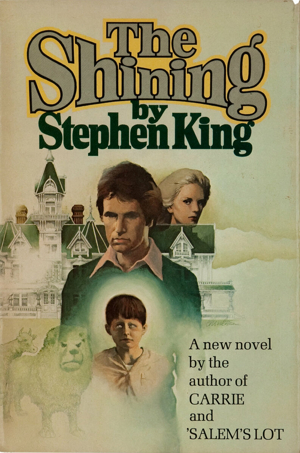
If it were 1977 and I was at the grocery store standing in front of the books (oh? You didn't know grocery stores sold books at one time? They probably did!), I would never in a million years purchased this book. What was Dave Christiansen thinking?! The original cover is a fucking disaster! Why is there a fucking cow on it?! And is that supposed to be a lion? Maybe it's a Chow Chow but who fucking knows? If I were Dave Christiansen, I would blame the gardener in the book who sculpted the hedges to look like various animals. "I know how to draw a lion or dog! But that gardener sucks at hedge sculptures!"

And what's up with Danny Torrance?! Is he terrifying because he has white eyes or is he terrifying because he's an ugly little snot with a terribly fucked up haircut? Why is Wendy hidden behind the house?! And why don't any of the characters look like they did in the movie?! That's the part that's really fucking with me!

Am I in the minority of people who believe the movie was fifty-bajillion times better than the book? The hedgerow ending is way better than the boiler blowing up even if the heater blowing up is just a metaphor for Jack Torrance's temper. In the book, he's an angry drunk and the way he dies relates to being drunk and angry and too much pressure on him. In the movie, he's drunk and angry but also lost which makes him more sympathetic. Also Danny looks like a way better bad-ass in the movie pulling the backtracking in the snow stunt over Danny in the book who, I don't know, just kind of makes Jack forget about the boiler?

The only part of the book that's better than the movie is that Scatman Crothers gets to live. But then he wasn't Scatman Crothers in the book so why would I care if he lives? Man, I fucking loved Scatman Crothers as a kid. He's one of the main reason I loved Scavenger Hunt so much! Along with every single other aspect of the movie, of course (including Schwarzenegger).

I might be forgetting some of the things I really loved about the book because I read it months ago and forgot to do my review immediately after so now I'm mostly thinking about the movie and Doctor Sleep. I remember appreciating that Jack was going nuts based solely on Jack being kind of an abusive asshole and the hotel not having to do much to influence him. At first I thought, "This is much better than in the movie where the ghosts get him liquored up and he can then blame the drink! This is all on Jack since there is no alcohol in the bar!" But then there's another scene in the lounge and Jack gets drunk from ghost liquor and then I was all, "Well, fuck, that sucks. Whatever."

The topiary animals aren't just terrible on the cover. I fucking hated that aspect of the haunted hotel. Just really fucking stupid. I'm surprised there was never a director's cut of Kubrick's film that was released after computer generated special effects could have enabled the topiary animals and the scene was reinserted. If only Kubrick had filmed the scenes with people in terrible animal hedgerow costumes that could have been replaced by the computer animation later. Like George Lucas did with Jabba in his re-release of Star Wars! Man, that would fucking blown! But in a really hilarious terrible way that I could have appreciated.

The movie can still terrify me when I think about it sometimes in the dead of night. Just like the images of the vampires in the made-for-television 'Salem's Lot movie. But when I think about this book? Nothing. Nada. Zip-o-rooni tunes. Not scary in the slightest. It's about a father that gets drunk in isolation with his family, treats them bad, and then explodes. Good riddance! I suppose in that context, I love the book! Can't get enough of a terrible father getting his comeuppance tale!

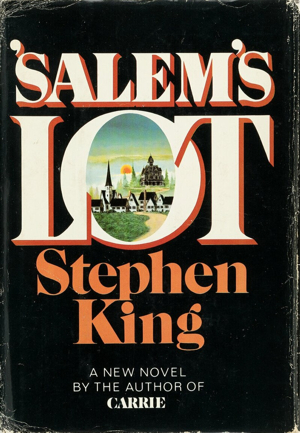
'Salem's Lot by Stephen King (1975)


Carrie ends with the entire town being burned to the ground. 'Salem's Lot ends with the entire town about to be burned to the ground. Did Stephen King's creative writing teacher tell him that this was the best way to end a story? King even has a scene where Ben, the main character who is a writer, burns his manuscript based on Jerusalem's Lot instead of finishing the book. Has anybody checked to see if King's college alma mater isn't just ash and smoldering ruins?

At least The Shining is his next book and we all know that one won't end with the entire setting being burned to the ground because we've all seen the movie and it ends in a snowy hedge maze instead!

This book is the print version of a snuff film. That's not a complaint, by the way! Not that I have ever seen a snuff film nor do I think I would enjoy it. I'm just writing a review! King spends the first half of the book making sure the reader gets to know every single resident of Salem's Lot so that he can spend the second half of the book killing them in ways that make you go, "Who is this again? Oh! It's the jerk bus driver, I guess." Maybe people who remember names better than I do didn't have as much trouble remembering that Ruthie Crockett was the high school girl with the nipples and Sandy McDougall was the baby puncher and Charles Rhodes was the kid hating bus driver. Anyway, they all die. That's sort of a spoiler but not really because I'm pretty sure the first chapter lays out plainly that pretty much everybody died but one guy and one boy.

For a vampire book, there weren't enough homoerotic scenes for my tastes. Hmm, maybe I should do a review of The Tale of the Body Thief. That's one of the best books about how people commit acts to ensure that they never lose the person they love but those acts actually cause them to lose the person they love. Lestat probably should have been more like Barlow. Although we never really get to experience Barlow's feelings towards Straker. I bet there were some longing romantic looks over torn out children's throats in that household.

Stephen King spends an inordinate amount of time with his characters trying to convince themselves and others that this vampire invasion is a reality. It's a modern conundrum King has to navigate in that he realizes his characters would know all about the myths and fictions of vampires and it would be insane for them to not question the evidence piling up all around them. It's almost like modern writers having to figure out how to deal with cell phones in modern horror and suspense films. To make it realistic, you have to deal with the questions which will be foremost in the reader's minds. "How would an actual person react to evidence that somebody might be a vampire?" I think I'd probably be like the sheriff. I'd realize something was wrong and slowly realize what was wrong was that vampires were all over my town and then I'd crack and run screaming. You want to be a hero? Then you can end up impaled on knives at the bottom of some boarding house cellar! Bravo! You were brave!

All in all, this was a solid Stephen King book. It also may have had the first appearance of Pennywise in Callahan's childhood memory of Mr. Flip staring at him from out of the closet.

P.S. Hey, Internet. Look up dramatic irony and the concept of jokes before you correct me about the ending of The Shining!

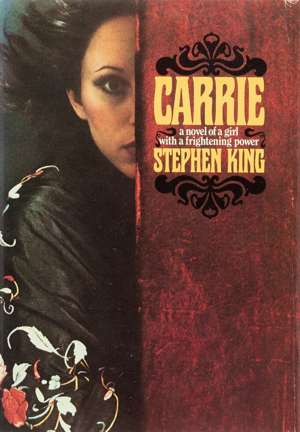
Carrie by Stephen King (1974)


If I remember correctly (which I don't always), Kurt Vonnegut said something, somewhere, about being interested in all the characters of stories. Maybe Breakfast of Champions says something about this. I don't know. It's been a long while since I've read it. And this isn't about a Kurt Vonnegut book anyway. But it's smart of me to begin by hinting that I've read loads of Kurt Vonnegut, right?! Maybe it's smarter not to even hint about it: I've read all of Vonnegut's books. I even understood like half of them.

The point I was getting at was how stories which tell the tale of a protagonist at the expense of all the people in the background whose lives are harmed or complicated or uplifted by the protagonist's actions are shallow at best. I have never been able to enjoy action-packed blockbusters where the characters the camera follows live through the huge natural disaster while thousands of others die. Am I not supposed to care about any of the other casualties? Am I supposed to feel uplifted at the end that The Rock lived? I guess I am supposed to but I never actually am.

What this has to do with Carrie is that Stephen King's book isn't about a girl with telekinetic powers. It's about a town and the people who drove Carrie to do what she did and the people who wanted to help but didn't do enough and the bullies behind it all as well (always bullies in a King novel. He, for one, knows who the true antagonists of the world are. Is it Pennywise? Or is it really Henry Bowers?).

King's first novel is surprisingly more postmodern than I'd remembered (I mean, I first read it when I was 15. What did I know of postmodern?! Hell, I'm 50 now and what do I know of postmodern?!). The story is told across a variety of texts: books written after the event, transcripts of commissions trying to get to the bottom of it, books written by Carrie's peers, AP news stories. We don't just see the events unfold from Carrie's point of view. We practically see the entire town's point of view.

My favorite bit about King's style is how he somehow learned early as an author that withholding information from the reader was hack writing. I've read a lot of comic books through the years and the worst thing a writer can do is have some unnamed nemesis, allowing characters to see who it is by showing the back of the head on panel while the hero croaks, "You!", but never letting the reader know. Expecting that the reader's need to find out the answer is what will keep the reader intrigued. They don't realize that giving answers is more satisfying to the reader and giving an answer just expands the questions in the reader's mind. That keeps the reader engaged. King somehow realized this with his first novel. It's not a third of the way through the book and King has already mentioned what happened to the town on the night of prom. He's mentioned the death count. He often ends some section of story through a character's point of view with the ending summation about how they have less than two weeks to live. It's pure chaos! King's just all, "Here! You want to know how it ends? Badly! Really badly!" And then he expects—he somehow knows—that this will just keep the reader further engaged, more excited to see how Carrie turns the town into a smoldering ruin.

Oh yeah! The characters! King treats nearly all the characters that interact with Carrie in nearly any way, no matter how miniscule, as fully formed people. The respect he shows to every character in this book deserves a grand metaphor that I can't come up with. Is the book about Carrie? Yes. Is it about Sue Snell? Yes. Is it about Tommy? Yes. Billy? Yes. Chris? Yes. Momma? Yes. Teddy Duchamp? Well, no, but it was surprising to see that name! I think King just liked the name so much he used it again later for "The Body." The book is simply about all of them in a much bigger way than most books with a cast of characters allows the plot and themes to be about all of the characters. Carrie should have overshadowed everybody in this book. That she didn't just exposes, so early in his career, King's mastery of storytelling.

Being King's first novel, it suffers from all the weird King crap that all of his future novels will suffer from! I'm not here to write an essay on King's flaws. I mean, his flaws are partly what made him so popular. He says and does things in ways that no other author (or editor! Who is the champion editor that kept all that slack in King's writing leash?!) would do. Because they're grossly expressed. Or weirdly stated. Or seriously off-putting. I've already returned my ebook to the Multnomah County Library so I can't go back to find examples. But there are things like an article about people who knew Tommy and how, in a parenthetical reference, King writes, "A lot of people referred to him as a good shit." But not that! It was worded really strangely. I wish I'd kept the exact quote because it's such a weird sounding bit of slang that it may have worked fine with one person having said it but saying "a lot of people" said it just made me roll my eyes in the way that I love to roll my eyes when King is making up some cool slang. Maybe it was slang in use in Maine in the 70s but if so, I don't trust Mainers.

The book might also have been about menstruation and how menstruation is not only a sign of fertility and the beginning of life but also, starkly, a sign of the end of or loss of life when considered from the view of somebody miscarrying. Miss Carry ing? is that a thing? No, you know what, never mind. This review is done!

P.S. This part of the review isn't in my original review I posted on Goodreads because I just thought of it thanks to my lame joke at the end. Could this book be about Carrie's mother miscarrying Carrie? Is the book about her mother's hopes and dreams of her child that end in a torrent of blood and misery and grief? The evidence for this isn't actually in the book. The evidence for this is in Danielewski's House of Leaves which might possibly be telling the same kind of story: Pelafina loses Johnny Truant at birth and his entire life is made up by her while in The Whalestoe asylum. He was her little boy that she lost. He was truant. The five and a half minute hallway that his sister Poe sings about, the choking of Johnny by his mother in the foyer of their home (you know, the entrance/exit to the womb), are all metaphors for strangling during birth. At the end, Johnny remembers his mother's final words before letting him go. But not knowing Latin, he hears them phonetically: Etch a Pooh Air. Behold, a boy. Did King beat Danielewski to the punch with the mother's delusional life dream of her child lost at birth (or by miscarriage)?! Um, probably! I'm smart!

Wednesday, July 30, 2025

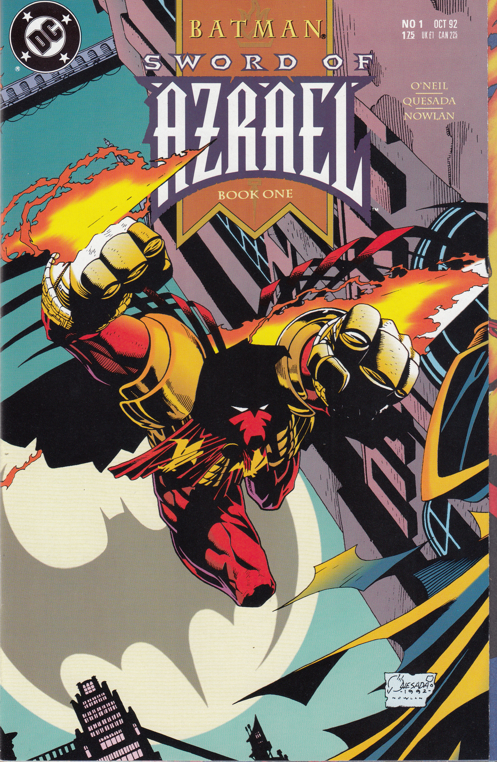
Batman: Sword of Azrael: Book One #1 (October 1992)


If you love this comic book, I ask you to turn away now. I'm going to hate fuck it so hard!

Now, I'm not entirely sure that I'm going to hate fuck this comic book so, for the moment, I'm going to put my anger dick away. I don't particularly remember any details about this comic book. But I do remember that I couldn't fucking stand the Cousin Oliver little shit who becomes Azrael. I probably never gave this character a chance because I hated him so fucking much. Maybe not as much as I hated Danny Chase but it was probably pretty close. If that twat is already Azrael in this comic (which it appears he is), maybe my rage will remain caged? Who knows? The adventure of life is discovering things that fill us full of various emotions, that wrench us outside of the status quo comfort of our daily lives. Perhaps in the heat of my hate, I will rediscover the passion I once had for life! Maybe that's why so many people actively fill their lives with drama? Because it makes life so rich and full! And also awkward and uncomfortable and a real pain in the ass. I don't get loving drama but then, I guess, some people only subconsciously love drama and they don't realize that they constantly sabotage shit to feel alive. Is that a kind of Munchausen Syndrome? "My life is sick and also I didn't make my life sick it just happened to get sick why are you looking at me like that i'm telling you the truth! i think it's dying and you're asking me why i have so much antifreeze in my kitchen?!"

Small Bit of Eee! Tess Ate Chai Tea Trivia: This is the first comic book I've reviewed written by Dennis O'Neil. Also the first comic book drawn by Joe Quesada!

Much More Extremely Smaller Bit of Eee! Tess Ate Chai Tea Trivia: Also the first book inked by Kevin Nowlan.

I can't tell you if it's the first comic lettered by Ken Bruzenak because I don't keep track of the letterers. Some people make a point of praising letterers but I'm going to stick to my guns and not give a shit about them, no matter how important they are to the finished work. One cannot be made to care about everything! If you're such a champion of letterers, go write your own blog where you praise the shit out of them. Just don't contact me when you realize you've run out of ways to describe their work! "Oh, it's so competent! Incredibly legible! Fantastic? More like fontastic!" But if you do contact me, I'll just respond like so: "Ah ha ha ha ha! Mortal fool!"
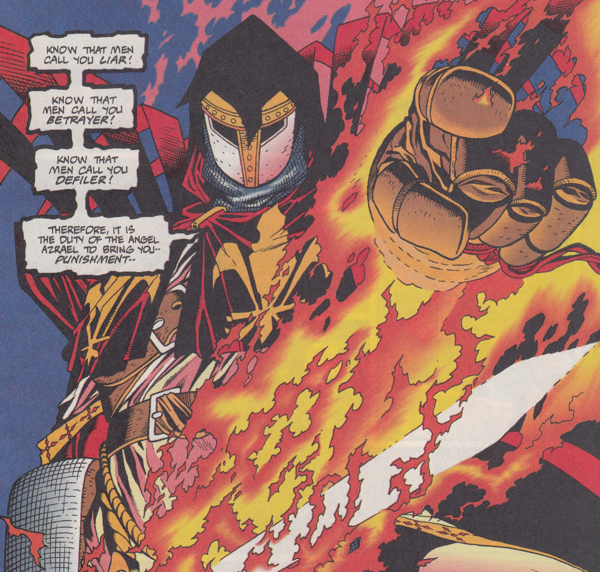

What the fuck did I do?!

Oh wait! Az is pointing accusingly at another comic book character and not directly at me. Heh. I actually knew this comic book character wasn't talking to me because I am not a liar. I mean, maybe that's not true but I'm certainly not a betrayer. Or, at the very least, you can't definitely say I've ever defiled anything. At least not on camera. Oh, um, also he's a second dimensional character while I'm a third dimensional sentient being which means while I can observe him and talk to him all I want, he cannot see me, talk to me, or even hear me. That's probably the better argument because then I don't have to poorly defend his accusations to prove he wasn't speaking to me because he almost certainly wasn't. Right?

Quesada's art and layouts on this thing are so fucking crowded that they remind me of Chris Bachalo's work on Steampunk. I should probably come up with a comparison that more people know so they could exclaim "Oh yeah! I see that!" instead of "What the fuck is Steampunk?" The main difference is that a Steampunk page, while crowded, looked like a complete work of art, as if all the swirls and flourishes added to the sense of it all. Quesada's pages just look like somebody dropped a bunch of really violent postcards to different vacations sites on the ground.
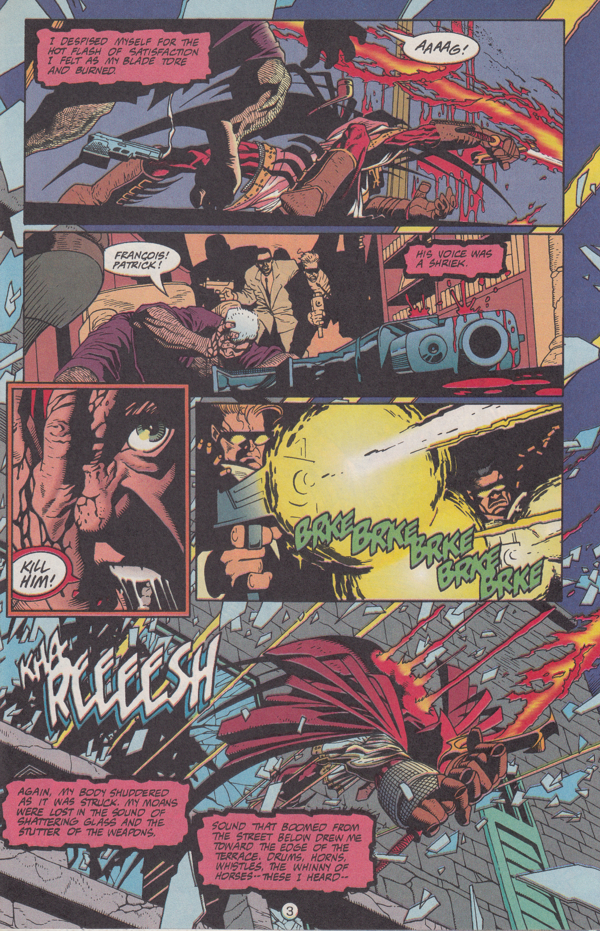

I'm not complaining! I'm just describing! Remember, my anger dick is still tucked away in my pants.

Now that I've scanned just that page without the facing page adding to the chaos, it doesn't strike me as quite as crowded as seeing them together. The logic of that statement is just off the charts but I'm leaving it in! "So this comic book I'm reading, if you look at two pages at once, there's a lot more going on than if you look at just one page! Ever noticed that?!"

That guy holding his bleeding eye socket where Azrael's burning sword just was? I don't know who he is. But Azrael dropped in to kill him for being a liar, a betrayer, and a defiler, so I'm going to assume he's the bad guy. Mama didn't raise no fool nor a man who is equipped to be on a jury. But while Azrael dropped by with a flaming sword, this man had a gun with bullets that could pierce Azrael's body armor. So Azrael takes three bullets to the chest. When he's shot by the guys with Uzis, I'm going to assume they didn't have the power to penetrate his body armor so he probably still has a chance to live if he can throw himself out of the window and fall forty feet to the ground in time. And, um, softly?

Luckily there's a parade going on in the street outside so four or five baton twirlers break his fall.
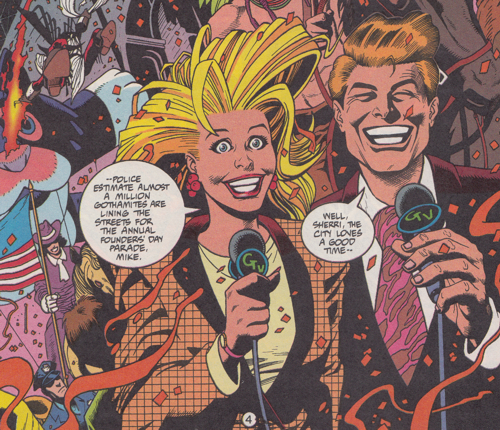

Does T.O. Morrow run the local Gotham news network?

That's a joke about these reporters looking like robots. If I knew who was the most famous person in Gotham for making sex dolls, I would have used that person's name instead of the guy famous for robots. Oh wait! Dammit! Professor Pyg!

Some readers might be thinking, "If you suddenly came up with the sex doll maker's name, why don't you just re-edit this and use the joke you say you wanted to use in the first place?" To them I say, "You might be too stupid to read really stupid Internet comic book reviews." Now that I've said that, it's up to you to come up with why I kept the bit in that I wanted to keep in and not the bit I said I wanted to think up in the first place. It's an easy assignment because I'm telling you that I wrote exactly what I wanted to write. Oh, and don't send me your homework. Just work it out in your head (probably in the shower since that's the only place anybody seems to be able to think anymore because their minds are always scrolling their phones). I don't need to hear your conclusions.

Speaking of phones, you know how people hate AI for what it's doing to people's ability to think for themselves and come up with their own arguments and it ultimately is going to make everybody dumber? That's the way I've felt about cell phones for, like, ever. It's just people feel they can hate AI because there's enough pushback against it. But mostly everybody just accepted phones and how dumb they're making everybody and so if you say what I'm saying here, people will hate you forever. "Oh no! He criticized a thing that I've been using most of my life and it's just part of my life and he says I'm dumber! What a fucking prick!" Yeah, maybe I am. But you're still dumber for attaching yourself to that tech.

Azrael swings onto a parade horse and races away, trampling the sexbots in the process.
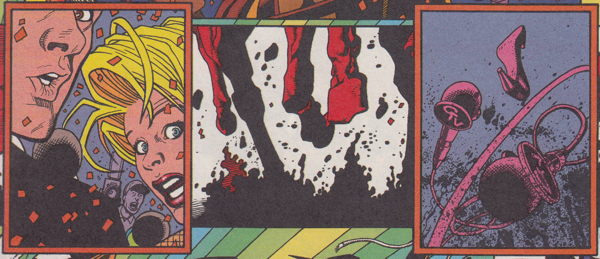

They must be really high end sexbots. Look at all the blood and gore they produce when trampled!

It's not that I don't think cell phones don't have their uses! Airport pick ups now that you can't meet your friends and family at the gate? Cell phones are invaluable! But you don't need to constantly be connected to everybody and you don't need a device that keeps you from feeling the need to ever really know anything because, hey, you can look it up on your phone! Also, great for taking pictures and videos of your cats and posting them on the Internet. 10/10 application. Probably why I'm like, "Okay, fine, I won't complain too much! Look at the kitties!"

I also just realized I probably say this a lot too: "Okay, fine, I won't complain too much! Look at the titties!"

It's a good thing this comic book is about Azrael and not about those news reporters or else it would be over already! I wonder if anybody cares that two plastic talking heads were just killed while doing a puff piece in Gotham? Probably not. Maybe a few Facebook tributes with myriad comments from people's creepy uncles saying things like, "Man, those titties! What a loss!"

Azrael stumbles through a back alley on his way to whoever the fuck patches him up after debacles like this.
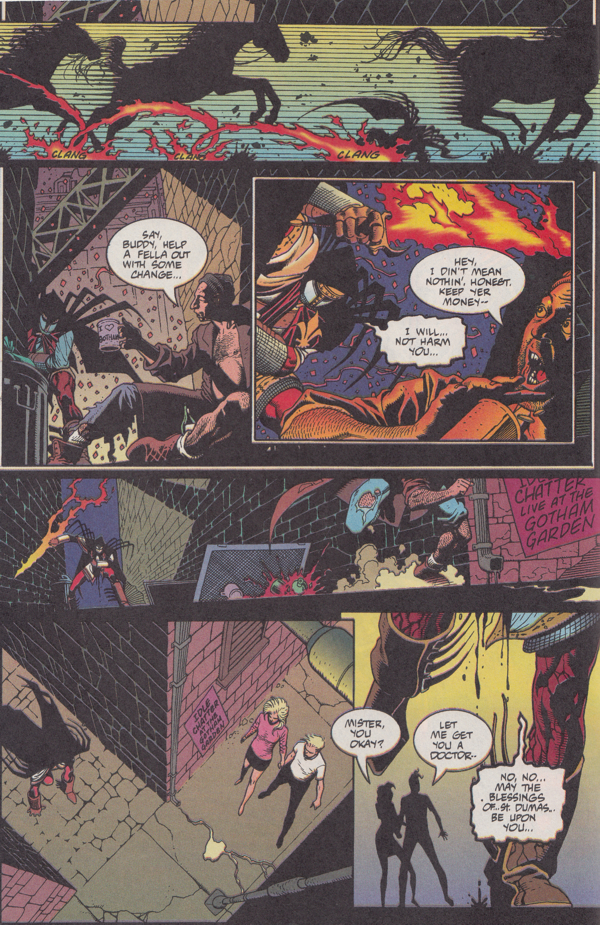

Didn't I recently read this comic book?!

I recently read The Crusades if anybody was wondering what I meant by that caption. It had a lot of scenes just like this one! Too bad it was written ten years later so I can't accuse O'Neil and Quesada of plagiarism. My anger dick twitched but I was all, "Calm down, buddy! These guys couldn't have copied The Crusades and if The Crusades copied them, it's too fucking late to rage about it!" Also, just because two things are similar isn't a reason to automatically assume somebody copied somebody else! That's almost always an accusation by the unimaginative who think it makes them sound smart to say, "Look at this! I noticed similarities between two different things in life! I am so observant and smart!"

Azrael manages to drag himself to the door of his son. His son answers and my dick pops out of my fucking pants and screams, "It's showtime!"
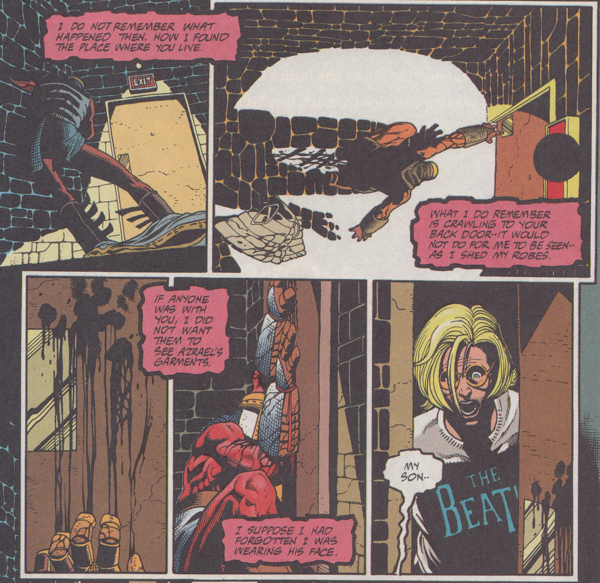

MOTHER FUCKING COUSIN OLIVER PIECE OF SHIT!

Cousin Oliver's father dies in front of him after giving him a few instructions on how to keep the identity of Azrael secret and how to become the new Azrael and probably directions to the Brady house where he'll be living from now on.

Meanwhile at Wayne Manor, creepy uncle Bruce Wayne is all, "I really liked that reporter's tits so I'm going to investigate her death, Alfred."
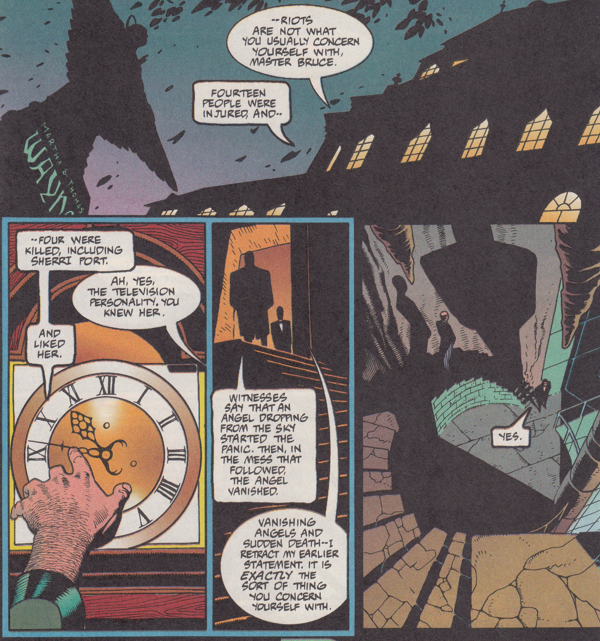

I wasn't aware Batman deals with a lot of vanishing angel cases?

I wouldn't jump right to the conclusion that Bruce Wayne is psychologically unhealthy but maybe setting his secret door clock to the exact time his parents were murdered doesn't help not lead me to that conclusion.

Police found some body armor close to the scene that was completely riddled with bullet holes so Batman figures the angel was shot by the arms seller who lives in the apartment above where the angel fell. An even more important thing we learn as Batman discusses the case with Alfred: Batman puts his shirt on before his underwear.
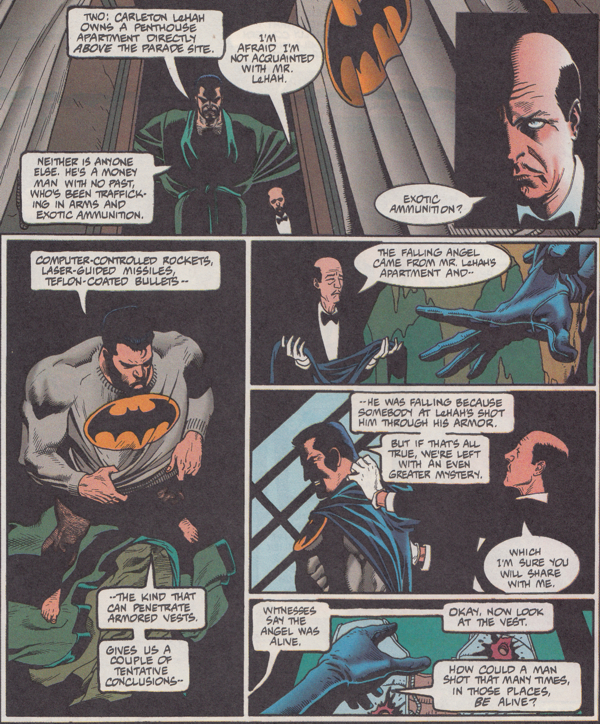

Hell, according to these panels, my guess is he's standing with his dick out while just wearing his top, cape, and gloves. Poor Alfred.

Meanwhile, Cousin Oliver opens the mystery package his father left for him some time ago that the idiot was to incurious to open. It contained instructions on where to go if his father ever died along with forty thousand dollars. So this kid, having witnessed his father die in some truly insane way, decides, "What the hell? I'm only currently busy getting a computer science degree! Heading to Switzerland with forty grand in my pocket sounds way better!"

Somewhere in Switzerland, after being taken from the airport to a hidden chalet six hours into the Alps, the kid meets a strange little creature named Nomoz. His job is to inculcate him into the Order of St. Dumas, a secret organization from the 1300s, and train him to be the next Azrael. I suspect that an important feature of Azrael is that each one comes from a single bloodline or else why wouldn't they just put a bullet in the back of this kid's head as soon as they saw him and searched for a more appropriate Azrael?
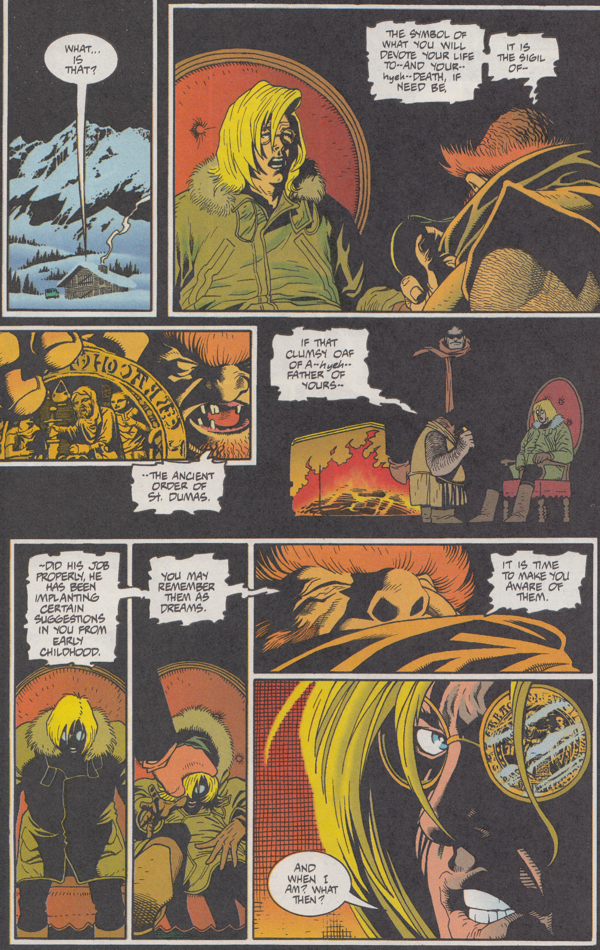

Oh, okay. Wouldn't want all that post-hypnotic suggestion to go to waste by killing the dumb kid.

Obviously the post-hypnotic suggestion thing is just O'Neil giving a sly wink to the readers saying, "We know you'd never believe this fucking nerd college kid could become a cold-blooded holy assassin so will this idea of hypnotic suggestions implanted over the course of his life be enough to get you fuckers off our backs?" No, Mister Denny, sir. It is not. I am going to hate this fucker for the entire four issue run!

Batman learns, from Commissioner Gordon, that witnesses saw the angel with a flaming sword at one end of an alley and then witnesses at the other end of the alley described him as not having any kind of sword, flaming or otherwise. Gordon is all, "Man, I wonder what happened to that sword?" And Batman is all, "I guess I'll go check out the alley and find the one obvious place where it could have been sequestered since your fucking cops are too lazy."
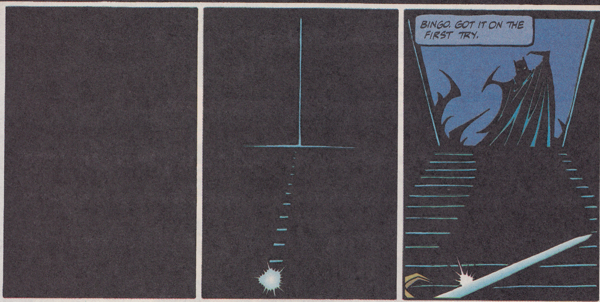

Without even mentioning the Gotham Cops, Batman thoroughly savages them.

Gordon mentioned how the cops would love to have the sword to check for fingerprints and other evidence. But Batman definitely isn't going to give it to the Gotham Police because they couldn't even be bothered to look in the only place the sword could have been hidden if a person believed the witnesses which the cops probably didn't. They probably had a gut instinct that the witnesses were lying and also another gut instinct that one of the witnesses was the angel. They're probably still investigating all of the witnesses and asking the District Attorney which one could most easily go down on trumped up charges.

Meanwhile in Switzerland, Cousin Oliver's subconscious hypnotic training is brought to the surface. He finds he's able to defend himself against attack instinctively now.
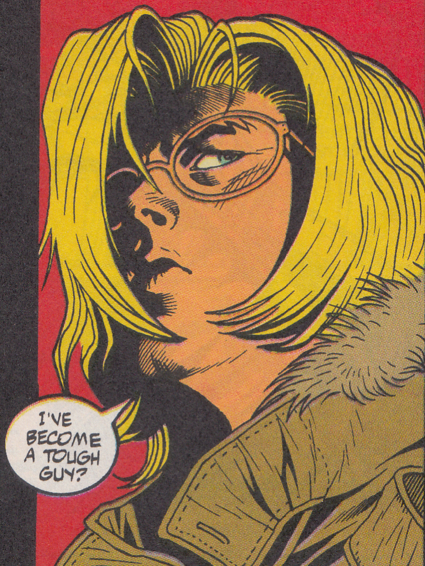

Ha ha ha! Oh, no. No no no no no. You're still a floppy-haired loser.

With the help of Oracle, Batman learns all about the Order of St. Dumas. They were an off-shoot of the templars and were involved in the Crusades. She says their order disappeared in the 1400s. So they didn't hang around for long, historically, before disappearing into the shadows. Now I guess they're less of an order and more of some dwarf in the mountains with a few bodyguards and the family that gets to cosplay an angel every generation?

With Babs' help discovering that the Order settled down in Switzerland, and Batman's investigation of the weapons merchant Azrael tried to kill, Batman finds himself over the Alps in a helicopter hovering above the chalet where the Order of St. Dumas resides. Also looking down on the chalet? The weapons merchant with a rocket launcher full of experimental explosives. Apparently he knew all about the assassin who attempted to take his life and he's looking for revenge.
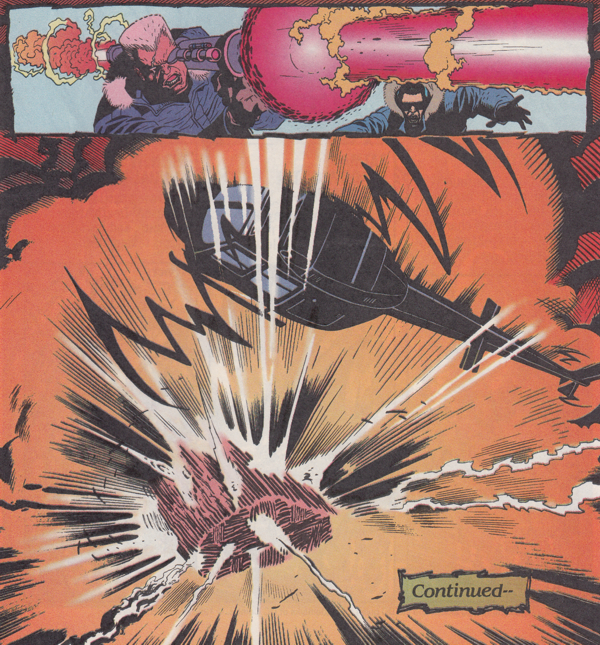

And I guess he gets it?

Bruce Wayne and Alfred are in that helicopter in the last shot. Cousin Oliver and the creature Nomoz were in the middle of the explosion. I guess the final three issues of this series will be Batman searching the rubble for clues, going back home, and shrugging that it all must have worked out somehow?

Batman: Sword of Azrael: Book One #1 Rating: B+. The art is fucking fantastic. Great job. The writing is top notch. Excellent portrayal of Batman doing detective work. Nice mythology set up that feels redundant having recently read The Crusades (was that comic pitched as an Azrael Vertigo book and then just changed to exclude any ties to mainstream DC?). A lot of good shit that should have probably made this an A-rated comic book. But then it also starred fucking Cousin Oliver who sucks so badly that he doesn't even get a fucking name. He's just "son" and "computer science major" and "stupid haircut nerd with glasses". Is there some kind of collective unconscious symbol within our human brains that leads us to hate the floppy bowl-cut haired, tow-headed, glasses wearing kid? Or is it just me? Am I projecting my dislike of Cousin Oliver, Danny Chase, and Azrael onto everybody else? Did some kid who looks like these jerks beat the shit out of me in second grade, pin me to the ground, and spit in my mouth and I've just blocked those memories but unconsciously hate anybody who resembles the perpetrator? This hatred of this character type doesn't suggest the need for therapy, does it? Sure, sure. Other things suggest it, like the way I blame my anger on my cock. But not this, right?

Tuesday, July 29, 2025

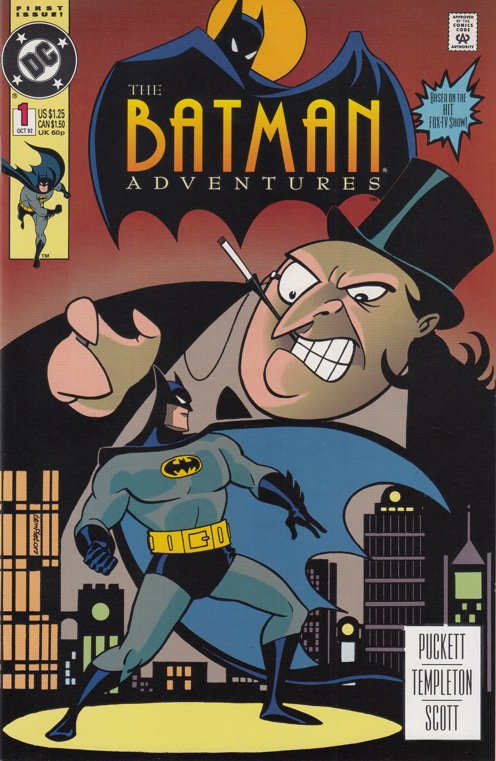
The Batman Adventures #1 (October 1992)


No, I do not own Issue #12.

I guess it's time to read a cartoon? What was I in 1992? A child?! No, I was a grown-ass man by then, according to scientific biological consensus with how human beings age if not by the measure of my maturity or income or quantity of sex I'd had. I don't remember being particularly excited about Batman: The Animated Series, or maybe I wanted to be but it just didn't happen. Because I do remember, after all this time, that the first episode featured Man-Bat. I probably tuned in excitedly for the first episode and then couldn't be bothered to remember to watch the second episode because I was having so much sex that day. By the time the 3rd or 4th episode would have been airing, I would have been turning 21 and riding a mechanical bull because, at the age of 12 or so, my friend Bob Henline and I made a pact to ride the mechanical bull at the Saddle Rack when we turned 21 (he turned 21 two days before the first episode of Batman: The Animated Series aired). And that we did! On a side note, the lady who was allowing me to touch her taint while I came in my pants was there that night. She gave me a Lobo t-shirt for my 21st birthday. I was so cool! Drinking! Riding mechanical bulls! Sort of having sex! Getting a Lobo t-shirt! Purchasing and reading The Batman Adventures! What a life I once led!

Now my life is remembering my life. Which is pretty good too because I don't get exhausted from having lived it and I can sit in the shade with an iced tea and do absolutely fuck all.

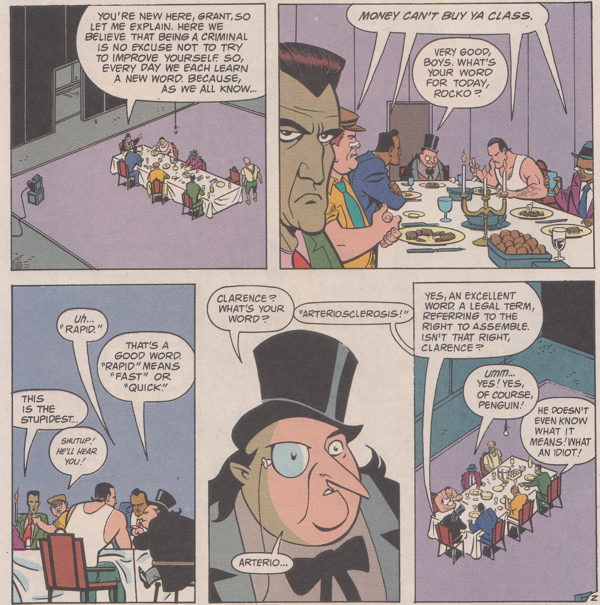
The first episode of this comic book cartoon begins with The Penguin playing the part of Pelafina while his henchmen play the part of Johnny Truant and The Penguin is all, "Get thee to an OED!"


I guess I could have also made an Infinite Jest Hal Incandenza memorizing the dictionary reference.

Do you think Danielewski and Foster both inserted these "the main character knows the dictionary backwards and forwards" moments in their books because they themselves couldn't help but use all the great big words they spent their entire childhoods obsessing over learning so they could seem better than all of us plebes who spent our time outside the house having fun? But also, there's the ambiguous narrative of both texts as to who's really writing and/or directing everything? The readers all know it's ultimately the author. But the author, being (typically) outside of the narrative, must be left out of the equation. So do the characters use words they shouldn't know in Infinite Jest because James Orin Incandenza has been directing their lives from the after life, a ghost putting his thoughts into people's heads, directing his final version of Infinite Jest (obviously a massive retelling of the story since the first five (or was it six?) Infinite Jests were of the PGOAT apologizing to her baby for birthing it into this world of pain, the baby being played by the audience via camera tricks and perspective, an audience who were technologically reduced to that of the infant character by holographic lenses invented by James?

What I'm trying to say is that everything you need to know to understand Infinite Jest resides in the footnote that lists James Orin Incandenza's filmography. And everything you need to know about House of Leaves resides in Blair Witch II: The Book of Shadows. Okay, maybe that's not right. But you will find loads of titties in that so it's worth a viewing.

The Penguin, angered at being called an idiot, very nearly shoves his umbrella up the nose and into the brain of the guy who insulted him. But at the last minute, everybody remembers this is a comic book based on a cartoon and exposed brains shouldn't be a part of it. So somebody interrupts The Penguin before he can stab this guy's temporal lobe. Apparently somebody has just delivered a massive interactive television! The Penguin switches it on and discovers he's got a new friend.


It's The Joker, right? Or maybe Simon Stagg?

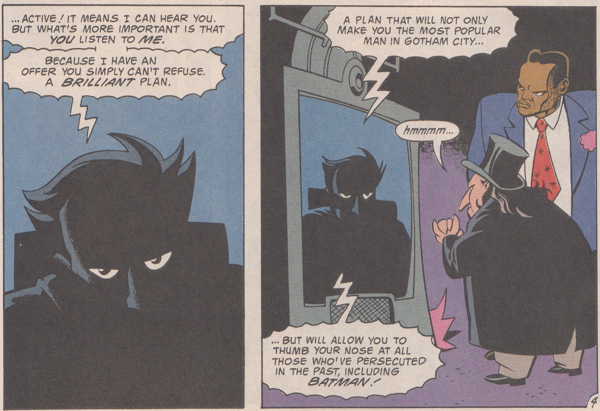
I think the guy on the television needs to bone up on the dictionary himself if he thinks "persecute" is an intransitive verb. I mean, I guess it could be. I guess I could run around exclaiming, "I persecute! I persecute!" But most people are going to be all, "Oh yeah? Who? Just, like, everybody and everything? What are you talking about, you dumb piece of shit?"

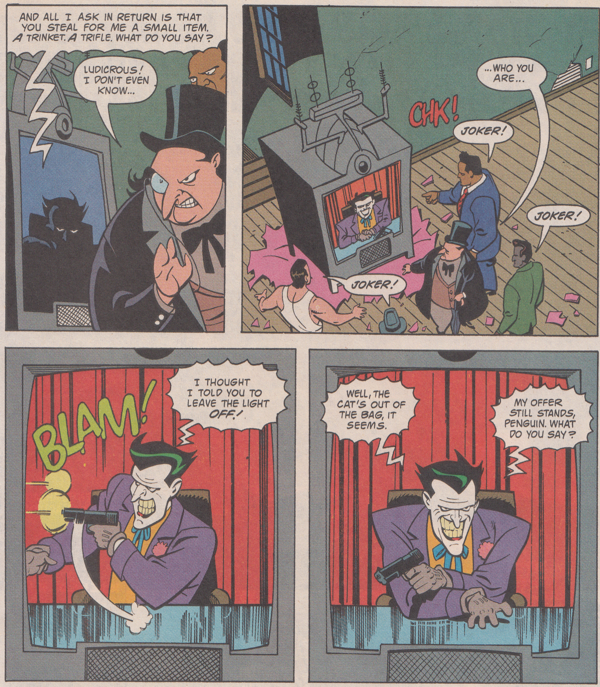
If I were to receive a surprise interactive television and a shadowy figure appeared on the screen and told me to do crimes with it, the first thing I'd ask is, "Are you a cop?" Because a television has to tell you if it's a cop or else it's entrapment. Even if that were legally true and not just a legal urban legend, we all know cops lie so that isn't what I'd do. The first thing I'd do is say, "Man, don't you hate cops? They're so fucking stupid. You know, I heard to become a cop, you have to eat dog shit every day in training. And most cops love doing it! You've totally heard that and agree, right?" But The Penguin doesn't have to do that because on of The Joker's henchmen switches the light on and reveals that it's The Joker even though his hairstyle in the dark already revealed it was The Joker. Or Simon Stagg. But it wasn't Stagg so, you know, The Joker.


Oh, I guess you can blow out people's brains in a comic book based on a cartoon. It just has to be just off-screen.

Where did The Joker get the technology for Interactive Television in 1992? Did he invent it? If so, why not give up a life of crime and get rich selling Joker Interactive Televisions? Or, because we know The Joker is insane and loves playing with Batman, just use the profits to poison more of Gotham's water supply more often? Also, why does The Joker need The Penguin to steal something for him? Does The Joker currently have a bad case of diarrhea so he needs to stay close to his toilet? And why would The Penguin willingly team-up with the most insane person in Gotham? The Penguin is a nearly legitimate business man! He does crime for power and money not for obsessive or insane reasons like most of Batman's gallery of arch-villains.

The Penguin successfully pulls off The Joker's crime later that evening. Batman, arriving to the scene of the crime too late, still smashes through a window causing more damage than The Penguin and his goons. Batman investigates by asking the tied-up guard who committed the crime but the guard didn't see anything. Batman immediately ends the investigation because looking for other clues is fucking boring. He swings away on his Bat-Rope leaving the guard to think, "When did this window get smashed?"

Apparently The Penguin's attempts to sound better educated by learning new words daily comes on the heels of his dramatic change of persona in the public eye. He has, of late, been presenting himself as an actual, honest-to-God legitimate business person, giving to charity and appearing on television talk shows to redeem his reputation. He smokes while on television which makes me see him as a villain but then I remember this was published in 1992 and smoking had yet to be completely banned everywhere except casinos. Can people still smoke in casinos? I don't know because I haven't been in one in many, many years. I think the last time I visited Las Vegas was when that stripper offered to stab me in the face for $20 and I was all, "I'm in love!"

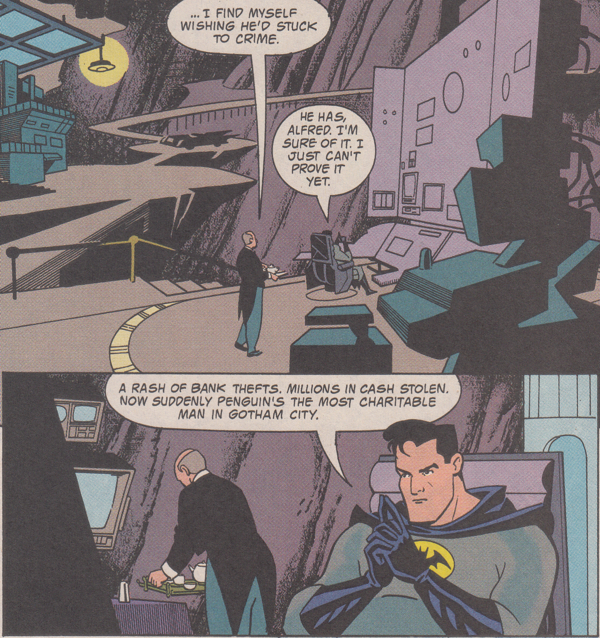
But Batman isn't falling for that shit! Not because he has evidence to the contrary but because he's a paranoid motherfucker who doesn't believe anybody can really change.


Okay, it's circumstantial, but I suppose that's evidence. You've bested my best argument, Bruce!

Alfred pouts Bruce some tea but Bruce doesn't drink tea. The caffeine really makes him edgy, especially when he's fully hopped up on amphetamines.

Bruce does a little research and realizes that The Penguin has been robbing banks owned by Gotham philanthropists which has bankrupted the philanthropists and allowed The Penguin to take over as the most charitable person in Gotham. Ha ha ha! Oh, cartoon economics! Thinking billionaires could be bankrupted by a few casual bank robberies! Have they never heard of the FDIC in Cartoon Gotham? Hell, forget any kind of federal insurance protecting wealthy people and their financial institutions! We've already seen that even if the insurance industries go broke betting on bad investments, the federal government will bend over backwards to make sure all the billionaires retain enough money to keep getting their dicks sucked by other financial institutions, investors, and all the fucking morons who still invest in the stock market. I don't mean they're fucking morons because the stock market isn't eventually lucrative for regular people who keep their money in it over a long period of time. I'm saying they're fucking morons for participating in a scheme that just makes the ultra-wealthy even more wealthy. Get your fucking money out of that shit! Let it die! Stop putting new money into their rigged system!

What was I talking about? Oh yeah! The Penguin has become the darling of Gotham high society! Although can he really be anything more than a passing fancy, being that he's fat, deformed, and ugly? That statement wasn't meant to offend fat, deformed, and ugly people! It was meant to offend high society by pointing out how fucking shallow they are! I would never do anything to hurt my fellow fats, deformeds, and uglies! Solidarity!

Bruce attends the Policemen's Charity Banquet. Oh, you modern kids might not know what means! Police used to have to beg for extra money to commit their illegal acts on the citizens they purport to protect. Obviously they don't need to engage in that kind of grift anymore because politicians from every party just love it when they give cops enough money to wage war on the poors. They know the poors are getting poorer and angrier thanks to their inability to give a fucking damn so they have to keep increasing the amount of money to police to keep the poors in check. Anyway, these Policemen balls usually honor the biggest donors.


Was allowing The Penguin to alternately go by "Oswald Cobblepot" for public appearances deemed too confusing for younger readers?

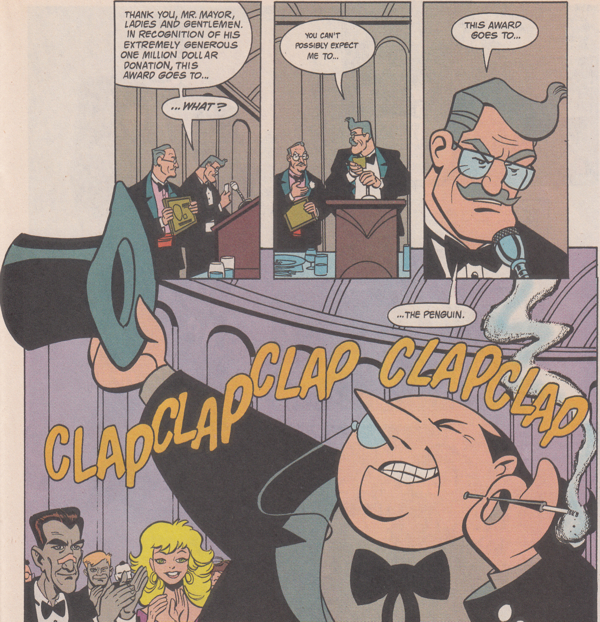
After The Penguin receives an award for being so generous, Commissioner Gordon rips it from his hands to hand over to the real recipient of the award: Bruce Wayne! Bruce managed to toss two million dollars at the Gotham Police just to piss of The Penguin. But now Batman can't say he hasn't killed anybody with a gun because that two million dollars is going to go toward killing a lot of poors. Also maybe Batman doesn't count the people Bruce Wayne gets killed when Batman declares he doesn't kill. Oh yeah, that totally tracks.

That ends the first two acts of the story and we still haven't found out what part The Joker's been playing in all of this. Maybe Kelley Puckett just forgot all about The Joker's appearance!

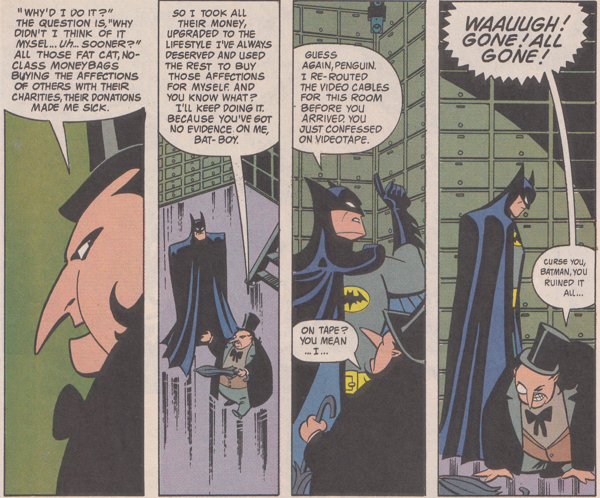
The last act is just The Penguin trying to rob and bankrupt Wayne Tower just like Batman figured. Piss off The Penguin and he'd go for Bruce next. Batman's waiting for them at Wayne Industries, takes all the henchmen out one-by-one, and finally confronts The Penguin. The Penguin, being dumb and low class and barely knowing any words from the dictionary, confesses thinking that Batman can't have him arrested just on the circumstantial evidence of having broken into Wayne Industries' vaults and being caught red-handed. Obviously the only way somebody could be arrested for robbery is if somebody videotaped it!


D'oh! I mean, "W'augh!"

The final panel shows The Joker happy about having got some scroll from The Penguin that's probably some blueprints of an important building or old Court of Owls' porn. But that's a story for another episode!

The Batman Adventures #1 Rating: B. Some panels from next month's comic appear after the letters page and it features Catwoman which reminds me that I've still got a Batman: The Animated Series Catwoman figure somewhere. I guess I was into the show somewhat. Not enough to really remember it but enough to have comics and action figures from it. Also I did just turn 21 around this time so maybe I got black-out drunk way more often than I realized! Maybe I just lost some memories when I was thrown from the mechanical bull? Also, this seems to be the only issue of this series that I own. Why couldn't stupid me have just stuck with the series for a full year?! I could be so rich if I'd owned Harley Quinn's first comic book appearance! If I had access to a time machine right now, I'd waste it because the way I'm feeling, I'd go back to 21 year old me and just kick him in the fucking balls.

Sunday, July 27, 2025

Anthem by Ayn Rand (1938/1946)


In Twain’s “Huckleberry Finn” (The Adventures of), Finn proclaims that he’s willing to go to hell for acting out against what society taught him was right. He fully believes that he’s going against the law and goodness when he decides to help and protect Jim from those who would enslave him. From the outside, we see that he is doing the right thing. But it’s made all the greater because he believes he will be eternally punished for doing what he believes. The moment becomes all the more powerful because he does what is right in the face of unending torment.

In “Anthem,” Rand gives us basically the same story and moment. But instead of standing against society’s belief in slavery being something good in the face of God, we get somebody standing up and declaring that they’ll embrace their evil by being arguably more evil. Okay, that’s hyperbole. They’re really just embracing their own personal desires in the face of a society that suppresses personal desires. But Rand plays it in much the same way as Twain plays Huck’s revelation. As if it’s some huge moment of tragic insight, full of a strength of character by the protagonist. And I suppose for people who often find they’ve been called an asshole on a near daily basis in their lives, this probably feels like a strong and uplifting life moment.

The main problem with this moment is that Rand’s portrayal of a future satirizing her present makes little sense. When Vonnegut created the world of “Player Piano,” he constructed a world that’s not just tangentially related to the world Vonnegut saw around him. It’s an acutely perceptive expression of that world, carefully pulled taffy-like out of the reality around him. Rand’s expression of the world around her into some future dystopia is delusional at best, a schizophrenic projection of her own insecurities and selfishness. She projects every possible failure of society onto the fact that people might actually care about other people. She sees the world becoming a worse place in inexplicable ways, simply connecting a communal viewpoint to whatever ills might possibly exist. “The future has lost all technological advancements and retreated into a medieval mindset? Oh, that’s because nobody can say the pronoun ‘I’ anymore!” There’s no connective tissue linking empathy and caring for others to her dystopia. She just proclaims, “Here is the future of a world where nobody acts on their own self-interests. It is the worst world ever.” This allows her to create a put-upon hero out of somebody who actually has desires and individual thoughts. The hero is simply somebody who thinks for themselves. Which seems like an obvious good trait to have. So how does she make it into a revelatory moment across the short novel? How does one not read this book and simply respond, “Duh!”

Well, I suppose there are people who have been told their beliefs are terrible beliefs because their beliefs are actually terrible. But they don’t think their beliefs are terrible so the other people must be sheep simply following other people’s nonsense because they can’t think for themselves. The only revelation in Rand’s story seems to be that Rand isn’t willing to explicitly detail the things society has told her she shouldn’t think. The story is all written in the most general of terms so that we can project onto the protagonist good and well-meaning individual thoughts. But in reality, the thoughts the main character is having are probably the same thoughts that, when voiced, caused other people to call them an asshole.

When the protagonist escapes from society and enters the freedom of the Uncharted Woods, they testify at one point, “We have made a bow and many arrows. We can kill more birds than we need for our food”. I mean, “Why?” Because they can? What is that about?! Seems like a waste. But I guess nobody is telling them they can’t so it’s good? To kill all those birds and let them go to waste? It was then that I started to think, “What does this protagonist actually believe that makes them better than everybody else?!” No, just kidding. I was already thinking that from the very first paragraph that’s all, “I’m a victim of society! Waah waah waah!”

The phrase “the tyranny of the majority” rang in my head pretty much the entire time I was reading this story. A phrase chanted by those who could live their life the way they want but they’re so upset about other people living their lives differently, that they simply must be angry about it. It’s as if other people living a selfish, individual life, full of their own desires which these observers do not share, is testimony to the observer’s ignorance of other people’s free will. And they hate it. “Personal freedom is the only thing,” they shout while determined to limit the personal freedom of those who don’t share their beliefs.

What I’m trying to say is this: “Suck it, Ayn Rand.”

P.S. The woman in the story isn’t allowed to have her own free and individual thoughts. She’s just there to worship the protagonist’s independent thought and to have sex with them. I mean, technically, she’s the one who sort of gets at the heart of the matter with the pronouns. But that’s expected! What kind of a man can figure out pronouns?! But after she gives him the idea, he doesn’t learn the word until he reads it in a book, probably by another man. Then he gets to choose his own name. But does he let her choose her name? No way! Screw individual thought for women! You’re Gaea, loser!

P.P.S. Some of my favorite complaints about socialism are always ones that are reflected back at the complainer in capitalism. In Rand’s future society in “Anthem,” people are forced into a job chosen for them at the age of fifteen. Sure, all their needs are taken care of but they can’t do what they want. As if that’s not also a part of capitalism! Sure, people aren’t “forced” into a job they don’t want. They’re only forced into taking a job that maybe gives them the health insurance their family needs. Or they’re swindled into debt at an early age by the trappings of capitalism and find they cannot easily leave a job which compensates for their debt and lifestyle. Rand’s protagonist’s argument is, “I wanted to be a scientist and not a street sweeper!” And that, to Rand, only happens because of the socialist world the protagonist lives in. As if that isn’t a feature in capitalism as well! How many scientists have we lost to poverty induced by systemic racism?! How many people have never pursued their dreams because of poverty and debt and economic inequality? How about we go halfsies on this, Rand? How about a world where everybody is free to do whatever they want but the people whose dreams garner them millions of dollars are taxed to pay for other people’s needs whose dreams aren’t meant to garner them millions of dollars? And they pay those taxes willingly because they believe so much in the personal freedom of others and see the goodness and need of all poets and artists, even those whose works don’t capture the imagination of the mainstream but still touch the hearts and souls of others? No? Does that infringe on your personal freedoms of not wanting to ever help another person? Well, I guess that gets pack to my thesis: “Suck it, Ayn Rand.”

P.P.P.S. At one point, the protagonist says, “I owe nothing to my brothers, nor do I gather debts from them.” This is critical to Rand’s philosophy. That she owes nothing to anybody else. That everything she has, she has earned on her own. The point of the story, by sending the protagonist out into the Uncharted Forest, is to show that the protagonist can live on their own merits. But the other half needs to be said though not shown and, willfully ignored: that the protagonist gathers no debts from their brothers. And yet the protagonist says this while living in a modern house from the Unspeakable Times, with literature that has given them the pronoun “I”. No debts owed, my Brother? Living in a house built by somebody else? Gathering knowledge from the generations who came before? Oh, yeah, okay. You definitely have created your own life yourself without any help from others at all. No debts owed! Forgive me for thinking we are social creatures and that civilization and all of our modern comforts are only feasible because we owe each other debts. Man, I think my thesis is too soft!