Showing posts with label Stephen King. Show all posts

Friday, May 29, 2026

Christine by Stephen King (1983)


This is not a story about a car. For some reason (pretty obvious reasons, actually), I remembered this book being about a jealous car. Maybe that was more pronounced in the film (which I don't remember at all) but it's what stuck: Christine the car as a jealous and protective girlfriend to Arnie. But Christine isn't jealous at all. She's not even sentient. Or alive. Or self-driving. She's the phylactery of the accidental lich, Roland LeBay, who drives her when she's off killing anybody who looked at Arnie funny. Not she! It! It's a fucking car being driven by a dead guy! "She" doesn't ever do anything on her own!

Christine's probably also the easiest metaphor to recognize in 20th century fiction since she's a Plymouth Fury representing Roland LeBay's, um, fury. Maybe even his "mouth fury" if you want to get even stupider with the metaphor! Stephen King spends an inordinate number of pages making sure the reader understands that Roland LeBay wasn't some supernatural genius who tried to become a lich. He was just this really fucking angry guy who pissed on everybody close to him and who had, in a supernatural way, an instinct for the supernatural! Because of these instincts, he manages to create the phylactery which keeps him living after death. He makes sure his daughter chokes to death in the car as blood ritual to prepare his soul's container. Then his wife "commits suicide" inside the Fury (in quotes because maybe Roland had a little something extra to do with that, you know? To really crank up the power of his soul's vessel! Remember, he had an instinct for these things!). By the time Roland's reaching the end of his life, he seeks out a young body which he can possess. That's Arnie Cunningham (name probably chosen to invoke Happy Days and thoughts of people in the '70s returning to the '50s).

Anyway, what I'm trying to say is that I was surprised that this was a story about a lich. Technically, I guess it's a case of possession as Roland begins to possess Arnie's body. But with the whole Christine as the device which enables Roland to live after death, and how it was ritually prepared (by accident and Roland's instincts, of course! Not actual magic! Roland wasn't a witch. He was just an angry dude, you know? A FURIOUS guy who loved to ply his mouth! No? Did that not work? Whatever), it really feels like a story about a lich.

I don't have too much else to say about this book. It was probably too long for the meager plot within it. The bookended sections narrated in first person by Arnie's friend Dennis are just awful as King tries to emulate a seventeen year old kid (maybe a 21 year old kid as I think he's "writing" this four years after events). The middle section with the third person narration is much better and the momentum it gave me while reading it helped me get through the second Dennis Guilder part.

Just like every previous King book, women are portrayed by how big a boner they give the male main character. So loads of males would probably really enjoy that aspect since I've been around enough guys who, when they first see a beautiful woman, will say, "I wonder how tight she is?" In this book, Dennis loves to remember, over and over again, how Roland LeBay said to Arnie while trying to sell Christine, "Nothing smells better . . . except maybe pussy!" I wonder if men learned to speak like that from reading Stephen King books?! It's an Ouroboros of male chauvinism! You know the Ouroboros, right? That snake that sucks its own dick? Best mythological creature ever!

I don't think Arnie ever fucked his car but I wouldn't place any bets in Vegas that he didn't. Everybody who got in the car always wrinkled their nose because of a weird smell. I bet it was all the rags soaked in semen hidden under the seats.

Thursday, April 30, 2026

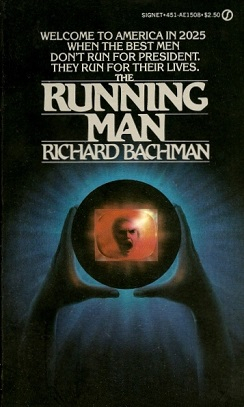
The Running Man by Richard Bachman (1982)


Good news! The best man doesn't run for president in our 2025 either!¹

If you asked Stephen King what his favorite genre of book to write was and I was standing nearby to hear the question, I would push Stephen King out of the way³ and answer, "He loves to write dystopian futures with deadly game shows!" You might follow up that question with, "Mr. King, are you okay?!" Or, if you're a good interviewer, you'd ignore King fumbling to get up and ask me, "Why would you suggest that when only two of his novels are about deadly game shows?" Then I'd scream, "This interview is over!", while everybody standing nearby would cheer and applaud as I ran off into the bushes.

Okay, so maybe Stephen King didn't continue to write about dystopian futures where everything has become Wonder bread and Barnum & Bailey. But Richard Bachman did! I'd suggest even Thinner is basically a terrible game show! Rage certainly is. And Roadwork. Not as literally as The Running Man and The Long Walk but if you squint your brain just right, you'll see how they are. Maybe you had to grow up in the '70s as a kid who constantly convinced his grandmother to let him stay home so he could watch The Match Game and Whew! with her. In the middle of the 20th Century, everything was game shows to such an extent that you could understand how all of Stephen King's visions of the future were just government game shows with loads and loads of death and misery.

Maybe instead of saying, "Stephen King loves to write about deadly game shows," perhaps it's less fun and fanciful to say, "Richard Bachman loves to write stories about the underdog facing up to authority before dying miserably." Like Rage (if I'm remembering it correctly since it's out of print and my copy is in my childhood home) and Roadwork and The Long Walk and this book and, um, Thinner? Does Thinner count? Was the old, um, G-word woman who cursed him "The Authority" the protagonist was fighting back against? Or was "The Authority" he was really battling his wife who wasn't cursed even though wasn't it really her fault that the man ran down that, um, G-word? I mean, who gives a guy a blow job while they're driving! That's completely irresponsible!

I'm curious as to why Stephen King asked to take Rage out of print because of Columbine and other school shootings but he didn't ask to take The Running Man out of print because of 9/11. What is he? A terrorist lover? Does Stephen King think it's a good thing to fly planes into buildings to solve the world's problems? Not that any problems were actually solved by the ending of The Running Man. Which makes sense because no problems were solved by 9/11 either! Except for the problem that the government couldn't get all up in our business easily. It kind of solved that problem. Hmm. I wonder if 9/11 was an inside job?!

America (especially current America) treats politics and diplomacy like a game so I suspect The Running Man is prescient in that aspect. Also in the aspect of environmental collapse thanks to corporations manipulating the government into destroying regulations because Conservative talking heads have so oft repeated the lie that regulations are nonsense hampering advancement that loads and loads of soft-brained people now believe that's true and they're all, "Yeah! Why should the government make rules that corporations have to follow?! I like my peanut butter to be at least 3% exhausted factory worker who fell into the nut smasher!" Nearly all government regulations have been put into place because people died so rolling back regulations just means that we're going to remember why they were put in place when more people die. If we're even allowed to hear about people dying due to poor safety regulations ever again!

The Running Man should be one of my all-time favorite books because my top ten list of books mostly contains stories where the protagonist realizes that they can't fight against The System and so they simply escape from The System instead. Books like Catch-22 and One Flew Over the Cuckoo's Nest and, in some ways although this is more like The Running Man — except the plane flying into a building is implied to happen later when Tom Joad can get his hands on an aircraft — The Grapes of Wrath. The Running Man is about a man who understands the system is shit and that he has no options to help his family so he takes the one bullshit option open to him: get maimed (or die) on national television for Big Bucks. As he "runs", he encounters an underground group of rebels who educate him on some of the really bad shit that's going down which the government's covering up and so Richards (the protagonist) decides to take up their cause and fight back. But he soon realizes that he holds no fucking cards and can't fight back. He has no power. And the propaganda machine has been set in place for far too long and is way too powerful. So in the end, he flies a plane into a building and kills some rich bastards but changes nothing. King doesn't even imply that somehow things might change somewhere along the way. Maybe Amelia survives being ejected out of the airplane while wearing a parachute she's unfamiliar with and goes on to lead some kind of rebellion that brings down the Fascist Game Show Network. But I doubt it. She probably cries all the way down until her head explodes against the earth with a loud KA-SPLAT!

Maybe I'm too cynical. Should I be more hopeful? I bet when I first read this at fifteen, I was all, "Things will work out! People have gotten enough glimpses of the truth! It's going to all fall apart now!" But I'm 54 now and if I have any earnestness, optimism, or hope left in my body, I've ejected it into space where it's fallen upon the sand dunes of Tatooine and been stolen by Jawas for parts. Too many people in this world are full of fear and hate and endless stupidity. Which is why I have chosen to spend my time with people I love whose hearts are full of compassion instead of fear; people who understand community rather than rant about individuality; people who would rather die fighting for the greater good than surround their house with barbed wire and fill their garage with oil barrels full of guns and ammo.

Did that have anything to do with the book? I don't know. Maybe part of the point of the novel was that people were too separated by their pain and suffering. The kid, Bradley, whom Richards runs into who's in a gang that visits the library and learns about the state of the environment seemed the most put together person in the book. He had friends, he had knowledge, he had family, he had compassion, and he hated the fucking cops. Just an all around great kid, you know? And his friend, the fat kid in Maine, says at one point that Bradley was his only friend. And that kid gives his life to help the cause. Was Bradley the hero? Is he the one we're staking our hopes on by the end of the book? Did he escape the Game Show Fascists chasing him to Cleveland?! I guess we'll never know because Stephen King didn't decide to make this world the world he cared about. He saved that one for that cool motherfucker Roland Deschain.

The only part of this book I didn't like was when Richards was trying to get to the front of the plane with his guts hanging out and then he steps on his guts and they pull at his insides and oh god I'm going to be sick. This review is over!


__________________________________________________________________________________
¹ This is both a joke about how 2025 isn't a year that somebody would run for president and how our president is actually the worst man in the history of men².
² Although — let's face it — men aren't actually out there being stellar, for the most part.
³ Being careful not to shove him in front of another van because I don't need to read a new and updated edition of The Dark Tower which includes me.

Saturday, April 25, 2026

The Gunslinger by Stephen King (1982)


I first became aware of this book in late junior high or high school when I was reading all of Stephen King's books. This would have been maybe 1984 at the earliest. My mother had all of his books and she had raised me on horror movies (mostly inappropriate and terrifying. Like imagine seeing The Sentinel before you're even 10 years old. It's probably why I can't love anything properly and you try to jump scare me and I'll just stand there stone-faced showing no instinct for self-preservation at all) so I figured I'd read them all. I remember holding It in my lap in the passenger seat of her Camaro as we drove home from the bookstore, excited to dive into it and see why that claw is coming out of the sewer and going for the paper ship. It was during this time that I asked my mom why she didn't own The Gunslinger as it was listed in the "Books By Stephen King" section of one or more of her paperbacks. She told me it was some limited edition thing he put out and, if you could find a copy, they were really expensive. I was dying to get my hands on a copy. But I'd have to wait until 1988 when the book was re-released with glossy and exciting pictures to help my limited comic book imagination!

Was it worth the wait? Did it live up to my imagination? Fuck yeah it did! Roland was (IS!) fucking cool, man. He fucks every chick he meets! He shoots every dirty rotten scoundrel that besets him! He, like, walks all over the place! Wait. Is that cool? Maybe I just liked that part because I walked everywhere too (except when I skateboarded by that's sort of walking, right?). And he sacrificed children for his own personal gain! I was raised areligious so if the book was some kind of metaphor for faith or searching for some higher purpose or just riddled with Biblical allusions, I missed it all. I just loved that Roland's gun made such a loud bang! Kill them mutants, Roland old buddy! Get that man in black! Let Jake fall into some other world! Ha ha! So cool!

Well, I just re-read it at the not-so-young age of 54 and let me say this: Roland is fucking cool! I just know when he gets to The Dark Tower, it'll be the most satisfying conclusion to any story ever made! I'm sure it won't end in fire like Carrie or 'Salem's Lot or The Shining or Firestarter or, um, did The Dead Zone also end in fire? No, no, that one just had a huge fire as a major plot point. At least nothing burned up in Cujo (if you don't count Cujo's brains. Poor doggy!).

Four of the five stories told in the first Dark Tower book take place in Roland's memory, one in the recent past (the massacre in Tull) and the others in Gilead when he was a teenager. I suspect the revelations from Roland's past in Gilead are supposed to be the story bits which pull a reader into the story. How did Roland's quest begin? How did he become the gunslinger? What drives him? But I kind of couldn't give a shit about his Gilead history. I just want to read his adventures while he remains mysterious and God-like. I don't want to read stories about the first time he jerked off on the roof of the castle! Or the first time he fucked a lady! Or the first time he sacrificed a friend to get something he wanted! I just want to read about him meeting Jake and sacrificing him without having to know that kind of thing is a habit of his!

Even though a friend of mine assures me that The Eyes of the Dragon is not part of The Dark Tower series, I still can't help thinking that The Eyes of the Dragon is the story of Roland in Gilead. How come I think that? Was I just that stupid as a teenager that I couldn't tell two different stories apart?!

Anyway, this book is nice and short and interesting and fires the imagination with the stories to come. Later, a lot of it will fall apart in a lot of ways and I'm not just talking about having to read King's accent for Susannah whenever her dark side takes over. How many "Child!"s and "Sure 'nuff"s can a person read before they take a Sharpie and just start obliterating every passage where Dark Susannah speaks?! I'll let you know when I begin reading my old copy of The Drawing of the Three and discover when I began blotting out big blocks of dialogue with black marker.

I know, I know! "Why's the marker gotta be black?!" Get out of here, you smart ass!

Am I done with this review? I think I'm done. Man. Roland is so fucking cool!

Thursday, February 19, 2026

Roadwork by Richard Bachman (1981)


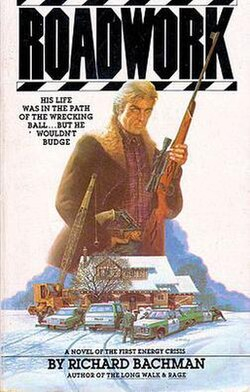
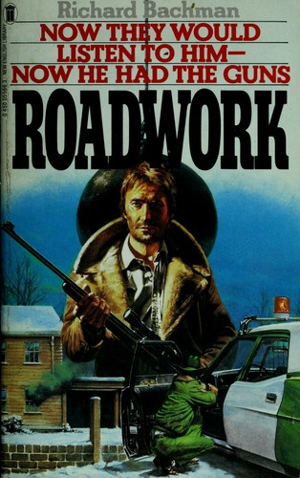
That cover couldn't be a worse choice for this book. No, wait. The UK First Edition cover couldn't be a worse choice for the book.


This is not a story about a man fighting back against an uncaring government destroying his life. This is not a story about a man using guns to fight back and change the world. The entire confrontation depicted by these two covers takes place across maybe ten pages out of about 280. The covers merely depict where this man's life wound up. This isn't a story about changing things or the little guy rising up to change the system or the underdog besting corporate and government greed. This is a book about a man who never figured out how to properly mourn his son and move on. This is a story about a man who probably should have gotten therapy.

Near the end, as Bart's in a standoff with police, a reporter asks Bart George Dawes what he wants. A plane to get away? A peaceful resolution? His house? But this is his answer:

"I want," he said carefully, "to be just twenty with a lot of decisions to make over."

The story hangs on the framework of an interstate being built through the middle of a town which has caused the government to use eminent domain to buy up everybody's houses. The interstate will not just run through Bart Dawes house and neighborhood but also the factory laundry where Bart works. His life will be completely upended and destroyed. Of course, his life has already been completely upended and destroyed by the death of his son with a brain tumor some years previous. The roadwork cutting through and destroying his life is just the metaphor for this man's inability to move on after the death of his son. He cannot move from this house where all the memories of his child remain. He cannot leave the job he worked his entire life. He cannot discuss any of it with the woman he married when they found out she was pregnant (a pregnancy which she subsequently lost). Throughout the book, Bart wrestles with the idea of suicide and what it might possibly mean to his soul. He wrestles with it because the man we meet at the beginning has already decided to do it. Most of the book is just Bart realizing, piece by piece, that he's killing himself.

In every book of King's (Oh? Did I forget to mention for anybody who hasn't heard? Richard Bachman is Stephen King, right? Yeah? Okay!), no matter how dull I might find it, or how predictable, or how utterly mundane the basic plot, he tends to have at least a few moments that are pure genius, moments that remind me that even I can sometimes still feel. And that quote I posted earlier was the moment in this book. It's a short book and doesn't contain a lot of great beats to it. The man buys some guns. The man buys some dynamite. The man takes some mescaline. The man yells at and insults his wife every time they try to talk and she doesn't once simply tell him to fuck off. Man, he treats her like shit! Luckily she eventually leaves him although they tool around with maybe making it work still. Of course, on his wife's side, that's all based on the lies he keeps telling her. Because he can't tell her the truth when he's still not fully aware of the whole truth himself. You know, the truth everybody he seems to meet pretty much picks up on. This guy is going to kill himself.

Roadwork felt like a first draft of Pet Sematary although reading some of King's comments on it argues against that. It felt to me like the dread of a father losing a son and what it might lead him to do. But the way King tells it, it had more to do about his mother's death from cancer. But then, Pet Sematary has a bit to do with that too, so, um, you know? Probably a little of it all in there. What really comes out is a man in his 30s really understanding and coming to terms with the idea of his own mortality. Bart experiences a couple of other deaths in this book and they just drive him even further around the bend. Probably because he knows he's already headed down the path to his grave and, even though it's writ in stone, he's still afraid.

I don't want to discuss the young woman he meets and fucks because Stephen King just likes to have guys meet women and fuck them. I mean, sure, meeting women and fucking them is cool! But Stephen King doesn't know how to write a short story that makes it as cool as it really is in real life. King manages to make me think he believes the key to meeting and fucking women is to be super creepy and adulterous.

The Epilogue is pretty nice though because it makes it clear that everything Bart Dawes did had no great consequence. He just wanted somebody, anybody, to witness his suicide, to acknowledge that his pain was real, and to finally, actually see him. Plus I guess the girl he fucked turned her life around with his help so I guess that meant something?

Sunday, February 15, 2026

Danse Macabre by Stephen King (1981)


I read this book in the '80s. I believe I re-read my mother's copy (which I seem to have filched from her) in the 2010s. I tried to re-read it again while I'm doing a chronological read of King's books and I have to admit failure. At the time, I didn't know where I'd packed away my mother's copy so I was checking it out digitally from the library. But by the third time I'd had to return it without finishing it, I had to admit I couldn't read it again. It's just, well, not good. I can't imagine writing a book at 34 on anything and believing I had enough to say on the topic that hadn't already been covered by academics and obsessive hobbyists who actually loved doing research about the thing I'd decided to write a book about. Stephen King imagined differently. The most interesting parts are when he discusses his own memories of horror films as a young boy. But then I believe that all analysis and critique should be stuffed to the gills with personal anecdotes and opinions. Some really intense nerds on the Internet think so differently than me on that aspect that they sometimes tell me how terrible I am at writing comic book reviews and I'm like, "So I can't give a comic book a 10 out of 10 rating just because of one panel where you could see half of Lobo's naked ass? Well then you can't read my comic book reviews anymore!" Then they'll comment on another one of my reviews and I'll be all, "I thought I revoked consent from you! You know what you're doing by reading one of my reviews without my consent, right?! You know! That thing people can't make jokes about! That's what you're doing to me!"

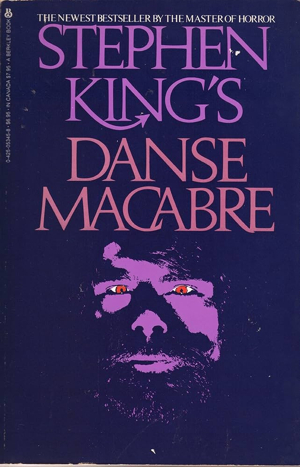
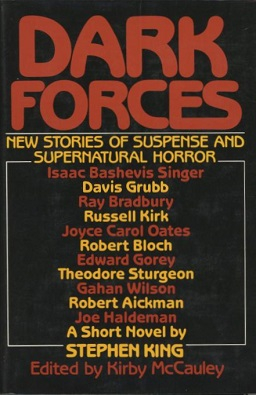
This book reads like that cover. Derpy. Does that look like a trusting source of information? That looks like a guy who just accidentally drank a bottle of acid because he'd put his beer down on the tray full of bottles of acid and thought, "Well, this *might* be my beer?"

I knew I was in for a tough read when I read the newer essay at the beginning of the book where Stephen King admitted to liking the ending of Frank Darabont's The Mist. I mean, what? Is your favorite movie also Boondock Saints, you fucking hack? Because the ending of Frank Darabont's The Mist was the most nihilistic ending to any movie I've ever seen. It was pure fucking edgelord in the worst way. Sure, sure. I can see ending the movie with the guy having to kill everybody, even the kids, and then maybe wandering off into the mist on his own, sure to be struck down by a weird monster. But to have him kill everybody and then have the army move in immediately to save his ass? Fuck you, Frank. And not just because of that! Because based on that ending, Frank made the fucking lunatic religious lady the hero. She was right. They just had to stay in the supermarket and they'd all be saved. Hell, maybe even her sacrifice of somebody's child was the reason they were saved! Maybe God was all, "Fuck everybody. The Mist time!" And then when she was all, "I give you this virgin blood to save us from damnation, Lord!", God was all, "Oh, yeah, okay. Cool. Send in the army. Everybody is saved now!" Stephen King liked that ending. HE FUCKING LIKED IT! And if you liked it too, you no longer have permission to read my blog because you're too stupid to enjoy art.

Here are some more shitty opinions Stephen King had while writing Danse Macabre:


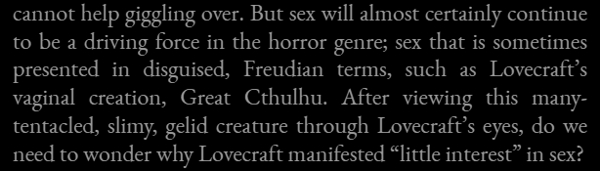
Had King never seen an actual vagina by 34? Who the fuck thought H.P. Lovecraft was writing about a deep sea vagina that causes madness from the description?!


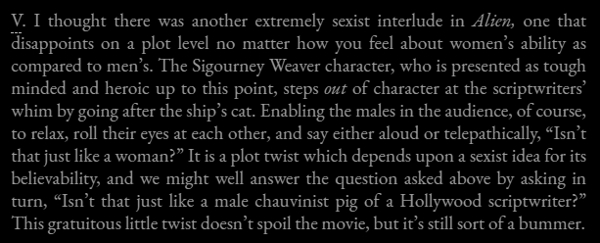
What are you fucking talking about? You're being sexist by pretending you noticed sexism! I also would have gone back for my cat, you stupid, dimwitted, emotionless, piece of vapid shit!


No wonder my mother raised me on Last House on the Left, The Sentinel, and Prophecy! She was using this as a parenting book! THIS IS WHY I CAN'T FEEL ANYTHING!

I really kind of wished I'd kept reading so I could rant about some other quotes from the book. But I gave up. I figure I'd read it twice in my life, I don't need to read it a third time, right? Although I did just find the book last week so, I mean, maybe I should try to get through it again? Yeah? No, no! I'll just move on to Roadwork!

Thursday, August 14, 2025

The Mist by Stephen King (1980)


This was probably my first time reading the full novella of The Mist as opposed to whatever hack job was published in Skeleton Crew. I say "hack job" in that it was certainly edited for space so it was "hacked" up and not "hack job" as in it was done carelessly. Maybe it was but I'm not the one to judge because I didn't make a careful comparison of the two. All I know is that I liked it a lot when I first read it and I liked it a lot now in its original form. It's possible, based on how much I liked it divided by word count, that it's mathematically my favorite Stephen King story. Sure, I've probably gotten more joy out of "Library Policeman" but I've only ever expressed that around my closest friends who don't judge me when I find immense pleasure in the idea that King wrote a story where a little kid fears being raped because his library books are overdue. "Thteady! Thteady!" But you, not being one of my closest friends, didn't read that here! Plus the last time I had a really good laugh about that "Thteady! Thteady!" line was when I was still hanging out with my friend Soy Rakelson, Catholic Conservative Frat Boy who once worried about whether he should use a condom if he had the opportunity to have sex in college because he didn't want to make the Pope sad without once being worried that the pre-marital sex might make the Pope sad. I know! I know! Conservatives only care about hypocrisy when they can try to prove one of their nemeses is being hypocritical, and usually they can only marginally do that through semantics and false representations of actual facts.

Look, this review isn't about Soy Rakelson! It's also really not about Stephen King's novella The Mist either because I've pretty much finished with that. Loved it! Good job! Although just like It, the story is almost ruined by the unneeded sex scene. In It, the tween gang bang in the sewers, as terrible as it fucking is, was meant to express how the children had to grow up to escape the clutches of Pennywise. But why did David Drayton, in The Mist, have to commit adultery with the hottest woman in the supermarket? Oh, because it was an embracing of life at one of the darkest, most depressing, horrifically terrifying moments of their lives? It was to show how hard they were clinging to survival? Expressing their passion and their need to live no matter the cost? Maybe you should have expressed that point a little better than just having the two hottest people in the supermarket fuck so that Frank Darabont wouldn't have made a film that just flushed the entire idea of mankind's ability to keep up hope and survive against the most insurmountable odds! I guess the ending of Darabont's film adaptation of The Mist was also seeded by the moment when King has Drayton compare the amount of bullets in the gun with the number of people in his escaping truck as well. King's story doesn't end with everybody escaping into an unmisted world but it does end by hitting you in the face with a lead pipe with the word "HOPE" written on it. Maybe Darabont's first language isn't English so he sort of missed that hope bit.

I understand why people like Darabont's film's ending. Hell, even Stephen King expresses his love for it in his 2010 "Forenote" to Danse Macabre. But I've got to tell you, as the biggest cynic in any room but one that appreciates and values when people can be absolutely, bloody awfully, embarrassingly earnest, Darabont's The Mist has the most nihilistic and cynical ending of any film I've ever seen. And that's not a fucking compliment. It's the kind of ending a 7th Grader would have tacked onto a story he was writing just for the shocking twist. And I'm not talking about David killing everybody with the final bullets in the gun and then walking out into the mist to die by giant spider. That would have been a better ending! They tried but they failed and the world has gone to shit and that's that. But Darabont was all, "Hee hee! Haw haw haw! What if I get the main guy to blast his son in the face with a bullet from his gun only to immediately walk out of his car and be surrounded by the military saving the world? OH MY GOD! Ha ha ha! How funny would that be? I mean tragic! I meant it to be tragic! OH NO! So tragic! HEE HEE HEE HEE HEE!" Fuck Darabont! Darabont's little trick at the end makes Mrs. Carmody more heroic than David Drayton! Oh, sure, maybe she sacrificed a few people back in the old Megalo Mart. But she was fucking right that it was death to leave and they should stay in the supermarket because guess what? Except for the few unfortunate souls her group sacrificed (which, I mean, maybe they're what convinced God to let the military save the day after all? Who am I to say being that Mrs. Carmody was absolutely fucking right in the end?!), those who stayed in the supermarket were eventually rescued.

Hey Franky? Read my blog name out loud. That's for you, buckaroo!

The other thing I wanted to discuss was the Interactive Fiction game based on The Mist by Mindscape. I really enjoyed it for the atmosphere and for actually feeling like I was in the story, and extending the story in various ways that King only hinted at. It was, as a story, fun. But as a text adventure game? Holy shit did it suck. I remember way back in the mid-80s playing this thing and realizing at some point that I can't get any further because there were monsters everywhere. Sure, you could kill the slug thing with salt. Easy! But the other things couldn't be killed. So I thought, "There's a gun in the story? Maybe if I ask everybody for a gun, I'll have a gun to shoot everything!" And guess what? Yeah, one of the characters has a gun. You also need to ask the characters for a key to the hardware store and a key to the truck. The main puzzles in the game are asking people for things that you can't find (one of them being a gun which is never, ever mentioned, as far as I know. You just have to assume somebody has a gun! You're in Maine, for Christ's sake!). After that, the final puzzles are mostly shooting everything. By the time I worked my way to my son Billy (yeah, in the text adventure, Billy isn't with you. He's staying with a family friend), I still had one bullet left in my gun and, like Frank Darabont, I was all, "Fuck this shit!", and shot Billy in the head. It was the only humane thing to do!

Anyway, great story minus the sex scene especially when David thinks how massive his erection is. Gross. Stupid first person perspective!

Tuesday, August 12, 2025

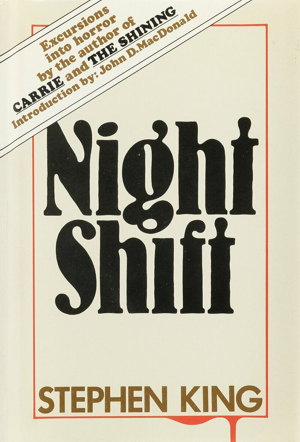
Night Shift by Stephen King (1978)


It's been a few months since I read this. I have trouble writing reviews for story or essay collections which is also why I haven't done a review of Palm Sunday by Vonnegut yet. Although this doesn't explain why I failed to do a review of Cat's Cradle by Vonnegut. Why am I providing arguments against my own excuses?! Either forget the Cat's Cradle revelation or believe this subsequent lie: Cat's Cradle was also a short story collection! I bet hardly anybody has read it so they won't know that's a lie! Ha ha! Idiots!

I'm going to try to remember each story and shart out an opinion on each one. King probably worked terribly hard on every story in this collection and I'm going to just vomit up terrible opinions on each story and label them as "critical reviews". This is why I like being a reviewer over an actual author!

Jerusalem's Lot: Oh! This is why that one book was called 'Salem's Lot! It was short for Jerusalem's Lot! Good thing King wrote this story so that people would understand the title of that book years later! It's like how nobody has yet realized The Beatles spell their name not like the insect but like "beats" in a song. That one's particularly hard to figure out because The Beatles never wrote a song called, "Check Out How Our Band's Name is Spelled, You Twats!" I only noticed because I'm the absolute genius who came up with the blog name, "Eee! Tess Ate Chai Tea!"

Oh, I forgot about my review! This is already way longer than I expected it to be. Too bad the thought faucet in my brain has been stripped and I can't stop it from constantly dripping. Okay, Me, concentrate now! Review time!

While Stephen King's stories show a lot of obvious influence from H.P. Lovecraft, "Jerusalem's Lot" is the most Lovecraftian of them all. It's epistolary and H.P. loved a good bit of correspondence story telling. It also culminates in what's basically the appearance of a Great Old One in a blasphemous church in an abandoned town. One of the most interesting bits is how King calls the Great Old One "It" (capitalized!) so I'm assuming this is also the first appearance of Pennywise.

Prognosis: Pretty Good!

Graveyard Shift: This story could have been a sidequest in Fallout. While it's ostensibly about a bunch of mutant rats living beneath an old textile mill, I think it's really a fantasy about murdering your boss. We've all had that boss that we'd have loved to spray with a firehose until they stumbled into the waiting maw of a massive deformed rat. Mine was named Barb! No, I'm kidding! Barb wasn't that bad. She just wasn't what you'd call "good at her job". She once cried during a performance review with me because I wouldn't be her friend! Look, Barb! It's fucking work! Work is not playtime! Now get in that giant rat's mouth already!

Prognosis: Satisfying.

Night Surf: This story takes place in a less optimistic version of The Stand. A bunch of cool kids (they must be cool because they hang out at the beach, smoke, drink, and have sex. So cool!) hang out at the beach to smoke, drink, and have sex. Also they talk about how they've all survived a plague they call "Captain Trips". That's the same flu as in The Stand! But in this one, after burning a guy for their cool bonfire, one of them shows signs of having Captain Trips and the protagonist realizes that, although they survived the initial plague, they're probably all going to die anyway. And they didn't even need some nightmare dark man to do it! Losers. Cool losers, of course!

Prognosis: Am I using "prognosis" right?! I'm not a doctor! Which is what these kids needed! Ha ha! Better than The Stand because it was about 1500 pages shorter.

I Am The Doorway: King doesn't often do on-the-surface cosmic horror but if this is an example of him doing that, I wish he'd do more! I qualified "cosmic horror" with "on-the-surface" because if you think about an awful lot of his stories, many owing a debt to Lovecraft, you can probably squint them into being cosmic horror stories. It almost certainly is. Tommyknockers. Possibly all the Dark Tower books? King's written too many books to contemplate (and many I haven't read) so I'm going to end the list there.

This story is about a guy who becomes all eyeballs. It's pretty gross. I think he kills himself in the end because his eyeballs are catching? I don't remember it that well. But it was creepy and gross!

Prognosis: Different but sort of forgettable.

The Mangler: One of the immutable facts of the universe about Stephen King is that he often has better ideas than the stories that come out of those ideas. But the great thing about Stephen King is that the opposite of that is also true! Sometimes his ideas sound like shit on a loaf made of shit and, guess what? They end up tasting great! Mmm, mmm! I love King's shit sometimes! "The Mangler" is one of those ideas I really like that ends in such a laughably terrible moment that I checked to see if King graduated from Clown College. The initial premise is that a laundry machine called "The Mangler" by the people who use it (because it's so dangerous!) becomes possessed by a demon because all the right ingredients from a Satanic Ritual somehow wound up getting passed through it. And then maybe somebody said some Latin or something. Anyway, fantastic idea! Love it! King quickly realizes the problem with this set-up though: once people realize the machine is evil and killing people, people can just not go near it anymore. Perhaps unplugging it also doesn't work because it's possessed. But it's still just a big block of metal in the basement of some shop. Just put up a sign: "Caution! Demon Laundry Folding Machine in Basement! Stay Out!" How scary is that? It's not scary at all! is probably what Tabitha said after reading it.

So King, realizing he had a huge dud of an ending coming up and thinking, "I could set the whole place on fire but I've already done that in like every book I've written so far and a few I'm going to write." So what does he do? He has the machine become mobile, climb out of the basement, and begin stalking the people who tried to perform an exorcism on it! Ha ha! Can you picture this big fucking block of metal lumbering down the street somehow catching and eating people unawares?! The protagonist realizes it's coming for him at the end of the story and instead of walking outside and yelling, "What the fuck are you going to do? Catch a sprinting human being?!", he trembles in fear and waits to die. Or does he actually die? It's been awhile. I don't remember exactly. Although now I really need to see the film based on it and the film's two sequels!

Prognosis: King's Clown College Thesis Paper.

The Boogeyman: This is the first story I can't remember from the title alone so I'll need to read the Wikipedia entry to remember it.

Before even finishing the first sentence of the plot synopsis on Wikipedia, my memory was jogged. Yeah, I would not have remembered this story at all if not for revisiting it in this review. This is another story, if I remember correctly, with a fucking absolutely fucking ridiculous fucking fucking ending.

The story is about a man whose children keep getting killed by The Boogeyman that lives in the closet. He's describing his terrifying life's path littered with dead babies to his therapist. At the end of the story, we discover that the therapist is actually The Boogeyman! Um, what? No, no. That's the biggest "what?" I've ever meant. I think I usually don't really mean it when I respond "what?" to some dumb plot contrivance or stupid twist. But this time, I'm being serious. "What?" This paranormal creature that's been eating this man's children decided to become a psychiatrist? So it can relive the pleasure of the terror it created, I guess? But also it can look and act enough like a man to just wear a mask and fool actual people? Did it study to become a psychiatrist? Did it learn how psychiatrist's act by watching victims watch The Bob Newhart Show from its hiding place in the closet? How is this a fucking twist?! M. Night Shyamalan laughs at this twist and most of his twists are pretty fucking stupid. Like how the twist in Signs was that the "signs" in the title weren't the crop circles but all the clues littering his life that leads him to defeat the aliens! Is that a twist? Can you make the twist a play on the title?!

But to get serious about this less-than-serious story, is this King's commentary on therapy? That therapists just drag terrible things out of the closet of our memory to make our lives worse? Maybe that's his point? I would have liked this story if he'd just left out The Boogeyman, called it "The Rapist", and then had the therapist rape the guy after he spilled his guts about how he, I don't know, fears being raped? Did I make the story better or much, much, much, much worse? At least it's got a better title twist than Signs!

Oh! This story also has a feature film based on it! I have to fucking get my hater mitts on that!

Prognosis: Fucking ridiculous. Unless King was commenting on therapy. And then maybe it's just ignorant?

Gray Matter: Oh yeah! This latest reading of Night Shift was obviously a re-read but having read the book over 35, maybe 40, years ago, I certainly only vaguely (if at all) remembered most of these stories (other than Lawnmower Man! Who can forget that one!). So it was weird that as I read "Gray Matter", I kept thinking, "This is really fucking familiar. Did I just recently see this somewhere?" At some point while reading it and getting stronger and stronger feelings of déjà vu, I realized that I had just recently watched it on Shudder's Creepshow series. You probably didn't need to know any of that but what are you? Too busy to hear a boring anecdote from some idiot on the Internet you'll never meet and never truly know but still want to have sex with for some reason? I mean, right? You do want that?

I suspect this is a metaphorical tale and not just a story about a guy who drinks some bad beer and turns into The Blob. Being that "gray matter" is another term for the brain, and this story ends with the "gray matter" splitting and the implication that each new ooze will split into more oozes and so on and so forth until they consume the world, I'm going to assume that this story is about how gossip, shit ideas, and propaganda spread to destroying the humanity of everybody caught up in the nonsense in the process. Maybe it's not that sophisticated an idea and it's just about alcoholism and how that destroys a person and the people around them. Maybe it's one of those metaphorical tales that can be used to explain whatever the reader wants it to explain. Like Joseph Conrad's Heart of Darkness.

Prognosis: Gross.

Battleground: A toymaker's mother sends some dangerous army men toys to the hit-man who killed her son in this story that reads like Stephen King was writing a Twilight Zone episode instead of a Stephen King short story. Richard Matheson's son, Richard Matheson, must have recognized this fact as well and, following in his father's footsteps, adapted it for television. If The Twilight Zone had been on the air at the time, he probably would have written it for that. Instead, it was made for Nightmares and Dreamscapes: From the Stories of Stephen King which, I suppose, was the perfect place for it. Richard Mathesonson also wrote an episode of Three's Company. Was there an episode where Jack makes a deal with the devil or Janet dates a serial killer or Larry discovers The Ropers' storage shed full of corpses? I only ask because Richard Mathesonson is known for horror and not sexy mishaps comedy.

Prognosis: Fun which isn't horror so bad in this context, I guess?

Trucks: The only good thing to come out of this story having been written is the greatest AC/DC song of all-time, "Who Made Who". You can argue with me all you want with that opinion, if you're so inclined, but realize that two people arguing over the greatest song from a band whose songs all sound the same might be a slight waste of all of our time. Stephen King tried to blame the failure of Maximum Overdrive, the film based on this story, on cocaine but I think the real blame should be put on King trying to make a full-length movie out of a story with nearly no narrative meat on the bone. Although maybe cocaine was to blame because Stephen King got so fucked up on it one night that he couldn't remember the difference between apes and big rigs while watching Planet of the Apes. Or maybe it was that jerk at that party from earlier shooting the shit with King who said, "Imagine if those apes on that planet had actually been Peterbilts!"
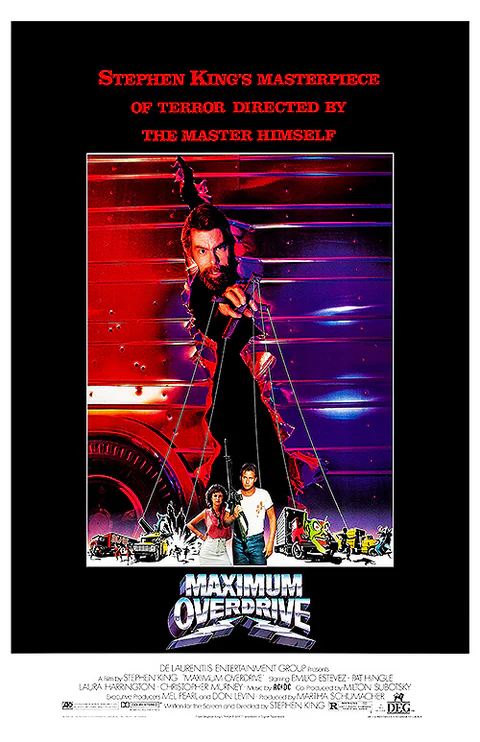

I hope whoever designed this movie poster was haunted by the zombies of three long dead Greasers.

Prognosis: Depressing.

Sometimes They Come Back: A teacher is haunted by the zombies of some greasers who killed his brother twenty years ago but then they all died in a car accident soon after. We never find out why the greasers return from the dead to kill the kid brother of the guy they killed earlier. Or did we and I don't remember? It seems like an important detail. Why would they want to kill him so many years later? Was the afterlife so boring that they felt they needed to bully the kid brother of a kid they bullied to death so long ago? Maybe he kicked one of them in the balls while escaping? That seems like a good enough reason to come back from Hell to torment some guy. I would never forget being kicked in the balls! I'd haunt that ball-kicking fucker to the end of time, even if I had deserved it because I was killing his brother! It's just not fair giving a guy a shot down there. These greasers kill his wife but the teacher performs a Satanic ritual to hire a demon to re-kill the greasers. But what's to stop them from coming back yet again? Maybe that's the story in the sequel to the movie, Sometimes They Come Back . . . Again! That movie title really should have an exclamation point on it.

Prognosis: Not good. A teacher protagonist with psychic or mystic shenanigans and not one single town or haunted hotel or government facility gets burned to the ground? Was King off his game when he wrote this?!

Strawberry Spring: I've sat on this title for a few days with the outrageous belief that if I thought about it long enough, I'd remember what it was about from the title alone. But before I check the synopsis on Wikipedia, here's my guess: a serial killer kills some girls on a college campus? No wait! That was the middle part of The Dead Zone! Fine. I'll look it up.

Well pry the nails out of Christ's crucifix! I was right! Good brain! You're a good little girl, brain! So smart! I guess it wasn't interesting enough to remember but since King basically used it again for The Dead Zone, my brain filed it away correctly. The big twist is that the murderer, Springheel Jack, is the narrator who doesn't remember being Springheel Jack. I guess it's Fight Club with less fighting and more murder. Probably about the same amount of misogyny.

Apparently it was adapted to a podcast series with Sydney Sweeney playing one of the roles. Why would she do a podcast? You can't see boobies in a podcast! Ken Marino was also a voice if you know who that is. I think he was a comedian who played quarterback for the Miami Dolphins.

Prognosis: Amateurish.

The Ledge: This story is about a guy who's forced to walk around a tiny ledge on the top floor of a really tall building. He succeeds and then gets his vengeance on the man who forced him to walk the ledge. I don't remember anything terrible happening to the protagonist or his family so I'm not completely convinced Stephen King wrote this. No wait! The wife of the antagonist who the protagonist was fucking is killed. Sorry for doubting you, Steve!

This story was included in the film Cat's Eye which means I need to make a note of yet another film I need to watch (or re-watch? Was Cat's Eye the one with the Drew Barrymore story with the cat "stealing" her breath but actually protecting her from a gremlin thing? Or was that something totally different?! (Just checked! That's the one!)).

Prognosis: Not horror but I guess King had to practice doing non-horror stories so he could eventually write things like "Rita Hayworth and the Shawshank Redemption" and The Green Mile.

The Lawnmower Man: Imagine having read this short story and then hearing that a film called The Lawnmower Man. And then imagine not hearing anything about the content of the film because you thought you knew what it was about and couldn't wait to see a naked man slithering around on the ground eating grass while his wang flops all over the place. Now imagine the absolutely spectacular tantrum I threw when I realized I'd been had! I think it made the local papers.

Anyway, this story is fucking crazy. That should be the prognosis. Just a second.

Prognosis: Fucking crazy.

Quitters, Inc.: A well done story that might be a commentary on Alcoholics Anonymous but also maybe isn't at all. The Wikipedia page for this story is so fucking long because somebody decided that what it needed was some other writer's literary thesis on King and this work in particular. It's a lot of words to say King had a mistrust of psychiatry which I pointed out a few entries ago writing about The Boogeyman. And I didn't even do any research to know for sure that King had that mistrust! I just read the story and thought, "Boy, King doesn't like psychoanalysis, does he?!" What I'm trying to say is where is my Doctorate of Literature?!

Prognosis: Another story that easily could have been an episode of The Twilight Zone.

I Know What You Need: Another story I don't recognize by the title alone. Although the title reminds me of The Twilight Zone episode, "What You Need". See? It's basically the same title! Anyway, time to look up the synopsis!

Oh, this was the story about the manipulative stalker who tricks a woman into dating him until she stumbles upon his closet shrine to her and his copy of the Necronomicon. I think I blocked this story out because it hit too close to home regarding me and my plans for Aubrey Plaza and/or Jemaine Clement, whichever I could dupe first. I'm not convinced I could have duped either of them, even with magical voodoo powers like the guy in this story. They seem way to smart and clever and sexy and handsome and pretty and sexy and caustic and whimsical and sexy and sexy and sexy and sexy. Also I don't have a copy of the Necronomicon which I think is the most important tool in the plan. Another important tool? Actually trying to meet the person you're obsessed with. Copying a .jpg of their face and cutting and pasting it onto an image of Wonder Woman's body isn't the best method to meet the person you're stalking. It also helps if you went to elementary school with the person and knew all of their moves and had the ability to murder their boyfriend via magic and also to kill your parents (via magic as well) so that you'd get the life insurance money so you wouldn't have to get a job and could spend 100% of your time researching their lives.

If you were ever interested in successfully stalking somebody and tricking them into loving you, this story gives you some helpful advice by showing that the biggest flaw in the stalker's plan was not killing his obsession's roommate. That roommate just bad-mouthed him constantly and made his lover doubt his sincerity! So, you know, take that helpful advice for what it's worth. Thanks, Stephen King!

Prognosis: I was only kidding about being a stalker. I wrote one Wonder Woman review where I played up my crush on Aubrey Plaza to make it seem like I was obsessed and now I have an FBI file. Thanks a lot, people who don't understand facetious whimsy! Stupid FBI can suck eggs!

Children of the Corn: My friend from high school, Randy, an actual stalker of Arnold Schwarzenegger, looked like Malachai but only if you first threw a little Steven Tyler DNA up Randy's butthole. I've never seen Randy in a field of corn so I don't think he worships He Who Walks Behind the Rows but it's possible! I just used "but it's possible" there in the same way people who deny most science use the term "but it's possible". Meaning that they believe anything they can think with their brains could possibly be true and you can't prove it's not true because you can't prove a negative so they just go on believing the stupidest shit in the world and their YouTube algorithm just gets dumber and dumber. All of that is to say this: you know this story. Why do I have to describe any of it? There are scary children. There's scarier corn. People die scared. The end.

I lived in Nebraska for nearly two years and not once did I meet He Who Walks Behind the Rows. That's probably obvious because I was over 18 at the time and I'm still alive now. But I also never met any children who worshipped him. Not that I talked to many children. The only kid I knew while living in Nebraska was Jordan, my friend's kid. Jordan was about five or six and he once told me he had a dream where he was a girl when he was in his mother's tummy. I loved it and told his dad about Jordan's dream and his dad's reaction was, "Ummm, uh, ummmm." He was from Nebraska. That was probably a pretty liberal reaction at the time!

Prognosis: Good enough to make a movie and 665 sequels!

The Last Rung on the Ladder: This was the best story in the entire collection. I fucking loved it and I think I probably cried quite a bit. Just beautiful and sad and really highlights King's strengths. Well over half of King's books, I'd wager, aren't really that horrific. They're popular because he writes pretty compelling characters. Sure, he writes a lot of crap and stereotypical and boring characters too. But when he gets a character right, the book just shines. I think that's why I loved It so much because he manages to make just about every kid in the book compelling, and most of their adult versions. Also the sewer clown's pretty funny too.

Prognosis: Am I wrong to think this is the best story in the book? I don't know! It's not like I have a Doctorate in Literature like I probably should have if I hadn't been too smart to realize more schooling was a waste of my time!

The Man Who Loved Flowers: Did I sleepwalk through most of the last quarter of this book because I've really forgotten what a lot of these short stories were about? Back to Wikipedia!

After reading the Wikipedia synopsis, I realize my brain was doing God's work all along by forgetting certain stories in this collection. I feel like that moment in Total Recall where I go to get a memory implanted only to find I've had some memories changed and erased and now I need to find out why I had my memories changed or erased only to discover that I was better off having had them changed or erased. That's the problem with forgetting, on purpose or by the simple process of knowledge retention through barely adequate electric flesh circuits. Having forgotten something, and then discovering that you've forgotten a thing, you're naturally curious to discover what that thing was. But shouldn't we trust our brain more? Shouldn't we know better than to dig up the past? Haven't we all read or seen Pet Sematary?! Give up on the past! It's a pre-dug grave! It's a trap! Nostalgia is suicide!

Prognosis: I don't know because I trust my brain and if I can't remember it, it's not worth remembering!

One for the Road: This is the other 'Salem's Lot story, right? Some guy gets into a car accident in the snow near The Lot and he finds some old men to help him because his family were left in the car and the old men are all, "Your family is gone. Sometimes dead is better. Oh, but, um, not in this case, I guess! Wrong story!" But since the old men know there are vampires in The Lot, they decide to try to help save this guy's family. But it's too late. They're already vampires! So they fight them and some people die but I think at least one of the old men survive?

Prognosis: Do not trust children, especially if they're in snow or corn.

The Woman in the Room: Some guy's mother is slowly dying and he decides to help her along. That summation is mine and it's about as long and detailed as the Wikipedia description of the short story. Apparently Frank Darabont adapted this story as one of King's "Dollar Baby" movies (look it up yourself!) when he was a college student. I'm guessing that in his version, the guy realizes his mom is dying and he hates to see her suffer so he helps her along by killing her with pills only to discover that the doctor was about to tell him that she was getting better. That would be about what I suspect from Darabont after having seen his version of King's The Mist, possibly the most nihilistic movie I've ever seen and I hate it so fucking much. But more about that in my next review since I've just finished re-reading The Mist!

Prognosis: I guess shocking in 1978? Maybe it'd be shocking for some people in 2025 too. Especially doctors who treat patients who are likely going to die as if they're already dead but they're not allowed to actually end the patient's life through action and usually just go with inaction by not really taking care of them or letting them basically starve to death. Are things different in 2025 than they were in 2003 when I had to watch the hospital staff do that to my grandfather?!

That's all the stories! I love short story collections! Give me more! Although I was hoping for much shorter stories than King sticks in this collection. I like stories that are five to ten pages long because reading is difficult.

Thursday, August 7, 2025

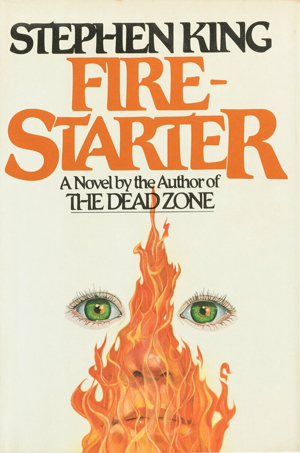
Firestarter by Stephen King (1980)


I have no idea how to approach this book, the least interesting of all of King's early books (that I've re-read so far! I'm looking at you, Christine). I've already discussed how King seems to think terror is somebody having a psychic power that ends in everything being burned to the ground. It's possible King didn't realize he was doing this until somebody said to him at a wild cocaine party, "Have you noticed that all of your books are about a writer or teacher dealing with psychic powers (either their own or another character's) which ultimately ends in everything being burned to the ground?" And Stephen King exclaimed, "That's a great idea for a book!" And then he wrote Firestarter. After it was published, King wound up at the same party as the guy who gave him the great idea for the book. The guy snorted a line, turned to King, and said, "Dude, you need a new idea! You're like a rabid dog gnawing on a bone!" And King was all, "That's a great idea for a book!" And finally, King wrote a different book. Not a different scary book. Just a book about a family who couldn't manage to beat a dog to death with a baseball bat and then go get their rabies shots. Pathetic!

Since I don't have any idea how to get a handle on this book, I'll just write the most boring thing anybody has ever said about this book (I assume because even I'm bored saying it which means the most boring people in the world have probably already said it): "Is this a prequel to Carrie?!" Ha ha! Get it?! It's basically the same book except with a new added creepy Native American assassin paedo character! Okay, fine, I'll give King the benefit of the doubt and believe Rainbird wasn't a pedophile. He just had a massive boner for killing a little girl. That's different somehow, right?

The final chapter of the book had me thinking that King wrote the entire book just for that final revelation of what publication would publish a story about government drug experiments, kidnappings, and assassinations. He was probably having a discussion at that party with that super coked up guy and was all, "The country has changed so much! If Watergate happened right now, who would even dare to publish the article and out the government?!" And the guy wiped his nose in that way they do in the movies after doing coke but I have no idea if people really do it, squeezed his nostrils for a moment, and said, "Um. TV Guide?" And King was all, "No! I'll tell you what paper would have the rock and roll balls to do it! But you'll have to read 425 other pages before I give the big reveal!" And the guy was all, "What were we talking about? Has anybody broken open the adult piñata yet?! I hear it's full of acid tabs." And King was all, "Rolling Stone! Get it?! Rock and roll balls! It would be Rolling Stone!"

After reading the book, I got my Monkey's Paw out of the closet and was all, "Monkey's Paw? Can you make it so that Stephen King writes children better? I hate how Charlie constantly giggles at everything, especially swear words! Are kids really like that? Shouldn't they be a bit more adult about stuff like that?" And the third finger on my Monkey's Paw curled up and I thought, "Ah! That's better! Now King will write children way better!" And then in 1987, he came out with It and I read most of that book thinking, "Fucking A, Monkey's Paw! For once, you came through without fucking up the wish!" And then the children had a gang bang in the sewer and I was all, "Goddamn it, Monkey's Paw!" Later that night, feeling sorry I yelled at my Monkey's Paw, I made a wish on it that I could get my dick sucked. I'm, um, not going to tell the end of that story. Stupid fucking Monkey's Paw.

Monday, August 4, 2025

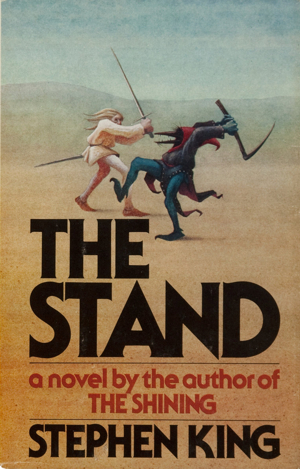
The Stand (Complete and Uncut (Hee hee!) Edition) by Stephen King (1978/1990)


I just finished re-reading The Stand after more than 30 years of having not read it again. If I were Stephen King, I would have called the book The Long Walk but I guess he couldn't because his alter ego was busy on a story with that same exact title at the time. Maybe A Long Walk with a Dog?

The first time I read The Stand, I remember thinking, "What the fuck? The good guys didn't do shit but take a long hike with their dog. Randal Flagg and all his cronies fucked up a bunch and then Trash Can Man took them all out himself." The heroes of The Stand were the most passive yet horny heroes of any book where good faces off against evil. But this time, I realized that their strength was simply in their resistance (and possibly their horniness). Was The Stand a novel about the success of passive and non-violent resistance movements? Because the only actions the heroes take against Flagg are being killed by him and his goons in ways that make Flagg mad and make his people less confident in him. I suppose if I were gullible, naïve, or earnest-minded, maybe I wouldn't sneer at the thought that God was the real hero of the book. Maybe The Turtle from It was the real hero of The Stand? Was The Turtle still alive at this time? Or had it already choked on its own sick?

Anyway, my favorite part was when the nerd got to have butt sex with the hot older kindergarten teacher. Although later he tried to shoot her in the face and I just want to make it known that I didn't think that was cool at all.

Thursday, July 31, 2025

The Shining by Stephen King (1977)


First and foremost in Stephen King's mind must be this thought: "Psychic powers are terrifying!" Carrie is about a psychic girl who burns down her hometown because nobody likes her. The Shining is about a psychic boy on vacation. The Dead Zone is about a psychic man who enacts an elaborate form of suicide because the woman he loved married some other guy while he was napping. Firestarter is about a psychic girl who hates to set things on fire but still sets a lot of things on fire. Christine is about a psychic car, I think. The Stand is about a psychic cool guy and a psychic old lady who divide up the last people in America for a game of war. 'Salem's Lot might be the only early Stephen King book that isn't about a psychic because it's about a gay vampire couple who just absolutely obliterate real estate values when they move into town. Also vampires are kind of psychic so, you know.

Another thing Stephen King believes must be a key aspect of horror is that the main character should be a writer and/or teacher. Mostly that's because he was a writer and/or a teacher and he probably didn't want to research other jobs. Researching other jobs is almost as boring as actually doing them so I get it. Most of the main characters in my fictions are people in comas.

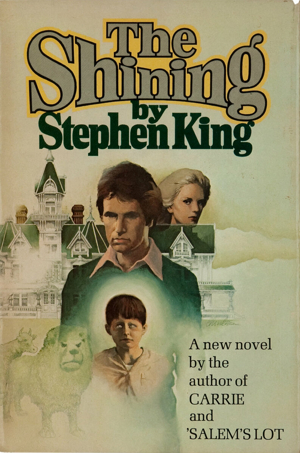
If it were 1977 and I was at the grocery store standing in front of the books (oh? You didn't know grocery stores sold books at one time? They probably did!), I would never in a million years purchased this book. What was Dave Christiansen thinking?! The original cover is a fucking disaster! Why is there a fucking cow on it?! And is that supposed to be a lion? Maybe it's a Chow Chow but who fucking knows? If I were Dave Christiansen, I would blame the gardener in the book who sculpted the hedges to look like various animals. "I know how to draw a lion or dog! But that gardener sucks at hedge sculptures!"

And what's up with Danny Torrance?! Is he terrifying because he has white eyes or is he terrifying because he's an ugly little snot with a terribly fucked up haircut? Why is Wendy hidden behind the house?! And why don't any of the characters look like they did in the movie?! That's the part that's really fucking with me!

Am I in the minority of people who believe the movie was fifty-bajillion times better than the book? The hedgerow ending is way better than the boiler blowing up even if the heater blowing up is just a metaphor for Jack Torrance's temper. In the book, he's an angry drunk and the way he dies relates to being drunk and angry and too much pressure on him. In the movie, he's drunk and angry but also lost which makes him more sympathetic. Also Danny looks like a way better bad-ass in the movie pulling the backtracking in the snow stunt over Danny in the book who, I don't know, just kind of makes Jack forget about the boiler?

The only part of the book that's better than the movie is that Scatman Crothers gets to live. But then he wasn't Scatman Crothers in the book so why would I care if he lives? Man, I fucking loved Scatman Crothers as a kid. He's one of the main reason I loved Scavenger Hunt so much! Along with every single other aspect of the movie, of course (including Schwarzenegger).

I might be forgetting some of the things I really loved about the book because I read it months ago and forgot to do my review immediately after so now I'm mostly thinking about the movie and Doctor Sleep. I remember appreciating that Jack was going nuts based solely on Jack being kind of an abusive asshole and the hotel not having to do much to influence him. At first I thought, "This is much better than in the movie where the ghosts get him liquored up and he can then blame the drink! This is all on Jack since there is no alcohol in the bar!" But then there's another scene in the lounge and Jack gets drunk from ghost liquor and then I was all, "Well, fuck, that sucks. Whatever."

The topiary animals aren't just terrible on the cover. I fucking hated that aspect of the haunted hotel. Just really fucking stupid. I'm surprised there was never a director's cut of Kubrick's film that was released after computer generated special effects could have enabled the topiary animals and the scene was reinserted. If only Kubrick had filmed the scenes with people in terrible animal hedgerow costumes that could have been replaced by the computer animation later. Like George Lucas did with Jabba in his re-release of Star Wars! Man, that would fucking blown! But in a really hilarious terrible way that I could have appreciated.

The movie can still terrify me when I think about it sometimes in the dead of night. Just like the images of the vampires in the made-for-television 'Salem's Lot movie. But when I think about this book? Nothing. Nada. Zip-o-rooni tunes. Not scary in the slightest. It's about a father that gets drunk in isolation with his family, treats them bad, and then explodes. Good riddance! I suppose in that context, I love the book! Can't get enough of a terrible father getting his comeuppance tale!

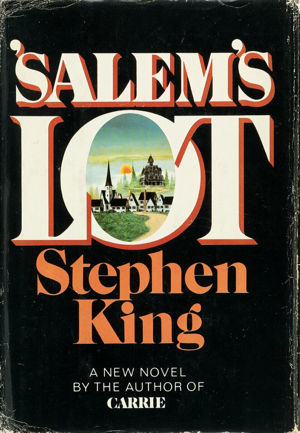
'Salem's Lot by Stephen King (1975)


Carrie ends with the entire town being burned to the ground. 'Salem's Lot ends with the entire town about to be burned to the ground. Did Stephen King's creative writing teacher tell him that this was the best way to end a story? King even has a scene where Ben, the main character who is a writer, burns his manuscript based on Jerusalem's Lot instead of finishing the book. Has anybody checked to see if King's college alma mater isn't just ash and smoldering ruins?

At least The Shining is his next book and we all know that one won't end with the entire setting being burned to the ground because we've all seen the movie and it ends in a snowy hedge maze instead!

This book is the print version of a snuff film. That's not a complaint, by the way! Not that I have ever seen a snuff film nor do I think I would enjoy it. I'm just writing a review! King spends the first half of the book making sure the reader gets to know every single resident of Salem's Lot so that he can spend the second half of the book killing them in ways that make you go, "Who is this again? Oh! It's the jerk bus driver, I guess." Maybe people who remember names better than I do didn't have as much trouble remembering that Ruthie Crockett was the high school girl with the nipples and Sandy McDougall was the baby puncher and Charles Rhodes was the kid hating bus driver. Anyway, they all die. That's sort of a spoiler but not really because I'm pretty sure the first chapter lays out plainly that pretty much everybody died but one guy and one boy.

For a vampire book, there weren't enough homoerotic scenes for my tastes. Hmm, maybe I should do a review of The Tale of the Body Thief. That's one of the best books about how people commit acts to ensure that they never lose the person they love but those acts actually cause them to lose the person they love. Lestat probably should have been more like Barlow. Although we never really get to experience Barlow's feelings towards Straker. I bet there were some longing romantic looks over torn out children's throats in that household.

Stephen King spends an inordinate amount of time with his characters trying to convince themselves and others that this vampire invasion is a reality. It's a modern conundrum King has to navigate in that he realizes his characters would know all about the myths and fictions of vampires and it would be insane for them to not question the evidence piling up all around them. It's almost like modern writers having to figure out how to deal with cell phones in modern horror and suspense films. To make it realistic, you have to deal with the questions which will be foremost in the reader's minds. "How would an actual person react to evidence that somebody might be a vampire?" I think I'd probably be like the sheriff. I'd realize something was wrong and slowly realize what was wrong was that vampires were all over my town and then I'd crack and run screaming. You want to be a hero? Then you can end up impaled on knives at the bottom of some boarding house cellar! Bravo! You were brave!

All in all, this was a solid Stephen King book. It also may have had the first appearance of Pennywise in Callahan's childhood memory of Mr. Flip staring at him from out of the closet.

P.S. Hey, Internet. Look up dramatic irony and the concept of jokes before you correct me about the ending of The Shining!

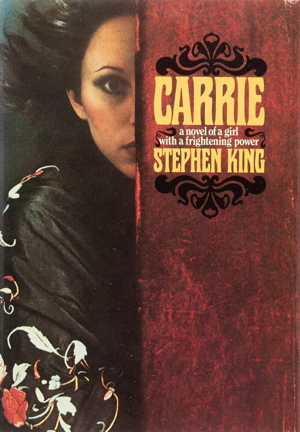
Carrie by Stephen King (1974)


If I remember correctly (which I don't always), Kurt Vonnegut said something, somewhere, about being interested in all the characters of stories. Maybe Breakfast of Champions says something about this. I don't know. It's been a long while since I've read it. And this isn't about a Kurt Vonnegut book anyway. But it's smart of me to begin by hinting that I've read loads of Kurt Vonnegut, right?! Maybe it's smarter not to even hint about it: I've read all of Vonnegut's books. I even understood like half of them.

The point I was getting at was how stories which tell the tale of a protagonist at the expense of all the people in the background whose lives are harmed or complicated or uplifted by the protagonist's actions are shallow at best. I have never been able to enjoy action-packed blockbusters where the characters the camera follows live through the huge natural disaster while thousands of others die. Am I not supposed to care about any of the other casualties? Am I supposed to feel uplifted at the end that The Rock lived? I guess I am supposed to but I never actually am.

What this has to do with Carrie is that Stephen King's book isn't about a girl with telekinetic powers. It's about a town and the people who drove Carrie to do what she did and the people who wanted to help but didn't do enough and the bullies behind it all as well (always bullies in a King novel. He, for one, knows who the true antagonists of the world are. Is it Pennywise? Or is it really Henry Bowers?).

King's first novel is surprisingly more postmodern than I'd remembered (I mean, I first read it when I was 15. What did I know of postmodern?! Hell, I'm 50 now and what do I know of postmodern?!). The story is told across a variety of texts: books written after the event, transcripts of commissions trying to get to the bottom of it, books written by Carrie's peers, AP news stories. We don't just see the events unfold from Carrie's point of view. We practically see the entire town's point of view.

My favorite bit about King's style is how he somehow learned early as an author that withholding information from the reader was hack writing. I've read a lot of comic books through the years and the worst thing a writer can do is have some unnamed nemesis, allowing characters to see who it is by showing the back of the head on panel while the hero croaks, "You!", but never letting the reader know. Expecting that the reader's need to find out the answer is what will keep the reader intrigued. They don't realize that giving answers is more satisfying to the reader and giving an answer just expands the questions in the reader's mind. That keeps the reader engaged. King somehow realized this with his first novel. It's not a third of the way through the book and King has already mentioned what happened to the town on the night of prom. He's mentioned the death count. He often ends some section of story through a character's point of view with the ending summation about how they have less than two weeks to live. It's pure chaos! King's just all, "Here! You want to know how it ends? Badly! Really badly!" And then he expects—he somehow knows—that this will just keep the reader further engaged, more excited to see how Carrie turns the town into a smoldering ruin.

Oh yeah! The characters! King treats nearly all the characters that interact with Carrie in nearly any way, no matter how miniscule, as fully formed people. The respect he shows to every character in this book deserves a grand metaphor that I can't come up with. Is the book about Carrie? Yes. Is it about Sue Snell? Yes. Is it about Tommy? Yes. Billy? Yes. Chris? Yes. Momma? Yes. Teddy Duchamp? Well, no, but it was surprising to see that name! I think King just liked the name so much he used it again later for "The Body." The book is simply about all of them in a much bigger way than most books with a cast of characters allows the plot and themes to be about all of the characters. Carrie should have overshadowed everybody in this book. That she didn't just exposes, so early in his career, King's mastery of storytelling.

Being King's first novel, it suffers from all the weird King crap that all of his future novels will suffer from! I'm not here to write an essay on King's flaws. I mean, his flaws are partly what made him so popular. He says and does things in ways that no other author (or editor! Who is the champion editor that kept all that slack in King's writing leash?!) would do. Because they're grossly expressed. Or weirdly stated. Or seriously off-putting. I've already returned my ebook to the Multnomah County Library so I can't go back to find examples. But there are things like an article about people who knew Tommy and how, in a parenthetical reference, King writes, "A lot of people referred to him as a good shit." But not that! It was worded really strangely. I wish I'd kept the exact quote because it's such a weird sounding bit of slang that it may have worked fine with one person having said it but saying "a lot of people" said it just made me roll my eyes in the way that I love to roll my eyes when King is making up some cool slang. Maybe it was slang in use in Maine in the 70s but if so, I don't trust Mainers.

The book might also have been about menstruation and how menstruation is not only a sign of fertility and the beginning of life but also, starkly, a sign of the end of or loss of life when considered from the view of somebody miscarrying. Miss Carry ing? is that a thing? No, you know what, never mind. This review is done!

P.S. This part of the review isn't in my original review I posted on Goodreads because I just thought of it thanks to my lame joke at the end. Could this book be about Carrie's mother miscarrying Carrie? Is the book about her mother's hopes and dreams of her child that end in a torrent of blood and misery and grief? The evidence for this isn't actually in the book. The evidence for this is in Danielewski's House of Leaves which might possibly be telling the same kind of story: Pelafina loses Johnny Truant at birth and his entire life is made up by her while in The Whalestoe asylum. He was her little boy that she lost. He was truant. The five and a half minute hallway that his sister Poe sings about, the choking of Johnny by his mother in the foyer of their home (you know, the entrance/exit to the womb), are all metaphors for strangling during birth. At the end, Johnny remembers his mother's final words before letting him go. But not knowing Latin, he hears them phonetically: Etch a Pooh Air. Behold, a boy. Did King beat Danielewski to the punch with the mother's delusional life dream of her child lost at birth (or by miscarriage)?! Um, probably! I'm smart!

Friday, July 25, 2025

The Dead Zone by Stephen King (1979)


The Dead Zone can be taken exactly as Stephen King presents it: a story about a guy who can see the future and, having seen the future, change it for the better. Or, since it's a horror novel, I think it's more appropriate to view it this way: a story about a guy who can see the future and, having seen the future, have no way at all of changing anything about it. You might be thinking, "Come on, Tess! That's fucking stupid! I read the book and the guy changes the future!" But does he? I said, "Fucking does he, you Goddamned nitwit?!"

Sorry! I get a little bit passionate about how I'm always right about everything. Now some of you might be thinking, "Are you always right about everything?" And, well, fair point, person who doesn't know me and also whom I just made up in my imagination! I guess I'm not always right. But I am about this!

My basic premise begins like this: Stephen King writes horror novels. What's so horrific about a guy who can see the future, notices a man will cause World War III, and then stops that man from gaining the power to do so? That's just a boring Reader's Digest book! Over in like twenty pages! Oh! I just found more proof to my theory: Wikipedia calls The Dead Zone "a science fiction thriller." See?! SEE! If you read it the way everybody fucking reads it, that's all it is! A pulp science fiction thriller where a guy can see the future and read objects to see their history. Oh! But that's a good point, Tess, you should have been thinking. John Smith, the psychic lead in the novel, can see both the past and the future when he touches objects and people. And guess what? When he views the past, he can't change it. Which leads to my hypothesis: when he sees the future, he can't change it either. That's where the horror comes in. The dawning horror of the novel is that John Smith simply sees himself trying to assassinate Greg Stillson while Greg Stillson holds up a child in a blue and yellow coat to block any bullets that might come his way. He tries to assassinate Stillson because he sees himself assassinating Stillson. He fails just like he saw in his vision. His vision about the world looking like it had succumbed to Armageddon? That's not even a real vision in the book! It's what the kids today would call vibes! The horror is that John Smith didn't save the world. He was simply a victim of a brain tumor which gave him psychic flashes of events in the future or past that he had no agency over.

Need more proof? The vision that gets John Smith to believe that Greg Stillson will destroy the world is the one where he sees a building burn down, killing loads of young people in the graduating class of the kid he's tutoring. Guess what happens? The restaurant burns down, killing loads of kids from the graduating class of the kid he's tutoring. He never saw a vision of all the kids he saved by warning them but that doesn't mean that he always saved that many kids by warning them. Yes, he touched a person who didn't die in the fire when he saw the fire and all the people dying. But that doesn't mean he saved that person. That just means maybe the kid he touched was wearing a friend's piece of clothing that he gave back to that friend who subsequently died in the fire.

John Smith doesn't see any future when figuring out who The Strangler is so that doesn't matter. He doesn't see a future where he wins or loses while placing bets on the wheel at the carnival; he just sees what number the wheel will land on and, you know, it does. He sees his physical therapist's house catching fire because she left a stove on and, guess what? The house catches fire but is saved. Was John Smith the direct reason the house was saved? That one could be the best argument that he could change the future but we don't know that the future changed because John Smith saw what would happen and it happened and he's a person with agency who, not having any psychic vision, creates consequences in the world via his actions anyway. So if he didn't see it, would her house have burned? Well, no, because he saw it and they called her neighbor and the fire department was notified. He didn't have a vision of the house burned to the ground. He had a vision of the curtains catching fire which is what happened.

This story is about a man who was driven crazy by his ability to see the past and future, neither of which he could change, and then opted to try to assassinate a man instead of getting lifesaving surgery because he shook the guy's hand and got some bad vibes from him. That's where the horror comes in. It's a story about the lack of free will and our inability to manage and control our lives; it's about depression and heartbreak and choosing a hell of a way to commit suicide. Why else would Stephen King call it The Dead Zone? Oh, sure, something John called the areas he couldn't read psychically. But in reality, it's just depression and giving up and, through no fault of your own, be it fate or accident or psychic payback, having your life taken away from you without any chance of actually changing it.

Cujo by Stephen King (1981)


As everybody probably knows, Stephen King’s Cujo is about a rabid dog (a St. Bernard in the movie but was it also that in the book? I don’t remember! It’s been over three decades since I read it! Should I even be doing a book review of a book I haven’t read in a third of a century?!) which means it’s not really much of a horror book. I guess maybe some people are scared of dogs and everybody should be scared of rabid dogs. But is that really enough to base a horror novel on? Not really which is why Stephen King introduces some other creepy factors like the ghost thing in the kid’s closet and the strangler running around Maine strangling people. Unless that was The Dead Zone.

I suppose it would be scary to be locked in a hot car while a rabid dog decides to not let you out because I guess the dog isn’t just rabid but also a huge jerk? It’s not like the book was written before there was a cure for rabies. Knowing that rabies can be cured, maybe beat the crap out of the dog with a shovel and then go get some shots? If this book were set in 1884, I’d understand why nobody would want to get out of their covered wagon to beat the dog to death because one little bite and it’s all over! But by the late twentieth century, we had so much more medical and dog-killing technology that getting trapped in a hot car by your rabid dog just seems like maybe you brought that on yourself.

The end of the book is the best part because the rest of the book says, “Look at this scary dog! It’s going to eat your face! Kill it! Get away! Ahhhhhh!” But then the last page is all, “You know what? The dog didn’t mean it. Give it a break! Have some sympathy! Don’t be such an unfeeling jerk!” It’s like what do you want out of me, Stephen King?! To be frightened or to feel guilty?!

Four stars!