I don't know if the point of this next section was for the reader to conclude that Teddy Bloat is a hipster but here we are! Teddy Bloat is totally a hipster. The evidence is the long list of items he keeps in his fashionable kangaroohide messenger bag.
The other revelation is that Tyrone Slothrop is slovenly. I think that's why he's named the way he is and also Bloat is named the way he is because, um, he's a hipster? I'm not writing any sort of companion work to this book to help future readers so I don't need any supporting evidence for my conclusions.
In this section, Teddy Bloat has been tasked with taking clandestine pictures of a map on Slothrop's wall. The map is of London and is covered in stickers labeled with women's names. He's being paid by some organization to secretly gather this information. For the reader who is just 16 pages into Gravity's Rainbow, why he's doing it must remain a mystery. But for the super intelligent person who is reading Gravity's Rainbow for the third time (all at the same time: read a section once, probably reread it a second time, and then eventually reread it a third time when I get to it on my second reading which is being conducted at the same time as the first reading but with a lag of about 100 pages. I believe this is the proper way to read this book (three times!)), they understand exactly what this is about. It seems that Tyrone Slothrop's sexual conquests are all predictions of where a V2 will fall sometime in the next, on average, 4 1/2 days.
More will be learned about Tyrone's powers later when we learn that, as an infant, he was experimented on to see if he could be conditioned to get a little baby hardon due to outside non-penis stroking stimulus. The big mystery is what that stimulus was and why it might still be part of him and how maybe it's the reason he can somehow predict where the V2s will fall. And just like the V2s being portents of doom in reverse, where they bring the warning of death only after they've already exploded, so too Tyrone Slothrop somehow reacts to the falling of a V2 before it actually falls.
But I'm getting way, way ahead of myself! At least I didn't also begin discussing how Tyrone Slothrop is also being hypnotized to recall his past experiences so they can learn more about the behavoir of Black Americans (I don't think Tyrone is black himself based on his recalled experience where he climbs down a toilet to recover his harmonica) for their propaganda operation to send radio signals across the channel that are meant to heighten racial tensions with South African Germans.
Fucking Christ this book has some weird shit going on!

Thursday, November 12, 2020
Gravity's Rainbow: Part IV

Gravity's Rainbow: Part III
In the second section, we get to know a little bit more about Captain Geoffrey "Pirate" Prentice. I don't know if he's the hero or just the first character that gets the spotlight. He's Gravity's Rainbow's Catch-22's Yossarian. He's sort of stuck doing the job higher ups demand from him while he constantly worries about his death. Except he's The X-Files version of Yossarian. Yossarian didn't have any magic powers. He wasn't special at all. That was kind of the point both with his predicament and his senior officers' attitude toward his possible death. But Pirate has a super power: he can invade, take-over, and manage other people's fantasies. And once the military discovered he had this power, he was roped into using it for their benefit.
You're probably wondering, "What? Fuck you. That is not a thing in this book." Don't worry! I'm not upset that you're cussing at me in my imagination. But think about it! Mason & Dixon was 1/3 historical novel, 1/3 paranormal strangeness, and 1/3 Mason's boner. It totally makes sense.
This is the section I most remember from my previous attempts at reading the book because it's the section that talks about all of the different meals Pirate makes from bananas. Cultivating bananas and making food with them for his colleagues is sort of the thing he does to destress from living other people's fantasies. The last fantasy he had to manage for a number of years was where he attempted diplomatic relations with a gigantic and sentient adenoid that was destroying London. It was the fantasy of some guy who needed to be busy with some other shit in the Middle East but he was too busy dealing with his dream adenoid. So Pirate took over so the other guy could do his job. And then once the guy did his job and saved the world (but, as noted in the book, not from World War II. He saved it from some other historical problem that I couldn't be bothered to read more about at the local library), he was found dead in a bathtub full of custard. So I guess that's how the Paranormal Military retires the weird people they don't need anymore.
I guess Pirate's nickname "Pirate" is because he commandeers other people's fantasies?
Some other characters are mentioned but I don't know enough about them to know if what we learned was important. Like some guy named Bloat and some other guys named other things. There are a lot of characters!
It wasn't until this reading that I realized how much this book is about the weird, paranormal offshoot experiments of World War II. Maybe they were all real. Maybe they're just hyperbolic representations of the militaries experiments with ESP and Astral Projection and Mind Control. Does it matter? Probably to Pynchon! But not to a dumb casual reader like me! If I can't explain why Clifford the Big Red Dog was so fucking massive, why would I think I could explain any plot points in a Thomas Pynchon novel?! I know my fucking limits!
Gravity's Rainbow Part II: Section One
The first chapter is called "Beyond the Zero" and I don't know what that means yet. The chapter heading is followed by a quote from Wernher von Braun, the most famous German engineer who helped develop the V-2 rocket, a major character in this book. Like really major! The quote is some nonsense about how science has taught Wernher to believe unscientific pablum. That's important because a lot of this book relies on groups conducting paranormal research for reasons which become almost immediately apparent! This book is like an episode of The X-Files if The X-Files had too many characters with silly names and scenes which seamlessly slipped into different scenes from different times without warning you that everything you were reading has suddenly changed and now something else entirely is happening.
The book opens like this: "A screaming comes across the sky. It has happened before, but there is nothing to compare it to now."
After I got done giggling about a screaming coming all over the sky, I decided to think about it for awhile. Opening lines are important and you'd know that if you ever heard anybody say, "Call me Ishmael," and then nod twattishly as if they'd just recited four of Shakespeare's plays in a row. Or maybe one time somebody wanted you to think they were smart and so they said, "It was the best of times, it was the worst of times." If they really wanted you to think they were smart, they would continue with "It was the age of wisdom, it was the age of foolishness." But that's really gilding the lily a bit and also it's calling a bit too much attention to how A Tale of Two Cities has kind of a crappy opening. Is it really profound to say, "It was everything but it was also nothing. Think about that, prick!"
Just a second. I have to make a note for a new book I just decided to write because I thought up that great opening line.
Gravity's Rainbow starts off much better than those other dumb books I mentioned which I can pretend I've read because this is the Internet and you don't know me. These first two lines tell you something concrete about the setting.
A scream is a warning or an indication of tragedy or catastrophe. It's a portent of danger. Also a portent: anything that comes screaming across the sky! That's why the next line says this has happened before. Portents of death and the end of the world are as common as terrible opening lines in novels. But the next line is all, "But hold up, Grandma! This isn't like any portent you've ever seen before! This is postmodernism!"
The reason the current "portents" have nothing to compare them to now is that they don't portend doom after which doom follows. These new screaming portents kill before the warning comes. They travel faster than the speed of sound and so they smash into you and you die and then they scream their warning. Like, how is that fair?!
The next line might be a bit confusing until you've come to reckon with the idea that the screaming portents kill before anybody knows they're coming. "It is too late. The Evacuation still proceeds, but it's all theatre." Because the missile has already hit. Whoever was going to die, has died. Now it's time to get everybody to safety! I suppose there will be fire and rubble and stuff that you want to move people away from but that's just picking at nits.
The modern age has found a new way to terrify people with the specter of death. Most people think, "Oh boy! I'll live life and then when death comes, I'll probably have time to prepare or I'll have lived a good life or I'll somehow be at peace with it." But now it's more like, "Oh boy! I'll live life and then...." Well, you're dead. Just like that! Bye bye!
Most of my favorite books are about escaping the world rather than fighting back, books like Catch-22 and One Flew Over the Cuckoo's Nest. I sometimes include The Grapes of Wrath in that because in one sense, Tom Joad flees into the shadows while his family must struggle on. But inherent in his flight is that he'll always keep fighting against injustice. So while it's one of my favorite books, I can't keep grouping it with the others. But Pynchon might be starting out Gravity's Rainbow with the inherent idea that there will be no escape and there might not even be a chance to fight. What's going to happen to you is going to happen to you and, well, you've got a lot less control over that than you might feel good about. While being evacuated, the evacuees all think, "Is this the way out?" And the answer is no, not at all. The Evacuation "is not a disentanglement from, but a progressive knotting into."
Each one, believing they're the only one to think it, thinks, "You didn't really believe you'd be saved. Come, we all know who we are by now. No one was ever going to take the trouble to save you, old fellow...."
In this chaos, we are introduced to Captain Geoffrey Prentice, also known as Pirate. In the morning after the evacuation, he notices a V-2 vapor trail rising into the sky against the horizon. He knows that means only a matter of minutes before the V-2 slams into London. He thinks about warning somebody in authority, or waking those around him, but ultimately realizes he might as well put it from his mind and go about his business. If it's going to hit, he's already dead anyway.
This is the setting which begins Gravity's Rainbow. It's heavy, like gravity! But it's not pretty like a rainbow. Maybe rainbows have negative attributes that I never learned. I know they're a symbol of God's pact to never again drown all mankind! Sometimes people say it's God's pact that he won't kill all mankind again but he's a shrewd businessman, that God, and specifically writes up in his contract that he won't drown them all. What a jerk.
The last thought about the V-2 Pirate has in this section, before he simply wipes it all from his mind and gets to making banana breakfasts for everybody, is this: "What if it should hit exactly—ahh, no—for a split second you'd have to feel the very point, with the terrible mass above, strike the top of the skull...."
Gravity’s Rainbow by Thomas Pynchon: Part One: Trepidatious First Steppery
I stopped reading The Familiar for some reason and never picked it back up. Probably because I decided to wait until every book of the series was published and/or I was dead. You might be thinking, "You just didn't understand it, you coward!" But my rebuttal to that is "Now I'm reading Gravity's Rainbow and I'm definitely not going to understand that so who's the coward now?!"
Whenever I begin reading a book, I like to come to grips with the title. Like when I was reading The Grapes of Wrath, I was all, "Oh, this book will be about angry grapes." Then when the book wasn't about angry grapes, I was all, "What the hell? How was I supposed to understand the title was a Biblical and/or Shakesperian allusion! Or maybe T.S. Eliot?" And then when I was reading House of Leaves, I was all, "Oh! This is about a house that nobody wants to remain in." And then when I finished that book, I was all, "Yep! Nailed it! Also it's a book. A house of leaves is a book. I get it. I'm smart." But now I'm reading Gravity's Rainbow and I'm going to admit something I don't usually admit: What?!
Was that an admission? I don't know.
I did some high school physics in — you guessed it! — high school and I scored barely passing grades. It's possible we learned what gravity has to do with rainbows but you know the problem with learning physics? You have to remember the first things you learn to understand the second things and so on and so forth! It's like a pyramid scheme of learning and I was a terrible salesperson. From what I remember from the class, gravity bends things and rainbows are bent at both ends. So there's probably something there, right?
Although it's unlikely, it's possible there's a character named Gravity in this book since there are characters named Pirate, Slothrop, Mexico, and Moonmoss. If that's the case, I totally understand the title! It's just a statement about some jerk's possession!
You might be wondering how I know some of the names of characters already. Well, I've already read 80 pages of this book. That would normally make it hard for me to discuss the pages I've already read but guess what? This book is so complicated that I'm reading it twice and at the same time! Yes, I've already started rereading it and let me tell you: the second time through is marginally easier to understand!
Judging on some of the sentences in this book that go on so long that I forget where they were headed when they began, I'm probably going to need some help understanding certain passages. And since I'm not taking a class on this book, I'm hoping some non-troll Internet residents will help me understand this thing! Post your smart but not smart ass comments in the comment section! And no spoilers because I probably won't understand them anyway.
Thursday, October 29, 2020
Justice League International #8 (1987)
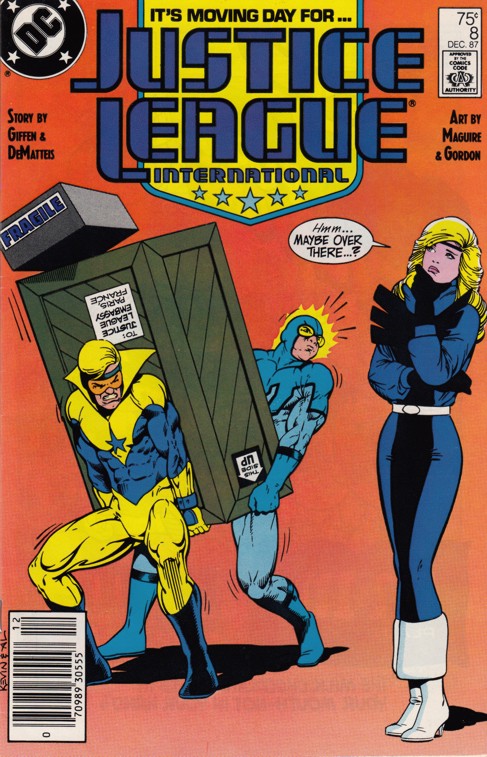
Is it weird that I have a newsstand copy of a comic book when I definitely was shopping at my local comic shop in 1987?
I probably left out the joke about the hernia although that one might just be implied. Also, it'll probably be a blatant joke later in the story.
The issue begins with Jack Ryder on his right-wing radio call-in television "news" program fiasco of a show Hot Seat trying to get the masses to shit blood over the Justice League. It'll work because the masses in comic books (as well as the masses not in comic books because we've all seen how people who listen to and watch right-wing radio call-in television "news" programs easily believe the alternate reality fed to them because it speaks to their inherent biases and selfishness) are idiots. (That might be my favorite interruption by parenthetical reference I've ever written.) I also know that it will work because Glorious Godfrey only recently did the same thing a year or two ago and it worked. But comic books don't recognize time and space in the same way that we more logical and real readers do so the masses won't remember that they were fooled just a year ago by idiotic television pundits who don't mind seeing the world burn as long as they can cash a fat check over it. I doubly also know it will work because Millennium is coming up and I think that might be proof that maybe Jack Ryder was sort of right because aliens have infiltrated Earth and are pretending to be heroes and possibly even right-wing radio call-in television "news" hosts.
I don't really remember much about Millennium except that it was weekly and there were Manhunters in it.
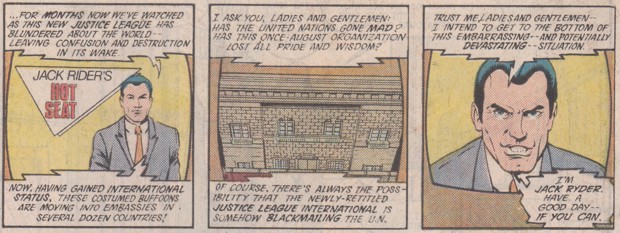
My favorite comic book characters when I was a kid were Blue Falcon and Dynomutt. I bet Jack Ryder was Sean Hannity's favorite. Tucker Carlson's favorite was probably Hitler.
J'onn, Mister Miracle, and Captain Atom are setting up the New York Embassy which leads to lots of jokes about shoddy construction and terrible wiring and lazy movers. At one point Captain Atom electrocutes himself and then destroys all of the wiring because he's the guy the United States wanted to represent them on the new international team. I'd say his penchant to escalate a situation straight to violence proves the United States made the right decision.
Batman and Guy Gardner oversee the outfitting of the Russian Embassy with a little help from Rocket Manhunter #7.
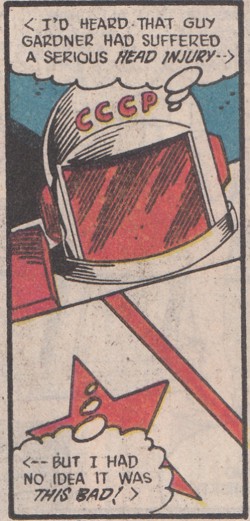
Even Rocket Red has heard about Guy's serious brain trauma and yet nobody has even discussed getting him a medical check-up. What a bunch of bastards!
The "Bwa-ha-ha-ha" gag begins when Booster tries to hit on a Parisian woman and gets shot down. Later, she winds up being the League's Paris Bureau Chief. And also maybe Crimson Fox?
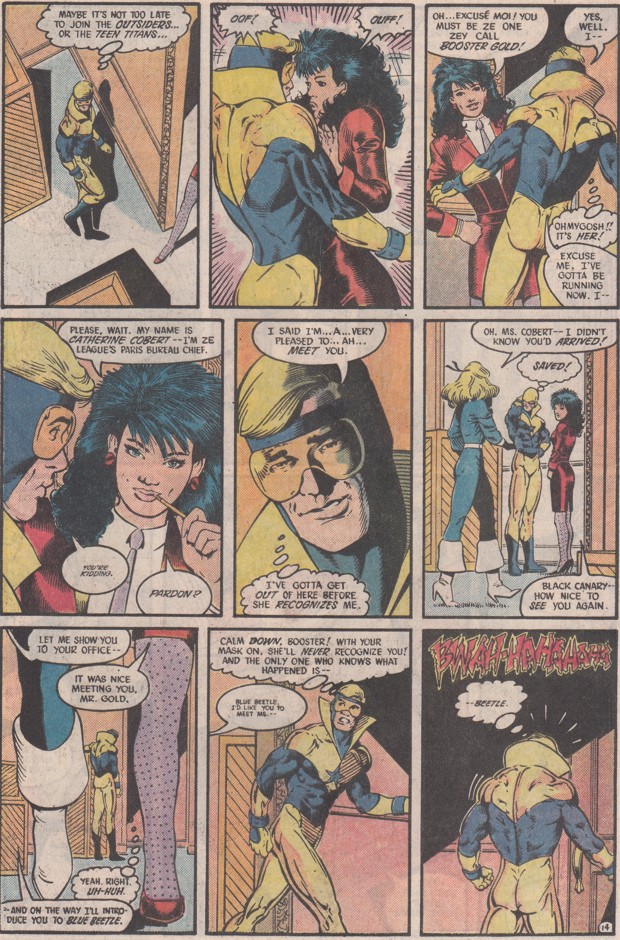
This scene is well done in a book that often tries too hard for stupidly silly humor.
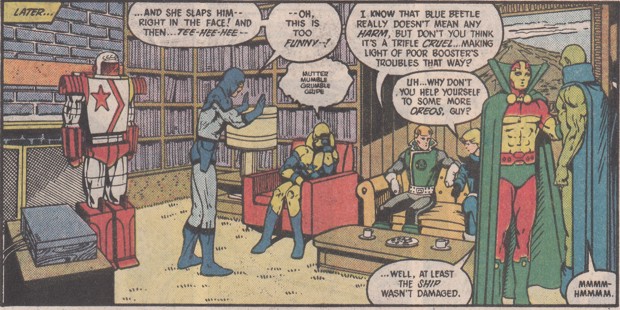
Maybe I'm a dick who doesn't understand true friendship but this is totally what it looks like, right?
Justice League International #8 Rating: B+. How come when I publish a manifesto, people refer to it as a 'zine?! How do you get the fucking power to have your photo-copied screed with "art" considered a manifesto?! How many people do I have to rant at to get some Goddamned recognition?! "The Truth About Star Trek Transporters" is not a fucking fanzine, people! It's a manifesto of the alternate reality we're being asked to accept! The alternate reality of an alternate reality where people are being sent to their deaths every fucking mission only to be replaced by clones of themselves and nobody fucking cares! Probably because they're all clones of clones of clones and their ability to think rationally has diminished to the point of dogmatic stupidity! Am I the only one witnessing this while others simply think its some kind of retrograde perspective?! Does my antediluvian intellect subquester the means of proliferating the parallax of reality?! Does the inclusion of three hilarious dick jokes deny me the mantle of manifesto writer, oublietting my ego into an infinite mirror trick of endless zineian declarations?! Fuck this shit! And fuck that satellite that's been following me throughout this meandering conclusion!
Tuesday, October 27, 2020
Cerebus #19 (1980)
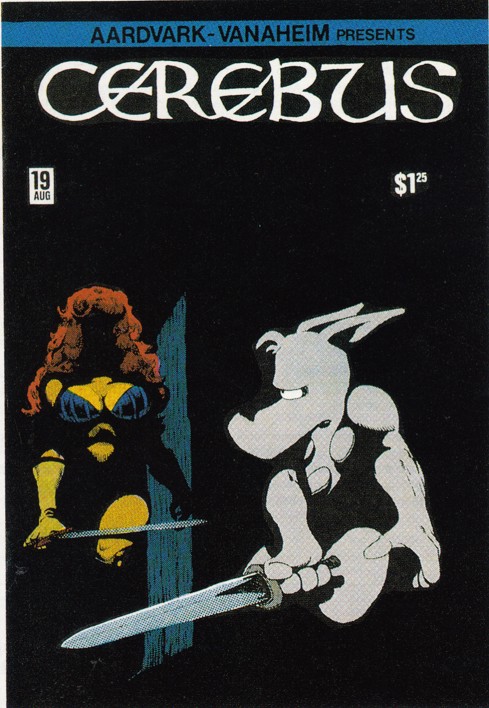
Is this StarRoach or RoachFire?
Dave's essay from Swords of Cerebus gives me more to work with so I'll be discussing that in the following X number of sentences. I will not counting the sentences and then replacing the X with that number. The X, as we all know, is the king of variables and you should understand the work it's doing.
Dave begins the essay with "This is when the story started getting a little weird." You read that correctly. Weird wasn't when the erdschweine first road into the villaggio on the caballo. Weird wasn't the introduction of the frenetic albino Foghorn Leghorn. Weird wasn't even the amnesiac merchant who became a hissing vigilante every night. Weird wasn't Groucho Marx governing a literal bureaucracy. Weird was this issue when he begins to lay the foundation of the Cirinists and Kevillists. Sim has already introduced a whole bunch of nationalities that I can't keep straight and now he expects me to follow the intricacies and dogma of two embittered sects at constant odds with each other? I've read the first half of Cerebus quite a few times (and the last half or so just the once. Probably everything post Guys) and I'll be damned if I can remember where Kevillists and Cirinists differed on anything. I think Kevillists are okay with abortion but Cirinists think it's the worst thing you can do. Also Kevillists are daughters and Cirinists are mothers, if that helps clear up anything. I promise to try to pay more attention during this read through.
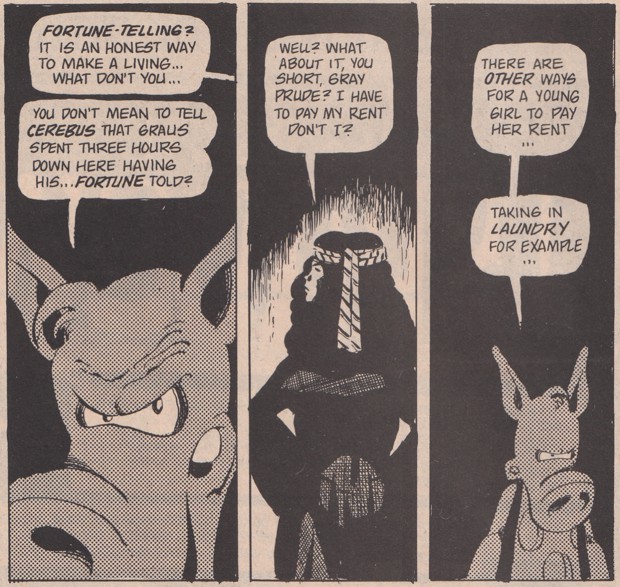
Early on, we discover Cerebus is against sex work. But don't worry! He's not a total prude! He's all for rape (within the confines of marriage, of course! I'm sure Christians and Conservatives would agree).
Lord Gorce is busy trying to raise an army to defend Palnu (under Lord Julius' instructions) by swindling and manipulating other leaders into giving him access to their armies. He seems a bit overly confident in his abilities so I suspect he'll be dead before Cerebus even knows he exists. Cerebus is also continuing to try to raise an army to capture Palnu. And like all good Dungeons & Dragons campaigns, this leads to somebody sending him on a quest for a priceless artifact. Unlike a good Dungeons & Dragons campaign, Cerebus won't wind up slaughtering a whole orc community in their lair while somehow retaining the alignment of Lawful Good.
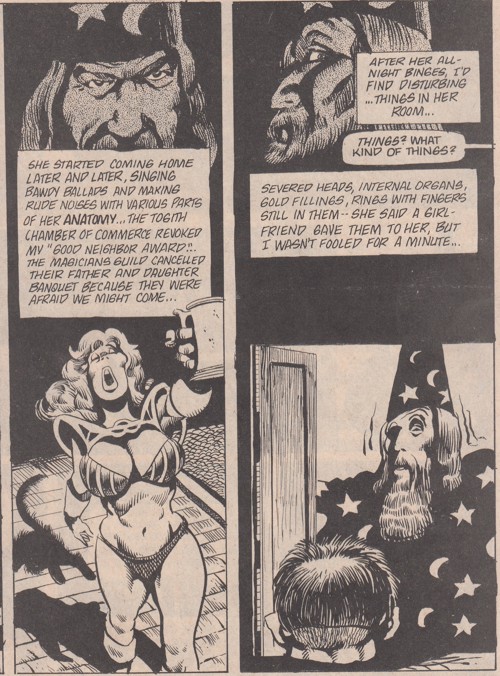
In his quest for the priceless artifact, Cerebus once again encounters Henrot and Red Sophia. Well sort of Red Sophia. A magical clone of Red Sophia.
I might be remembering some parts of the story out of order. And incorrectly. Most of my brain power is currently tied up in trying to understand Gravity's Rainbow.
Michael Loubert's "the aardvarkian age" continues to be a huge disappointment. I thought I was going to get a bunch of funny extras about Estarcion and Cerebus but instead I've just gotten additional ill-written reading material that I can barely comprehend. The ill-written part is Loubert's fault; the barely comprehending is most likely my own.
Cerebus #19 Rating: B+. I wonder if women are more comfortable and less self-conscious about being naked because their naked form is basically the same as their clothed form (especially if they're wearing a shirt which allows their nipples to poke through). But as a guy, you've got this added dongle dangling there just acting goofy. I'm not trying to suggest that penises aren't sexy; they obviously are! So nice to look at! But it is a bit weird to look at yourself in the mirror while brushing your teeth naked (the way everybody does it, right?) and have to see that thing just sort of hanging there like a wilted bunch of grapes. Erotic grapes, of course! Um, that's all.
Sunday, October 25, 2020
Justice League International #7 (1987)
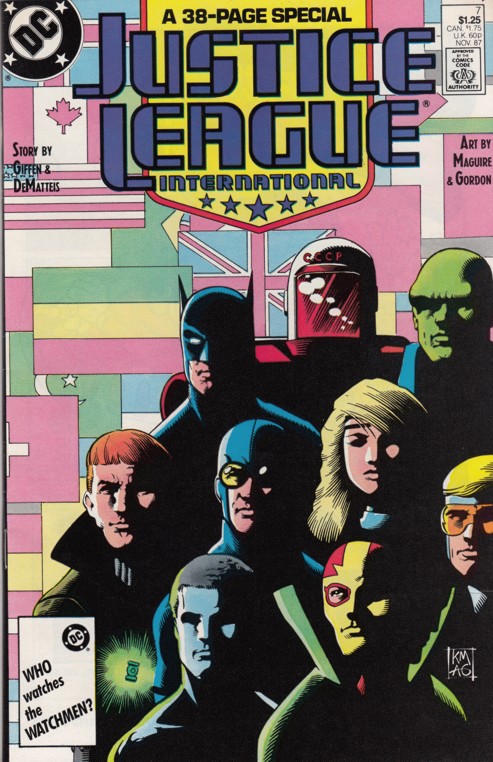
Kevin Maguire not really trying looks an awful lot like John Romita Jr at his best.
Was all that previous nonsense poisonous, vile, and toxic? I suppose one could argue the point. But I'd also guess that somebody arguing that point has never seen John Romita Jr's art. Or perhaps they have seen it and like it because they have a terribly underdeveloped sense of aesthetics. Otherwise nobody would argue with me at all! They'd just read the previous poisonous, vile, toxic nonsense and nod their heads in agreement while pausing for a second to snort a line of Adderall.
Fine, I'm sorry, JRJR! Obviously you're an artist! Drawing squinty people with block heads and weird noses holding geometric guns without a single curve on them absolutely falls under the definition of art! Although I draw the line at accepting that Rob Liefeld is an artist. That's a bridge too far!
What the fuck does that even mean, "a bridge too far"? It must be a term bombers in WWII used, right? "What the fuck do you mean, carpet bomb Dresden?! If we fly past the Geralthauskopfplatz Bridge, we're definitely getting scrawked by anti-aircraft flak, you bingehart!" Did that sound like an authentic American bomber pilot from the 40s? It's not like Catch-22 is my favorite book or something.
Wait. Catch-22 is my favorite book. I guess I'm just no good at written impressions. I assure you it sounds exactly what you'd expect from an American pilot in the Forties if you heard me do the impression live.
Also, this is probably the last month of my life where I'll be able to say, "Catch-22 is my favorite book." Because I'm over 500 pages into Gravity's Rainbow and it's just as fucking amazing as everybody who has pretended to read it says it is.
This issue begins with Guy Gardner regaining consciousness after having been violently assaulted by his employer.
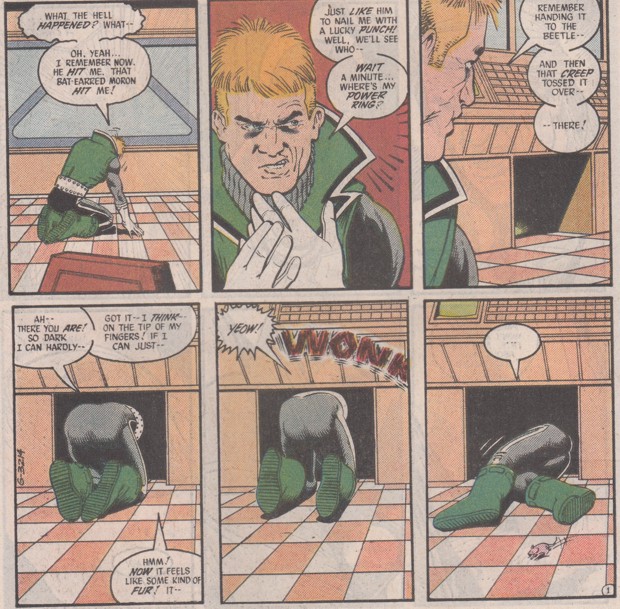
Why was the mouse glowing green?!
The Justice League didn't quite finish destroying The Gray Man last issue so that story gets resolved pretty quickly this issue. Doctor Fate transported him to the Realms of Order where a big blob of Order disintegrates him. Which is what he ultimately wanted. It's what we all ultimately want. It's just you don't know that you want it until you've lived long enough for all the wonder to be bled out of life. That's why he's the Gray Man! Some people think life's too short but at 49, I'm beginning to suspect that it's way too fucking long.
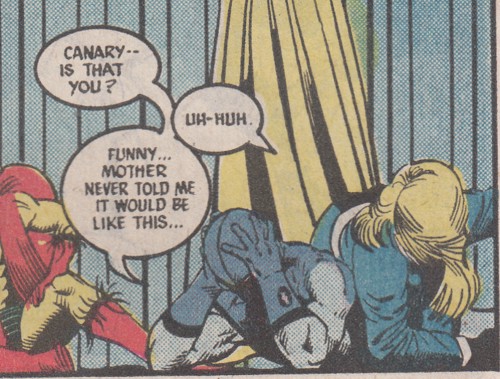
This comic book passes the Reverse Bechdel Test: "Any story that has only one woman in it and every scene she's in, she's treated like a sexual object."
People talk in derogatory terms about the coastal bubbles but they absolutely shouldn't. I won't disagree that I grew up in a totally different environment in the San Francisco Bay Area than people who grew up in the Midwest. A bubble? Sure. But it was a fucking good thing. I was recently showing the Non-Certified Spouse some of the station breaks from local stations in the late 70s and early 80s out of San Francisco and she was amazed at the representative shorts these stations presented, especially KTVU's "Bits and Pieces." Sure, there were the ones about ethics and morality humorously presented with a horse and bulldog puppet. But there were also the ones that showed different ethnicities and their lives, often ending with "I'm proud to be a Chinese American!" or "I'm proud to be a Black American!" The one about Japanese Americans even mentioned how Japanese families were put in interment camps during World War II. One was about Italian Americans and instead of Italian history, it just showed Italian art and various activities of people in the Italian community. One of the Japanese American shorts just had a Japanese American kid having to explain how he was tired of answering questions about being Japanese in America because he was fourth generation and just American as anybody else. But I guess that kind of commie pinko hogwash is why I'm a big fat America hating socialist!
As I was saying before my politics politely interrupted (my politics interrupting impolitely would look like this: Trump voters should be forced to shit in their own mouths for all eternity), the main thrust of this story is to set up Justice League International. Judging by the cover, that means hiring some guy with a bucket on his head from Russia and Captain Atom, another white American male.
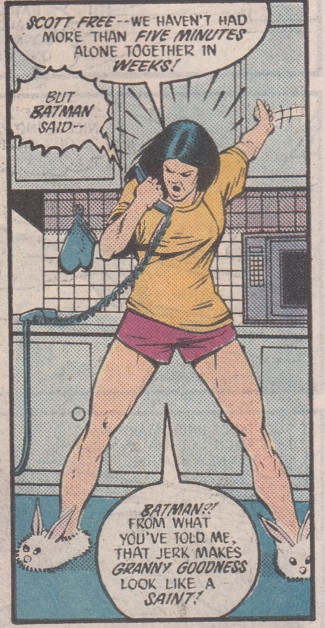
Ah yes! The introduction of the best character of the series: Big Barda!
Max and J'onn discuss the United Nations possibly backing the Justice League while Superman talks respectfully with President Reagan. What a mistake! The biggest do-gooder on the planet normalizing fucking Ronald Reagan! He should be scolding him with a liberal smattering of Kryptonian tsk-tsks! That's when a Kryptonian gives you a little burst of heat vision every time you deny the AIDS crisis or invoke the spectre of Welfare Queens or destroy the economy by lowering the top marginal tax rates pretending that the money saved will trickle down to everyone instead of fat corporate cats simply keeping all the extra for bonuses and investors. Fuck that guy. I'm so mad now!
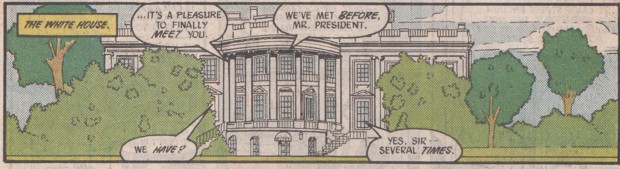
Of all the digs they could have taken with Reagan, they poke fun of his dementia?! Christ, Giffen and DeMatteis.
Backing Maxwell Lord is a computer satellite in space. Is it Brother Eye already?! Are they already working together in 1987?! Or is it just some alien gizmo from the Millennium bullshit coming up? I don't remember! Heck, this Maxwell Lord might even be a Manhunter!
Anyway, the satellite begins destroying shit on Earth with a giant heat beam. The Justice League, having nearly nobody who can do anything about it, doesn't call Superman to fix the problem. Instead, they decide to spend precious hours borrowing a space shuttle from STAR Labs to launch them into space to battle the space station. Also, they leave Guy Gardner back at headquarters on monitor duty. Because who needs the guy with experience battling in space with a ring that can protect every other member of the League while in space? Also the ring is the greatest weapon in the universe. So, you know, sideline that guy, right?
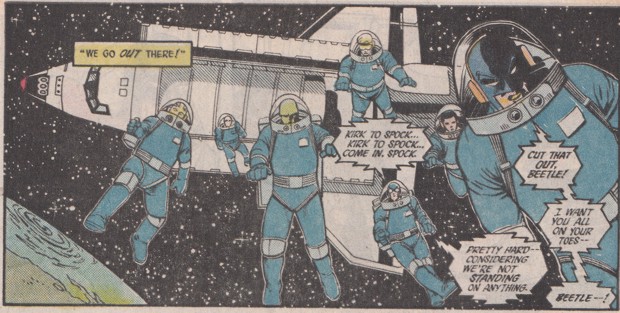
It's possible this was in the era where Superman couldn't survive in space either, really. But then that's even more incentive to get fucking Guy Gardner up there with them!
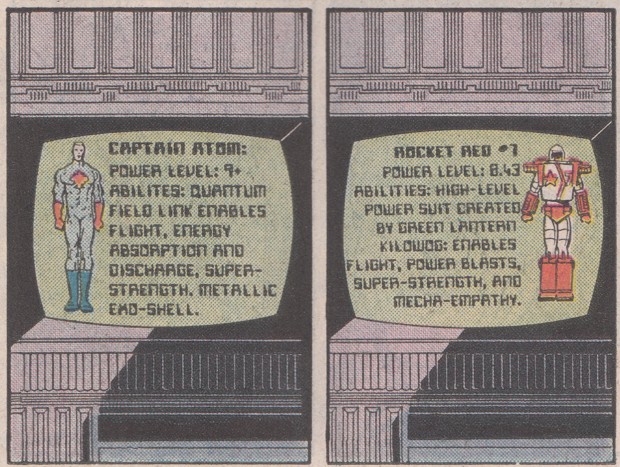
I've read a lot of ridiculous things in comic books but Rocket Red's power levels being nearly equal to Captain Atom's might be the most ridiculous.
Captain Marvel quits the team and Batman steps down as leader so J'onn can lead. And that's about it, I guess! The issue ends with some kind of flim-flam about how its the 80s and we've become a global world and boundaries just don't work anymore and superheroes are cool as shit. I guess it's inspirational or something. There's still just one woman on the team though.
Justice League International #7 Rating: B. Seven issues in and the Justice League has defeated two villains who weren't actual threats to anybody. They were just scams to get the Justice League some press. They also beat up and killed an old guy who was just frustrated with the boredom that came with the immortality the Lords of Order forced on him. So all in all, they're nearly as terrible as the New Titans who practically only ever battled relatives while putting the residents of New York City in danger every time.