Showing posts with label Gravity's Rainbow. Show all posts

Tuesday, March 23, 2021

Gravity's Rainbow: Part XXIX.II

Slothrop arrives in Zürich looking for Waxwing's next contact. He finds him but he's just a lead to the next contact whom Slothrop can find in one of three possible cafes peddling the information Slothrop seeks. So Slothrop hunkers down in Zürich for a bit, alternating sitting at each of the three different coffee shops waiting for somebody to come by and give him some information on Jamf or Imipolex G.

Just as Slothrop meets a guy who informs him Jamf is dead but the company he works for, Sandoz, has files on him he can liberate for Slothrop for 500 Swiss Francs, Slothrop's paranoia begins to get the better of him. He's slipped from one of the cast of Asylum Keepers in an Asylum Nut almost as soon as he loses the confidence of his Zoot Suit which he sells for some quick cash. But then he sees a Rolls and remembers "Proverbs for Paranoids, 4: You hide, they seek." He ducks in an alley, figures They're onto him. He calls the hotel lobby he's staying at, asks if the Englishman in the lobby is still there and *WHAMMO* Englishman on the phone. Now he feels his paranoia has been confirmed, it just begins to escalate. Now he figures They know he knows They're here! Slothrop is quickly spiraling out of control.

Then the sausage of the chapter, simmering in fondue, takes place: Slothrop meets Squalidozzi, the Argentine revolutionary. He recognizes the same paranoid glances, the driving search for some kind of freedom, the need for a life not trapped within Their labyrinth. And they do talk of labyrinths! Of course they do! You can't have a novel most people would classify as postmodern without a nice long labyrinth passage. I mean, we've already discussed the minotaur with good old Pointsman!

Squalidozzi describes what's gone wrong in Argentina by describing how it used to be with the wide open pampas. But now it is all fences and streets and sewers and train tracks and labyrinths. And those are just the physical manifestations of its modern labyrinthine nature. He describes this in an effort to explain to Slothrop why he's come to Germany. Because now that the war is over, the boundaries and borders of the German states have all been blown open. It's like the pampas now! It's a new freedom and Squalidozzi thinks he and his fellow revolutionaries can make something of it from their stolen submarine.

Slothrop's argument against Squalidozzi is barbed wire. Barbed wire stretching out across the open plains, blocking it up with twists and turns of dangerous fencing . . . that's progress! That's a good thing! But Squalidozzi doesn't take this argument seriously, being poorly thought out and crazy. Nobody praises barbed wire except landlords!

"In ordinary times, [Squalidozzi] wants to explain, "the center always wins. Its power grows with time, and that can't be reversed, not by ordinary means. Decentralizing, back toward anarchism, needs extraordinary times . . . this War—this incredible War—just for the moment has wiped out the proliferation of little states that's prevailed in Germany for a thousand years. Wiped it clean. Opened it."

I'm currently reading Against the Day (One Line at a Time!) and this quote is nearly identical to thematic points I've made about the book. I don't mean identical in that I'm talking about Germany and World War II! But at least thematically consistent! I've noticed, in the first 36 pages of Against the Day, how much the book is about imperialism. It highlights the structure of the world and how white Western Civilization is the center. "Its power grows with time, and that can't be reversed, not by ordinary means." It's rare the event that can "decentralize it," perhaps driving it "back toward anarchism." In Against the Day, Pynchon chooses to use the Chicago World's Fair as a microcosm of the world with The White City at the center, surrounded by exhibits from various non-white countries. But each of those country's exhibits which Pynchon chooses to highlight is a reminder of a moment in time when the center was "decentralized." Except maybe the Donkey Show masquerading as a Reindeer Show!

Slothrop offers to help Squalidozzi get a message back to his compatriots in the submarine (currently off the coast of Spain) by delivering it to another agent since Squalidozzi is being watched. In exchange, Squalidozzi pays Slothrop enough to get him his Jamf information and to keep him fed for weeks.

Eventually (after some long bit about college and the clock tower and death manipulating reality to close in around him or some such something . . . it was really confusing!) Slothrop finds himself sleeping atop Jamf's grave in the mountains waiting for the packet of information on Jamf himself. It's on Jamf's grave that Slothrop feels something slip from him, perhaps he comes to terms with his past. Jamf is dead and his Revenant will not be stalking Slothrop. He seems more at ease and perhaps this is why this section of the book is about to end. One part of Slothrop's journey ends here. He has stopped chasing his past.

But then he reads the packet on Jamf and something else begins. Perhaps chasing his future now? The section (which is the penultimate section of the chapter and the last one Slothrop appears in, so basically the end of the chapter for Slothrop) ends on this ominous note: In the weeks ahead, in those very few moments he'll be allowed to wallow in his past, he may even have time to wish he hadn't read any of it. . . .

Too bad I don't remember enough details to speculate on that bit of worry!

Friday, February 26, 2021

Gravity's Rainbow: Part XXIX.I

This section begins with a primer on plastics, a brief history leading up to Jamf's Imipolex G. I'm not a chemist so I don't understand the lingo but I've done enough chemistry so I get the gist. That's the fairly standard description of my intelligence! I can't explain anything to anybody in great detail (except maybe why Cerebus can't get pregnant) but I'll definitely understand any amount of detailed explanation of a subject with which you'd like to bore me. Here's an example of me reading this book:

Jamf at the time was working for a Swiss outfit called Psychochemie AG, originally known as the Grossli Chemical Corporation, *Me, yawning, nodding along, eyes glazing over* a spinoff from Sandoz (where, as every schoolchild knows, the legendary Dr. Hoffman made his important discovery). *me, eyes flashing open, grin on my face, nodding enthusiastically. "Yeah, yeah! Every schoolchild! Good old Albert Hoffman! My hero! Genius!"*

The primer also describes the links between all the petrochemical companies of the time. It's probably supposed to show how big business and corporations and the advancement of science (particularly plastics, in this case) had no loyalty to any nation. It was all about profits and advancements and more profits. One of the companies had an address at Schokoladestrasse which made me happy because I knew those words. I'm not bragging! Obviously everybody knows those words! It just made me happy! In the same way somebody in the book could have said "Ziegenstrasse" and I would have come in my pants.

This is all discovered by Slothrop as he researches Jamf and Imipolex G and the German blueprints for rockets and especially this one weird rocket that was built with a section composed of Imipolex G which seems to have been top secret: The "S-Gerät, 11/00000." While doing the research, he also comes up with "Proverbs for Paranoids, 3: If they can get you asking the wrong questions, they don't have to worry about the answers." Hmm, that may have been a proverb for paranoids in 1945 and also 1973 but I think it's just standard operating procedure for anybody with any money or power at this point. I don't think saying that makes me paranoid. I think it makes me observant.

During the days of researching, Slothrop discovers Tantivy has died. Or might have died. Basically, They want Slothrop to think he's dead so whether they sent him out to a dangerous mission to get killed or they just planted a story in the paper so Slothrop would read it, it hardly matters. Thinking Tantivy has not just died but was most likely killed by Them to get to Slothrop, Slothrop's path becomes clear. He's no longer content to sit in the Casino and study and sort of ignore that they're manipulating his life. It's time to head into The Zone and figure out what's going on.

He heads to Nice to find the address given to him by Waxwing, the address where he can get a new identity.

Just for the knife-edge, here in the Rue Rossini, there comes to Slothrop the best feeling dusk in a foreign city can bring: just where the sky's light balances the electric lamplight in the street, just before the first star, some promise of events without cause, surprises, a direction at right angles to every direction his life has been able to find up till now.

For Slothrop, that moment must be heaven. A promise of events without cause?! How does one so paranoid as Slothrop ever reach that stage? I guess upon arriving in a new city at dusk before he has a chance to see the strings, the facades, the seeming random coincidences that, upon slight reflection, prove themselves to be manipulations.

Slothrop arrives at the address given to him by Waxwing and winds up among a bunch of bohemian drifters and squatters. In a description of their shoes: . . . saddle-stitching in contrasting colors (such as orange on blue, and the perennial favorite, green on magenta. . . . What is it with magenta and green?! Did Pynchon suffer from some kind of PTSD derived from wearing bowling shoes?!

After a lot of paranoid delusions of conversations with people he thinks he knows but they're just wanderers and drunks, squatters and Johns, he gets his papers. He's now Ian Scuffling, war correspondent, and he's headed to Zurich.

Wednesday, January 13, 2021

Gravity's Rainbow: Part XXVIII

I don't know what meaning green and magenta have in this novel but they spring up again in this chapter. As Slothrop wanders around Raoul's party, he's enlisted for some secret service by a guy in a white zoot suit. As he follows him outside, they run into Jean-Claude Gongue, described as the "notorious white slaver of Marseilles," "busy white-slaving." Ha. Two of the girls he asks to be white slaves declare they do not, the first one saying she wants to be a green slave and the second one wanting to be magenta. A third wants to be vermilion but I don't think vermilion is important. She's just there to obfuscate the green and magenta bit!

I can't make a guess as to what it's about. I can only note every time it happens to appear. I think this is the third time? I'm sure I missed some. But eventually, in the final chapter, Pynchon gives us a section called "The Last Green and Magenta." So, I mean, it must mean something, right?!

The man in the zoot suit is Blodgett Waxwing. He's important because he's going to get Slothrop his own zoot suit and also forged papers so Slothrop can flee the Casino and head into Germany looking for signs of his connection to Jamf and the Rocket. Blodgett is doing so many deals that depend on so many people coming through that he's basically the Milo Minderbender of this book.

The story here tonight is a typical WW II romantic intrigue, just another evening at Raoul's place, involving a future opium shipment's being used by Tamara as security against a loan from Italo, who in turn owes Waxwing for a Sherman tank his friend Theophile is trying to smuggle into Palestine but must raise a few thousand pounds for purposes of bribing across the border, and so has put the tank up as collateral to borrow from Tamara, who is using part of her loan from Italo to pay him. But meantime the opium deal doesn't look like it's going to come through, because the middleman hasn't been heard from in several weeks, along with the money Tamara fronted him, which she got from Raoul de la Perlimpinpin through Waxwing, who is now being pressured by Raoul for the money because Italo, deciding the tank belongs to Tamara now, showed up last night and took it away to an Undisclosed Location as payment on his loan, thus causing Raoul to panic. Something like that.

At least I feel like if I read that a few more times, I could work out all the trails and connections and it would make sense. I've read Catch-22 multiple times over the last twenty-something years and I still don't know how Milo paid for the eggs.

The tank in the previous quote, driven by an angry Tamara, crashes the party. Tamara fires a round into the house (a dud so it only does minimal damage from blunt force) and Slothrop has to wrestle her out of the tank. Between the obvious sexual metaphor of the tank's gun slamming into the mansion and firing off a load and Slothrop wrestling the woman out of the tank, Slothrop's penis does not get erect. Pointsman will never get to add this occurrence to the data of his experiment because none of his minions were there (or sober enough) to report it. But I guess we, the readers, should probably make note of it, right? Just a second.

"Tank's massive turret with the gaping bell-end launches its payload into the cavernous rooms of Raoul's mansion. Slothrop's penis does not get hard even though that's the sexiest bit of writing I've ever read. You can tell by how sexily I have summarized it. Ooh la la, as the American soldiers will say to their wives after coming home and giving them gonorrhea." Note Copyright Grunion Guy 2021.

Waxwing lets Slothrop know, once and for all, that the incident with the octopus was staged. How he knows, he doesn't tell Slothrop. But he gives Slothrop a business card and a clue as to where to run to, as well as the zoot suit, and a keychain.

Before the end of this section, there's a bit about police, describing what we all know is true about them but what some people choose to pretend they don't see. And by pretending not to know this truth, we see a despicable truth about themselves as well. They never realize what they're exposing of their true selves when they deny to accept a reality with which they secretly agree.

The zoot suit is in a box tied with a purple ribbon. Keychain's there too. They both belonged to a kid who used to live in East Los Angeles, named Ricky Gutierrez. During the Zoot Suit Riots of 1943, young Gutierrez was set upon by a carload of Anglo vigilantes from Whittier, beaten up while the L.A. police watched and called out advice, then arrested for disturbing the peace.

The Blue Lives Matter folk are delusional, racist bastards and anybody with any sense (mostly the senses that are the providence of the ears and eyes) knows it.

Sunday, January 10, 2021

Gravity's Rainbow: Part XXVII

I write another blog (several but this is the relevant one) where I discuss each line of Thomas Pynchon's Against the Day one at a time. Right now, it's fairly easy because it's just the first two chapters discussing the Chums of Chance adventure to Chicago. No sentences have been truly difficult. But as I do it, I often think about Gravity's Rainbow and how hard it would be. Here's the first sentence of this section which basically amounts to: "Hey! It's spring in late March!"

The great cusp—green equinox and turning, dreaming fishes to young ram, watersleep to firewaking, bears down on us.

If I were a bitter, cynical, bastard of a person, I'd think, "I'm trying to read a book, not analyzing Goddamned poetry!" Good thing I'm just a bitter, cynical, decent kind of person. No bastard here! Although for poetry, this is fairly easy. It's just Pynchon saying the date in four different ways: "great cusp," "green equinox," Gemini turning to Aries, and, once again but differently, Gemini (water) turning to Aries (fire) combined with winter (sleeping) turning to spring (waking). It really is poetry, like so much of this book. Which is one quarter of the reasons that make reading it so hard. The other three reasons are 1. changing perspective without notice, 2. tons of references nobody understands without research or having been there, and 3. reality often shifting, sometimes to dreams or daydreams, sometimes to "let's describe this scene as if it were a movie or comic book," or some other kind of strange hallucination. All of those things make this book difficult to read; all of those things make this book beautiful and surprising.

The second paragraph does much the same for the statement: "The war is nearing an end." It even mentions the resident of the asylum, Lloyd George, who believes he's the avatar of the war, is dying.

Life has also changed at the Casino Hermann Goering. Slothrop has learned that he isn't completely ineffective in his rebellions against the conspiracy against himself. He begins coming up with his "Proverbs for Paranoids" with the first proverb: "You may never get to touch the Master, but you can tickle his creatures." He learned that by forcing Dodson-Truck to confess some of what he knew, and for, well, whatever he did to have them take Katje away. That was probably mostly punishment for his work on Stephen Dodson-Truck. I mean, Pointsman also needed her back at The White Visitation to shit in Brigadier Pudding's mouth.

Slothrop has found himself increasingly in a state of reverie. That means he seems to be daydreaming a lot but another definition of reverie is "a fanciful or impractical idea or theory." In his reverie, he seems to somehow get in touch with the other side, and begins getting messages or transmissions or maybe impractical theories from the late Roland Feldspath, "long-co-opted expert on control systems, guidance equations, feedback situations for this Aeronautical Establishment and that." Roland was the spirit Carroll Eventyr was speaking with when we first meet Carroll Eventyr. At the time, Roland was speaking about his time in some kind of contact with Dominus Blicero. Roland's forte is control systems and he comments on how controls had gone topsy-turvy while "transected" with Dominus Blicero. He discusses how the wind is the major factor in the control of a rocket because, once launched, the rocketeers and rocket have lost contact. But Roland goes on:

"It's control. All these things arise from one difficulty: control. For the first time it was inside, do you see. The control is put inside. No more need to suffer passively under 'outside forces'—to veer into any wind. As if . . ."

Was Roland trying to describe the Schwarzgerat to them? That Blicero was experimenting with putting a living person in the rocket for means of control? And here I thought it was just a sex thing!

Roland describes his previous contact with Carroll as a bunch of bullshit about German economics because that's what all the ghosts are into. I think. Look, I failed statistics in college because it was too boring for the math to be that difficult. What I'm saying is that I'm also bored to tears by economics, even when it's discussed by a ghost! And I loved In Search of... so you'd think I'd be more into this. Maybe I'd have been more into it if economic models were described the way Roland describes them here, like wandering an empty city until you came to the edge and ventured into fields and then a forest where you, inevitably, can go no further, like all the mathematical theories reaching the limit of some confusing equation. And then that, somehow, brings us to the Rocket and the equations for its gravitational rainbow.

I'm sure if I were smarter, I'd understand what Roland's getting at. But I'm more on Slothrop's level of intelligence and so I react much like he does after these Roland reveries:

Afterward, Slothrop would be left not so much with any clear symbol or scheme to it as with some alkaline aftertaste of lament, an irreducible strangeness, a self-sufficiency nothing could get inside. . . .

As for Slothrop's non-daydreaming hours? He spends them learning German and learning about rockets and learning about propulsions and engineering and diagrams and ordnance. In doing so, he begins to realize how ridiculous the corporate connections are to the war effort. He tells a man named Hilary Bounce how ridiculous it is that the Germans are firing rockets out of a Shell company fuel manufacture site directly at Shell headquarters in London. Hilary, being a good corporate man, doesn't get what Slothrop is driving at. Can't this damn paranoid see that corporate profit and the business of war are two entirely different things that also just happen to rely on one another?!

Slothrop comes up with his second Proverb for Paranoids: "The innocence of the creatures is in inverse proportion to the immortality of the Master." I don't know what that means, exactly. I guess it means the more powerful a corporate entity or political position, the greater the dumb subservience of the people who work under it. Like these Goddamned idiotic Trump supporters who never see the terrible bullshit he's spouting or supporting and only pretend to see some greater good or generous scheme.

It's during this time that Slothrop begins to get the scent of the Schwarzgerat. He discovers blueprints for a rocket that needs some sort of insulation made of Imipolex G. What for? Turns out it's a state secret and not easy to uncover. Nobody will help him with it. But Slothrop learns Hilary has a teletype back to Shell in his room and he devises a means to get Hilary out of the room and get himself inside to send a message asking about Imipolex G. On the night he does this, after he gets the message back (to be read later), he heads to the party he sent Hilary and one of the dancers to, followed after by some sneaky sneak. The plot thickens!

Can this plot thicken much more?! Sure it can! Five hundred pages more! And how many of those pages will I understand? Hopefully at least 450 of them!

Sunday, January 3, 2021

Gravity's Rainbow: Part XXVI

This chapter begins with a quote from Pavlov at 83 and then a poem inspired by the quote, from Pavlov's point of view. After the first word of the poem, in brackets, we get "Pointsman never shows these excursions of his to anyone". So Pointsman writes poetry? As an excursion away from his work on stimulus and response? It seems surprising except, of all the things poems do, is not one of them to evoke a certain response? A poem is just another bell. Or explosion. And I wouldn't stop at just poems, of course. All writing is just a focused stimulus created to get a particular response from the subject.

As for the subject of Pavlov's talk and the poem, even though it's about the way an old person concentrates, I'm all too familiar with the subject. Pavlov was speaking on regular, mundane life. As one gets older, their concentration on one idea or object causes the surrounding ideas or objects to blur out and lose focus. The rest of the world disappears from their mind in the effort to concentrate on that single thing. I'm only 49 but I've just begun feeling this same thing. Not in the real world where it might be worrisome! But in video games where everything is hyper-real and made to push a player's reactions to the limit. I used to be really good at first person shooters. I could play a winning game of Halo while also fucking around with my buddies, barely needing all my concentration to beat my opponents. I launched more than a few nukes in Call of Duty: Modern Warfare back in the day. But lately when I'm playing Apex with my cousin's seventeen year old son, I just feel like a confused old man in a busy cafeteria. I'm busy trying to figure out where all the sounds are coming from or where I'm being shot from. Meanwhile, he just zips from one enemy to another, killing them all while I hope to at least get one assist out of the fracas. It didn't used to be like this! I was at my best interpreting the sounds of my enemies to line up my next shot! Now my poor onscreen avatar just looks like Vincent Vega looking around confused as Mia speaks to him over the intercom. Maybe I should hang up my controller and just read more.

There's a funding meeting going on at The White Visitation because everybody's worried that the Slothrop Experiment won't last too much longer. But Pointsman assures them the money will keep rolling in with the confidence of a man who has Brigadier General Pudding by the woman who shits in his mouth. When the meeting ends, we get a Busby Berkeley song and dance routine involving Webley Silvernail and all the black, white, and gray mice on the ward, grown to man-size. After the number, Pynchon gives us one of my favorite paragraphs in the book.

They have had their moment of freedom. Webley has only been a guest star. Now it's back to the cages and the rationalized forms of death—death in the service of the one species cursed with the knowledge that it will die. . . . "I would set you free, if I knew how. But it isn't free out here. All the animals, the plants, the minerals, even other kinds of men, are being broken and reassembled every day, to preserve an elite few, who are the loudest to theorize freedom, but the least free of all. I can't even give you hope that it will be different someday—that They'll come out, and forget death, and lose Their technology's elaborate terror, and stop using every other form of life without mercy to keep what haunts men down to a tolerable level—and be like you instead, simply here, simply alive. . . ." The guest star retires down the corridors.

Those with tender sensibilities and weak stomachs should probably stop reading this section after that beautifully melancholy and depressingly accurate moment. Because now we get to the scene where we learn how Pointsman has kept the money coming in. He's discovered, like a good Pavlovian, what stimulus Pudding needs desperately. And he's hired Katje to provide. My initial reaction after first reading this scene a few months ago was, "How come every mention of Gravity's Rainbow doesn't begin with 'There's a spectacularly graphic shit eating sex scene!'?" I suppose it's the same reason nobody begins their declaration of love for Gravity's Rainbow by saying, "The main character fucks an underage girl and pretty much falls in love with her!" Although, that's the synopsis for Lolita and people do mention it in that! I suppose somebody who hadn't heard of Lolita would be in for a huge shock if somebody just said, "It's about a teacher who goes on a grand adventure!" And I suppose mentioning either the shit eating scene or the underage girl fucking doesn't really capture the magic of Gravity's Rainbow in quite the way you'd think it would. I mean, wouldn't? Wait, what do I mean? I think I mean to say is that you should mention the loads of penis jokes before you mention the other stuff because they're more closely tied to the theme of the novel. The other stuff are just small, digressionary writing larks by Pynchon.

This scene does compare a turd to a black man's penis so that's sort of thematic with the rocket and the Schwarzkommando! Hmm, that's probably another thing that shouldn't be mentioned when trying to describe how great this book is. Because then you'd have to start backpedaling and explaining why that isn't as racist and problematic as it seems because the thought comes from a man who was already super old in 1945 and, due to his post traumatic stress disorder developed in the trenches and mustard gas of the first World War, surrounded by the stench of the mud and the decaying corpses, he has developed some kind of paradoxical phase stimulus where the smell of shit and the pain of war now make him feel sexually alive which explains why the shit reminds him that he also wants to be dominated by a large African man. Wait. Did that make it better?

You know what? It's both a gross and a terrific scene! I highly and unhighly recommend reading it! Doo do do! [That was the Reading Rainbow music tag for when a dumb kid has finished his dumb book review.]

Friday, January 1, 2021

Gravity's Rainbow: Part XXV

The next section begins sometime in Slothrop's future. Some time has passed since his conspiracy breakdown and loss of everything that kept him tethered to his former life, like his Hawaiian shirts and his gaudy ties and Tantivy Muffer-Mafick. He spends his days with Katje and studying German rocket blueprints, trying to discover his connection to the rockets and, maybe, why They are doing what They're doing to him, whatever that is.

Stephen Dodson-Truck has arrived at the Casino. When he arrives, he interrupts Slothrop on the beach reading a Plasticman comic book. He might be there to spy on him. He might just be there because his wife was sick of looking at him and wanted to fuck everybody else at The White Visitation for awhile. But anyway, he gets to have some scenes for a few pages until we can all forget about him again until the next time when we'll ask, "Wait. Who was this guy again?"

Sir Stephen Dodson-Truck is into words. He's the Susie Dent of World War II. The introduction of Sir Stephen Dodson-Truck allows Pynchon to explain part of his process and love of writing directly to the reader. Pynchon's names are wacky but they often suggest other things, like Slothrop suggests (or directly states!) "sloth" and "slob". Stephen Dodson-Truck suggests (among maybe other things) Yerkes-Dodson law. This is what the Wikipedia entry on Yerkes-Dodson law states: "The law dictates that performance increases with physiological or mental arousal, but only up to a point. When levels of arousal become too high, performance decreases." I'm not sure how that fits in with Stephen Dodson-Truck's character but I'm sure it has something to do with sex and his wife, Nora Dodson-Truck. She probably needs some kind of level of super arousal after which his performance drops off which is why she needs to fuck all the other guys at The White Visitation. Pynchon explains how he makes these connections in the first conversation between Slothrop and Dodson-Truck. Slothrop begins the following conversation:

"Taking a break from that Telefunken radio control. That 'Hawaii I.' You know anything about that?"
    "Only enough to wonder where they got the name from."
    "The name?"
    "There's a poetry to it, engineer's poetry . . . it suggests Haverie—average, you know—certainly you have the two lobes, don't you, symmetrical about the rocket's intended azimuth . . . hauen, too—smashing someone with a hoe or a club . . ." off on a voyage of his own here, smiling at no one in particular, bringing in the popular wartime expression ab-hauen, quarterstaff technique, peasant humor, phallic comedy dating back to the ancient Greeks. . . . Slothrop's first impulse is to get back to what that Plas is into, but something about the man, despite obvious membership in the plot, keeps him listening . . . an innocence, maybe a try at being friendly in the only way he has available, sharing what engages and runs him, a love for the Word.


Now doesn't that sound exactly like what Pynchon's doing, engaging with us in the only way he knows how while using peasant humor and phallic comedy and names that suggest these things all wrapped up in technical jargon and rocket lore?

Later, Slothrop meets with Katje in the gambling hall as she's manning a roulette wheel. He considers what They are betting on with him and he comes to a conclusion that they're basing all of their experiments (or whatever they're doing to him, exactly) on past observations. They know something about Slothrop's past life that even he doesn't know and now they want to see how that event plays upon his present actions. He then thinks about Katje's involvement in this plot and wonders how much she knows or how they might be manipulating her as well. And then there's a moment that mirrors a bit of Against the Day which I'm reading now. I'm going to quote both passages. First, Gravity's Rainbow:

Something was done to him, and it may be that Katje knows what. Hasn't he, in her "futureless look," found some link to his own past, something that connects them closely as lovers? He sees her standing at the end of a passage in her life, without any next step to take—all her bets are in, she has only the tedium now of being knocked from one room to the next, a sequence of numbered rooms whose numbers do not matter, till inertia brings her to the last. That's all.

And now, Against the Day:

From this height it was as if the Chums, who, out on adventures past, had often witnessed the vast herds of cattle adrift in ever-changing cloudlike patterns across the Western plains, here saw that unshaped freedom being rationalized into movement only in straight lines and at right angles and a progressive reduction of choices, until the final turn through the final gate that led to the killing floor.

In postmodern writing, you encounter a lot of images and metaphors of the Labyrinth. In these two passages, you get the exact opposite. You have people (and cows! But I think the cows really represent the immigrants of Chicago here! (hell, they really just represent us all and the aging process)) whose lives, while starting out full of freedom and choices, have come to that point where the previous choices made have cut off opportunities for further choice, winnowing their lives down to a single path which they can only follow helplessly until death. The cows have been forced into this kind of life just like the people of Chicago (earlier, the city had been described as being a Cartesian grid which the right angles and straight lines of the cow's Stockyard enclosure echo); life on the plains was a kind of freedom while life in the city a trudging journey along a single corridor maze to the killing room floor. Katje has sort of arrived at the same kind of place even though she's still young. But her choices have narrowed her chances at new opportunities faster than most: Blicero's sex slave, Allied spy, obligation to Prentice for rescuing her, Pointsman's tool, and now Slothrop's keeper. Not much choice for her in most of that. Just a roulette ball skipping about from number to number on a circular path, the number where it will eventually come to rest having no real meaning to the journey.

Dammit, Pynchon, I'm trying to read as much as possible before stopping and writing and he just won't let me go! Immediately after this initial conversation, Katje spins the roulette wheel again and we get the section that might be considered the titular bit. I must say, it's all a little too much for me. I get the part about how the rocket connected Katje and Slothrop; she was at the source, it's birth, while he was at the impact, its death, and between them the total life of the rocket. But I'm not sure what makes the parabola such a special shape that informs the connection between them, "as if it were the Rainbow, and they its children. . . ." I can also, maybe, grasp how they're children of the rocket, how all of us in the modern era are children of the rocket. The rocket that taught us death was not something you can prepare for or see coming; in the modern era, there is no languishing or regrets or remorse at the end. The end just comes, without warning. We become intrinsically different creatures, new children, from that knowledge hanging over us, from the dread of death come as surprise (which was obviously a thing at all times of human existence but not on such scale and not by something man has created and harnessed of their own volition). Perhaps the parabola represents the birth canal?

I'm just speculating here! Ha ha! That's a pun on speculum!

Later, when Slothrop chooses to grow a mustache, there's a moment where Pynchon himself (or some other narrator, not just omniscient of the story and era but out of time, from the future, from 1973, at least) intrudes.

"What kind?" Katje wants to know, soon as this one is visible.
    "Bad-guy," sez Slothrop. Meaning, he explains, trimmed, narrow, and villainous.
    "No, that'll give you a negative attitude. Why not raise a good-guy mustache instead?"
    "But good guys don't have—"
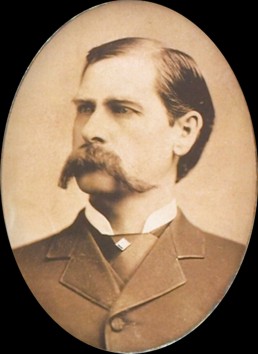
    "Oh no? What about Wyatt Earp?"
    To which one might've advanced the objection that Wyatt wasn't all that good. But this is still back in the Stuart Lake era here, before the revisionists moved in, and Slothrop believes in that Wyatt, all right.


The mustache Slothrop decides to grow

If Slothrop lives in the time of Stuart Lake (the author of Wyatt Earp: Frontier Marshall, 1931) who depicted Earp as an unrepentant hero of the West so that everybody in that era believed him to be a perfectly fine and upstanding law man who didn't exact any kind of personal vengeance through ambushes and slayings of the Red Dandy Hanky Gang, why even bring up the revisionist take on Wyatt and how one might argue his legacy? Unless maybe that revisionism had already started by 1945 in which case the narrator is just the usual kind of omniscient and felt like cutting off any reader arguments who would sneer at Katje's naivety. Although doesn't it sound like a 60s or 70s thing, that revisionism? Maybe it was a popular idea when Pynchon was writing this and decided to throw that comment in. But that line, "this is still back in the Stuart Lake era," is the proof that it's Pynchon, or at least a modern narrator speaking, right?

My point is that it's kind of weird! But I liked it, of course! Nice moment!

Slothrop discovers that he gets erections reading technical rocket manuals and blueprints. Perhaps the manuals, taken from German sites, were used around Imipolex. Or maybe it's part of the paradoxical or ultra-paradoxical or one of those other things that happen to Pavlov's dogs after long hours of being experimented on. I really never understood that psych stuff too well. Anyway, Stephen Dodson-Truck is always there during the study hours to time how long it takes for Slothrop to get a hardon.

Slothrop concocts a plan to get Sir Stephen drunk so that Stephen might spill some beans on the conspiracy. Dodson-Truck confesses that, as he got more and more lost in his work, the less he cared about satisfying his wife's urges (Yerkes-Dodson law, right?!) and so she began sleeping with the psychics and paranormals at The White Visitation. He mentions a son, whom I think might be being used as leverage to get him to participate in the Slothrop experiment, and admits his part in the conspiracy: he's meant to observe Slothrop to make sure Slothrop studies up on the rockets. And that's all he admits to knowing.

The scene switches, as it often does without warning to London and Eventyr (less warning than usual in this one although it is somewhat tied together by the image of some large hooded figures overlooking the land, and the Casino, somehow observing from the other side which connects them to, of course, Eventyr and Peter Sascha). One of Their operatives needs Eventyr's help but not the usual help of contacting somebody on the other side through Eventyr's control, Peter. No, this time, they're just interested in Peter. They know how Peter Sascha was killed in the street by police but now they want to find out how it came to that and how Leni Pökler may have led him there.

I can't say I completely understand this part but I get bits of it. Like how Peter sees his boring, pathetic life through the revolutionary actions of Leni, how he admits Leni is right when she says she can't be a mother to Ilse because she needs to be human for Ilse and being a mother is what They want. They have her at their mercy if she's a mother. So to protect Ilse, she cannot be a mother to her; she must be a revolutionary and a fighter and maybe she loses Ilse because of that but it can't be helped.

At the moment of Peter's death in the vision (or visitation?), the scene shifts back to the Casino with a mention that Dodson-Truck has vanished by morning. "But not before telling Slothrop that his erections are of high interest to Fitzmaurice House."

Dammit! I know Fitzmaurice House was recently mentioned but I can't remember when or where. Maybe it's not important!

By the end of this section, Katje has gone. Slothrop will never know why but before she goes, she tells him some stuff that he'll need to remember later. Hopefully I'll remember it too, if it's important. Although I've already read this once and I don't know how it's important now! So I might be a lost cause.

"Oh Slothrop. No. You don't want me. What they're after may, but you don't. No more than A4 wants London. But I don't think they know . . . about other selves . . . yours or the Rocket's . . . no. No more than you do. If you can't understand it now, at least remember. That's all I can do for you."

And later:

"Maybe you'll find out. Maybe in one of their bombed-out cities, beside one of their rivers or forests, even one day in the rain, it will come to you. You'll remember the Himmler-Spielsaal, and the skirt I was wearing . . . memory will dance for you, and you can even make it my voice saying what I couldn't say then. Or now."

Is she referencing one of Slothrop's final narrative moments in the book? Doesn't he play some instrument, camping in the rain, after fleeing from everybody's perception? I'll have to keep this in mind when I finally get there! It's only about five hundred plus pages away!

By the way, the skirt she references is a rainbow-striped dirndl skirt of satin. That could be important!

Sunday, December 27, 2020

Gravity's Rainbow: Part XXIV

The first time through the book, not realizing what was coming up with Slothrop or how his life was being manipulated by Pointsman, I was living vicariously through Slothrop's paranoia. What was going on? Was he being set up? Or was it just Slothrop's nature to feel persecuted and manipulated? Although I did realize the octopus had definitely been trained to attack Katje so I knew a little more than Slothrop suspected. I just also didn't know enough. I was as lost as he was.

Bah! Who am I kidding?! I still don't know enough! Except maybe that, by nature, Pointsman is just a cruel man desperate to raise Pavlov's theories to some kind of ultimate answer to the meaning of life and why humans do the things they do. Wouldn't it be nice if you could discover that every reason behind every single thing a person does is because they've been conditioned to react in that way? What a breakthrough! And if you could prove that even a diseased personality like Slothrop reacts like one of Pointsman's dogs to different stimuli, you could change the world!

The chapter begins on Dr. Porkyevitch's boat, having recovered Grigori the octopus whom he had let loose earlier in the day, orders from Pointsman. Now he's done his part, he wonders: how will he still be useful to Pointsman? The war is nearing its end and funding is drying up all over The White Visitation. Except when it comes to Pointsman.

While wondering if Pointsman has any more use for Porkyevitch, he has a moment of existential dread that has something to do with his having fled Stalin's Russia. He was able to escape because of his love of science, because of his belief in Pavlov's physiological experiments. It gave him something to believe in other than the sanctity of Mother Russia. But he fears something he doesn't name. Possibly being sent back, exiled from his current exile back to his old home? Or hunted down for his part, true or not, in the Bukharin conspiracy against Stalin? Did Porkyevitch flee from the Great Purge and is now worried that he might not yet be completely free? He seems to think Pointsman is the type of man who would betray him (because of course he would!). I'm not clear on all the particulars of this opening bit but it seems like Porkyevitch does his part in the Slothrop experiment, gets worried that Pointsman has no use for him now (and no loyalty), and so he flees, to forget Russia and all, to live yet another new life, the last one post-Russia, this one post-Britain.

After running into Katje at dinner (where she asks him to meet her in her room after midnight), Slothrop heads to the bar with Tantivy to discuss conspiracies, particularly the one that involves an octopus and himself. Specifically, he wants to know what's up with Tantivy's friend Teddy Bloat.

Tantivy moans. "God, Slothrop, I don't know. I'm your friend too but there's always, you know, an element of Slothropian paranoia to contend with. . . ."

Tantivy reveals that Bloat has been receiving messages in code. Proof enough for Slothrop that Bloat and Katje are involved in some conspiracy against him. Tantivy reports he's also feeling the paranoia, the manipulation. He feels that Bloat no longer acts like his friend. Tantivy's now just a connection Bloat made at Oxford, to be used or redeemed for the benefit of the more underhanded party. I'm not sure what I felt for Tantivy the first time through the book but I feel sympathy for him this time. I like him and I'm sorry his and Slothrop's friendship doesn't continue. Slothrop could have used an ally he didn't have to constantly feel was using him for hidden reasons.

At 11:59 Slothrop turns to Tantivy, nods at the two girls, tries to chuckle lewdly, and gives his friend a quick, affectionate punch in the shoulder. Once, back in prep school, just before sending him into a game, young Slothrop's football coach socked him the same way, giving him confidence for at least fifty seconds, till being trampled flat on his ass by a number of red-dogging Choate boys, each with the instincts and mass of a killer rhino.

There's so much to this book that I often forget about parts of it that I should have constantly ready to reference at the front of my mind. But as Slothrop predicted, it would take only a small matter of time to forget about the rockets, just enough, in fact, for him to return to London to be completely petrified by the thought of them again. So I'd forgotten this book is about rockets—it's right there in the title!—until this line:

For a minute he lies coming awake, no hangover, still belonging Slothropless to some teeming cycle of departure and return.

Do the rockets, like human sleepers, forget what they are as they arc to their destination? Do they only remember their terrible purpose only as they're about to make impact? Or do they only remember after it's too late to remember, like the noise of their approach? Maybe I shouldn't be thinking too much of rockets here (although Pynchon is obviously referencing them) and I should just concentrate on the beauty of being "Slothropless" upon waking. We've all been there, often after waking from a nap that took us from daylight to dark, woke too suddenly from some alarm or loud noise, and thought, panicky, "Who am I? What time is it? What is happening?" A brief flurry of nearly unendurable seconds in which we know almost nothing, babes expelled from some dream posing as reality, exiled into fear and the unknown. Some beliefs and spiritualities concern themselves with total loss of ego and they must love those moments. They must be pure ecstasy. Aside from those waking moments, the only time I felt a loss of ego was when I took too many hallucinogenic mushrooms and found myself in the parking lot of a strip club in San Jose wondering if that had always been my life and the other life where I was a college graduate with plans to travel Asia in a few months was just a fantasy I engaged in to fill my empty life with meaning.

Oh! That moment of Slothroplessness takes place after Slothrop meets with Katje. After they fuck and they perform some Three Stooges/Marx Brothers/W.C. Fields slapstick routine (after which they fuck again). Slothrop might not be so concerned with Bloat's conspiracy if he just fucked Bloat too.

In the morning, Slothrop hears somebody in the next room stealing his clothes and he gives naked chase, eventually winding up wrapped in a purple sheet and falling out of a tree in front of Bloat and some general. It seems his night with Katje was a set up to steal all of his clothes, his papers, his identity. Everything. Even, he notices as Bloat takes him to his room for a British uniform to wear, Tantivy. No sign of Tantivy who had been rooming with Bloat. Just gone, overnight, when he should be returning well hungover and well fucked. But They've got to him too. They've got everything that connected Slothrop to who he was the night before he went to Katje's room. Like one of Spectro's patients that Pointsman lusted after, he's completely virginal. Pointsman's ideal subject.

Slothrop leaves Bloat to search for Tantivy. He winds up in the gambling hall of the casino but realizes the room was meant for something different, for something darker. It's the lodge of some secret organization whose dark purpose Slothrop can't begin to fathom, only knows that it involves him. It's as if the entire hotel were created for whatever purpose They have for him. Slothrop was not sent to a vacation spot on the Riviera; he was sent to some Masonic stage where every prop could be set just right and where every person plays a secret role. Slothrop has not been staying at a bed and breakfast; he'd been sequestered in a theater. Or, worse, a lab.

Being in a British uniform causes Slothrop to imagine all of his family's history in reverse until the first Slothrop who sailed to America was sucked back across the Atlantic by the reverse wind so that Slothrop never had an American ancestor. I mention this because it's just one of those nice "What the fuck is happening now?!" moments that Pynchon interrupts the story with on a near constant basis.

Lost and alone, having had everything of his taken from him, Slothrop can think of only one place left to go: Katje's room. And so he returns, not knowing if he's walking into salvation or suicide.

Saturday, December 19, 2020

Gravity's Rainbow: Part XXIII

Part XXIII begins Chapter 2, "Un Perm' au Casino Hermann Goering". I didn't know what that meant (I mean, I knew what five-sixths of it meant! It was the "perm'" part that was stumping me!) so I had to look it up. It means "A Furlough at the Hermann Goering Casino." And that's exactly what this chapter is about! It's about Tyrone Slothrop's furlough at the Herman Goering Casino in France. But being that everything in this book isn't exactly what it seems, it's also "L'expérience au Casino Hermann Goering"!

The quote used to open this chapter is

"You will have the tallest, darkest leading man in Hollywood." — Merian C. Cooper to Fay Wray

How does this relate? Is calling King Kong the tallest, darkest leading man the Hollywood equivalent of calling Poinstman's experiment on Tyrone Slothrop a furlough?

Slothrop is on furlough with his office mate and friend Tantivy Mucker-Maffick and Teddy Bloat, Tantivy's friend who has been spying on Slothrop. So already, it's feeling like a bit of a set-up for Slothrop. Not that I'm going off just those clues! I just read nearly two hundred pages of Pointsman drooling like one of his dogs over getting Tyrone Slothrop as a test subject!

This initial scene of Slothrop first laying eyes on the Casino, and the first morning as he looks out over the ocean in the cold morning weather is just lovely and tranquil. And that it's punctuated by a feeling deep within him that his day can't actually start until he hears a rocket explode is just fucking ugh. Yes, that's right. I just described something as "fucking ugh." That's why I'm such a great critic of intelligent literature. I know how to really deconstruct this shit.

Bloat comes into Slothrop's room "gnawing on a smoldering pipe" and now I can only think of him as Aarfy from Catch-22. And not just Aarfy. I'm picturing him as Charles Grodin from the film. So now my mental image of Bloat is that of a hipster Charles Grodin with Aarfy's psychotic demeanor.

Slothrop is immediately suspicious of Bloat. Perhaps because he should be suspicious of him! But mostly it's just because Slothrop is a paranoid personality and Bloat is basically a stranger to him. But also, I mean, he's right to be paranoid about him! I guess that's just the life of a paranoid. You're going to be paranoid and suspicious of everything and everyone and, occasionally, you'll be proven right. Which will just make you dig in your heels believing all the paranoia you were wrong about as well.

As Slothrop shaves and gets ready for the day, Tantivy begins yelling out the window at some French lasses. He looks back at his mates and says, "J'ai deux amis, aussi, by an odd coincidence. Par un bizarre coincidence, or something, oui?" Yeah. Or something is right, Tantivy. The word "coincidence" is the paranoiac's least accepted rationale. Nothing is coincidence. Which, when you're writing situations for characters in a novel, is ultimately true. Obviously nothing that happens to Slothrop or any of the others is a coincidence! As a writer, you can't actually write coincidences! So a character in a book should be a paranoiac! What does that do to a novel like Gravity's Rainbow? Ultimately it's a book about a guy who is trying to discover why his life is the way that it is and who made it that way. It's not all random and while, yes, he's paranoid, he's ultimately correct to be paranoid. But this is a novel. Even if Pynchon wrote a book where Slothrop wasn't correct to be paranoid, how would that be any different? Because Slothrop is still, as a character being written into situations by an author, being manipulated by some greater Them. Does Gravity's Rainbow ultimately not work or is its inability to cope with coincidence and conspiracy the entire point?! Or maybe it's just that none of us have any real free will because we're ultimately slaves to our kinks and desires and anxieties which force us to make the decisions we make. Like not being able to not write Gravity's Rainbow. Ultimately, Pynchon's ability to not write this book was hampered by his needs and desires in absolutely the same way Brigadier Pudding can't help gulping down Katje's fecal emissions.

Slothrop decides to wear a Hawaiian shirt on their picnic with the French lasses because that's a fashion option now thanks to the war in the Pacific! Man, couldn't we have defeated the Japanese before American GIs decided to go all-in on Hawaiian tourist culture? Although I guess it gave boring suburban white people a way to show they were loosening up and really getting wild by wearing Hawaiian shirts and lighting tiki torches in their backyards. Plus now they could euphemistically serve hot dogs in pineapple rings as oer d'oeuvres. Très chic!

Slothrop begins to feel that maybe he doesn't have to feel paranoid. The day is too lovely. The picnic too sensual. The company divine. But then comes the moment where it will all change. It begins with Bloat pointing to a woman standing by the sea and outright asking Slothrop if she's a friend of his. A mistake. A huge mistake, Bloat. When trying to get somebody to witness a thing you've manipulated so that they'll witness it, you cannot be the one to point it out to them. You must let them discover it themselves or it will mar the entire manipulation. If Slothrop had witnessed this woman (and the subsequent attack by an octopus which I've yet to mention) without Bloat pointing it out, perhaps later, Slothrop would not have begun to dissect every part of the interaction. Like how did Bloat just happen to have the crab to drive the octopus away? And how did Bloat know exactly how to drive the octopus away in the first place? And how come it was Bloat who pointed out the woman just before the attack anyway? And what was that thing that was said back at the hotel about coincidences?!

My friends and I used to go messing around in the Santa Cruz hills at night, hiking and junk. We eventually found an old abandoned set of buildings up there, unguarded. So we concocted a plan to take one of our other friends who didn't know about it up there where we would stumble upon a Satanic ritual. Some of our friends dressed up in black robes and set up candles and painted arcane symbols around one of the abandoned rooms. The plan was to have our friend, Bon Rowman, stumble upon it as we searched around the abandoned complex. But one friend, Bason Jeymer (our only actor friend, by the way!), took it upon himself to lead Bon Rowman to the building with the ritual, discover the Satanic ritual himself and then called Bon over in hushed words. "Bon! Bon! Come look at this! What's going on?!" As if it were nothing! As opposed to having Bon lead the way, stumble into the ritual, and be completely freaked out! As soon as Bason calmly called him over to check it out, the prank was ruined. Bon didn't buy it for a second. Anyway, that's the experiential veneer through which I interpreted this scene!

As Slothrop watches, Katje is attacked by the octopus which Pointsman trained to be enamored of Katje. Slothrop fails to save Katje until Bloat produces a crab and explains the octopus is just hungry. Slothrop uses the crab to lure the octopus away and Katje is saved.

Slothrop immediately becomes suspicious. Between Bloat having the crab and Katje's ID bracelet and one of the dancers speaking to the just-saved-from-the-octopus Katje in some language other than French, Slothrop can't help but be consumed by paranoia. Something isn't right here and he's right to think it isn't.

"So it is here, grouped on the beach with strangers, that voices begin to take on a touch of metal, each word a hard-edged clap, and the light, though as bright as before, is less able to illuminate . . . it's a Puritan reflex of seeking other orders behind the visible, also known as paranoia, filtering in. Pale lines of force whir in the sea air . . . pacts sworn to in rooms since shelled back to their plan views, not quite by accident of war, suggest themselves. Oh, that was no 'found' crab, Ace—no random octopus or girl, uh-uh. Structure and detail come later, but the conniving around him now he feels instantly, in his heart."

Subtly, during the rest of the picnic, Ghislaine, the woman who seems most associated with Bloat, gives off clues that Bloat is the master behind some grand manipulation here. And on the way back to the Casino, she nearly states it outright, suggesting the octopus was staged and that Slothrop should be very careful. Her revelation gives me goosebumps so I imagine it made Slothrop shit his pants. And then Katje tells Slothrop she thinks they were maybe destined to meet and that's it. Paranoid Level Alpha. His entire life's a set-up and, well, it's come to this . . . whatever this is!

Sunday, December 6, 2020

Gravity's Rainbow: Part XXII

The first chapter ends on a scene with Roger and Jessica spending Boxing Day with Jessica's sister's family. The perspective begins with Penelope, Jessica's niece, in a kind of Alice's Adventures in Wonderland montage of previous themes and characters hinted at in the details of the day. Penelope's sister Claire received a Goliwog for Christmas evoking the Schwarzkommando and Operation Black Wing. The two fish Penelope watches at the beginning taking the shape of Pisces, reminding the reader of both The White Visitation's PISCES (Psychological Intelligence Schemes for Expediting Surrender) and the abundance of astrological references recently made in the Peter Sascha/Leni Pökler sections. The pantomime they have gone to see was Hansel & Gretel which reminds us of Katje and Gottfried and Weissman's game (they even hint at the gender swapping often engaged in by the group). Of course the rocket hits reminding us of Slothrop and everything else, really. The war and all that. After the rocket hits, Gretel sings a song that mentions "We can fly to the moon, we'll be higher than noon in our polythene home in the sky" alluding to Imipolex and Jamf's obsession with plastics and chemical structures (as well as living on the moon which is Franz and Leni's daughter Ilse's fantasy). We're reminded of Carrol and Peter and their experiments with and connections to the afterlife by Penelope's visit from the ghost of her father. I'm sure there's more but that's all my memory of the first reading of the book will allow for now!

After the perspective shifts from Penelope's view to Roger's, the narrative becomes a bunch of whinging and grousing on Roger's part about how he suddenly knows Jessica will soon leave him. He thinks it's because Jessica is being infected by the War but I think it's because of his "skinny, 20-pushup arms." Maybe try improving your body instead of just pushing pins in a map all day! I bet Beaver has thick, masculine 25-pushup arms! That's how many pushups gives you big biceps like mine, right?

"If the rockets don't get her there's still her lieutenant. Damned Beaver/Jeremy is the War, he is every assertion the fucking War has ever made—that we are meant for work and government, for austerity: and these shall take priority over love, dreams, the spirit, the senses and the other second-class trivia that are found among the idle and mindless hours of the day. . . . Damn them, they are wrong. They are insane."

I take back that bit about Roger whinging and grousing because in actuality, I love him very much. I love poor heartsick Roger and his romantic view of the world and I hate the War and everybody who would tell Roger that he is being silly or irrational or nonsensical or immature. Fuck those guys. Fuck them right in their boring holes because they're so boring they probably wouldn't like it at all.

Gravity's Rainbow: Part XXI

I really shouldn't be so hard on myself for not truly understanding large aspects of this book. I'm only on my second reading of the book which is, ultimately, the true first reading. It's the first time you can actually follow the relationships between characters, or see the importance of certain experiences each has during their journey. But more than that, it's important to come to a work of literature first through your own eyes and your own experiences. One of the themes Pynchon comes back to often is how everybody experiences something differently based on their motivations, education, past trials and travails, and their general emotional demeanor. We're all going to first get something different from the book than everybody else. Different parts of the text will stand out due to our own personal philosophies, hobbyhorses, and crotchets. Some people will want to go beyond that and try to ferret out what the author meant, specifically, with his choices and characters and metaphors based on Hansel and Gretel. What was happening during the time Pynchon was writing the novel that he might have been commenting on? What historical moments did he work with, and why, and how did he fictionalize them to express whatever it was he was trying to express? This won't lead anybody to one secret text which exposes the entire novel, flayed open and dissected for goggle-eyed students in lab coats to gawk at as they take notes on cradled clipboards. The texts will be varied, concentrating on different themes and ideas. Just as everybody approaches the novel from a different angle based on who they are.

What I'm saying is I'd like to establish my own relationship with the novel before I read any academic studies of it (which I almost certainly will). That's what this blog (and my Against the Day blog are meant to do. They aren't great insightful documents for other people. They're just my thoughts codified and left out for anybody to read. Enjoy them or not. But don't expect me to explicate every last bit of a book I'm only really just getting to know.

This probably would have been a good way to start my discussions on Chapter Two! But I was just thinking about it after the last section of the book which blew my mind wide open. So it goes here a bit early, two sections before starting Chapter Two. What can I do? (Aside from copy and pasting it and saving it for Part XXII (which I totally don't want to do))

This section finds Pointsman alone over Christmas but excited about his experiment with Slothrop. He's so excited that he keeps getting boners thinking about it! So is Slothrop's boner the stimulus now for Pointsman's boner? That's gay, right? Anyway, it allows Pointsman to start making puns which leads him to state this joke from the mainstream (so not smart and probably not funny because it's told by non-academic dolts): "What did the Cockney exclaim to the cowboy from San Antonio?" He doesn't give us the punchline but my guess is that it's either simply "'owdy pardner!" with a Cockney accent or whatever the rhyming slang for "Howdy partner" is. Eva Gardner, maybe? No wait. I get it. He gives the stupid answer before asking the riddle since he's spending time punning on the word "cortex" and how it can be translated to "bark" from Latin to English. So that's it. It's just "Cor, tex" (as in "Cor blimey! Me tea jus' up an kippered me pants at the car boot sale, ya berk!"). It's basically more of the Kenosha Kid way of reading things.

Maud Chilkes, a woman Pointsman has mentioned previously in his inability to flirt with her, blows him at The White Visitation Christmas party. I only mention this because it's hot and also because of this line in a paragraph that follows: "Maude knows something's up all right, the finances of PISCES pass through her hands, nothing escapes her." Hee hee. Right-o! Cor blimey!

We learn Gwenhidwy is still alive and get a bit of an update on how he's doing. Mostly it's singing and drinking. I love this bit: "He is descended directly from the Welshman in Henry V who ran around forcing people to eat his Leek." Plus he has a theory that the Big Bang was a masturbatory experience. I'm totally on board with that since it's how I described the creation of the universe in the DC Mythos based on Krona's observations of The Big Bang (see whatever comic book blog post in which I discussed this. Don't worry. There are only like 4500 of them. You'll find it in no time).

Gwenhidwy, who spends his time treating those the rockets have injured or displaced, has a paranoid theory about the city and how it grows like a living organism that has somehow chosen for the poorest, most abused of society, to be the expendable front in its defenses. The minorities and the poor have all been shunted to the east and south sides of the city because those were the places the City most feared danger or attack. From the sea or across the continent, from some Other place that is not England. That's where the east and south of London face and so that's where the City has chosen to place those it deems most expendable.

Gwenhidwy has another theory about the babies being born over the last year and how they fall, like the rockets, in a Poisson distribution. Is he suggesting they're Slothrop's kids? Probably not, right? But, I mean, why bring it up? Is it just Gwenhidwy's optimism, to point out that the constant state of universal randomness that can be measured by Mexico's statistics not only works for death but life as well?

The section ends with an allegory of bugs chewing away at the hay in Jesus' manger. Just getting on, their actions sometimes causing the other bugs to stumble and fall, with Jesus' cries off in the distance, sometimes heard and acknowledged as existing but of no real consequence to the lives below, chewing hay and getting on with it.

Saturday, December 5, 2020

Gravity's Rainbow: Part XX

This section is about Leni, Franz's wife, Peter Sascha's lover, Ilse's mom. She's just left Franz and living in a crappy broken down building no better than a skip with a bunch of other dissidents. She has a thought which pulled me out of reading to come here and transcribe it:

"Franz is just the type they want. They know how to use that. They know how to use nearly everybody. What will happen to the ones they can't use?"

I mean, chills, right? In a way she doesn't yet realize, she's also talking about her daughter Ilse. When Ilse can't be used, she's in a camp. But when they figure out a use for her, designed to get Franz back under control when he seems to be slipping his bonds, they let her out. But those who they can't even find this small use for? Like I said, chills.

One of the aspects of Gravity's Rainbow narration style is how it almost exclusively mentions those things the character whose perspective the story is currently being told through would know. So we don't get much blatant and forthright discussion of the German death camps. We get maybe one mention of the atomic bombing of Japan. But we get reference after subtle reference to the existence and/or possibility of these things. The novel is informed by these tragedies while never really looking directly at them.

This section broke part of my mind because I realized that this book was written in 1973. So a lot of it is about 1973. Which isn't something I really thought about during the first read through and wasn't anything I thought about until reading this section. It's a commentary about the youth anti-war revolution of the 60s, right? And maybe the heart of what it's getting at is the writing on the wall: "AN ARMY OF LOVERS CAN BE BEATEN." So my mind broke because I began to realize, "I'm too far past 1973 to truly understand, on my own, without any guides, some major aspects of this book." So the part of me that sees the futility of truly understanding the majority of Pynchon's themes starts breaking in to say, "Yeah. Duh! That's why you're supposed to be making immature jokes about what you're reading! To camouflage your lack of understanding!" And then the truly stupid part of me that constantly forgets that says, "Oh yeah! Other people can point out how this section parallels the anti-war movement! Somebody else can explain who Rosa Luxemburg is and why she's mentioned! Some huge nerd can point out that Triangle D isn't a dirty reference but a Greek letter and math notation! You just enjoy the book as best you can, dumby."

There's that moment (after all the masturbation talk and then the sex with a Jewess talk that leads to masturbation (by other readers, I mean! Ahem)) when she meets with her old school friend Richard Hirsch, surprised to find he didn't die out on the front in France, which reads almost exactly as if it were a young American woman running into a friend she'd thought lost in Vietnam. The section is rife with astrology, something Leni wholeheartedly believes in. It might as well be the 60s moving on into the 70s.

Going back to the above quote, I suppose the question "What will happen to the ones they can't use?" can also be viewed in terms of the 1960s and 70s anti-war movement. How many Kent States did the politicians and soldiers actively long for? We see that even now with how much they want to run down protestors or send in the military to quash any protest criticizing police and government. It's so disturbing to see how many Americans have terrorist mindsets, especially now that so many of them have been inundated with so much propaganda.

That's not to totally let everybody off the hook though! As we'll see later, Pynchon sees in the overarching conspiracy how both sides simply wind up fighting for the rich and powerful. The bit where Pirate discovers he's working for Them whether he's with them or against them seems prophetic in this day and age and how corporations and government have infiltrated and manipulated the Green Movement for their own personal gain. Even when fighting for a better world, money and power manages to climb on top and direct the conversation.

"'Not produce,' she tried, 'not cause. It all goes along together. Parallel, not series. Metaphor. Signs and symptoms. Mapping on to different coordinate systems, I don't know . . .' She didn't know, all she was trying to do was reach."

Is this not an explanation for how to read Gravity's Rainbow itself? Every section seems almost a short story that can be read out of context with the rest of the book. Sure, it all sort of tells a linear story. But so, in a way, do all of Roger Mexico's pins in his map representing rocket strikes. There's data to be analyzed, something to be learned. But the order of the strikes doesn't really matter, do they? If only we, as readers, could read every section in parallel rather than in a series. Would something more come together?

"But he said: 'Try to design anything that way and have it work.'"

Ha ha! Did it work, Tom? Has it worked? I don't think I'm smart enough to say.

I still don't know what the significance of the colors "magenta and green" are but they stealthily poke up their heads in this chapter too in the description of the destroyed paint factory Franz worked at before moving on to rockets: ". . . paint cans exploded in great bursts of crimson and bottle-green. . . ."

We learn the history of Franz and how he came to be working on the rockets (after the paint factory burned down and he began putting up advertisements for movies that turned out to be maybe not movies at all but times and dates for the meeting of revolutionaries?) and how Leni came to leave him and went to let Peter Sascha know. In this part, we get a bit about assassinations which reminded me of the moment Omar is killed in The Wire:

"The moment of assassination is the moment when power and the ignorance of power come together, with Death as validator."

Only somebody who is ignorant of who the powerful is, of what he represents, can muster the nerve to murder them. Nobody dared go after Omar until somebody who didn't know anything about Omar decided to. It's probably exactly what happened between Caesar and Brutus too! The subject of assassination comes up because that night, Peter Sascha is trying to contact a man named Walter Rathenau, a former minister who was assassinated and whose import to one of the main themes of Gravity's Rainbow will probably be lost on first time readers. And also second time readers (which would normally be me but, well, sometimes I notice things?).

"Rathenau—according to histories—was prophet and architect of the cartelized state. From what began as a tiny bureau at the War Office in Berlin, he had coordinated Germany's economy during the World War, controlling supplies, quotas and prices, cutting across and demolishing the barriers of secrecy and property that separated firm from firm—a corporate Bismarck, before whose power no account book was too privileged, no agreement too clandestine."

A large part of the conspiracy that everybody lives under is that of The Firm, or the generalized "They." I'm pretty sure that entire conspiracy is the corporations coordinating to manipulate everything—the war, the economy, people's lives—simply to increase profits. Before this account of Rathenau, there's a minor story about how one corporation built a weapon that would blind people in a ten mile radius but they were censured by the rest of the corporations because a bomb like that would destroy the dye industry post-War. So you see, the war must be waged in a way that profits everybody, during and after!

The section ends with Rathenau's words through Peter Sascha. I don't know what it means, what any of it means! Something about the creation of plastics, maybe? It ends with this "You must ask two questions. First, what is the real nature of synthesis? And then: what is the real nature of control?" Hmm. Maybe I should think about reading a book about Gravity's Rainbow instead of Gravity's Rainbow! Because then instead of exclaiming after each paragraph, "Duh!", maybe I'll be able to exclaim, "Aha!"

Wednesday, December 2, 2020

Gravity's Rainbow: Part XIX

Carroll Eventyr finally gets his own section. Or part of a section seeing as how Pynchon loves to start a section from one character's point of view and then slip into the memory of another character when the first character remembers an experience they had with that new character and then that character has a memory of another character whose point of view we wind up slipping into.

That's a thing that happens, right? I'm not just a terrible reader? Am I?!

Well, that question is answered almost immediately as the point of view shifts to Nora Dodson-Truck observing Carroll in the memory of Carroll's medium powers first expressing themselves. She didn't quite catch who was coming through, nor remembered exactly what was said, but she recognized something spiritual happening because she immediately took a sidewalk artist's ochre chalk and drew a pentagram around her and Carroll.

Back to Carroll, he suspects that, perhaps, his sudden psychic powers expressed themselves as a way to keep Nora close to him (apparently they were engaged in an affair). Had he felt her slipping away and in an effort to keep her close, he called up "the control" (Peter Sascha, the voice, or spirit, on the other side that helps facilitate meetings with certain people passed on).

Carroll's drama with Nora, simply hinted at in the beginning of this short tale, careens into descriptions of the paranormal characters at The White Visitation. These general descriptions of the powers of the various people eventually focuses on Gavin Trefoil and his ability to change his skin color from albino white to a dark, purplish black. Speculation on how this could work scientifically turns into a mini-play (written by Rollo Groast to his father? Or just imagined by the narrator? Or by us, the readers?) about how the cells in the Central Nervous System react to becoming cells in the epidermis. It becomes an allegory of life and death on the human level, and the possibility of ascending to a heaven, an old home to be called back to. But which, ultimately, must remain theoretical, a dream, a fantasy, because no messages are ever sent back by those who pass on.

And now we see them, Nora and Carroll, together in their intimacy, in Nora's power, in Carroll's fear. Nora uses all those at The White Visitation as windows to something past the world we know. She tries to see something, some "Outer Radiance," but gets back nothing, time and time again. She has become empty in that search. Maybe, once, she used them for hope. But now she just uses them, cynically, to reiterate the Zero, to show her, again and again, that no matter what their powers profess to explain, she witnesses nothing. Nothing at all.

This is a complicated section featuring characters we never really learn a whole lot about. So I'm speculating wildly here with what textual evidence I'm able to comprehend!

Nora can't believe but it doesn't keep each of them from trying to convince her, to impress her with their abilities. Cherrycoke, the psychometrist, speaks of visions he sees when touching objects owned by other people. Over and over, he tells Nora things he should not know about her and yet she expresses her denials, no matter how accurate his guesses.

But Cherrycoke does get visions. His visions of St. Blaise's encounter with an angel on a bombing run the most substantial proof of his gifts. Nobody but St. Blaise and his wingman knew of this event but Cherrycoke picked up on it. St. Blaise believed it was a trick, Cherrycoke's divination of this event. But he couldn't have known from anybody else because the wingman was dead. And so Carroll Eventyr decided to reach out across the gap to this dead man, to certify what Cherrycoke had discovered.

The wingman's name is Terence Overbaby. Does anybody in academia know definitively how Pynchon picked his characters' names because this is getting ridiculous!

When Carroll tries to contact Terence, we, the readers, get a short biography of Peter Sascha, Carroll's spirit control. A medium himself, killed in 1930 by a blow from a police man, he used to do readings and séances for high ranking officials. One of them was Weissman, just back from Africa with his Herero aide (Enzian). Also at these functions, for his drugs (used in various paranormal ways, I suppose?), was Wimpe, the chemist who "befriends" Enzian's half-brother, Tchitcherine. These are connections I absolutely would not have made the first time reading this book.

During this scene at Sascha's séance, a man named Walter Asch has something happen to him. As each of the people at the event watch, they all interpret it in various ways. This theme, that we all interpret a "text" based on our own biases and experiences, we've seen previously in the way the members of The White Visitation viewed Slothrop's ability to predict rocket impacts with his hard-on. In these interpretations, we first experience a point of view through Enzian's eyes.

A new moment now, an interaction between Roger Mexico and Edward Treacle about needing to study death and the afterlife in order to understand life, since they are two sides of one conversation. Edward brings up the Herero as a culture who take it as gospel that they constantly speak with their dead.

Finally, we learn that Peter Sascha was in love with Leni Pökler, separated wife of Franz Pökler who worked on the rocket with Weissman, mother of Ilse, the young woman who would spend her life in a camp, only allowed short visits to go with her father to Zwölfkinder (if it was actually Ilse at all, of course!).

And that's it! Once again, just a lot of plot summary as I try to wrap my head around as much of this stuff as I can. Mostly so it's all in there when I need it for later sections when all of this information is referenced!

Saturday, November 28, 2020

Gravity's Rainbow: Part XVIII

This section begins in the middle of a dream Pointsman is having. Kind of. I guess it begins with Pointsman asking himself, "When did you enter the paradoxical phase? Because it must have happened recently. You're now sleeping through the noise of all those bombers noisily flying by! So much noise! But also so much sleep! And what are you doing instead of waking up? You're dreaming!" If Pynchon ever reads my blog, he'll probably be thinking, "Damn! That young man said it how I should have!"

Also, I'm not a young man. But I still get called a young man by really old men. It's super fucking cute.

Part way through the description of the dream, as Pointsman is leaving his house to enter the childhood village where he grew up, he begins to remember how previous dreams in this location usually go. He usually walks out of his house and turns right where he winds up in a cemetery and then begins to fly. But he can only rise so far, slowing as he goes. And then he stops. You know. The way the rocket does. I mean until it begins to fall, of course. I'm not dumb! I've known how rockets work since I was like twelve! But this time in the dream, he goes left. I suppose that's the direction where the rocket falls back to Earth? It's also known as the sinister direction. You know. Left. Which Pointsman mentions to the woman who is his wife whom he doesn't know at all because he's never had one. It's sinister time!

Other rocket imagery in the dream: a white light falling from the sky and the time of day, 6 o'clock, where the hands are straight up and down.

Pointsman awakes with a start at the tentative knocking on his door of Thomas Gwenhidwy who has come to report that Spectro has been killed in a rocket blast. That's what makes him realize he's in the paradoxical phase. He sleeps through loud noises but wakes to quiet ones. Also Gwenhidwy means a lot of different things in Welsh depending on how I put them into Google the Terrible Translator. It can mean filthy smile or white filtrate! I think it also meant something else when I put it in some weird way but I've forgotten because I did that a few days ago.

As Pointsman contemplates his mortality in the face of Spectro's death, I can't help thinking of the seven scientists who have shared The Book (five of whom are dead now) as a superhero group, probably because of names like Lamplighter and Spectro. Plus they're all being picked off in some Watchmen style plan by the smartest man in the world. It's a weird superhero group though because they're battling the Nazis and their super weapons by studying conditioning and madness and paranoia but failing at every turn. How could they succeed? What are they studying that can be used proactively against the rocket, against pure violence? Abreactions, conditioning, madness, hysteria? Like the sound of the rocket coming only after it hits, the things they study are the results, the after-effects, of the rocket's violence. Like how Roger's statistics can't save anybody, it can only offer some kind of understanding of the pattern of the rockets which seems to offer a vague hope or slight control, Pointsman and his group's studies will not save one life. But it might shine new light on how people become numb to the death all around them, how people can live with the possibility of instantaneous obliteration in the same way they've always lived without it. In a way, it's nothing new. It's just one more way to die that must be cloaked in denial and disbelief if one wants to get anything done at all during daylight hours.

Pointsman even sees himself as the Superman of the group, the lone survivor (he apparently can't imagine that the lone survivor of The Book's group might be Gwenhidwy), stepping up to accept the Nobel Prize for finally discovering the proof that it all, every single aspect of human behavior, comes down to physiology. He even imagines his final obstacle as some arch nemesis, some super villain (or Minotaur or Nazi hound or silent killer). In some way I don't totally understand because I've never had any ambition, he has his own death wrapped up in his fantasy of his final and ultimate success. Perhaps it seems more glorious to him this way, more heroic.

But he had lost that dream many years ago, beat down by routine and funding and bosses. Until now. Now, with Slothrop in his sights, he once again sees the possibility of seeing Pavlov's work completed and bringing the ultimate truth of why humans are what they are and why they do what they do to all mankind. Or maybe he just desperately needs to know why Slothrop gets hard-ons at places the rockets will fall. He probably makes a big deal about it so that the reader, realizing they still have six hundred pages left in the book, will be all, "Oh! Yeah! I want to know the answer to that too! I'm going to totally stick with this book to find out the answer which Pynchon will definitely reveal to me!" Ha ha! Idiot.

Slothrop has already been sent to the Riviera so I guess Pointsman's experiment has already started. Oh yeah. That makes sense since I am only about thirty pages away from Chapter 2.

"There's something here, too transparent and swift to get a hold on—Psi Section might speak of ectoplasms—but he knows that the time has never been better, and that the exact experimental subject is in his hands. He must seize now, or be doomed to the same stone hallways, whose termination he knows. But he must remain open—even to the possibility that the Psi people are right. "We may all be right," he puts in his journal tonight, "so may be all we have speculated, and more. Whatever we may find, there can be no doubt that he is, physiologically, historically, a monster. We must never lose control. The thought of him lost in the world of men, after the war, fills me with a deep dread I cannot extinguish. . . ."

Another possibility is that Pointsman simply fears losing the funding he's been getting because of the War. The only way to keep going after the War is to run the Slothrop Experiment! And also to bribe Pudding with poo-poo and pee-pee.

Tuesday, November 24, 2020

Gravity's Rainbow: Part XVII.III

I've been avoiding this part for a few days because writing about it is going to expose my inability to comprehend any writing that refuses to insert a paragraph break at least once per page. Reading three or four pages that are also just one paragraph must be how Bilbo felt wandering through Mirkwood without any food and beset by giant spiders. I can only relate to things through references to The Hobbit. "Being fat in junior high was like discovering you were the joke dwarf who always fell in the river or couldn't be pulled up a rope or fell into a self-induced coma when there wasn't enough food and too many miles to hike by throwing yourself into a 'magic' river!" I mean, seriously, nobody believes Bombur was actually unconscious for days, right? He probably woke up after an hour or so and realized he was being carried and was all, "Oh, um, snore! I'm snoring still!"

The never ending paragraphs of the last nine pages of this section begin with Roger and Jessica passing by a church around Christmas. A bunch of soldiers are singing religious songs so that Pynchon can discuss a bunch of stuff like colonialism and more colonialism and, I don't know, religion? Toothpaste maybe? Is this when he goes off on toothpaste?!

Roger sees Jessica's reaction to the people going in for service and he surprises her by stopping and suggesting they go inside. It surprises Jessica because Roger has been such a cynic about religion and the paranormal and Christmas. But he explains to her as they walk inside, "To hear the music." Yeah, buddy. Sure. More like "Because I fucking love you and I saw the way the entire scene caught in your throat and threatened to overwhelm you with nostalgia and memory."

After that, it's all, well, Pynchon stuff. We begin with noticing only one face in the choir is black: a Jamaican corporal from Kingston. And since we (we being the narrator and the reader, discovering these things together, I suppose) have noticed him, we might as well take a quick peak at his life back on the island, right?! And from there, we can, through a passing description of the different coins he has gathered by singing on the streets, get a glimpse of how the Empire works. This island native brought to England to fight Britain's war only to wind up in an Anglican church singing songs in German. All this to sort of drive a certain point home in a bit of writing that I loved the first time I read this and I loved the second time I read this and I loved yet again in whatever numbered time this reading is:

"With the high voice of the black man riding above the others, no head falsetto here but complete, out of the honest breast, a baritone voice brought over years of woodshedding up to this range . . . he was bringing brown girls to sashay among these nervous Protestants, down the ancient paths the music had set, Big and Little Anita, Stiletto May, Plongette who loves it between her tits and will do it that way for free—not to mention the Latin, the German? in an English church? These are not heresies so much as imperial outcomes, necessary as the black man's presence, from acts of minor surrealism—which, taken in the mass, are an act of suicide, but which in its pathology, in its dreamless version of the real, the Empire commits by the thousands every day, completely unaware of what it's doing. . . ."

I love the image of the Empire committing suicide by its very nature. The idea that Britain thinks it's making the world in its own image but what it's actually doing is bringing the world to itself, incorporating the world into it, and changing itself forever. In a sense, immolating itself with diversity.

Next, we listen to the choir and must realize this is the War's evensong. Come! It is time to float, omnisciently, over the island and see what the War is doing, how it's acting, how it's transforming reality! First, let us begin with toothpaste and toothpaste containers and how they're transformed, perhaps transsubstantiated!, into weapons and vehicles of the War! And how those toothpaste tubes, how they do their duty as toothpaste tubes before doing their duty as war machines! Through one mundane item, Pynchon tracks how it connects those on the homefront with those on the battlefront. He explains the cycle so that he may shine a light on the way the War obfuscates this connection in its need to keep a stark divider between homefront and battlefront. He says of the Allied war effort, "it wants a machine of many separate parts, not oneness, but a complexity. . . . Yet who can presume to say what the War wants, so vast and aloof is it . . . so absentee."

Is Pynchon preparing the reader for the vast conspiracy to be speculated upon later? The need to hide the connections because the Corporate connections show a War that has no sides at all, really. Just a bunch of German and American and British Corporations that all have a hand in the tills of the War, and all seemingly work together in vast and mysterious ways to build the rockets which they fire not upon the enemy but, seemingly, upon themselves. The parts must be kept separate and obfuscated so that nobody knows, until it's too late, that they're all working for the same cause. Even when they fight against it, they're working for it, as Pirate finds out later.

Speaking of which, the whole Counterforce situation that arises later reminds me of the documentary Planet of the Humans which takes a deep dive into green energy and where the money comes to support it and how the definition of "green energy" gets distorted to the point that it no longer legally means what people think it means. And thus the people fighting for what they believe is green energy turns into a bunch of people fighting on the same side as fossil fuel backers and producers. Watching that documentary really helped me get a grasp on what was happening in the Counterforce section of the book.

At least I think it did! I still need to re-read it!

The paragraph decides not to end and begin a new paragraph when it begins discussing a mental patient at The White Visitation who believes he is World War II because I guess it's still discussing the same thing? What is the War? Is it possibly a vast conspiracy? Is it possibly a never ending cycle between civilian life and war casualties? Is it an insane man in a mental hospital on the cliffs overlooking the North Sea?

Pynchon allows some speculation on the mental patient: is he actually the War? Or just the person chosen to die for the War so it will live on? And what if it does live on? Where and when will it return? What terrible gifts will it bring the future generations? Will they embrace the gifts? Or will they just fart.

That was actually a pretty literal synopsis!

Oh! Oh! A new paragraph! My, that was a long one. Two pages! No way this next one can be...oh. Oh shit. Five pages?! Come on, Pynchon! You're doing my head in!

Luckily, this five pages of paragraph aren't some abstruse philosophical or conspiracy minded musing on the War. I mean, it might be! But at least on the surface, it's a description of Christmas in London near the end of the War but while the threat of the rockets still exist. We get a description of wedding dresses from weddings that never came to be. Descriptions of prisoners of war back from Indo-China staring half-starved and gawking at the women braving the possibility of rockets to find some Christmas gifts for their children. A description of Italian postal carriers who grope those women shoppers with their "dead hands." The GIs back from the front who just want their normal lives back, who want to maybe learn to identify and get to know those children. And those children! We get descriptions of the toys they were given last year, toys made from recycled Spam tins, which they take in stride having played with actual Spam tins the months and seasons before. Yet now, this year, as the War is nearing an end, the toys are once more back to normal.

Then there's a bit about the older people and how they watch as the clocks run faster due to the War's burden on the energy grid. It's a complicated bit that I'm going to need to re-read after giving my brain a short break from this incessant paragraph. See you immediately after this paragraph ends in your timeline but after a good long break in mine!

It would be cool if I knew some of the themes I should be concentrating on so that I could understand some of these passages in the context of those themes. But I feel like the theme in Gravity's Rainbow is everything and all of these sections are just Pynchon writing, "Hey, here's another weird thing I was thinking about. You should think about it too. So, you know how old people are like 'My time is short and it just feels like time keeps going faster every year?' Well, did you also know that due to the electrical load on the grids in Britain during the War, electric clocks actually did speed up? Wouldn't that have been a huge mind fuck! Being elderly during that time! Woo boy! Crazy, right? Also, remember that time people lost a week due to the change from the Julian calendar to the Gregorian calendar? What if somebody actually lived through that week? What would that have been like? I wonder who was alive during that so I can use that in another book. Let me see...oh! Mason and Dixon! Perfect! From the start, those characters set up the idea of boundaries! I can jizz that kind of shit out without even having breakfast!"

So after the old people you get a scene of a foggy London street which is compared to a lone beach so—hey! why not?!—let's get a long description of the beaches and the barbed wire and the abandoned cruise ships too! And since we've moved on now, lets' move on up to the foggy downs beyond the cliffs overlooking those beaches! I mean, the reader is probably lost now anyway! What better way to imagine that sense of being lost in the writing by moving the reader all over a geographic landscape at the same time?! Eventually we'll get back to the church scene, right? And then the reader can think, "Well, I made it back to the part of this scene I remember. I suppose all that other stuff didn't really matter. What did it have to do with plot, anyway? Plot is all there is! Plot, plot, plot!"

When the narrator does welcome all back to the church, it's described as a refuge for all those tired of, exhausted by, the routine of the War.

"Come then. Leave your war awhile, paper or iron war, petrol or flesh, come in with your love, your fear of losing, your exhaustion with it. All day it's been at you, coercing, jiving, claiming your belief in so much that isn't true. Is that who you are, that vaguely criminal face on your ID card, its soul snatched by the government camera as the guillotine shutter fell—or maybe just left behind with your heart, at the Stage Door Canteen, where they're counting the night's take, the NAAFI girls, the girls named Eileen, carefully sorting into refrigerated compartments the rubbery maroon organs with their yellow garnishes of fat—oh Linda come here feel this one, put your finger down in the ventricle here, isn't it swoony, it's still going. . . . Everybody you don't suspect is in on this, everybody but you: the chaplain, the doctor, your mother hoping to hang that Gold Star, the vapid soprano last night on the Home Service programme, let's not forget Mr. Noel Coward so stylish and cute about death and the afterlife, packing them into the Duchess for the fourth year running, the lads in Hollywood telling us how grand it all is over here, how much fun, Walt Disney causing Dumbo the elephant to clutch to that feather like how many carcasses under the snow tonight among the white-painted tanks, how many hands each frozen around a Miraculous Medal, lucky piece of worn bone, half-dollar with the grinning sun peering up under Liberty's wispy gown, clutching, dumb, when the 88 fell—what do you think, it's a children's story? There aren't any. The children are away dreaming, but the Empire has no place for dreams and it's Adults Only in here tonight, here in this refuge with the lamps burning deep, in pre-Cambrian exhalation, savory as food cooking, heavy as soot. And 60 miles up the rockets hanging the measureless instant over the black North Sea before the fall, ever faster, to orange heat, Christmas star, in helpless plunge to Earth. Lower in the sky the flying bombs are out too, roaring like the Adversary, seeking whom they may devour. It's a long walk home tonight. Listen to this mock-angel singing, let your communion be at least in listening, even if they are not spokesmen for your exact hopes, your exact, darkest terror, listen."

There's that mention of Dumbo and his magic feather again! This mention of belief in something, in anything, even if that thing cannot and will not save you. They (capital 'T') need you to believe in something greater so that you believe in the cause They need you to fight for, to keep Them in power and money. It doesn't matter what this thing is. A magic feather? A lucky bone? a Miraculous Medal? A half-dollar? A sense of patriotic fervor? Christ Himself? It's all the same. It's a magic feather that enables you to ignore your fear of flying, your fear of death, so that you can perform a trick for Them.

And back to the mass, to the evensong, sung to bring all together, to smash the boundaries of self, of our own peculiar fears and anxieties, so that we might sing away, as a group, as one, all of our own individual darknesses. So that we can share in a moment of hope for something better, for salvation.

The story slips into second person, imagining the readers themselves are there that night, long ago, to get a glimpse of their salvation, to see the miracle baby, the one who will redeem us all for our greed and lust and envy, for our bombs and our wars and our unimaginable, unending need to murder the other. This tiny baby, this possible Christ, this unimaginable frail redeemer . . . how is that our only hope for salvation? And yet . . .

"But on the way home tonight, you wish you'd picked him up, held him a bit. Just held him, very close to your heart, his cheek by the hollow of your shoulder, full of sleep. As if it were you who could, somehow, save him. For the moment not caring who you're supposed to be registered as. For the moment anyway, no longer who the Caesars say you are."

In my narcissism, this reminded me of a poem I wrote in college (look at this brave act! putting some old, humiliating piece of youthful writing on the Internet! So brave!):
Being There


As the cross was set upon the ground and ready to be raised to stand up high, I thought of the coming vengeance.
As they led the 'Messiah' to his proving grounds, I laughed and scorned his hated name.
As they threw his bones upon the ground, I was the first to kick him.
And they tore off his clothes and they spit on his face and they laid him upon his wooden tomb.

And the crowd roared for a miracle, but the heavens would not open up.

As they bound his wrists upon the posts, I felt my own wrists burn.
As they tied his ankles around the base, I felt that I might fall.
As they put the crown of jagged thorns upon his human brow, I felt the sting of angry barbs encircling my own.
And the pounded the nails down into his wrists and they raised the cross to stand up high, and one of them ran him through with his spear.

And the crowd roared for a miracle, but the heavens would not open up.

As the blood flowed down his broken wrists, I thought of every man I'd fought.
As the blood ran down his gasping chest, I thought of all my words against God.
As the blood seeped down below his waist, I thought of every woman I'd known.
And he called to the Lord and the guards they all laughed and a few of the women, they cried.

And the crowd began to walk away for the heavens would not open up.

All grew quiet as he sighed his last breaths, and I suddenly knew I was wrong.
So I cried to the Lord that I should be forgiven but knew that he ignored all my words.
And I walked away to live my life so that Jesus Christ might die.

The section ends asking what have they, these men taking a break from their war lives, given to use here this night? Or, more apt, what have we taken from them?