Thursday, November 12, 2020

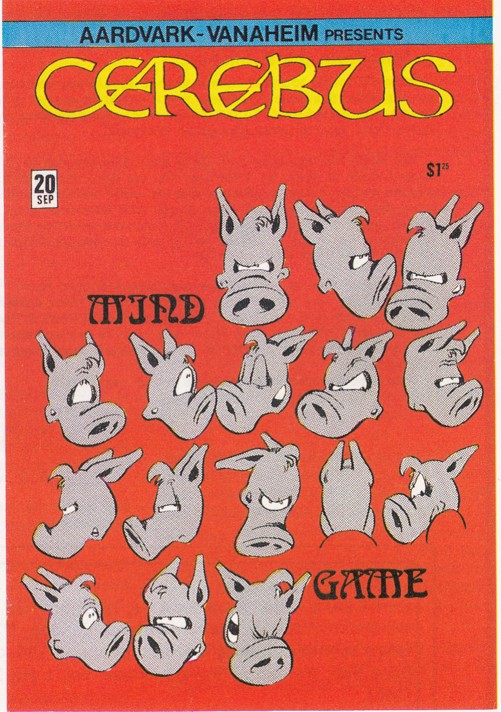
Cerebus #20 (1980)


Cerebus' expressions from the beginning of the blow job to the end.

This is the issue where Cerebus truly became presidential. Or whatever adjective I should be using to describe how Cerebus was just a Swords & Sorcery parody comic book with guest appearances of parodies of other fictional characters (Come on. We all know Groucho Marx is a fictional character) but then suddenly became a political and religious and philosophical parody comic book with guest appearances of parodies of political, religous, or philosophical personas. Maybe I meant it matured? Sure, it'll still have Elrod for a bit and satires of DC and Marvel heroes and, sometime after the next couple dozen issues, the McFleagle Brothers but it'll also have a bunch of stuff I don't understand too! And if I don't understand something, you better believe it's smart! That's gospel coming from somebody who just finished reading Pynchon's Gravity's Rainbow and understood exactly 12% of it (that 12% deals with boners, sex, drugs, and coprophilia (my parents would be proud that I didn't even need to Google how to spell that!)).

Why do I think this is the issue where Cerebus matured? Because it begins with a quote from Cirin's The New Matriarchy. Shit's about to get real, goose.

This is the second great joke in Dave's blank page series of jokes.

I absolutely mean it when I call the blank page jokes great. It's an important example of what I think differentiates Early Stage Writer Dave Sim with Late Stage Writer Dave Sim: his whimsy. At some point after this moment when the comic book matures, Dave Sim begins to take things way too seriously. Sure, he still gets goofy even at the end when he introduces the Three Stooges. But it's different because it's goofiness in service to the serious. It's not just goofiness for goofiness sake. It might be slapstick but it's not whimsical. Or maybe it is but it's hard to see it that way after you've just read a year or two of horribly dry and reaching Biblical explications.

Last issue, Cerebus was captured by Perce, a Cirinist. He has been drugged and about to have his cards read to see if he will be a fitting ally for the rise of the Matriarchy. It's either that or be destroyed even though the quote from Cirin's book says "We cannot dismiss any soul as extraneous. All originate with the Mother and all must be instructed in her ways." I suppose later when we learn Cirin isn't actually Cirin but Cirin's general, it makes sense that the words of Cirin don't match the action of the current Cirinists.

While in his drugged state, Cerebus reaches the Seventh Sphere and begins talking to somebody (not Gort). I believe it's Cerebus' first communication with Suenteus Po (the third aardvark after Cerebus and "Cirin" (really Serna, Cirin's general who takes over the movement)). I'm sure that will be revealed by the end of the issue. It probably isn't too important now.
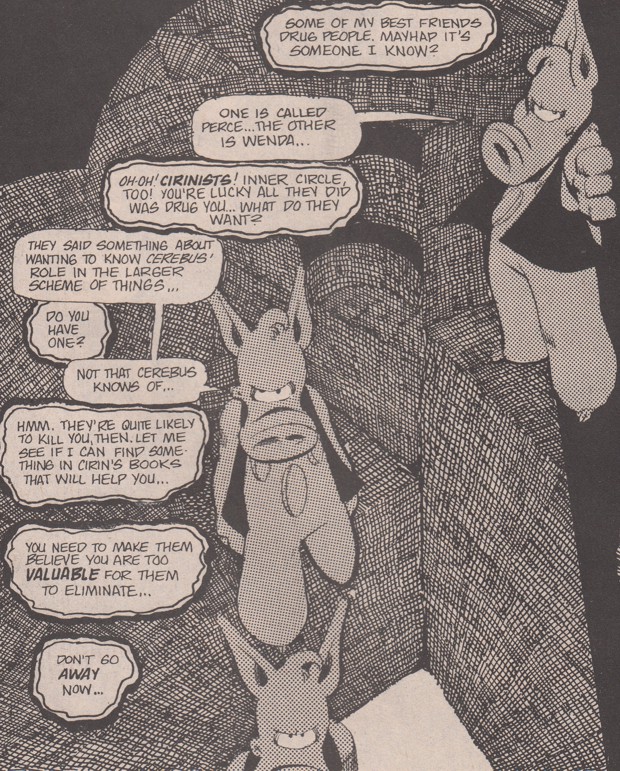

This conversation takes place after Cerebus tells the voice he has been drugged. "Some of my best friends drug people" is a fantastic line.

Suenteus Po reveals himself and Cerebus recognizes the name as the founder of Illusionism. I don't remember any of Po's Illusionist philosophies. That means he probably isn't super important to the story except for a later big reveal that he's also an aardvark. It seems like Astoria and Kevillism become more important. That's probably because Astoria and Cirin are out there on the battlefield crossing swords while Po is, I don't know, hanging out with guys who drug people and partying in the seventh sphere. Hmm, you know what? That might actually be the basic tenets of Illusionism: drink, fuck, and blow your mind, dudes!

Oh, I also just remembered that this might not even be the actual Suenteus Po! I guess Dave Sim loves the "this character wasn't really the character you thought it was" reveal! Or maybe Sim just found that a convenient way to shift continuity when he realized an early voice of a character didn't exactly fit the character he wanted it to be in a later story arc.

Cerebus tries to pit the Illsuionists against the Cirinists in a battle just outside the place he's being held captive. It almost works but before Wenda and Perce both leave him alone to fight Illusionists, Wenda drugs him again and he loses consciousness.

So the Illusionists (at least this version that probably interpreted all of the real Po's writings incorrectly because who wouldn't want to believe in a philosophy where you just indulge in debauchery?) get their asses kicked by the Cirinists because the Cirinists mean business and the Illusionists mean fun. And business always trumps fun for some stupid reason. I guess maybe that reason is ambition or something.

The letters page was unremarkable. The Single Page had an Evan Dorkin "Milk & Cheese" strip. The best part was seeing the address to Slave Labor Graphics on Bascom Avenue in San Jose, some of my old stomping grounds. Pretty sure it was located next door to a shop that sold old toys and collectibles. It wasn't too far from Taco Bravo.

Cerebus #20 Rating: B+. Remember when Neil Gaiman wrote that 24 hour comic book about "Heliogabalus"? I do. See you next time, farts!

Gravity's Rainbow: Part XI.I

My brain couldn't stop thinking about the last section, mostly the way the story elements align with the final section's headers (even the non-header headline about Gerhardt becoming a sodium amytal freak). Tyrone's propulsion when flushed down the pipe by, possibly, Malcolm's turd (getting one of his dingleberries jammed up his nose), predicts (or is? Or parallels? Or synchronicities?) Gottfried's journey in the rocket. Slothrop's vision also suggests that there is only one of every person. In some way, is Slothrop also Gottfried? Not literally (although maybe literally?!). But he too becomes close and intimate with Katje. Gottfried, surrounded by the Imipolex chamber, reflects on the smell from childhood (I can't find this passage at the moment but I'm certain it was there). Gottfried also has an erection in this Imipolex chamber as he's ready to be rocketed to his end. What are the connections here? What is the synchronicity between Gottfried and Slothrop?

Another bit: one of Gottfried's memories as he's trying to remember as much as he can before his end is about a red terrier that came to see him off and he "can't remember the meaning of red." In Slothrop's fantasy, he constantly refers to Malcolm X as "Red," and he assumes Red was the one to flush the toilet, to see him off.

I don't know how it all fits together but at least it's all there in my head for the majority of the reread. Hopefully I'm just in Brennschluss right now and the ideas will start rolling in with the descent.

Gravity's Rainbow: Part XI

This is the Kenosha Kid section. If you haven't read Gravity's Rainbow because you're either too stupid or too sane, you don't have any idea what that means. If you have read the book, even if it's been forty years, you're now rolling your eyes and saying, "You never did The Kenosha Kid." Although I have no idea which way you're choosing to say it. Those of you who haven't read the book don't know what I mean by that. Those of you who have read the book are now doing the International Sign Language sign for jerking off and saying, "What the fuck was that shit all about?!" I would love to tell you! But being that I've now finished my first read of Gravity's Rainbow and I didn't understand it at all (okay, maybe I understood it a little bit! But I'm hoping to understand it more by writing hundreds of these blog posts during my second reading!), I'll never manage to write some kind of academic paper revealing what the fuck is going on. Although if I'm going with my gut instinct, Pynchon is just having a bit of fun with language here. And of course, in that fun is evidence that language isn't exactly the clear cut way to communicate a thought. It's sometimes a bit foggy and nebulous.

The various ways the words "you never did the Kenosha kid" can be spoken or written or punctuated are occupying Slothrop's thoughts (for whatever reason) as he's being prepped for interrogation in The White Visitation by being injected with Sodium Amytal. The people interrogating Slothrop work for PISCES (Psychological Intelligence Schemes for Expediting Surrender). They're asking him about his experience with Black Americans back in Boston before Slothrop enlisted. I believe it's to gather information for Project Black Wing, a psi-ops to make the Germans believe in a secret Black German underground movement called the Schwarzkommando. To increase paranoia which would lead to "expedited surrender," I guess?

Spoiler Warning: The Schwarzkommando wind up being a real thing. Nobody really knows which was the stimulus and which was the reaction. Which brought the other to life. Which was the cause, which the effect.

Slothrop has become a favorite subject at The White Visitation because of his ability to predict rocket impact sites via his sexual encounters. But tonight, in this session, he will simply talk about the night he lost his harmonica in the toilet as he was bent over vomiting up his day.

About all the scientists with PISCES will learn tonight is that Slothrop has a terrific and vivid imagination, especially when it comes to describing various kinds of shit. Because maybe Tyrone Slothrop did, one time back in Boston, lose his harmonica in the toilet while vomiting. But he almost certainly did not fish it out by climbing down into the toilet (while nearly being raped by Malcolm X before he could wiggle his ass down into the bowl) and following its path through the pipes and out to sea. Maybe, being that PISCES has that bit of the acronym about Psychological Intelligence, the point of the Sodium Amytal is to just get Slothrop fucked up enough to expose his own fears and fetishes. I don't know which of those two categories being gang ass-raped by a bunch of Black men falls under.

After somebody takes a shit and flushes, Slothrop tumbles end over end into a hidden toilet world, a beleaguered city with buildings full of people Slothrop seems to know but which he cannot enter for fear of joining them forever in whatever daily ritual of death or disaster they seem to forced to suffer through. In this landscape, he meets Crutchfield the Ur-Cowboy and his sidekick Whappo. Or not really the Ur-cowboy but the only cowboy. Apparently this fantasy landscape shifts according to Slothrop's whims and perspective. It's easy to think this is just a drawn out fantasy of Slothrop's while drugged up for the interrogation except for one small detail which nags at me saying, "This is probably important. Why would this be like this if it wasn't more important?!" That detail is Whappo's magenta and green bandana. One of the headers of the short passages in the final section of the novel is called "The Last Green and Magenta." Another one of the passages is called "Orpheus Puts Down the Harp." And what is this fantasy other than Slothrop descending into the bowels of the Earth to recover his lost harmonica.

These things must mean something, right?! This section is more than just Slothrop describing the different kinds of shits the people he knows would take and musing on the various ways to interpret the phrase "you never did the kenosha kid." Right?! Somebody tell me!

That's really about it. Slothrop begins the interrogation discussing a night at a Roxbury club and winds up hallucinating a trip down a toilet into a world where only one of any person or animal exists. As Slothrop begins to rise out of the fantasy, he seems to be asking the interrogators questions about how many people are real or unreal, and how many are necessary or unnecessary. And ominously, the response hints at having plans for those that are real and unnecessary. Or the other way around? No, no. It seems like the real and unnecessary ones since it evokes an image of thousands of dead in Ardennes.

The section ends with Slothrop's hallucination merging with his pre-drugged thoughts and he meets some pusher in an alley who gives Slothrop one more way of saying, "you never did the kenosha kid."

Oh wait! One more thing was hidden in this section! The realization that I'll never fucking really understand what is going on in this book! How many times do you have to read it to understand it?!

Gravity's Rainbow: Interlude One

Six hundred pages into Gravity's Rainbow and I'm not entirely sure what it's about. But then I'm used to reading books that you technically haven't read until you read them a second time. Which is why I'm reading Gravity's Rainbow a second time as I read it the first time.

One of the reasons it's difficult to pin down what the book is about is that it's written in sketches. And you don't usually watch a sketch show and expect to find a thematic element running through every sketch.

Another reason is that Pynchon is obfuscating events because the characters don't know all the details either. Slothrop's quest to find out what Jampf did to him as a baby and what They're doing to him now as a result of it is a quest to discover what the fuck is going on in the novel. I mean aside from everybody trying to live their life in the shadow of the War.

So what are some of the themes in this thing? I suppose, being a postmodern novel, I could just list all of the problems of modern civilization and I'd nail most of the themes: technology, colonialism, corporatization, sexuality, religion, death. Some of the most powerful moments in this book are really just short stories about a character dealing with a modern problem. The section about the Hereros and how they've chosen genocidal suicide over the life imposed on them by missionaries and colonialists was fucking heartbreaking. And while aspects of what the Germans did to the Hereros are important for the motivations of key characters tied to Slothrop's quest for Jampf or Imipolex or the part with the serial number 000000 (the Schwarzgerat (sp, probably?) or Their plot to manipulate his entire life, it really is mostly just a short story within the larger work.

In many ways, Gravity's Rainbow was a way for Pynchon to write about a whole bunch of stuff that he wanted to write about, all in one place. I'm sure it'll all come together at some point but it can still definitely be read as a bunch of short stories. Because I'm fairly certain that Slothrop's encounter with the older mother of one of the women he's fucking where she feeds him all sorts of terrible candy won't ever be a significant plot point in the overall book. But it was funny as fuck and well worth reading by somebody out of context of the book. A hilarious short story.

Anyway, one of the themes I was thinking about that I thought I'd kick around a tiny bit here was the theme of death. The book begins with its titular aspect of death: the rocket screaming across the skies of London. A portent of doom that has lost the "portent" part of its message in that the doom happens before the portent. The book begins with the knowledge that our experience of death has been subverted. And it's the way that we, modern people, must now deal with and experience death that changes something fundamental in our relationship with people of the past.

When death came to people of the past, it was generally something slow, something they would experience. A mortal wound or a mortal sickness would not obliterate them in a moment's notice without any kind of reflection. They would be able to see death coming. They would have time to feel it on them. Rarely would they simply wink out of existence without some kind of terrible or righteous or holy knowledge that they were leaving this mortal coil. Even being mauled by bear or attacked by a maniac with a mace, they would have time to understand their life was over.

But modern weapons changed that. And changed it so vastly that not only can a person's ego be destroyed before they can even think, "I'm going to die!" but it can be obliterated while simply thinking about the next second of life that will never come. Death all too often can come as a complete surprise in the modern era. Which leads to one of the other major themes of this novel: paranoia.

Everybody is inundated with deeply paranoid thoughts in this book. Roger Mexico basically disappears during the entire five hundred pages of the second chapter but he's a good example of one of these paranoid people just trying to deal with modern life and death. Which is also, in a postmodern society, often dealing with the loss of religion, because how can anybody believe in God or an afterlife when they've witnessed the horrors of modern man in the 20th Century?

Anyway, Roger, being an unbeliever amongst believers (the people he works with in The White Visitation all believe in ghosts and the afterlife and a whole host of improbable mysteries of the unseen universe), must find his own way to live with the constant specter of death at any moment. One cannot live without paranoia when you're living in a space constantly filled with more-than-instant death from above. And how does he come to terms with this paranoia? Statistics. It gives him some sense of control even if the basic truth of his gathering of statistics is that the knowledge he gains cannot save him. He may be able to predict the probability of a rocket striking a certain area but he can never predict where the rockets will eventually fall. The probability of not dying is all he has. It's his only comfort. And, as we see in Jessica's remembrances of their conversations, it isn't fucking much. He's still terrified but he can't voice his terror. To do so would be to somehow invalidate the statistical charms with which he's outfitted himself.

So that's what I think this book is about right now. Paranoia, mostly. Paranoia is the search for meaning in a world where all faith in religion has been lost. If religion is about putting order to a random and chaotic universe then where do you find that order when you can't believe in religion anymore? You find it in conspiracies. You find it in corporations working with governments across the borders of battlefield disputes. You find it in the name of a man who experimented on you as an infant baby being the person who invented a kind of plastic that has been somehow tied to the rockets that give you a hardon days before they actually crash down upon the city. You give meaning to all coincidences because if life is simply a coincidence and not a story then death is also a coincidence and can happen at any time without a proper and fitting conclusion to your story.

I could be wrong about all of this. I'm not a Pynchon scholar. I'm just some dumb jerk reading one of the best books I've ever read.

Gravity's Rainbow: Part X

About five hundred pages into this monster, the parts began to come together so I could stop asking, "Why was all of that stuff about Pirate Prentice necessary?!" Not that I'm any clearer on what his big secret mission delivered by the Rocket was supposed to be. But I am learning about the people who delivered that message and how it's tied to Slothrop's quest to find the plastic, probably the secret to Slothrop's hardons, in which the message was contained.

But that's getting about 450 pages ahead of myself! Currently, I'm at a part of the book where I haven't registered that Slothrop is important at all. He's just a guy who keeps a poster of his sexual conquests that some psychic nutjobs and Pavlovians think is important.

This section finds Jessica smoking alone in the dark of her and Roger Mexico's squat located in an abandoned village she can't name and thinking about the imposition of War. She would like the life she and Roger Mexico are living to be less of an imaginary thing wherein they hide from the realities of the War and more, well, you know, reality. The War is too big to conceive, too much to visualize as a whole. And it will not bother them, except maybe by A4 Rocket, and then, well, they wouldn't even know, right?

Jessica thinks about a conversation she had with Roger Mexico about the Poisson distribution of the Rocket strikes. I've never had too much trouble with higher math or science (okay, Physics in my senior year of high school gave me some trouble but half of that was my attitude as a soon-to-be-high-school graduate who just couldn't be bothered with all this learning crap) but a college course in statistics was my first real indication that maybe I wasn't as smart as my mother kept insisting I was (although like my Physics course, it's possible that the situation surrounding my enrollment in this particular Statistics class and my apathetic attitude toward the material had more to do with why I didn't understand it). But with this following passage, Pynchon has me believing that my lifelong belief that Statistics is a language that very few have the capacity to learn was correct (not that I need much proof to acknowledge a belief which tends toward my own self interest).

"Roger has tried to explain to her the V-bomb statistics: the difference between distribution, in angel's-eye view, over the map of England, and their own chances, as seen from down here. She's almost got it: nearly understands the Poisson equation, yet can't quite put the two together—put her own enforced calm day-to-day alongside the pure numbers, and keep them both in sight. Pieces keep slipping in and out.
    "Why is your equation only for angels, Roger? Why can't we do something, down here? Couldn't there be an equation for us too, something to help us find a safer place?"
    "Why am I surrounded," his usual understanding of self today, "by statistical illiterates? There's no way, love, not as long as the mean density strikes is constant. Pointsman doesn't even understand that."
    The rockets are distributing about London just as Poisson's equation in the textbooks predicts. As the data keep coming in, Roger looks more and more like a prophet. Psi Section people stare after him in the hallways. It's not precognition, he wants to make an announcement in the cafeteria or something . . . have I ever pretended to be anything I'm not? all I'm doing is plugging numbers into a well-known equation, you can look it up in the book and do it yourself. . . ."

See?! In Pynchon's description of Roger's statistical life, even the psychics can't get their heads around Statistics! It's mystical hoodoo!

This section is a good example of why Gravity's Rainbow can be such a confusing read at times. This section begins from Jessica's perspective as she looks for a smoke in her and Mexico's squat. It then moves to a remembered conversation between Jessica and Roger. But then, during this remembrance, the scene shifts to a morning in Roger's life at The White Visitation seen from Pointsman's perspective. It's easy to lose oneself in these shifts of time and perspective, and to forget where the scene began if and when Pynchon decides to return to what had seemed like a linear bit of story telling.

In the now shifted scene, Pointsman feels compelled to drop in on Mexico every morning to try to get a handle on the whole statistics thing. Pointsman's problem, as a Pavlovian, is that he only seems to understand binary results. Does a stimulus cause a reaction or not? (Yes, I've simplified this because I don't know much (or anything at all) about "summation," "transition," "irradiation," "concentration," or "reciprocal induction.") But Roger deals in seemingly random possibilities. What does a 0.37 chance even mean when you get right down to it?! To Pointsman, it simply means you don't know anything at all, really. If the numbers Mexico comes up with don't indicate how to avoid being hit by an A4, what fucking good are they then?!

Pointsman's observation of what Mexico's ability to live comfortably with seemingly random probability evokes in me echoes of Douglas Coupland's Generation X (and not just because the word "generation" is italicized in the text!).

"How can Mexico play, so at his ease, with these symbols of randomness and fright? Innocent as a child, perhaps unaware—perhaps—that in his play he wrecks the elegant rooms of history, threatens the idea of cause and effect itself. What if Mexico's whole generation have turned out like this? Will Postwar be nothing but "events," newly created one moment to the next? No links? Is it the end of history?"

I mean, it's like Coupland's pitch for the book! Probably!

Immediately after the bit I just transcribed, the scene shifts again to a night Roger was having a drunken discussion with the Reverend Dr. Paul de la Nuit about Mexico's statistics. In this brief remembrance, the Reverend asks Mexico a simple question through an analogy of a bit of trivia about the Romans: What fucking good is your chart of A4 Rocket strikes? It's a fair fucking question, really.

And then we're back to Jessica's remembered conversation. Almost all the way back to the present narrative! Jessica pointing out that it isn't fair that his statistics don't tell them how to be safer; Roger once again being forced to repeat to yet another dullard that it's just an equation.

Ignoring the whole discussion of statistics for a second, I'd also like to point out that the linear narrative (you know, the easy parts of the book!) is clever and enticing and beautifully written. This book isn't becoming my favorite book simply because it's smart and difficult to read and postmodern. It's because of moments like this:

    "Well, it isn't fair."
    "It's eminently fair," Roger now cynical, looking very young, she thinks. "Everyone's equal. Same chances of getting hit. Equal in the eyes of the rocket."
    To which she gives him her Fay Wray look, eyes round as can be, red mouth about to open in a scream, till he has to laugh. "Oh, stop."
    "Sometimes . . ." but what does she want to say? That he must always be lovable, in need of her and never, as now, the hovering statistical cherub who's never quite been to hell but speaks as if he's one of the most fallen. . . .

The scene, once again, shifts to The White Visitation in a memory where Jessica and Pirate Prentice are talking while they watch Roger off in the distance playing in the snow. Pirate deems Roger's attitude toward the "rocket being fair" "Cheap nihilism." And later, when Jessica tells him about the exchange, he admits it. Sure. Cheap. Of course! But why should his reality, his fears, his way of coping with those fears, be less because of what others have truly suffered?

Roger Mexico is just as frightened of death as anybody else who doesn't believe in something more, something after. And yet he works at The White Visitation where they all believe in more. So why shouldn't he fear death more than they do? All he has are his statistics and, in the end, they might offer an illusion of control but they offer no solace, no hope, no eternal reward. There's just the end and now, with the marvels of technology, you don't even get any warning about that.

The section ends with both Jessica and Roger thinking about Pre-War life and how everything seemed silly and unnecessary and inconsequential. And as a reminder of the life one used to be able to lead without thinking about death constantly, a rocket hits nearby.

Gravity's Rainbow: Part IX

When I wrote my thoughts on the last section, I was about one hundred or so pages into Gravity's Rainbow. Now I'm five hundred pages in! So maybe I'll understand 20% of what I read instead of just 6%!

This section begins with a conversation between Kevin Spectro and Ned Pointsman. They're two of the seven owners of the mysterious Book (which won't be that mysterious for long. It's like Pavlov's journal or something). Ned is a complete Pavlovian doing all the things you'd expect of him: catching dogs, torturing dogs, wiring dogs' salivary glands so they leak directly into tubes. Spectro, well, I don't remember exactly what his specialty is. It probably doesn't matter because he'll be dead soon.

Pynchon uses the word "abreaction" in this section for (possibly?) the first time. He'll use it again so it's probably important! Mostly he uses it in the context of Pointsman's reality. Pointsman, being a Pavlovian working in a madhouse leased by paranormal researchers, runs into a lot of people who tend to have abreactions (here's the definition so you don't have to bother poor overworked Google: "the expression and consequent release of a previously repressed emotion, achieved through reliving the experience that caused it (typically through hypnosis or suggestion)"). That word might be a really important world in postmodernist literature. Not that I ever remember coming across it! But I'm sure I just ignored it like I ignore all the words I don't know. The definition just makes me think, "How can that word not be constantly used in postmodernist writing since it perfectly describes what we're all going through in a postmodern world?!"

Pointsman has apparently just opened up to Spectro about maybe experimenting on Tyrone Slothrop rather than his dogs. Some stimulus is giving Slothrop hard-ons and isn't it the job of Pavlovians to push that stimulus reaction further and further? Surely something can be learned about the human condition by studying what makes Slothrop erect?! Spectro isn't supportive of the idea because he doesn't see how you can justify experimenting on just one man. But Pointsman figures it might be moot anyway because he can't figure out how to get the funding out of Pudding, the general running The White Visitation.

Spoiler Alert: he'll get the funding out of him by providing him with weekly visits from Katje (who?! You haven't met her yet!) where she pisses and shits in his mouth.

Here's the crux of Pointsman's desire to study Slothrop: through some unknown stimulus, Slothrop can detect where a German rocket that has yet to be fired will land in London. In a way, the rocket itself, traveling faster than the speed of sound, mimics Slothrop's reaction: it blows up before it's ever heard. Response seems somehow to be coming before the stimulus. It's a mystery which turns all Pavlovian experimentation on its head.

Spectro works at a ward where people wounded by rockets are treated. Not only physically but mentally as well. They are full of abreactions! Am I using that word correctly?! Who can tell?! Anyway, it's a good segue into quoting this bit that I love from this section (is it really a segue if I interrupt the performative segue with a mention of it being a segue?!):

"[S]ooner or later an abreaction, each one, all over this frost and harrowed city. . .
     . . . as once again the floor is a giant lift propelling you with no warning toward your ceiling—replaying now as the walls are blown outward, bricks and mortar showering down, your sudden paralysis as death comes to wrap and stun I don't know guv I must've blacked out when I come to she was gone it was burning all around me head was full of smoke . . . and the sight of your blood spurting from the flaccid stub of artery, the snowy roofslates fallen across half your bed, the cinema kiss never completed, you were pinned and stared at a crumpled cigarette pack for two hours in pain, you could hear them crying from the rows either side but couldn't move . . . the sudden light filling up the room, the awful silence, brighter than any morning through blankets turned to gauze no shadows at all, only unutterable two-o'clock dawn . . . and . . .
     . . . this transmarginal leap, this surrender. Where ideas of the opposite have come together, and lost their oppositeness. (And is it really the rocket explosion that Slothrop's keying on, or is it exactly this depolarizing, this neurotic "confusion" that fills the wards tonight?) How many times before it's washed away, these iterations that pour out, reliving the blast, afraid to let go because the letting go is so final how do I know Doctor that I'll ever come back? and the answer trust us, after the rocket, is so hollow, only mummery—trust you?—and both know it. . . . Spectro feels so like a fraud but carries on . . . only because the pain continues to be real. . . ."

There's a strange bit in this section where Pointsman has a fantasy. On my first read-through, I thought we were learning that Pointsman was some kind of pedophile. But I think the creepy descriptions of children and virgins, the people he is lusting after to experiment on, to replace his dogs, is just an analogy of those who have moved past their trauma (as described in the transcribed passage above). They move past the trauma and spring anew as a blank slate, as a virgin, as a child. A mind so clean and clear of the trauma they had previously experienced that Pointsman lusts to project his own view of the world upon them. How can he get a better specimen, unless it's, say, an infant baby boy like Jampf used.

Pointsman, of course, does not get his mitts on one of Spectro's patients to experiment on (his fantasy being one of kidnapping as he lays in wait at the places he knows they will be extracted to once released from the hospital, and not a fantasy where Spectro just gives him access to one of his patients. Pointsman, you see, is a cold-hearted monster. That might be a spoiler unless you've already realized it). What Pointsman does get is an octopus named Grigori. It'll become important in one of Pointsman's schemes later.

Pointsman shows little concern for the war effort; he's merely trying to get enough money out of the war to fund whatever weird Pavlovian experiments he can get away with. So far the war has provided him with lots of free dogs and lots of money (maybe not enough money but he'll, you know, learn disgusting ways around that soon enough). Since I, for the life of me, can't figure out how Pavlovian studies could help the war anyway, it's nice to learn that Pointsman's goals are entirely self-motivated. And it's important to learn about him and his motivations now before we get to Chapter Two where his experiments on Slothrop begin in earnest.

Gravity's Rainbow: Part VIII

This book has so many sections that I'm going to have to contact my twelve year old self for help with the Roman numerals. I would do it via time phone over time machine because that kid smelled bad.

This section begins confusingly from the point of view of a dog and ends hilariously with Pointsman's foot stuck in a toilet and hanging out the side of the car as they drive away. It's a good thing history books exist because if I had to judge World War II by Catch-22, Gravity's Rainbow, and Slaughterhouse-Five, I'd have to assume the war was 85% soldiers slipping on banana peels and depraved sex acts.

I wonder if I should apologize to Vonnegut for remembering Slaughterhouse-Five as more Three Stooges than it probably was? It's been awhile but he's the guy who invented Kilgore Trout, interrupted his own book while talking about Vietnam to simply say, "Losers," taught me that an asterisk looked like a butthole, and concluded the whole point of evolution was to create beings that laugh at their own farts. I'm pretty sure I got all of that right.

Roger Mexico and Jessica Swanlake have finally found Doctor Pointsman in a wrecked part of London. Pointsman is hunting for dogs to use in his experiments. He's a Pavlovian and his research on stimulus will somehow help the war effort. I'm not sure how it's supposed to but eventually he takes an interest in Slothrop and the mystery of Slothrop's hard-ons. At that point, I stopped wondering how experimenting with Pavlovian stimuli was supposed to help defeat the Germans. Pavlovian experimentation looms large on the themes of this book but I haven't yet grasped why they're part of The White Visitation's experiments. I suppose that should be the least of my worries when The White Visitation is also dealing with telekinesis and clairvoyance and talking with the dead and promoting racial strife and there's also some guy who can change his skin color or something?

Anyway, this whole section is called "Beyond the Zero" which, and I know I'm getting ahead of the story here, has something to do with removing the reaction to the stimulus from the patient. See, if you train a baby to get a hard-on from an indirect stimulus, as a medical professional, you're supposed to also untrain the baby. So you have to get it to stop getting hard-ons from the indirect stimulus. But when you do that, you can't stop at the baby just not getting a hard-on. That's the zero point. But just because he doesn't get a hard-on doesn't mean the stimulus isn't still affecting him somehow, you know, to just to the point where it's about to get a hard-on. So removing the stimulus even further is going "beyond the zero." But why that's the title and a major theme of this chapter would take a smarter person to explain it to you. Maybe I'll figure it out by the time I get back to the section that discusses the whole "beyond the zero" part.

Where was I? Oh yeah! Pointsman was hunting a dog and had just gotten his foot stuck in a toilet!

If a reader hadn't noticed this book was funny in the previous forty pages due to the fact that nobody told them it was funny and Pynchon's writing can be a bit opaque, this section leaves no doubt about it. The physical comedy with the toilet bowl on the foot would be a big hit with the type of person who would never fucking read this book (and also me) but there are some other bits that really make me smile. Like this part with Jessica moaning about hunting dogs with the boys:

"The night, full of fine rain, smells like a wet dog. Pointsman seems to've been away for a bit. 'I've lost my mind. I ought to be cuddling someplace with Beaver this very minute, watching him light up his Pipe, and here instead I'm with this gillie or something, this spiritualist, statistician, what are you anyway—'
    "Cuddling?" Roger has a tendency to scream. "Cuddling?'"

Okay, maybe that's not ha ha funny like a joke but I fucking love Roger's oversensitivity to any possible intimate interactions between Jessica and her serious boyfriend, Beaver.

There's a bit of foreshadowing in this early section about Pointsman moving on from experimenting on dog's to experimenting on Slothrop.

"'What will you do for a dog, then.'
    They are under way again, Roger at the wheel, Jessica between them, toilet bowl out a half-open door, before the answer. 'Perhaps it's a sign. Perhaps I should be branching out.'
    Roger gives him a quick look. Silence, Mexico. Try not to think about what that means. He's not one's superior after all, both report to the old Brigadier at 'The White Visitation' on, so far as he knows, equal footing. But sometimes—Roger glances again across Jessica's dark wool bosom at the knitted head, the naked nose and eyes—he thinks the doctor wants more than his good will, his collaboration. But wants him. As one wants a fine specimen of dog. . . ."

I've probably already quoted too much of this section to include a somewhat confusing bit near the end but the bit seems more important than an actual description of the building where Doctor Spectro works. Pynchon describes a building built to house patients with colonic and respiratory illnesses. He describes the necessity and drive to build this building as the Victorian equivalent of what drove the people of an earlier age to build Gothic cathedrals. It feels very much like a writer describing the similarities and quite obvious differences between postmodern literature and literature from earlier centuries. What once drove mankind to write and think and ponder was almost exclusively God and religion and spirituality. But in a time when there is "a doubt as to God's actual locus (or, in some, as to its very existence)", the drive must come from another source. Pynchon's "joke" is that the new source is colonic and respiratory diseases. He says it much better (if not so mundanely):

"They are approaching now a lengthy brick improvisation, a Victorian paraphrase of what once, long ago, resulted in Gothic cathedrals—but which, in its own time, arose not from any need to climb through the fashioning of suitable confusions toward any apical God, but more in a derangement of aim, a doubt as to the God's actual locus (or, in some, as to its very existence), out of a cruel network of sensuous moments that could not be transcended and so bent the intentions of the builders not on any zenith, but back to fright, to simple escape, in whatever direction, from what the industrial smoke, street excrement, windowless warrens, shrugging leather forests of drive belts, flowing and patient shadow states of the rats and flies, were saying about the chances for mercy that year. The grimed brick sprawl is known as the Hospital of St. Veronica of the True Image for Colonic and Respiratory Diseases, and one of its residents is a Dr. Kevin Spectro, neurologist and casual Pavlovian."

See? It's practically a definition of postmodern writing! "Remember when we could look to an Almighty creator for hope and salvation?! But now it's like, man, that Guy can't exist, right? I mean, the fucking A-bomb, man! What the hell is going on?! How do we get out of this mess?!" Or maybe it isn't a definition of postmodern literature at all and it just speaks to me! Who can tell? Not God!

Just...what a great section. Mostly because it's so comprehensible! But also funny! And charming! And a bit melancholic by the end.

This is the first chapter that mentions Pointsman's mysterious "Book" with a capital "B". It was expensive and seven of the doctor's at The White Visitation had to chip in to buy it, so it makes the rounds, spending one week at a time with each different owner. Or wait. Was The Book already mentioned?! I can't remember since I'm reading this book so many times at once! Anyway, The Book is one of only seven copies (or something?) of Pavlov's notes. I'm not sure if it's ever named but one of the chapters is named later and I did a Google search back then to discover what book exactly they were discussing. I don't remember it exactly but it was Pavlov's notes and crap. More on The Book later, I'm sure!