
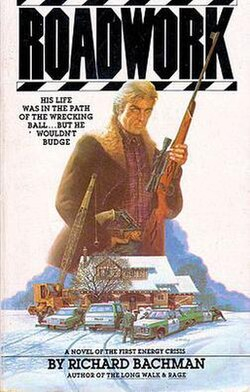
That cover couldn't be a worse choice for this book. No, wait. The UK First Edition cover couldn't be a worse choice for the book.
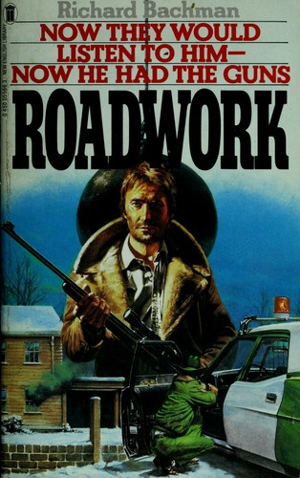
This is not a story about a man fighting back against an uncaring government destroying his life. This is not a story about a man using guns to fight back and change the world. The entire confrontation depicted by these two covers takes place across maybe ten pages out of about 280. The covers merely depict where this man's life wound up. This isn't a story about changing things or the little guy rising up to change the system or the underdog besting corporate and government greed. This is a book about a man who never figured out how to properly mourn his son and move on. This is a story about a man who probably should have gotten therapy.
Near the end, as Bart's in a standoff with police, a reporter asks Bart George Dawes what he wants. A plane to get away? A peaceful resolution? His house? But this is his answer:
In every book of King's (Oh? Did I forget to mention for anybody who hasn't heard? Richard Bachman is Stephen King, right? Yeah? Okay!), no matter how dull I might find it, or how predictable, or how utterly mundane the basic plot, he tends to have at least a few moments that are pure genius, moments that remind me that even I can sometimes still feel. And that quote I posted earlier was the moment in this book. It's a short book and doesn't contain a lot of great beats to it. The man buys some guns. The man buys some dynamite. The man takes some mescaline. The man yells at and insults his wife every time they try to talk and she doesn't once simply tell him to fuck off. Man, he treats her like shit! Luckily she eventually leaves him although they tool around with maybe making it work still. Of course, on his wife's side, that's all based on the lies he keeps telling her. Because he can't tell her the truth when he's still not fully aware of the whole truth himself. You know, the truth everybody he seems to meet pretty much picks up on. This guy is going to kill himself.
Roadwork felt like a first draft of Pet Sematary although reading some of King's comments on it argues against that. It felt to me like the dread of a father losing a son and what it might lead him to do. But the way King tells it, it had more to do about his mother's death from cancer. But then, Pet Sematary has a bit to do with that too, so, um, you know? Probably a little of it all in there. What really comes out is a man in his 30s really understanding and coming to terms with the idea of his own mortality. Bart experiences a couple of other deaths in this book and they just drive him even further around the bend. Probably because he knows he's already headed down the path to his grave and, even though it's writ in stone, he's still afraid.
I don't want to discuss the young woman he meets and fucks because Stephen King just likes to have guys meet women and fuck them. I mean, sure, meeting women and fucking them is cool! But Stephen King doesn't know how to write a short story that makes it as cool as it really is in real life. King manages to make me think he believes the key to meeting and fucking women is to be super creepy and adulterous.
The Epilogue is pretty nice though because it makes it clear that everything Bart Dawes did had no great consequence. He just wanted somebody, anybody, to witness his suicide, to acknowledge that his pain was real, and to finally, actually see him. Plus I guess the girl he fucked turned her life around with his help so I guess that meant something?
Near the end, as Bart's in a standoff with police, a reporter asks Bart George Dawes what he wants. A plane to get away? A peaceful resolution? His house? But this is his answer:
"I want," he said carefully, "to be just twenty with a lot of decisions to make over."The story hangs on the framework of an interstate being built through the middle of a town which has caused the government to use eminent domain to buy up everybody's houses. The interstate will not just run through Bart Dawes house and neighborhood but also the factory laundry where Bart works. His life will be completely upended and destroyed. Of course, his life has already been completely upended and destroyed by the death of his son with a brain tumor some years previous. The roadwork cutting through and destroying his life is just the metaphor for this man's inability to move on after the death of his son. He cannot move from this house where all the memories of his child remain. He cannot leave the job he worked his entire life. He cannot discuss any of it with the woman he married when they found out she was pregnant (a pregnancy which she subsequently lost). Throughout the book, Bart wrestles with the idea of suicide and what it might possibly mean to his soul. He wrestles with it because the man we meet at the beginning has already decided to do it. Most of the book is just Bart realizing, piece by piece, that he's killing himself.
In every book of King's (Oh? Did I forget to mention for anybody who hasn't heard? Richard Bachman is Stephen King, right? Yeah? Okay!), no matter how dull I might find it, or how predictable, or how utterly mundane the basic plot, he tends to have at least a few moments that are pure genius, moments that remind me that even I can sometimes still feel. And that quote I posted earlier was the moment in this book. It's a short book and doesn't contain a lot of great beats to it. The man buys some guns. The man buys some dynamite. The man takes some mescaline. The man yells at and insults his wife every time they try to talk and she doesn't once simply tell him to fuck off. Man, he treats her like shit! Luckily she eventually leaves him although they tool around with maybe making it work still. Of course, on his wife's side, that's all based on the lies he keeps telling her. Because he can't tell her the truth when he's still not fully aware of the whole truth himself. You know, the truth everybody he seems to meet pretty much picks up on. This guy is going to kill himself.
Roadwork felt like a first draft of Pet Sematary although reading some of King's comments on it argues against that. It felt to me like the dread of a father losing a son and what it might lead him to do. But the way King tells it, it had more to do about his mother's death from cancer. But then, Pet Sematary has a bit to do with that too, so, um, you know? Probably a little of it all in there. What really comes out is a man in his 30s really understanding and coming to terms with the idea of his own mortality. Bart experiences a couple of other deaths in this book and they just drive him even further around the bend. Probably because he knows he's already headed down the path to his grave and, even though it's writ in stone, he's still afraid.
I don't want to discuss the young woman he meets and fucks because Stephen King just likes to have guys meet women and fuck them. I mean, sure, meeting women and fucking them is cool! But Stephen King doesn't know how to write a short story that makes it as cool as it really is in real life. King manages to make me think he believes the key to meeting and fucking women is to be super creepy and adulterous.
The Epilogue is pretty nice though because it makes it clear that everything Bart Dawes did had no great consequence. He just wanted somebody, anybody, to witness his suicide, to acknowledge that his pain was real, and to finally, actually see him. Plus I guess the girl he fucked turned her life around with his help so I guess that meant something?

No comments:
Post a Comment