Saturday, January 2, 2021

Player Piano: Chapter 7

Vonnegut decides to use this chapter to shit all over the American military. Now, don't start getting all red-faced and shifting uncomfortably in your seat! He doesn't shit on the soldiers themselves! A good portion of this is from the perspective of a private who, I imagine, thinks the thoughts Vonnegut probably thought quite a few times while he was serving, thoughts about the kind of venemous and disrespectful things he'd love to say directly to his commanders once he's a civilian again and they can't punish him for it.

The Shah of Bratpuhr is in the scene to, once again, point out that Americans, especially these Americans in the military, sure do act an awful lot like slaves (Takaru in his language), no matter what you call them. Halyard tries to convince him, yet again, that they aren't slaves but it only confuses the Shah.

"Niki Takaru!" he cried, exhaling a strong effluvium of Sumklish.
    "No Takaru!" said Doctor Halyard. "Sol-dee-yers."
    "No Takaru?" said the Shah in puzzlement.
    "What's he say?" said General of Armies Bromley.
    "Said they're a fine bunch of slaves," said Halyard. He turned to the Shah again and waggled his finger at the small, dark man. "No Takaru. No, no, no."
    Khashdrahr seemed baffled, too, and offered Halyard no help in clarifying the point.
    "Sim koula Takaru, akka sahn salet?" said the Shah to Khashdrahr.
    Khashdrahr shrugged and looked questioningly at Halyard. "Shah says, if these not slaves, how you get them to do what they do?"
    "Patriotism," said General of the Armies Bromly sternly. "Patriotism, damn it."
    "Love of country," said Halyard.
    Khashdrahr told the Shah, and the Shah nodded slightly, but his look of puzzlement did not disappear. "Sidi ba—" he said tentatively.
    "Eh?" said Corbett.
    "Even so—" translated Khashdrahr, and he looked as doubtful as the Shah.


What an extraordinary example of why I love Vonnegut so much. He simply and elegantly describes the truth of the situation while including the lies Americans tell themselves to obfuscate that truth. In just a few, uncomplicated lines from 1952, he exposes the virtue signaling at the heart of patriotism. The soldiers do what they're told by men they hate in a job they didn't choose (remember, the machines made it so that most people have to either be soldiers or crew for maintaining the country's infrastructure) and everybody chooses to believe it's a noble and patriotic decision. I'm certain every person on Twitter who's constantly complaining about cancel culture would fucking cancel Kurt Vonnegut in a heartbeat for being some commie socialist liberal wank just because of this short scene. In actuality, Vonnegut is a creative genius who understands fucking America.

Friday, January 1, 2021

Gravity's Rainbow: Part XXV

The next section begins sometime in Slothrop's future. Some time has passed since his conspiracy breakdown and loss of everything that kept him tethered to his former life, like his Hawaiian shirts and his gaudy ties and Tantivy Muffer-Mafick. He spends his days with Katje and studying German rocket blueprints, trying to discover his connection to the rockets and, maybe, why They are doing what They're doing to him, whatever that is.

Stephen Dodson-Truck has arrived at the Casino. When he arrives, he interrupts Slothrop on the beach reading a Plasticman comic book. He might be there to spy on him. He might just be there because his wife was sick of looking at him and wanted to fuck everybody else at The White Visitation for awhile. But anyway, he gets to have some scenes for a few pages until we can all forget about him again until the next time when we'll ask, "Wait. Who was this guy again?"

Sir Stephen Dodson-Truck is into words. He's the Susie Dent of World War II. The introduction of Sir Stephen Dodson-Truck allows Pynchon to explain part of his process and love of writing directly to the reader. Pynchon's names are wacky but they often suggest other things, like Slothrop suggests (or directly states!) "sloth" and "slob". Stephen Dodson-Truck suggests (among maybe other things) Yerkes-Dodson law. This is what the Wikipedia entry on Yerkes-Dodson law states: "The law dictates that performance increases with physiological or mental arousal, but only up to a point. When levels of arousal become too high, performance decreases." I'm not sure how that fits in with Stephen Dodson-Truck's character but I'm sure it has something to do with sex and his wife, Nora Dodson-Truck. She probably needs some kind of level of super arousal after which his performance drops off which is why she needs to fuck all the other guys at The White Visitation. Pynchon explains how he makes these connections in the first conversation between Slothrop and Dodson-Truck. Slothrop begins the following conversation:

"Taking a break from that Telefunken radio control. That 'Hawaii I.' You know anything about that?"
    "Only enough to wonder where they got the name from."
    "The name?"
    "There's a poetry to it, engineer's poetry . . . it suggests Haverie—average, you know—certainly you have the two lobes, don't you, symmetrical about the rocket's intended azimuth . . . hauen, too—smashing someone with a hoe or a club . . ." off on a voyage of his own here, smiling at no one in particular, bringing in the popular wartime expression ab-hauen, quarterstaff technique, peasant humor, phallic comedy dating back to the ancient Greeks. . . . Slothrop's first impulse is to get back to what that Plas is into, but something about the man, despite obvious membership in the plot, keeps him listening . . . an innocence, maybe a try at being friendly in the only way he has available, sharing what engages and runs him, a love for the Word.


Now doesn't that sound exactly like what Pynchon's doing, engaging with us in the only way he knows how while using peasant humor and phallic comedy and names that suggest these things all wrapped up in technical jargon and rocket lore?

Later, Slothrop meets with Katje in the gambling hall as she's manning a roulette wheel. He considers what They are betting on with him and he comes to a conclusion that they're basing all of their experiments (or whatever they're doing to him, exactly) on past observations. They know something about Slothrop's past life that even he doesn't know and now they want to see how that event plays upon his present actions. He then thinks about Katje's involvement in this plot and wonders how much she knows or how they might be manipulating her as well. And then there's a moment that mirrors a bit of Against the Day which I'm reading now. I'm going to quote both passages. First, Gravity's Rainbow:

Something was done to him, and it may be that Katje knows what. Hasn't he, in her "futureless look," found some link to his own past, something that connects them closely as lovers? He sees her standing at the end of a passage in her life, without any next step to take—all her bets are in, she has only the tedium now of being knocked from one room to the next, a sequence of numbered rooms whose numbers do not matter, till inertia brings her to the last. That's all.

And now, Against the Day:

From this height it was as if the Chums, who, out on adventures past, had often witnessed the vast herds of cattle adrift in ever-changing cloudlike patterns across the Western plains, here saw that unshaped freedom being rationalized into movement only in straight lines and at right angles and a progressive reduction of choices, until the final turn through the final gate that led to the killing floor.

In postmodern writing, you encounter a lot of images and metaphors of the Labyrinth. In these two passages, you get the exact opposite. You have people (and cows! But I think the cows really represent the immigrants of Chicago here! (hell, they really just represent us all and the aging process)) whose lives, while starting out full of freedom and choices, have come to that point where the previous choices made have cut off opportunities for further choice, winnowing their lives down to a single path which they can only follow helplessly until death. The cows have been forced into this kind of life just like the people of Chicago (earlier, the city had been described as being a Cartesian grid which the right angles and straight lines of the cow's Stockyard enclosure echo); life on the plains was a kind of freedom while life in the city a trudging journey along a single corridor maze to the killing room floor. Katje has sort of arrived at the same kind of place even though she's still young. But her choices have narrowed her chances at new opportunities faster than most: Blicero's sex slave, Allied spy, obligation to Prentice for rescuing her, Pointsman's tool, and now Slothrop's keeper. Not much choice for her in most of that. Just a roulette ball skipping about from number to number on a circular path, the number where it will eventually come to rest having no real meaning to the journey.

Dammit, Pynchon, I'm trying to read as much as possible before stopping and writing and he just won't let me go! Immediately after this initial conversation, Katje spins the roulette wheel again and we get the section that might be considered the titular bit. I must say, it's all a little too much for me. I get the part about how the rocket connected Katje and Slothrop; she was at the source, it's birth, while he was at the impact, its death, and between them the total life of the rocket. But I'm not sure what makes the parabola such a special shape that informs the connection between them, "as if it were the Rainbow, and they its children. . . ." I can also, maybe, grasp how they're children of the rocket, how all of us in the modern era are children of the rocket. The rocket that taught us death was not something you can prepare for or see coming; in the modern era, there is no languishing or regrets or remorse at the end. The end just comes, without warning. We become intrinsically different creatures, new children, from that knowledge hanging over us, from the dread of death come as surprise (which was obviously a thing at all times of human existence but not on such scale and not by something man has created and harnessed of their own volition). Perhaps the parabola represents the birth canal?

I'm just speculating here! Ha ha! That's a pun on speculum!

Later, when Slothrop chooses to grow a mustache, there's a moment where Pynchon himself (or some other narrator, not just omniscient of the story and era but out of time, from the future, from 1973, at least) intrudes.

"What kind?" Katje wants to know, soon as this one is visible.
    "Bad-guy," sez Slothrop. Meaning, he explains, trimmed, narrow, and villainous.
    "No, that'll give you a negative attitude. Why not raise a good-guy mustache instead?"
    "But good guys don't have—"
    "Oh no? What about Wyatt Earp?"
    To which one might've advanced the objection that Wyatt wasn't all that good. But this is still back in the Stuart Lake era here, before the revisionists moved in, and Slothrop believes in that Wyatt, all right.
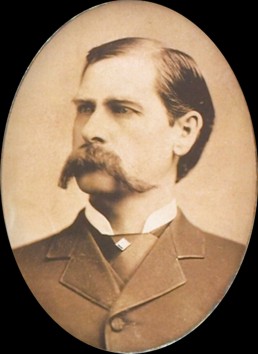


The mustache Slothrop decides to grow

If Slothrop lives in the time of Stuart Lake (the author of Wyatt Earp: Frontier Marshall, 1931) who depicted Earp as an unrepentant hero of the West so that everybody in that era believed him to be a perfectly fine and upstanding law man who didn't exact any kind of personal vengeance through ambushes and slayings of the Red Dandy Hanky Gang, why even bring up the revisionist take on Wyatt and how one might argue his legacy? Unless maybe that revisionism had already started by 1945 in which case the narrator is just the usual kind of omniscient and felt like cutting off any reader arguments who would sneer at Katje's naivety. Although doesn't it sound like a 60s or 70s thing, that revisionism? Maybe it was a popular idea when Pynchon was writing this and decided to throw that comment in. But that line, "this is still back in the Stuart Lake era," is the proof that it's Pynchon, or at least a modern narrator speaking, right?

My point is that it's kind of weird! But I liked it, of course! Nice moment!

Slothrop discovers that he gets erections reading technical rocket manuals and blueprints. Perhaps the manuals, taken from German sites, were used around Imipolex. Or maybe it's part of the paradoxical or ultra-paradoxical or one of those other things that happen to Pavlov's dogs after long hours of being experimented on. I really never understood that psych stuff too well. Anyway, Stephen Dodson-Truck is always there during the study hours to time how long it takes for Slothrop to get a hardon.

Slothrop concocts a plan to get Sir Stephen drunk so that Stephen might spill some beans on the conspiracy. Dodson-Truck confesses that, as he got more and more lost in his work, the less he cared about satisfying his wife's urges (Yerkes-Dodson law, right?!) and so she began sleeping with the psychics and paranormals at The White Visitation. He mentions a son, whom I think might be being used as leverage to get him to participate in the Slothrop experiment, and admits his part in the conspiracy: he's meant to observe Slothrop to make sure Slothrop studies up on the rockets. And that's all he admits to knowing.

The scene switches, as it often does without warning to London and Eventyr (less warning than usual in this one although it is somewhat tied together by the image of some large hooded figures overlooking the land, and the Casino, somehow observing from the other side which connects them to, of course, Eventyr and Peter Sascha). One of Their operatives needs Eventyr's help but not the usual help of contacting somebody on the other side through Eventyr's control, Peter. No, this time, they're just interested in Peter. They know how Peter Sascha was killed in the street by police but now they want to find out how it came to that and how Leni Pökler may have led him there.

I can't say I completely understand this part but I get bits of it. Like how Peter sees his boring, pathetic life through the revolutionary actions of Leni, how he admits Leni is right when she says she can't be a mother to Ilse because she needs to be human for Ilse and being a mother is what They want. They have her at their mercy if she's a mother. So to protect Ilse, she cannot be a mother to her; she must be a revolutionary and a fighter and maybe she loses Ilse because of that but it can't be helped.

At the moment of Peter's death in the vision (or visitation?), the scene shifts back to the Casino with a mention that Dodson-Truck has vanished by morning. "But not before telling Slothrop that his erections are of high interest to Fitzmaurice House."

Dammit! I know Fitzmaurice House was recently mentioned but I can't remember when or where. Maybe it's not important!

By the end of this section, Katje has gone. Slothrop will never know why but before she goes, she tells him some stuff that he'll need to remember later. Hopefully I'll remember it too, if it's important. Although I've already read this once and I don't know how it's important now! So I might be a lost cause.

"Oh Slothrop. No. You don't want me. What they're after may, but you don't. No more than A4 wants London. But I don't think they know . . . about other selves . . . yours or the Rocket's . . . no. No more than you do. If you can't understand it now, at least remember. That's all I can do for you."

And later:

"Maybe you'll find out. Maybe in one of their bombed-out cities, beside one of their rivers or forests, even one day in the rain, it will come to you. You'll remember the Himmler-Spielsaal, and the skirt I was wearing . . . memory will dance for you, and you can even make it my voice saying what I couldn't say then. Or now."

Is she referencing one of Slothrop's final narrative moments in the book? Doesn't he play some instrument, camping in the rain, after fleeing from everybody's perception? I'll have to keep this in mind when I finally get there! It's only about five hundred plus pages away!

By the way, the skirt she references is a rainbow-striped dirndl skirt of satin. That could be important!

Wednesday, December 30, 2020

Player Piano: Chapter 6

Why Paul's wife, Anita? That's the question that popped into my head during this chapter where Anita won't let Paul sleep because she's anxious that he's going to lose the promotion to Pittsburgh and he doesn't seem to care. She's seen how Finnerty's arrival has done something to her husband that she doesn't like. The sad thing is that what Finnerty has done has uplifted Paul in some way; Finnerty's allowed Paul to see that he doesn't have to live the enervating simulacrum of a life he's been living. He's given Paul a glimpse that maybe life doesn't have to be the life everybody expects from you, and maybe the life you've always felt obligated to live. And maybe that's what Anita fears most. She isn't just worried about their social standing and Paul's lack of ambition; she realizes that she is also part of that life Paul felt forced into. She's losing him.

Anita comes off as a shrew and maybe that's a stereotypical wife trope that's lived way longer than it should have. I blame the Adam and Eve myth that generally puts the wait of the sin on Eve and allows Adam to be a passive instrument in her nagging and temptation. But Vonnegut's twisting the myth somewhat here. In this case, Finnerty is the snake in the garden tempting Adam. Eve desperately doesn't want her helpmeet to lose his innocence. She wants the lie of Eden to survive. Mankind has built a sham Garden of Eden where everybody is supposedly cared for and happy and Finnerty has just slithered on in to tear it all down.

This short chapter also deals with some of Paul's father issues which crept up last chapter concerning Kroner. He's the patriarch and mentor of the organization, so much so that everybody calls his wife "Mom." Paul feels inadequate around him and has an innate need to please him. But that need is what has driven Paul's life, that need to make his own father proud. I've always said that the reason I lack ambition is that I don't give a fuck what my father thinks of me. It's apparently a pretty serious driving force in a young man's life. Anita has tried to use this against Paul (or to help him succeed which is sort of the same thing since Paul doesn't really care about the idea of "succeeding"). Early in their marriage, she framed a picture of Paul's father to place in the bedroom. This is a man she had never met. But she admired his success and his drive and projected all of that onto Paul (as has Kroner and probably everybody else in Paul's orbit). So now he has to live up to that picture of his father in the bedroom too! Ghastly!

If Paul eventually tries to embezzle from the company and smashes some of its machines and winds up being happier on the Reconstruction and Reclamation Crew, I'm going to assume Mike Judge's Office Space is the movie version of Player Piano. Except for the wife part. Even in the late 20th Century, comedies, for some reason, needed to also be romantic meet cute films so Peter needed to be single. But we still get a brief glimpse of the Anita role when the movie begins and his Anita (whose name is Anne! So close!) spends a short amount of screen time in the movie trying to get Peter to care more about success and eventually breaking up with him when he stops caring about work completely. His obligatory drive to succeed didn't need a wife anyway because he lives in America where the Garden of Eden illusion of safety and happiness is built around the capitalist idea of making more and more money, no matter how unhappy you are. In this chapter, Paul wonders at Finnerty's ability to quit his job, a quality that seems so foreign to him. How does one simply upend one's life so easily? What kind of courage must that take?

When I saw Office Space, I was like, "Yep. That's the world!" But I don't remember having the same feeling after reading Player Piano. I'm fairly certain I've read a lot of books in my life where I just enjoyed them without thinking too much about them. Or, and this is probably more true, I just forgot how much I thought about them because I just moved on to other things without writing any of my thoughts down. Which is why I've begun all these blogs in my 40s. I need to remember this crap! Office Space was so viscerally true and yet I'd never had an office job. But what I had learned and understood (thanks to my Grandfather, no doubt) was that a person in debt was never actually free. I always avoided debt (and, yes, I was privileged in many ways to be able to avoid debt, having no accidents, a strong family safety net, and a state college degree from the early 90s (so inexpensive! Sorry, Millennials and those who came after. Us Gen Xers maybe haven't been granted the resources and capital of the greedy Boomers but we, at least, lived in a world where we could be apathetic bean bag sitters and not have to worry too much overall) mostly because I wanted the freedom to say "I quit" to any job that made me feel like, and ultimately expected me to just take it because I had to, a corporate wage slave.

Again, I want to boldface this: I was lucky enough to choose to not go into debt. Many, many people simply have it forced on them because of capitalism. My grandparents, who lived three houses down from my mom's house (more privilege, really!), were instrumental in showing me how to live, and allowing me in many supportive ways, my best life. They were the best people I've ever known and I was lucky enough to be related to them.

Sunday, December 27, 2020

Gravity's Rainbow: Part XXIV

The first time through the book, not realizing what was coming up with Slothrop or how his life was being manipulated by Pointsman, I was living vicariously through Slothrop's paranoia. What was going on? Was he being set up? Or was it just Slothrop's nature to feel persecuted and manipulated? Although I did realize the octopus had definitely been trained to attack Katje so I knew a little more than Slothrop suspected. I just also didn't know enough. I was as lost as he was.

Bah! Who am I kidding?! I still don't know enough! Except maybe that, by nature, Pointsman is just a cruel man desperate to raise Pavlov's theories to some kind of ultimate answer to the meaning of life and why humans do the things they do. Wouldn't it be nice if you could discover that every reason behind every single thing a person does is because they've been conditioned to react in that way? What a breakthrough! And if you could prove that even a diseased personality like Slothrop reacts like one of Pointsman's dogs to different stimuli, you could change the world!

The chapter begins on Dr. Porkyevitch's boat, having recovered Grigori the octopus whom he had let loose earlier in the day, orders from Pointsman. Now he's done his part, he wonders: how will he still be useful to Pointsman? The war is nearing its end and funding is drying up all over The White Visitation. Except when it comes to Pointsman.

While wondering if Pointsman has any more use for Porkyevitch, he has a moment of existential dread that has something to do with his having fled Stalin's Russia. He was able to escape because of his love of science, because of his belief in Pavlov's physiological experiments. It gave him something to believe in other than the sanctity of Mother Russia. But he fears something he doesn't name. Possibly being sent back, exiled from his current exile back to his old home? Or hunted down for his part, true or not, in the Bukharin conspiracy against Stalin? Did Porkyevitch flee from the Great Purge and is now worried that he might not yet be completely free? He seems to think Pointsman is the type of man who would betray him (because of course he would!). I'm not clear on all the particulars of this opening bit but it seems like Porkyevitch does his part in the Slothrop experiment, gets worried that Pointsman has no use for him now (and no loyalty), and so he flees, to forget Russia and all, to live yet another new life, the last one post-Russia, this one post-Britain.

After running into Katje at dinner (where she asks him to meet her in her room after midnight), Slothrop heads to the bar with Tantivy to discuss conspiracies, particularly the one that involves an octopus and himself. Specifically, he wants to know what's up with Tantivy's friend Teddy Bloat.

Tantivy moans. "God, Slothrop, I don't know. I'm your friend too but there's always, you know, an element of Slothropian paranoia to contend with. . . ."

Tantivy reveals that Bloat has been receiving messages in code. Proof enough for Slothrop that Bloat and Katje are involved in some conspiracy against him. Tantivy reports he's also feeling the paranoia, the manipulation. He feels that Bloat no longer acts like his friend. Tantivy's now just a connection Bloat made at Oxford, to be used or redeemed for the benefit of the more underhanded party. I'm not sure what I felt for Tantivy the first time through the book but I feel sympathy for him this time. I like him and I'm sorry his and Slothrop's friendship doesn't continue. Slothrop could have used an ally he didn't have to constantly feel was using him for hidden reasons.

At 11:59 Slothrop turns to Tantivy, nods at the two girls, tries to chuckle lewdly, and gives his friend a quick, affectionate punch in the shoulder. Once, back in prep school, just before sending him into a game, young Slothrop's football coach socked him the same way, giving him confidence for at least fifty seconds, till being trampled flat on his ass by a number of red-dogging Choate boys, each with the instincts and mass of a killer rhino.

There's so much to this book that I often forget about parts of it that I should have constantly ready to reference at the front of my mind. But as Slothrop predicted, it would take only a small matter of time to forget about the rockets, just enough, in fact, for him to return to London to be completely petrified by the thought of them again. So I'd forgotten this book is about rockets—it's right there in the title!—until this line:

For a minute he lies coming awake, no hangover, still belonging Slothropless to some teeming cycle of departure and return.

Do the rockets, like human sleepers, forget what they are as they arc to their destination? Do they only remember their terrible purpose only as they're about to make impact? Or do they only remember after it's too late to remember, like the noise of their approach? Maybe I shouldn't be thinking too much of rockets here (although Pynchon is obviously referencing them) and I should just concentrate on the beauty of being "Slothropless" upon waking. We've all been there, often after waking from a nap that took us from daylight to dark, woke too suddenly from some alarm or loud noise, and thought, panicky, "Who am I? What time is it? What is happening?" A brief flurry of nearly unendurable seconds in which we know almost nothing, babes expelled from some dream posing as reality, exiled into fear and the unknown. Some beliefs and spiritualities concern themselves with total loss of ego and they must love those moments. They must be pure ecstasy. Aside from those waking moments, the only time I felt a loss of ego was when I took too many hallucinogenic mushrooms and found myself in the parking lot of a strip club in San Jose wondering if that had always been my life and the other life where I was a college graduate with plans to travel Asia in a few months was just a fantasy I engaged in to fill my empty life with meaning.

Oh! That moment of Slothroplessness takes place after Slothrop meets with Katje. After they fuck and they perform some Three Stooges/Marx Brothers/W.C. Fields slapstick routine (after which they fuck again). Slothrop might not be so concerned with Bloat's conspiracy if he just fucked Bloat too.

In the morning, Slothrop hears somebody in the next room stealing his clothes and he gives naked chase, eventually winding up wrapped in a purple sheet and falling out of a tree in front of Bloat and some general. It seems his night with Katje was a set up to steal all of his clothes, his papers, his identity. Everything. Even, he notices as Bloat takes him to his room for a British uniform to wear, Tantivy. No sign of Tantivy who had been rooming with Bloat. Just gone, overnight, when he should be returning well hungover and well fucked. But They've got to him too. They've got everything that connected Slothrop to who he was the night before he went to Katje's room. Like one of Spectro's patients that Pointsman lusted after, he's completely virginal. Pointsman's ideal subject.

Slothrop leaves Bloat to search for Tantivy. He winds up in the gambling hall of the casino but realizes the room was meant for something different, for something darker. It's the lodge of some secret organization whose dark purpose Slothrop can't begin to fathom, only knows that it involves him. It's as if the entire hotel were created for whatever purpose They have for him. Slothrop was not sent to a vacation spot on the Riviera; he was sent to some Masonic stage where every prop could be set just right and where every person plays a secret role. Slothrop has not been staying at a bed and breakfast; he'd been sequestered in a theater. Or, worse, a lab.

Being in a British uniform causes Slothrop to imagine all of his family's history in reverse until the first Slothrop who sailed to America was sucked back across the Atlantic by the reverse wind so that Slothrop never had an American ancestor. I mention this because it's just one of those nice "What the fuck is happening now?!" moments that Pynchon interrupts the story with on a near constant basis.

Lost and alone, having had everything of his taken from him, Slothrop can think of only one place left to go: Katje's room. And so he returns, not knowing if he's walking into salvation or suicide.

Saturday, December 26, 2020

Player Piano: Chapter 5

The chapter begins with Paul Proteus concerned about impressing his colleagues and bosses but ends with Paul Proteus seeing Finnerty's point of view and seeing the ridiculousness of the entire system. Paul's wife, Anita, is not happy.

Paul's presentation to his co-workers is about the first and second Industrial Revolutions. The first one, he says, devalued muscle work. The machines created were much more efficient than man's muscles could ever be. They were stronger and could work longer hours. The second Industrial Revolution devalued mind-numbing, repetitive labor. Machines could now take over all the rote tasks with far fewer rejected units than a factory worker bored by the job and concerned with other aspects of their life, which left them prone to making mistakes. He doesn't get into the potential of the inevitable third Industrial Revolution because the checkers tournament against the machine at the end of the chapter puts a spotlight on that.

Paul is the Ilium Works checkers champion and it's tradition to play incoming engineers to defend his title. This year, the new recruits have brought in a checkers playing computer to beat Paul. At first Paul wants to concede, knowing that any machine built for a specific purpose will inevitably be better at that purpose than a human counterpart. But his pal Finnerty encourages him to play and makes bets with everybody there that Paul will win. Which he does because had seen, looking inside the machine, that it had a loose connection which causes it to catch fire. Finnerty's confidence wasn't that a man could beat a machine but that a machine will break down under the right conditions. I mean, a man will too! But a machine does it immediately and with lots of smoke and fire.

Everybody is upset that Finnerty didn't say anything about the loose connection but he couldn't give a shit about their concerns.

"'If Checker Charley was out to make chumps out of men, he could damn well fix his own connections. Paul looks after his own circuits; let Charley do the same. Those who live by electronics, die by electronics. Sic semper tyrannis.'"

We're going ever deeper into the philosophical question, "What is freedom?" At what point have the machines gone from freeing men to pursue their hopes, dreams, and happiness to enslaving man into roles as simple caretakers for the machines? And those who don't understand the machines? Well, they have to earn their reason for existence some other way. But since the machines are doing everything, their options are limited. Provide a reason for your existence as a citizen of your nation by either joining the army or filling potholes. An interesting note is that Vonnegut sees exactly the way America would wind up in a system where machines do all the work. It would still demand some kind of proof from everybody that they deserve to be "taken care of" by the government. Notably, Star Trek: The Next Generation bases their world in roughly the same environment but sees it differently. With machines and replicators available to do all the work, nobody needs to feel obligated to do anything they don't want to do. They are truly free to pursue any activity they want. In the Star Trek universe, everybody is taken care of when machines meet all needs. In Vonnegut's world (which is more realistic), the people in charge of the machines don't feel any obligation to provide for the people who don't own the machines and are no longer playing a part in the economic system. They're simply leeches and parasites who have to provide some service if they want any income at all. So it's the army or the Reconstruction and Reclamation Works.

Notably, there has yet to be any real discussion about artists and entertainment. Presumably, like the bartender, these careers still exist. Vonnegut still has two hundred pages to bring them up so I'm not yet going to assume they make the entire parable too messy. It's possible art has also been devalued by the efficiency of machines to the economy and it's just looked down upon as silly and a waste of time. If that's the case, I'm sure Finnerty's cohorts and revolutionaries will all be playwrights and poets.

Oh wait! I forgot this book is called Player Piano and there was that scene with the player piano! So Vonnegut has already shown how machines have, in at least some way, taken away the livelihoods of artists. And we saw that there was no connection between the artist and their audience; there was no crucial interaction or play between the art and the reaction, as you might expect with a piano player at a bar. Instead, it was just "five cents worth of joy" and the piano was done. It was a simple financial interaction; art had become a commodity.

Another theme in this chapter was how nepotism affected this new world. The guy who brought Checker Charley wasn't really smart enough to have become an engineer. But his father (who built the machine) was well known and well liked so Paul's boss went to bat for the kid, even if he was mostly a dumb jerk.

"Ordinarily, nobody would have hired him. But Kroner, who knew his bloodlines, had taken him on anyway and sent him to Ilium to be trained. The break had done anything but teach him humility. He took it as evidence that his money and name could beat the system any time and, paraphrased, he'd said as much. The hell of it was that his attitude won grudging admiration from his fellow engineers, who had got their jobs the hard way. Paul supposed, gloomily, that beaters of systems had always been admired by the conventional."

Reading something like this from 1952 by a fucking genius is depressing. This was America. This is America. This will always be America. What good is art that points out this bullshit if the "conventional" never read it, never learn from it, never fucking care? This is why all of my favorite books are the ones where the protagonists realize what Matthew Broderick realized in Wargames: the only way to win is not to play the game. You know, books like Catch-22 and One Flew Over the Cuckoo's Nest and, more recently, Gravity's Rainbow. Although nobody really wins in Gravity's Rainbow; Slothrop just sort of disappears from everybody's sight and vanishes into legend. But the sentiment is still there because Pynchon still shows how Pirate Prentice and Katje and others all realize that they're still working for the system when they choose to fight against it.

One of the things I've always believed having grown up on the West Coast is that even though we think of history as people fighting against tyranny and changing the world, what history really was was people fleeing westward instead of fighting to set up their own systems. Then the people subjugated and oppressed by those systems fled west to set up their own systems. Until there was no more west to flee to and the West Coast had all the misfits and anti-establishment revolutionaries bottled up trying to figure out the best way to live together. But this is also why, eventually, we're going to need a huge fight. Because we have nowhere left to run and we can't live with this bullshit system for much longer.

Friday, December 25, 2020

Player Piano: Chapter 4

In this chapter, we meet Finnerty. Finnerty's buzzer has recently gone off although his red light's been blinking for years. Finnerty's only friend is Paul Proteus and, I think, Paul's only friend is Finnerty. Finnerty's friendly interest in Paul was stemmed by his ability to see Paul's red light flashing so many years ago, even when Paul couldn't rightly see it. Paul's need to fit in and live a normal life has finally worn away and he's beginning to see the cracks in the system and how he's always been a bit on the outside. It was the cat. The cat totally did it. Especially since it was his fault the cat died. He was just trying to give it a normal life inside the normal confines of society's normality by taking it out of the alley and putting it inside a warehouse full of machines. But the cat didn't belong there and the machines killed it. Just like they've been killing Paul; he just didn't see it until that damn cat.

But Paul is still not sure. He rebuffs Finnerty's call to skip the work conference and discuss what's next. Finnerty just quit his job and he's ready to change everything. But Paul's a bit too invested in his life yet. He's got the wife, Anita, who desperately wants him to rise in the ranks of his career and needs her peers to see how well they're doing. She is his ambition since Paul really doesn't seem to care. And Paul's got his job and his standing and the obligation to his father and his intelligence and to the rest of society. Plus this is just Chapter 4! He's just not ready yet! But the cat and Finnerty have spoken and Paul's red light is blinking a little bit faster and that buzzer is just dying to let people know Paul Proteus is finally broken.

Finnerty's ready to see the world burn. But Paul has dismissed him. For now.

Wednesday, December 23, 2020

Player Piano: Chapter 3

Should we discuss the name of the protagonist, Paul Proteus? And by "we" I mean "I" and by "discuss" I mean "soliloquize." So protean means able to change easily or to transform. That's a pretty good name for a protagonist in a dystopian world, right?! Although this world isn't dystopian at first glance; we've been told it's efficient and perfect! By Paul himself! So I guess that's the change that's going to have to occur. Paul Proteus is going to transform the way he sees the world. And then he probably won't be able to accept the status quo anymore and he'll either rise up to bring it all down with an army of mice or he'll hang himself in a lonely motel room in New Mexico.

I've read this before but I can't remember which one he chooses!

Oh, I didn't discuss his first name, Paul. It probably has something to do with the apostle. And by "probably" I mean . . . wait, am I doing this tired joke again? I fucking hate myself. Anybody who knows anything about Saul of Tarsus gets why Paul Proteus is called Paul. He's all "These Roman machines are great and all these Luddites following that Messiah are nincompoops!" And then he'll be driving home from work one day and crash into a tree due to sudden onset blindness. Afterward, he'll be all, "Tear down the machines! They're vile temptresses destroying our souls!" That's the "I'm a total moron" take. Somebody with more ambition and a higher intelligence could probably make a nice academic paper out of this (and probably already has!).

In this chapter, we learn that Paul is as responsible a gun owner as modern day gun owners.

"He had had the car at the time of the riots, and among the bits of junk in the glove compartment—match cards, registration, flashlight, and face tissues—was the rusty pistol he had been issued then. Having a pistol where some unauthorized person might get at it was very much against the law. [. . .] Paul didn't want the pistol but was forever forgetting to turn it in. Over the years, as it had accumulated a patina of rust, he'd come to regard it as a harmless antique. The glove compartment wouldn't lock, so Paul covered the pistol with tissues."

I bet that pistol kills somebody before this is over! For maximum drama, maybe it'll be a young person, or a dog!

Paul is the most highly paid man in Ilium and yet he continues to drive an old clunker of a car. That means he's connected to the past and, in some deeper way, refuses to truly accept this newfangled future. His wife makes excuses for him and his car to her peers so as to not feel embarrassed by this outward sign of poverty, or his lack of caring about the accoutrements of their social and financial standing. Paul does not seem to care about impressing the other wealthy people. But when he goes across the river to purchase whisky, he changes into an old leather jacket. He seems embarrassed not by some old car driven in a wealthy neighborhood but by any show of wealth among those who don't have as much. Probably because he and his machines are a big part of the reason they don't have as much.

Paul stops at a bar on the way home to pick up a bottle of whisky for an old friend. While in the bar, the reader gets a glimpse of another profession that hasn't been taken over by machines: the bartender. Besides managers and engineers, a few other professions have remained because they're just not economical enough to be done by machines. Or, as almost certainly is the case of the bartender (evidenced by a short memory from Paul about trying to set up an automated bar and failing), people just can't seem to make the transition to dealing with machines in certain venues. Who wants to lose the camaraderie of a neutral participant in their mostly monologued conversation when out drinking alone? How is a machine going to play lightweight psychiatrist to the lost and the damned? It's just not the same.

Paul is recognized by one of the clientele. It's Rudy Hertz, the man whose lathing skills were translated to tape to be used by the Ilium Works machines. Rudy is a man whose skills were needed and so a corporation took those skills and disposed of Rudy. Rudy doesn't seem to be filled with resentment though; those years are far distant in his past and he's maybe grown a bit senile. He makes a big deal of knowing the great Doctor Paul Proteus which attracts the attention, and resentment, of the other clientele. Most of them are old enough to remember their lives before the machines took over; most of them see in Paul the reason they lost their livelihoods and their passions, their stability and income.

One man raises a toast to their sons and speaks directly to Paul. His son just turned eighteen and was not able to secure one of twenty-seven places available at the college. His future choice is now that of simply the army or government work in the Reconstruction and Reclamation Corps. Basically no decision at all. He wants more for his son but, with the machines and limited space for engineers and thinkers, there isn't any. The machines have taken all the more there was.

The punctuation of the chapter comes with Rudy Hertz playing a tune, in celebration of meeting his old friend Doctor Paul Proteus, on the player piano.

"'See—see them two go up and down, Doctor! Just the way the feller hit 'em. Look at 'em go!"
    The music stopped abruptly, with the air of having delivered exactly five cents worth of joy. Rudy still shouted. 'Makes you feel kind of creepy, don't it, Doctor, watching them keys go up and down? You can almost see a ghost sitting there playing their heart out.'"

And that's the book! Twenty-eight pages in and we've got it, Kurt! Thanks! Do I need to read the other 270 pages?! You blew your load with the scene that suggested the title way too early! I mean, most of us got the idea from Paul checking out the tape on the lathe machine in the first chapter. But that was just a hint at the idea! This is just pulling your dick out and showing us!

That's okay though. I trust Kurt Vonnegut to tell me lots of other things I should be angry about in an entertaining way that makes me cry while asking, "Am I happy? Sad? Angry? Why are these tears happening?!"