Thursday, January 9, 2020

Superman: Year One: Book Three


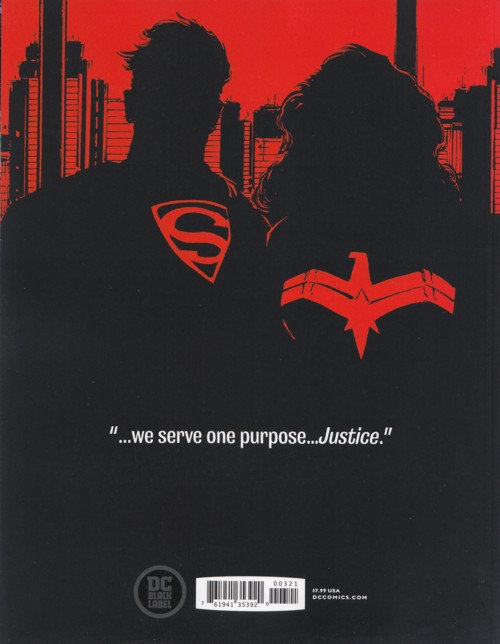
Here's the back cover instead because I misread it as "We serve one purpose: Jesus," and I was ready to accept that.

Now that Frank Miller wrote Superman into a relationship that's going to fail last issue, do we need to spend half of this issue reading about the break up? Shit. Now I wish Gertrude Stein had done a Superman: Year One in the style of her short story, "Melanctha." That would be a Clark Kent I could really identify with. Constantly unsure about the life he truly desires, he spends most of his time complaining that his current life isn't it until he finds himself alone and unloved with all of his potential squandered. I guess it wouldn't be a great Superman book. But it would at least be true to the Superman I would wind up being.

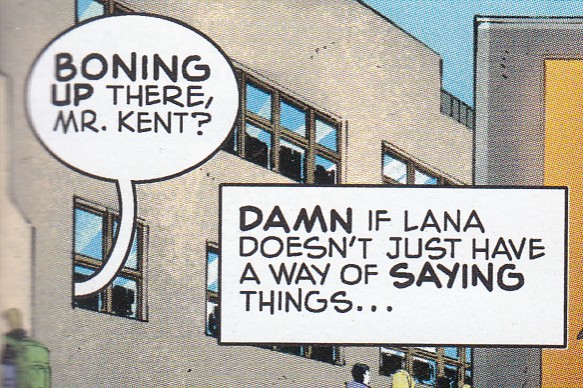
My hope is that Lori becomes dissatisfied with Clark's sexual techniques and kicks him out of Atlantis. Then she tells Aquaman all about it. Aquaman's knowledge of how bad Superman is at boning then becomes the only reason Aquaman makes it into the Justice League. Superman spends years defending Aquaman as a good choice until, completely weary and humiliated for having gone to bat for the undersea joke that Aquaman is, Superman finally admits to fucking poorly so he can stop pretending to admire Aquaman.

The issue begins with Lois Lane piloting a submarine as she searches for Superman in mythical Atlantis. But then there's a terrible accident which Frank Miller describes with the pathos and gravitas the situation demands.
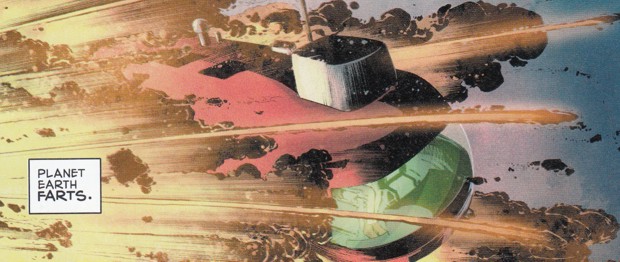

Due to the amount of lava and debris, I would have gone with "sharts."

Superman saves Lois Lane from dying under the ocean which probably means she's going to reward him with her big city sexual prowess. But before Superman can accept his reward for being a nice guy, he has to defeat a troop of Navy SEALS who have come to capture him. So everybody's looking for Superman now because he showed off a few too many times while training in the Navy and his commanding officer became jealous that the mermaids let Clark fuck them. So Superman's big enemies are the god Poseidon and the American military, both because Lori Lemaris chose to fuck Superman instead of them.

You might think I'm concentrating too much on Superman fucking the women he saved, and people being upset that they didn't get to fuck those women. If you are thinking that, it's probably because you haven't actually read Frank Miller's Superman: Year One. You'd totally understand that it's not me who is obsessed with Superman getting laid for fighting for truth, justice, and the American Way (honorably discharged version). It's apparently the entire theme of Frank Miller's Superman story.

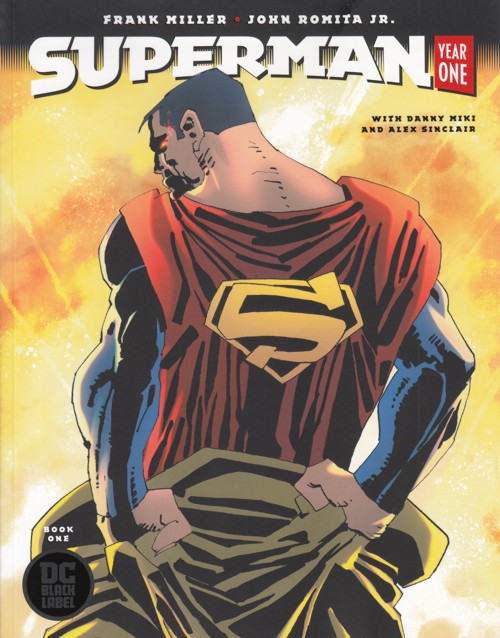
I just realized that I was going to make a Batman sucking Superman dick's joke based on the cover but then I didn't scan the cover. Oh well! Lesson learned!

Any time somebody says, "Lesson learned," you should immediately ask them, "Oh? What was that then?" I bet most of the time, they won't be able to explain how they learned anything.

The good thing about the cover of Book Three is that it was drawn by Frank Miller. And no matter what you think of Frank Miller's art, you have to agree (or at least better agree or we're going to have a problem) that it's better than John Romita Jr's art and better than Frank Miller's writing.

After beating up the Navy SEALS and rescuing Lois Lane, Clark Kent winds up graduating from college and interning at the Daily Planet. Don't ask me what happened to Lori Lemaris and Atlantis! I guess it was such a terrible break-up that even Frank Miller doesn't want to write about it.
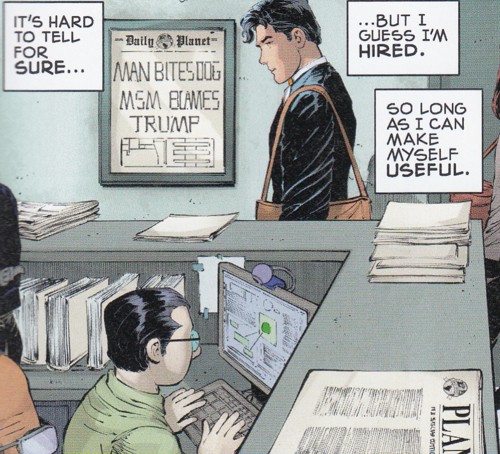

You can tell how dumb a person is by how much they defend Trump and blame the mainstream media. The fucking mainstream media bends over backwards not to point out just how fucking ignorant Trump is about everything!

Stepping away from the comic itself for a moment, here's what John Romita Jr had to say about this comic book after it was announced amidst a lot of "eye-rolls and groans" at San Diego Comic-Con. "The cynics that don't like my artwork or Frank's work were everywhere on the social media. Now we'll see what they have to say, because this is damn fresh, and I'm really proud of it." Well, I didn't have anything to say about it before reading it. I even bought it mostly knowing that I wasn't going to enjoy it even though I always hope that I enjoy everything I purchase as entertainment! Why else would I bother if not to hopefully be surprised and elated? Well, let me tell you, I was not surprised nor elated. Superman in the Navy might be fresh but it's also pretty fucking stupid. The whole idea was that Superman would join the Navy so he could see the world? But then he spends his entire time training in California where he learns he doesn't want to kill people after battling pirates in the Pacific waters off of the coast of California? Also he fucks mermaids during that time because why the fuck not? Now imagine reading all of that while looking at John Romita Jr's terrible facial expressions. The announcement of this comic book with this creative team should have garnered a lot more than groans and eye-rolls. There should have been jerking off motions as well.

Working at the Daily Planet with Lois Lane (who, if you remember from the part where I said she wants to fuck him, wants to fuck him), Clark Kent realizes he needs a disguise. So Frank Miller makes sure to explain how the hat and glasses work as a disguise. The hat "changes his silhouette" and the glasses are just "the geek factor" he needs. The whole "dress to unimpress" angle is the disguise. Fucking bullshit. We all know that the glasses and the outfit are the least part of the disguise. He needs to discuss how he changes his posture, how he acts clumsy, how he puts on the air of naive farm boy, how he's terrible at pleasing a woman in bed. These are all aspects that work to make it unbelievable that he could be Superman. Christopher Reeves in Superman nails all of these aspects and I wish writers would be more upfront about how Clark Kent's disguise is less about the accouterments and more about the act Clark puts on.

Superman begins deciding how to fight crime now that he's come to Metropolis. And his logic goes like this: "What do criminals want? Money! Where is the money? Banks!" And just like that, he becomes the protector of corporate America! He even thinks, "Never mind the third rate muggers and street swindlers." No wonder Batman doesn't respect this asshole! A third rate mugger killed Batman's parents and Superman is all, "Bah, they're harmless! Better get the guys going after the money that's insured!" Fuck this Superman!

Next Superman goes after street level drug makers. That's better, I guess, but couldn't he go after the pharmaceutical industry itself?
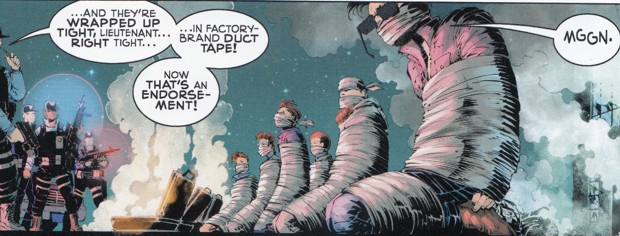

What the fuck is "factory brand duct tape"? Having managed a warehouse on the Netscape campus back in the 90s, I'd say they should be wrapped in shrink wrap.

This morning, I discovered Carrot Cake flavored Oreos. It was nice living without diabetes but I must say goodbye to those years now.

Later, Superman stops a man from abusing his wife and kids. I don't find out if she thanks him with her sex. But from what the previous chapters of this story have taught me, she did.

After that, Superman frees some hostages from a hostage situation that was set-up by Lex Luthor so he could meet Superman. Lex manipulates Superman into working for him to stop Batman. Why does Lex care about Gotham and Batman? I don't know! I don't even really know how Lex manipulates Superman! And I don't think it's because I'm too stupid to follow the story. I'm pretty sure I'm smart enough to understand a comic book! But this comic book feels like a bunch of pages are missing. Hell, Superman's first words to Lex Luthor upon meeting him for the first time are "You're a damned liar!" What did he lie about? When did he ever say anything to Superman? What the fuck is going on?!

Over in Gotham, Batman uses a gun. Okay. Whatever. Let's wrap this shit up.
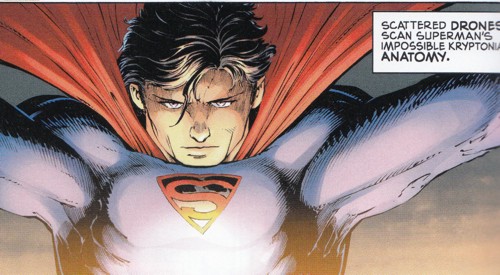

Here's a terrible picture of Superman since I can't write about a story I can't follow.

The gist of the rest of the story is that Lex Luthor is tired of Batman and Superman foiling his crimes. So he decides to convince Superman that Batman is a jerk. After they get done killing each other, Lex Luthor will profit. Not that he isn't profiting already. But he'll profit more, I guess?

Superman lands in Gotham to speak with Batman and Batman instantly tries to kill him. Oh yeah, Frank Miller totally understands these characters. Batman wants justice but is willing to kill Superman because Superman wants to talk to him. And Superman goes around doing good while constantly thinking, "I'll show them!" and "I could kill these guys!" and "Which other woman should I save so I can fuck her?"

Batman tries all kinds of violence on Superman while telling Superman smarts are what counts. If only he'd use some and realize he can't hurt this guy. This might be the dumbest version of Batman I've ever seen.

Eventually Wonder Woman arrives to point out to these two blockheads that maybe they should stop fighting and work together to make the world a better place. Batman is all, "Well, I can't hurt him anyway so I guess I'll work with him." And Superman is all, "How is she stronger than me? She doesn't need rescuing from anybody. Has she ever gotten laid?!"

The issue basically ends with Wonder Woman telling Superman that she's ready to fuck him after he goes into space to learn to fuck (by fighting Brainiac?) and Batman telling Luthor he hopes he gets raped in prison. So exactly the way I'd expect a Frank Miller Superman comic book to end.
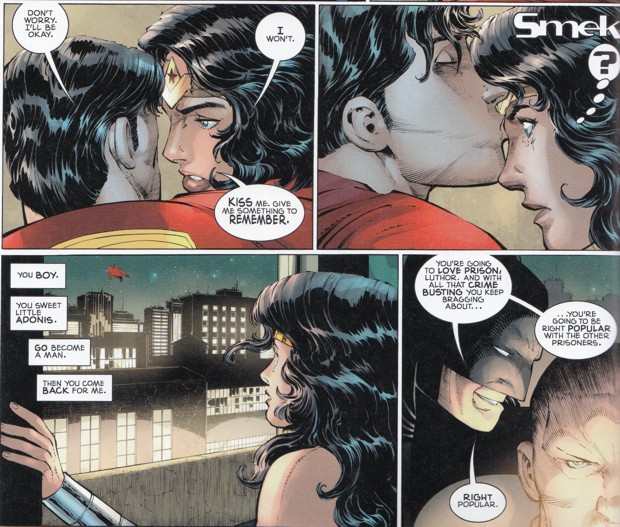

I wish I were right popular in high school.

Superman: Year One: Book Three Rating: What I learned from this comic book is that every woman in the DCU wants to fuck Superman and every man in the DCU is jealous of all the women Superman gets to fuck. What I also learned is that I should have read this series before purchasing Dark Knight Returns: The Golden Child. I'd still like to know what happened between Clark and Lori. I guess he just left her the same way he left Lana and the same way he left Wonder Woman (who he fell in love with immediately, I guess?).

Wednesday, January 8, 2020

Superman: Year One: Book Two


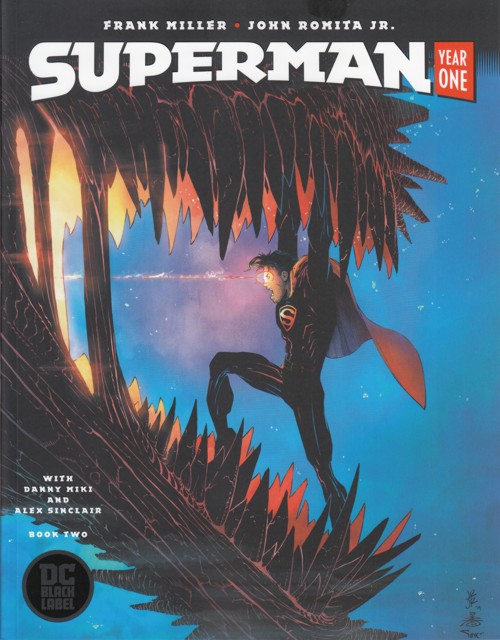
John Romita Jr finally giving up and sending this cover as finished: "Maybe all the fucking teeth will distract from Superman's leg."

Last issue ended with Superman joining the Navy. I know. I'm still fucking reeling from that revelation myself. Superman. In the Navy. I would type out the lyrics to The Village People song now but I'm afraid I don't actually know any of them and my version would just be a bunch of gay jokes. Oh, what the hell.

In the Navy! You can sail the seven seas!
In the Navy! You can get down on your knees!
In the Navy! In the Navy!

I should stop before I get too graphic about the Navy. I've had friends in the Army and the things they say Navy men do with sheep is simply disgusting. Although where do they get the sheep? Wouldn't those stories be more believable if they were about dolphins?

Maybe it was my friend in the Marines who told me the Navy's relationship with sheep. Probably to distract from all the rumors about what the Marines get up to with Navy men and their sheep.

My friend who was in the Navy never said anything about sheep which seems suspicious, right? Like he was hiding something! But he does have a habit of reciting poetry to people at parties which — let's face it — is more shameful than sheep fucking.

Hopefully nobody was upset about me seeming to make a joke out of being homosexual. Because I wasn't doing that! The Village People are gay so their songs are about gay lifestyle. Sure, I don't know the actual lyrics but at least I was keeping to the spirit of the group! Anyway, I don't think a man sucking another man's dick should be considered a gay act. It should simply be considered a lovely humanitarian thing to do for a friend.


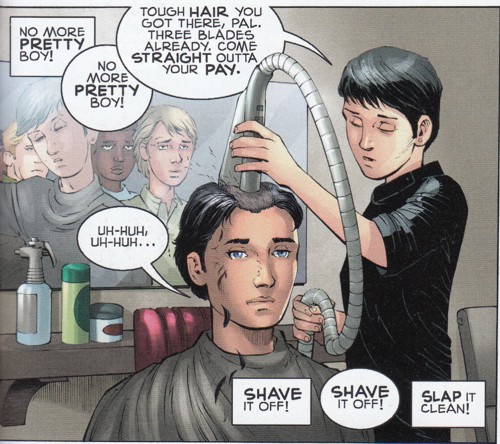
No razor made by humans can cut Superman's hair! I bet he had to will his hair to fall out as they attempted to cut it.

The Navy officers pick Clark to train as a sniper because Clark doesn't know how to not be perfect at everything he does. I guess when Pa told him not to show off or to stand out, Clark wasn't really listening. But now that he's in the Navy, I guess he's contractually obligated to kill loads and loads of non-Americans with his super abilities.

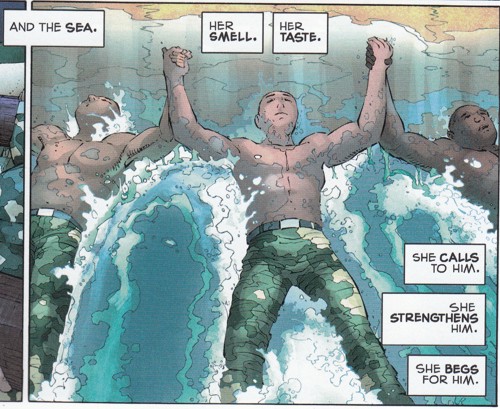
I don't get this whole "Clark Kent joins the Navy" story arc. At first, I thought it was a way for Clark to meet Aquaman. Now I just think it's a way for Miller to showcase his weird sea-fucking kink.


If you've ever been to the ocean with Frank Miller, you've swam in his jizz.

I could never find the ocean sexy. The most terrifying experience I've ever had was getting caught on a boogie board out past the breakers of the Pacific after the sun went down. I had to constantly stop myself considering what might be lurking under the black mirrored surface of the ocean as I tried to keep calm and paddle back towards the lights of Santa Cruz. I was out there with my buddy Larry who killed himself earlier this year. My theory is that he never could get that nightmare experience out of his head. Or maybe it was depression. Sure, you're probably putting your money on depression. That's exactly something somebody who never floated on the ocean in the darkness of night would do.

Clark notices mermaids swimming out in the ocean and one of his officers is all, "Yeah, boy. Mermaids! Sometimes guys try to fuck 'em but then they drown and we report them lost at sea and nobody asks no questions. You got me?!" And Clark is all, "Yes, sir! Don't try to fuck the mermaids, sir!"

Clark decides that since he isn't allowed to fuck the mermaids, he should head into town and start a bar brawl. Clark meets a woman who's working on publishing a story about Navy guys who hang out in bars and defend women from civilians who get too handsy with female reporters. Clark once again finds himself overwhelmingly horny. Oh, not for the woman! But for the idea of being a reporter! He's just too young to realize that he's not into woman; he's into bylines and columns and exposés. But before he can fuck a newspaper, Clark blocks a punch some jerk throws at him, breaking the guy's arm (just like that fight he got in high school! Is this good writing where we see echoes of the character's past history or bad writing where the writer just can't think of new plot points? Who can tell?!), and starting an all out brawl. He walks the reporter home afterward, dreaming about that black ink coming off on his cock and balls.

The next day, the training officer threatens to shoot him for causing trouble. Seems like an appropriate response. I guess Clark is learning that the military doesn't keep anybody safe. It's just a violent place where young people with no real hope of succeeding in civilian life go to gain instant meaning and heroic praise from others. That's like the opposite of journalism where young people with lofty ideals about changing the world by exposing truth and justice go to never actually do that and instead just parrot the lies told them by politicians because they don't understand the difference between being impartial and simply being a loudspeaker for misinformation.

I don't know what I'm talking about anymore. Frank Miller has me so confused. I mean, Clark Kent is in the Navy! What the fuck is going on in Superman's First Year?! Wait. This is all happening in just one year? It's because Superman grows super fast under a yellow sun, right?

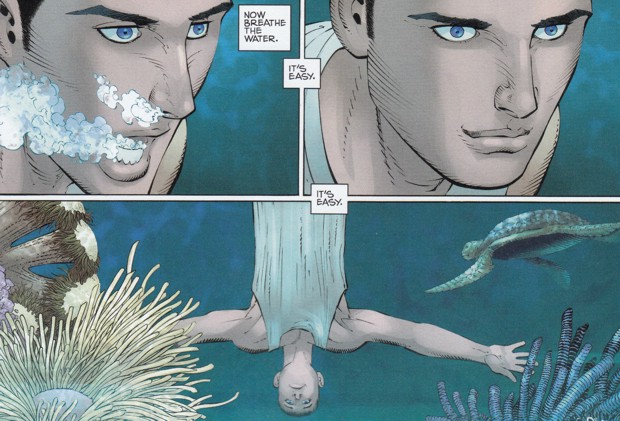
After being treated like shit by his commanding officer, Clark decides to go fuck some mermaids. That'll show him!


Just another reason why Aquaman is a redundant piece of Justice League shit.

Why did DC decide to call this comic book "Superman: Year One"? I would have called it "Frank Miller's Stupid Version of Superman by Frank Miller."

Underwater, Clark Kent meets Lori Lemaris. She leads him back to Atlantis where an experimental submarine has crashed into the city. Also, I don't know if this will soon be an important plot point but Clark Kent is suddenly wearing a huge watch on his left wrist. Up until the moment he dives in the ocean, Clark has never worn a watch in this series. How else is he going to be dealing with Atlantis's problems when he'll suddenly look at his wrist and say, "Jeezly crow! I've got to get back to base! I'll be back tomorrow night to fuck more mermaids! And help rebuild if I'm not too sleepy afterward"?


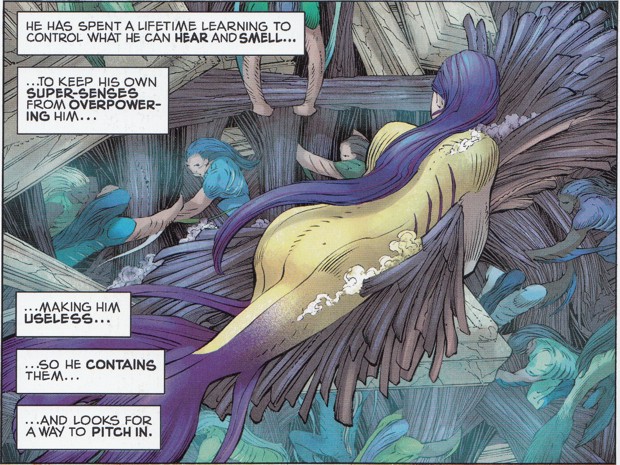
"The smell of fish poontang washes across Clark's senses, threatening to remove him from Atlantis and plop him down in Boner City."

What kind of an editor takes a look at the previous panel and doesn't ask, "Why, out of nowhere, are you discussing Clark's ability to stifle his sense of smell to keep from being distracted in a panel that depicts Lori Lemaris's ass?" It's a fair question.

Clark looks at his watch and thinks, "Jeezly Crow! I've only got a few hours before bugle! I guess I can help rebuild Atlantis before then!"

Once again, Clark's reward for saving a woman in trouble is sex with that woman. This might be a problematic message. Clark saves Lana from violent men. Clark bangs Lana. Clark saves the reporter from violent men. Clark bangs the reporter. Clark saves Lori Lemaris's ruined city from violent men and their submarines. Clark bangs Lori. I always suspected that sex was an expected reward for acting chivalrous! Thanks, Frank Miller, for justifying all the times I called a woman a bitch because she wouldn't sleep with me after I saved her by beating up a guy that had just called her a bitch!

This is the Internet so I should probably explain that the previous sentence was a satirical critique of Miller's problematic message. I mean, sure, impressing a potential sexual partner is a good way to get that person interested in becoming your sexual partner! So the Lori Lemaris plea for Clark to fuck her hard after he helps isn't the worst depiction of a relationship. But having two other women saved by Clark from brutes who are threatening non-consensual sex reward Clark with sex is the worst depiction of a relationship. Also, the story doesn't explicitly state that Clark and the journalist from the bar have sex. But I can read between the panel breaks!

A critical review aside: Frank Miller's narration in this series is confusing. Sometimes it's in third person and then it flips over to first person without the current narrative thought changing at all. It reads as sloppy, probably because it is sloppy.

Clark and his fellow Navy SEAL recruits go on an emergency mission to kill some pirates. Clark watches a bunch of pirates get shot in the head but he doesn't pull the trigger so nobody can accuse him of having killed a man. In fact, he saves a bunch of men by holding a grenade in his hands as it blows. But because he refused to kill on command, he's discharged from the Navy. I guess the American military doesn't have time for people who won't follow an order to murder.

Before Clark leaves the Navy, his commanding officer decides to give him some good advice about using his talents to help put fires out instead of causing more. Odd advice coming from a guy so hell bent on threatening to kill Clark and screaming at Clark to kill everybody he meets. I guess he's a complex character!

After Clark leaves the Navy, he walks into the ocean to battle Poseidon for the hand of his daughter, Lori. Poseidon doesn't want Clark fucking his daughter because he wants to fuck his daughter. That's not something I made up the way I make up so many other things. Frank Miller made that bit up. I don't know why. Couldn't Poseidon have just not wanted his daughter marrying a non-Atlantean instead of making it about Poseidon wanting to be the only person fucking his daughter? Luckily Clark defeats Poseidon's Krakens so no father fucks their own daughter in this series, no matter how much I bet Frank Miller's original script read, "Poseidon fucks his daughter. A lot. Over and over. Oh boy! What a hit this comic is going to be!"

In the end, Poseidon leaves the throne to pout and plot his revenge against Clark and the entire surface world. Clark and Lori settle down to rule Atlantis for as long as it takes me to read the third and final issue where, I'm certain, Clark will leave Lori to pursue his true love: writing opinion pieces about Superman for the Daily Planet.

Superman: Year One: Book Two Rating: The first issue wasn't so bad that I didn't not want to read the second issue. But this issue was so terrible that I'm not sure I'll have the patience to write about the third issue. If I never post a review of the Book Three, it's because I just couldn't bare to think more than superficially about Frank Miller's writing. Also I might have simply thrown myself off of a building because John Romita Jr's art was so fucking terrible.

Monday, January 6, 2020

Review of The Twilight Zone, Season 1, Episode 13: "Just One Guy Actually Dies"

Certain eras of television and movies make various uses of visual signifiers to indicate to the audience that they're supposed to believe something that isn't actually happening. The one that annoys me the most in our current times is gagging a person. To indicate a person can't speak or yell or make any noise whatsoever, a character will simply put a piece of cloth around somebody's head so that it is clenched in their teeth like a horse's bit. Obviously that won't stop a person from screaming at the top of their lungs. But I don't think non-horse-bit gags work as well as television and movies want us to believe they do for conveniences of plot anyway, so who really cares, right? I'm sure actors were tired of having duct tape wrapped around their faces to at least seem somewhat believable which led to some really uptight actor saying, "Can't I just hold this in my teeth and pretend that I can't yell? Acting!" And some director was all, "Fuck. Fine. Whatever. Just get the fucking scene shot already!" And then everybody saw it and was all, "Wait. Audiences will buy that that person can't make a sound now? Fuck yeah! No more duct tape, baby!"

In the fifties, one of the worst visual signifiers was saved for two people kissing. Instead of actually kissing, they just pursed their lips and smashed their faces together, with little to no movement, for an amount of time depending on how passionate the kiss was supposed to be. I've kissed my own grandmother more erotically than a 50s era television kiss. I bring this up because there's a kissing scene in The Twilight Zone episode, "The Four of Us are Dying," that looks like a child took two dolls and mashed their faces together for an awkwardly long amount of time. Actually, a child with two dolls would have been more dramatic. Maybe I shouldn't blame the 50s entirely. I'm pretty sure Ward and June Cleaver shared kisses that sometimes made me think, "Hugh Beaumont is enjoying that a little too much."

This episode also contains the signifier of loads of neon signs floating about the protagonist's head to indicate he's in a big city. I have no idea who first came up with that one but it's actually pretty good. I'm sure it was first done in some stage production of whatever early to mid-century play sees the protagonist go from a rural area to New York. Does that happen in Cat on a Hot Tin Roof? What about Poor Little Ritz Girl? Or maybe it was first done in a Bugs Bunny cartoon.

I thought that by the time I was done discussing the terrible kiss that I'd accidentally find a way to talk about this episode but it didn't happen. I don't know what George Clayton Johnson's original story, "All of Us are Dying," was actually like because I'd have to find a collection of his short stories to learn but I can't imagine it was lacking in as much substance as Serling's teleplay seemed to be. I was hoping that my brain would figure out the point of this episode so that I don't expose my own ignorance when somebody on the Internet decides to "actually" me and make me look stupid. And since I never received an "A-ha!" moment from on high that truly satisfied me for the reason this episode had to be filmed by Serling, I guess I'll just try to flesh out the only thought that came to me.

I'm sure people have made categories for all the different kinds of The Twilight Zone. Some are about the existential terror of loneliness, some are about nostalgia, some are about terrible disasters, some are about Kojak taking the piss out of his step-daughter's stupid doll, some are about a terrible person getting their comeuppance, and so on. I haven't figured out all the categories myself! But this one seems to be one of the comeuppance ones which introduces the audience to an unlikable guy and then kills him at the end so the audience learns not to be unlikable.

Serling's introduction to Arch Hammer is thus: "His name is Arch Hammer. He's thirty-six years old. He's been a salesman, a dispatcher, a truck driver, a con man, a bookie, and a part-time bartender. This is a cheap man, a nickle and dime man, with a cheapness that goes past the suit and the shirt; a cheapness of mind, a cheapness of taste, a tawdry little shine on the seat of his conscience, and a dark room squint at a world whose sunlight has never gotten through to him." I haven't heard a string of petty insults so beautifully rendered since Thurl Ravenscroft took The Grinch to task for being such a huge asshole. Sometimes when you're in the Twilight Zone, you don't have time for ambiguity! You just need to know, right from the start, if the protagonist is an asshole or a hero. Also, you always need to know that the male lead is actually thirty-six.

Hammer, a man who can change his facial features to look like whomever he wants, decides to use the power to accrue love and money. He uses his power as shortcuts to getting the things most people desire. He looks like the lover of a woman who believed he was dead (I mean, the actual lover was dead. But she readily accepts that it was all a case of mistaken identity) so that he can get some easy loving. Then he pretends to be a criminal betrayed by some other criminals so he can steal some stolen cash stolen from the guy he was pretending to be. But in the end, as he takes on the identity of a stranger he sees on a poster in an alley, he discovers that pretending to be other people comes with their terrible baggage as well. He runs into the guy he's pretending to be's father who hates him for knocking up a nice girl and ruining the reputation of the family. The father shoots him in the gut and pisses on his dying corpse. That sounds like maybe it wouldn't have aired on a 1950s television show so maybe I dreamed that bit later.

I guess the point is that there are no easy shortcuts because some shortcuts lead through bear country and you're liable to be mauled by a bear when you use one of those shortcuts even if that shortcut leads to tons of money and pussy.

Apparently in the original story (which I still haven't read but I've now read about!), Hammer couldn't control how he looked. In the end, he dies not knowing who he is, awash in the memories and lives of every person other people saw him as. There's probably a moral in that about being who we are and not who other people expect us to be lest we lose ourselves in the process. But who knows? Not me! I didn't read the original story! And Serling seems to have heard the treatment and thought, "Yeah! That'll be terrific! The man who could be anybody! Just think how much easy money and pussy you could get doing that! And how many cigarettes you could smoke!" Then he needed a way to show that maybe that wasn't the greatest life so he had to introduce the psychopathic father figure. Audiences would have nodded sagely when Hammer was shot, and probably said things like, "That creep had it coming!" and "Just goes to show you!" and "Just think how much more pussy he could have gotten if that jerko dad hadn't murdered him for practically no reason at all!" That last one would have been said by me after I time traveled to the 1950s.

The writer of the original story, George Clayton Johnson, also wrote the script for the first Star Trek episode, "The Man Trap." It's pretty much the same story except with an alien whose only desire is the luscious salt within the human body.

In conclusion, I am concluding this review by suggesting that perhaps this story wasn't meant to have much of a point at all. Perhaps Rod Serling was just sitting around one day and thought, "You know what I want to make? An episode that's a metaphor for jazz!" And that was this episode!

Saturday, January 4, 2020

Superman: Year One: Book One


I can't wait to find out why Superman shoved Jim Gordon's head up his ass!

Most of the time, I don't think, "I fucking hate myself." But then I'll purchase a comic book written by Frank Miller and drawn by John Romita Jr. and I think, "Well, obviously I'm wrong about that."

I haven't been reading too many comic books lately because I've been reading Alan Moore's Jerusalem which is not a comic book at all but a 1300 page book. The thing about a 1300 page book is that 1300 is a lot of pages to read. It's a daunting task! Just ask anybody you know who has read 1300 pages. You probably don't know anybody because you only know comic book nerds and they only read regular books if they're called things like Secrets of the Marvel Universe and DC: They Ain't Fucking Marvel!. I've read both of those books and, let me tell you, they don't actually exist.

Anyway, Alan Moore's Jerusalem was fucking fantastic. No, no. It was fucking fucking fan-fucking-tastic! It was like eating a half gram of magic mushrooms and then sitting on the floor in the middle of a raucous house party, just absorbing the frantic movements and warbling sounds. Unless it was better than that. Although I can't think of anything better than that. Possibly the best time I ever had was sitting on the floor while on mushrooms in the middle of my friend Jason Beymer's house while his sister's rager erupted all around me. I was fucking content. I was the Buddha under the fig tree. I was Christ on the cross. I was Mohammad wherever Mohammad found his bliss. With his cougar first wife, maybe?

Technically I have yet to finish Jerusalem. There's a chapter called "Round the Bend" which was Moore's attempt to write his own version of Finnegans Wake. It's fucking insane and I'm slowly making my way through it with copious notes. I've created a table with three columns for my notes as I read the chapter slowly, one sentence at a time. In the first column, I type the original sentence. In the second column, I type my literal interpretation of the sentence. And in the third column, I discuss what both the text and the subtext might be suggesting. It's a brilliant piece of writing that I think is worth the extended amount of time I'll be devoting to it.

All that being said, I need a little reading downtime before I begin A.R. Moxon's The Revisionaries. So I'm reading Superman: Year One! This probably doesn't have any non-white-supremacy subtext at all! So it shouldn't be too hard to get through.

DC Comics printed Superman: Year One as a magazine sized book for their Black Label, um, label? What is it with DC and redundancy? "Hey, people already call us DC Comics to differentiate us from other DCs even if pedants often complain about how redundant it is. What if we really piss off the pedants by calling our new adult comic book line 'Black Label'? Then people will have to refer to the DC comic with the Black Label label on it!" probably said Dan DiDio. And then Geoff Johns was all, "Man, I hate when I'm sexing my hot lover and my hot lover is all, 'Let's do ATM mouth!' Idiot!"

Dammit! I was making a point when I fucking interrupted myself with my DC offices fan fiction. I was going to point out how I'm going to be severely disappointed when there aren't any boobs or vaginas or dicks in this comic book. The only time I ever read magazine sized comic books was when I wanted to jerk off to cartoons and picked up a copy of Heavy Metal.

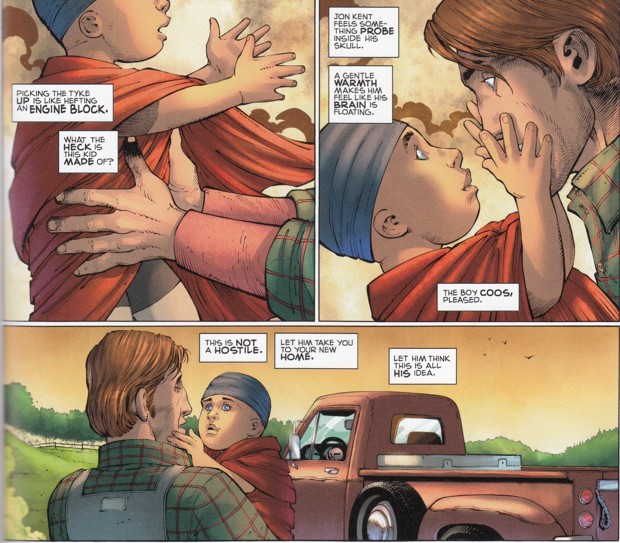
The story begins as all stories do: with the death of a planet and a small baby being shoved into a rocket and shot off into space. This baby understands way more than I think most babies tend to understand. It's hard to know for sure because nobody remembers being a baby and science doesn't really understand things like brains and babies and baby's brains. But this baby is a science fiction baby from another planet so I really can't complain if it already knows concepts like "partying" and "celebrating" and "donkey punching" and "billions of stars." Those are probably all concepts on the Kryptonian See and Say toy.

Before the baby exits the rocket after landing in a field in rural Kansas (that's the part of Kansas that isn't Kansas City or Wichita), the rocket speaks to him. I'm pretty sure it's his dad speaking to him in a recording since it calls him "my son" but I don't want to make any assumptions that might leave me vulnerable with Interent critics who like to criticize other Internet critics. Maybe the rocket thinks it's the baby's mother and is about to give birth to it on its new homeworld. Anyway, the voice tells the baby to wake up because "a world awaits. A world that needs you. A world you must save [...] from itself." I mean, really? Was that a necessary part of the story? Did the baby need that kind of pressure and meaning forced onto it so soon in its young life? And how, by the way, did the baby's dad or rocket ship know that this world needed to be saved? Was he (or it!) just projecting Krypton's terrible history onto this new planet? Obviously if it's a planet, it's going to need to be saved because the people on it are just going to ignore the mad scientists when they say the world is dying.

Seriously though! Why begin the comic book by telling Superbaby that he needs to save this world from itself? It seems like a clunky way of trying to force all of what makes Superman special into a few brief lines. "Hey, reader! Superman is here to save the world! It's his destiny!" How about just letting Superbaby have a father who was grateful that he could save his child from Krypton's destruction? Then you let Superbaby grow up and learn, from his Earth parents, right and wrong. Let him learn about truth and justice. Let him learn empathy and compassion. Then when he makes the choice to sacrifice a huge part of his existence in making Earth a better place, ita actually means something. But having a recorded message tell him he needs to save the world from itself before he's even learned not to shit his own pants seems a bit of crap writing desperate to make thematic points.


Jonathan Kent isn't a kind and generous man who wanted to take care of a baby. I mean, maybe he was but what does it even matter if something else is manipulating his actions?

Do audiences enjoy stories where characters are manipulated by Gods or destiny to become the thing they're meant to become to do the thing they're meant to do or is this just writers being too lazy to let a story tell itself along the way? My view of audiences would be severely diminished if it could get any lower and also if I were to believe they preferred stories about Chosen Ones rather than regular people who rise to the occasion to do something heroic. What makes a story better if we learn that the hero was always meant to be the hero? Isn't it more rewarding to have heroes like Frodo Baggins and Sam Gamgee who struggled to do what was right with no guarantee that they were cosmically destined to succeed? The only thing this whole idea that there has to be some thing (or Thing) manipulating events from behind the curtain is remove free will from the hero's actions, thus making the hero nothing more than an automaton programmed to succeed.

Jonathan brings the baby home and Martha is all, "Whelp! I guess we have a kid now! Praise Jesus!" And Jon is all, "Praise Jesus and his might rocket ship from Heaven!" And both of them feel slightly guilty because of all the times they cursed God for giving them faulty reproductive organs. Jon and Martha are still young so at least they can pretend that they kept faith that God would provide them a child. But I bet if they had been creeping up on the age of Abraham when he finally boinked the help, they would have fucked up God's plan too!

Jon and Martha quickly begin calling each other Ma and Pa because why not? It's not like anybody is going to somehow come along and take their new space baby away from them! They found it and so it's as good as theirs. It's not like Kansas has any laws on the books that say you can't keep a baby you found in a field that fell out of the sky in an alien rocket ship. Are there? Probably not, right? And even if there are, nobody in town seems to question where the fuck Jon and Martha got a kid.


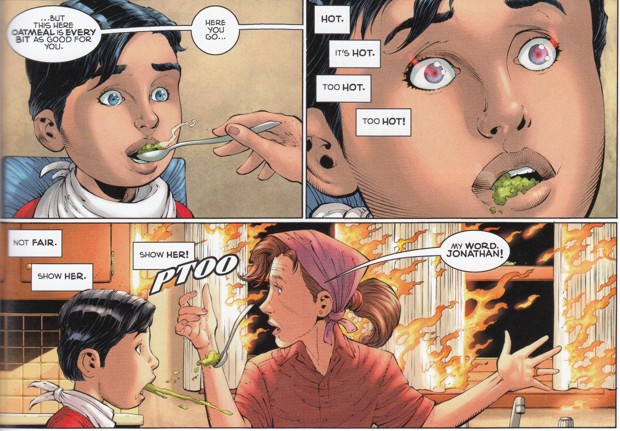
Oh yeah. I'm supposed to believe Clark can feel hot oatmeal. What flavor is it? Kryptonite? I mean, it is green.

Stupid penis! Every time I turn the page, it keeps thinking we're going to see thick chicks on space motorcycles with their tits flopping out and huge bushes streaming out from between their thighs! This isn't Heavy Metal, you stupid organ! I blame my brain for constantly thinking while reading this, "This comic book magazine sure would be better with more tits."

Between being a toddler and the first day of high school, nothing important happens. I mean, some important things probably happen. Like Clark's first wet dream. But Frank Miller doesn't think that's important enough to make the story. I don't know why. I want to see Ma asking Kent why he hid his sheets out in the field and also why he was re=plastering the ceiling of his bedroom.

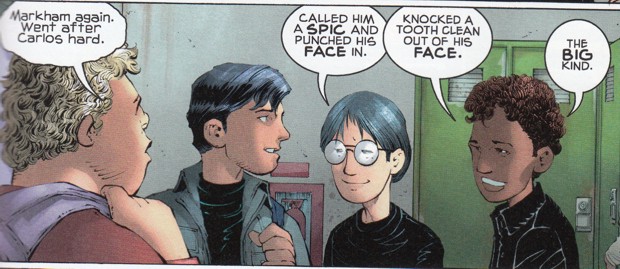
In high school, all the kids start talking about how amazing Clark Kent is. But he hangs out with the fat kid and the goth kid and the other kids that are probably losers in ways that I can't tell by John Romita Jr's art. They all just kind of look like John Romita Jr people. I think they others are misfits because one wears glasses and the other one is black and the other one is Latino. That just means they don't fit in with the white rural farm kids, I guess? I don't know how high school works in rural America. I grew up in Silicon Valley. Our nerds were the white kids who played Dungeons and Dragons. Our popular kids were the Filipinos who were style conscious when most of us still weren't wearing deodorant or washing our hair regularly enough. I would see them hanging out at lunch and think, "How do they get their hair to stay so high and look so good?!" If only I had known that part of that answer was simply, "They wash it regularly," maybe I wouldn't have been a big misfit loser jerk!

Clark sees the bullies picking on little Pete Ross (you have to say that in a high-pitched sneering voice. Unless you don't want to be a bully. Do you not want to be a bully?) and decides, "Enough is enough!" Even though he's not supposed to stand out or else the government will take him away to do experiments on him, he has to end the rash of bullying at Smallville High School! This looks like a job for Clark Kent! I don't think he's decided to call himself Superboy yet.

Apparently nobody in town knows how to stop a bunch of asshole kids from bullying other kids. It's just one of those Earth problems that can't be solved by Earthlings! It must be Clark Kent's destiny to stop bullying once and for all! And that's what Clark does. He takes the novel approach that nobody thought of and asks the bullies, "Hey? Could you stop picking on my friends?" Sure, that doesn't work. They just see it as Clark starting a fight. So they oblige him and throw a few punches. Clark blocks one and the bully's wrist breaks. So now the bullies realize they can't win and stop bullying! Yay!

Except they don't. They just bully even harder because why not? They're shitting on other people because their life is shit. Why would they not increase the shitting if something happened in their life to make their life even shittier?! Something like Clark "Break a Boy's Bones" Kent!


Why do they seem so happy about Carlos being called a spic and getting his tooth knocked out?! Fucking asshole weirdos!

Lana tells Clark she has a plan to stop the bullies. Her plan involves journalism! She has pictures of the bullies assaulting the weirdos and she thinks they can get the police to listen to them. But the goth weirdo overhears their plans and he's a big weirdo traitor! I guess if he snitches on the weirdos, he doesn't get beat up. I bet he's going to become a supervillain some day.

When Lana leaves her house at night thinking she's going to meet Clark, she's set upon by the bullies! They steal her pictures and threaten to rape her. These aren't just bullies! They're criminal psychopaths and I'm sorry I tried to understand their bully behavior earlier! I was thinking, "Maybe this story will be about the ambiguities of youth and how hard it is to navigate the world between childhood and adulthood, especially when you have serious issues with your parents and home life and self-esteem!" Instead I should have been thinking, "Clark and the weirdos are Good with a capital "G" and the bullies are Evil with a capital "E"! Hopefully the story will make this explicit so that I can truly just hate the bullies and not mind when Clark drowns them in the reservoir! And the best way for a narrative to help me understand how evil they are is if they commit attempted rape!" Whew! I sure am glad to know that whatever Clark does to them now, they totally deserve it! I'd hate for Clark to have to come up with a real life solution that stops the bullying and teaches the bullies how to cope with their own problems without resorting to small violences against other kids!

After saving Lana from being raped, Clark seems to insinuate that maybe Lana should fuck him as thanks. He's all, "Let me court you!" And she's all, "Whatever." And he's all, "Sleep tight!" And she's all, "Yeah. Sure. I'll sleep. Tight." I think that means she's going to masturbate? I'm not good at sexual innuendo but I figured it must be because the very next panel begins like this:


That's definitely sexual innuendo!

Kent forgets that he's supposed to be stopping the bullies because he starts dating Lana. They sneak off and Clark closes his eyes and pulls out his penis and is all, "Just touch it Lana!" And she's all, "Mmmph mmph mmmph!" And he's all, "Please! Just touch it!" And she's all, "Mmph mmmph mmph!" And he opens his eyes and realizes his penis is in Lana's mouth and he blows her brains all over the field with his load.

Later, after my fantasy is concluded, I return to the actual story where they only kiss. Lame.

After high school ends, Clark joins the navy. But not after banging Lana Lang all night! And that's not something I made up! It's right there in the comic book!

Superman: Year One: Book One Rating: It was a bit treacly but not super bad. Ha ha!. But I still don't know if the bullies ever got their comeuppance! Was I supposed to be satisfied with Clark bloodying a few noses and then saying to Lana, "We'll use reporting to get them good!"? How disappointing!

Friday, January 3, 2020

Review of The Twilight Zone, Season 1, Episode 12: "Slippery Shoes"

Once upon a time, people who were told stories listened carefully, sat in rapt attention at the twists and turns of the plot, and felt empathy for the protagonists. In this way, audiences generally became wiser and more compassionate. They heard stories about people different from them and their scope of the world grew. By journeying, even metaphorically, with another person on their trials and tribulations against a harsh and uncaring world full of people ready to manipulate and take advantage of whomever they could, we grew stronger in our ties. We built up the muscles of empathy and compassion. We were taught to root for those standing up against injustice and to boo and mock those who would cynically destroy other people for their own advantage. Once upon a time, stories could weave beneficent magic. But now in this all too current time, when hearing stories of goodness and justice and equality and underdogs against those who would use their selfishness and greed to advance their own cynical and dangerous desires, people simply see a critique of their own terrible flaws of character and they erupt in anger at the storyteller. We learn nothing. And we're proud of our defensiveness and our ignorance.

If you'll listen — listen in the old ways — I would like to tell you a story.

Once upon a time, there was a boy who claimed he loved ambiguity and subtlety in storytelling. "Why must the writer tell me right up front which character I should cheer and which character I should boo and hiss? Can I not be allowed to make up my own mind?" he would say to anybody who would listen (which was apparently about two dozen total strangers and not one family member (which was probably a good thing because how could he be honest about his life if he knew the people whom he was venting about were listening to his stories that didn't exactly portray them in a decent light?)). He believed a story that presented itself as a puzzle was the greatest kind of story a storyteller could tell. "If the story is intriguing enough, people will put in the effort to understand it!" he once claimed to a friend he knew was smart but who absolutely missed the entire point of John Barth's story "Night-sea Journey" from Lost in the Funhouse. That friend insisted that authors had a duty to their audience to make their message plain and simple. And yet he claimed to love "Night-sea Journey" while never realizing that the narrator of the story was a spermatozoa. But without that knowledge, without making the mental "A-ha!" leap of understanding while reading it, the story cannot be understood as it was meant to be understood. When the boy saw his friend do an existential double-take over learning the truth of "Night-sea Journey" not two minutes after declaring David Lynch failed his audience with Lost Highway, the boy nearly traded philosophical positions with his friend. Maybe his friend was right. Maybe subtlety and ambiguity were too much for even intelligent people to discern. Perhaps truth was too important to risk being misunderstood by the audience.

The boy did not change his opinion of complicated and not easily decoded stories. He continued to read Barth and Pynchon, Danielweski and Dick, Stein and DeLillo and Nabokov and Heller. And yet he also read comic books — so many comic books! Something in him demanded stories that were easily digestible. Stories so obviously about right and wrong that they took no brain power at all. Unambiguous stories not meant to say anything too deep or disturbing or existentially terrifying. Stories simply meant to inspire and to say, "Hey! Look, kids! We can defeat the bad guys if we just give it the old college try! Not the new college try because is beating evil worth the debt incurred? No, wait, never mind! That's getting too ambiguous!" Stories so simple that the boy could not help but mock them ceaselessly at every opportunity.

But one day, even comic books began to believe that ambiguity was more important than truth and inspiration. Writers began to ask, "What would happen if the good guys weren't as good as we thought they were?" And suddenly comic books themselves had changed their nature so much as to be unrecognizable. Where once the stories were about how we, as humans, could aspire to be like these flawless heroes who would sacrifice their own lives to make the world a better place, they were now stories about how they, as superheroes, were actually entirely too human and no better than the rest of humanity. And the boy thought, "Wait. What the hell is happening?"

But the boy could not change his nature. He might have noticed how comic book heroes were changing but he also loved stories full of ambiguity and subtlety. He liked stories about characters who couldn't claim to be either good or evil but were just people trying to navigate the maze of artificial social constructs on which civilization is based. Surely the audience, being intrigued by the high level of effort put into these stories, would ferret out the message and learn a little something about truth or maybe courage or possibly even the American Way (not the real American Way but the ideal American Way that has never really actually existed). Obviously a large portion of storytelling's audience would not have the patience or intelligence or will to read Somebody the Sailor or Gravity's Rainbow or House of Leaves or The Three Stigmata of Palmer Eldritch or "Melanctha" or White Noise or Pale Fire or Catch-22. But they would absolutely be able to read Watchmen or Sandman or Animal Man, being that their ideas and ambiguities and questions were somewhat camouflaged by all of the pretty pictures. So the boy was pleased with this turn of events where lots and lots of people were learning that stories could convey important ideas through complex and hard-to-navigate narratives. At least for awhile.

Eventually, perhaps even too late, the boy realized that the heart within a story so well hidden by intellectual contortions of storytelling might as well not even exist. If the audience can't find their way to the heart, the story has failed the audience. The boy realized his friend Soy Rakelson may have had an accidental point. Audiences would not be intrigued by a complex story. Audiences could not be trusted to put any work into their role. If the heart were too well hidden, the audience would never find it. They would barely even try to look. Instead, the audience would simply be angry and feel mocked. The audience would grow defensive. The audience would not just turn against the particular storyteller but against all storytellers. They would call the storytellers to task and demand stories that were not complex. They would demand stories that didn't point fingers at their flaws. They would demand stories about nothing at all. If the stories being told were important but the importance couldn't be ferreted out, well, why not just tell unimportant stories that simply state, "This person is good. This person is bad. By the end, the bad guy will be punched in the nose. And, don't worry, nobody will be upset by what makes the bad guy bad. He's just bad, okay? He's not a reflection of you, the audience! You're the good guy! Now calm down already and go read more garbage."

The boy thought, "How did we come to this? If important stories are too complex for their audience, that doesn't mean stories shouldn't still be important. Perhaps there was something to stories being simple and still important." Thinking to himself, he clarified his position: "Don't get me wrong! Don't take me halfway up to heaven without letting me swing down on my birch or whatever this allusion to a Frost poem was meant to say while also letting the audience know I'm well read! I still want complex, ambiguous, subtle stories about existential dilemmas without any real answers! But I could probably do with a lot more simple morality tales as well!" And it was with that statement, that the boy decided to discuss The Twilight Zone episode, "What You Need."

"What You Need" is a story of two men. One man is the protagonist. One man is the antagonist. One man, you are supposed to root for. One man, you are supposed to boo and hiss. Rod Serling tells you right up front which guy you should boo and hiss. After being introduced to Fred Renard barking at the bartender, Rod Serling interrupts the scene with his opening narration: "You're looking at a Mister Fred Renard who carries on his shoulder a chip the size of the national debt. This is a sour man, a friendless man, a lonely man, a grasping, compulsive, nervous man. This is a man who has lived thirty-six undistinguished, meaningless, pointless, failure-laden years and who at this moment looks for an escape, any escape, any way, anything, anybody, to get out of the rut." Basically, Serling calls the guy a loser. In a more complicated, late-twentieth century story, I would forgive the audience for thinking that maybe Serling's narration was describing the type of person who might wind up being the underdog hero. But this was the fifties and the audience knew that a statement declaring that a thirty-six year old was a directionless, lost failure of a human being meant that person was the antagonist. That person was lower than fleas on amoebas. That person was practically a rebellious youth except worse because that person was thirty-six and hadn't matured. This Fred Renard is the bad guy.

What happens in the story is that Fred meets a man with psychic gifts and decides to manipulate that man so that Fred can get whatever he desires. His greed and selfishness are writ big to be mocked by the storyteller. The audience cannot mistake that his attributes are not attributes to be admired. And the audience of the time would not have scoffed and been upset and made stupid statements about virtue signaling and social justice. They would watch the story and think, "That guy's a dick. Why would anybody want to be like that guy? What a jerk."

By the end of the story, the old man uses his psychic gifts to kill Fred Renard. He does so in self defense because he foresaw that Renard was going to kill him. In a modern story, that might be played ambiguously. Who is the real hero if the psychic killed the down-on-his-luck man just trying to turn his life around? The subtleties of the story would be ignored for a quick hot take where the person making the hot take, wanting to be thought of as intelligent and critical, simply thinks, "What's the opposite conclusion that any normal, sane, intelligent person would reach after watching this story? I'll pretend I believe that and everybody will be amazed by my insight and ability to deconstruct the story, even if I'm completely misunderstanding deconstruction in the same way New Age misfits misunderstand Quantum Physics!" And, yes, a story simply told can include subtleties. Because the beauty of this story lies within the subtleties.

Upon watching "What You Need," an audience would need not be forgiven for asking this question ("need not be forgiven" for it's the first and most important question to be asked by an audience trying to understand the character of Pidott, the old psychic man): "Why does the old man give Renard the scissors that save his life? If the old man saw that Renard was going to kill him, why not just let Renard die in the elevator accident?" And here is the heart of this story, not entirely hidden, but maybe needing some minor archaeology to uncover the entire thing (archaeology? That probably should have been a medical analogy!). The old man is the protagonist because he is a decent person. He doesn't want to be the architect of harm to any person, even Renard. He only wants to help people. If he doesn't give Renard the scissors, he is the cause of Renard's death. He saw it and could have prevented it. But even more subtle, he's giving Renard a chance to become a better person. He's Jesus allowing Renard the chance at redemption. The scissors are Pidott's way of saying, "Let he who is without sin cast the first stone." Perhaps if he saves Renard's life, Renard will see his life in a new light and change his ways. But he doesn't. So Pidott gives Renard another chance: he gives Renard the opportunity to win money gambling. But that's not enough either. Finally, Renard becomes the architect of his own destruction by jumping to the conclusion that a pair of slippery shoes are what he needs next. The big twist is that the slippery shoes are what Pidott needs. Renard's inability to change or to see past his own selfish desires become his undoing and he's comically hit by a car. I don't think it was meant to be comical. Maybe that was just the juxtaposition of my love of terrible old special effects and my love of people being hit by cars.

Renard isn't even portrayed as an evil or terribly bad person which is another slight subtlety that I love about the story. In its simple way, it's obvious who the audience should cheer and who they should boo. But it isn't simply because Pidott is preternaturally good and Renard is preternaturally evil. At one point, Pidott tells Renard exactly what he needs and they're things Pidott can't give him: serenity, peace of mind, humor, the ability to laugh at oneself, and patience. I don't know if this moment is in the original short story by Lewis Padgett or it was added by Serling in the teleplay but it's a tactical nuclear strike against terrible people in any decade. It's saying, "Renard, you aren't evil because Evil with a capital 'E' exists and some people are just bad and we need to destroy them." It's saying, "Renard, you've got some serious flaws that cause you to act horribly. They are things you can work on, if you choose to. You can be redeemed." To an audience that is willing to listen to a story, and consider the story, and reflect on its message, the story would have easily accessible heart and value and meaning.

Once upon a time today, the audience would simply see their flaws reflected back at them, and they would be angry. Because the audience today has no patience. It has no ability to laugh at itself. It has no serenity and no peace of mind. And while they all think they have humor because they still laugh at racist jokes, they are sorely lacking in truly understanding comedy. They can't even properly parse tragedy. Why should they? It might lead to a terrible bout of self-reflection.

Friday, December 13, 2019

Review of The Twilight Zone, Season 1, Episode 11: "Three Unnecessary Characters"

From early on in the story, you can feel something different about The Twilight Zone episode, "When the Sky Was Opened." It's not because the main character is so sweaty that it causes the viewer to feel uncomfortable, anxious, and sexually satisfied. Something about the existential dread felt by the characters in this episode reaches a level only hinted at in previous episodes. So it was absolutely no surprise to see that while Rod Serling wrote the teleplay, Richard Matheson, sci-fi/horror legend (wordplay!), wrote the story this episode was based on. I knew his name would be showing up in the credits eventually but wasn't expecting it so soon. In a way, it's a bit disappointing because I was thinking, "Wow! Rod really began hitting his writing stride earlier than I realized!"

This is a story about three test pilots who wind up in one of existence's subplots that Somebody ultimately realized wasn't needed. They return to Earth after crashing an experimental craft, begin to feel an undefined existential dread, and then disappear from existence entirely one by one. My theory is that God has a higher power which we should call The Editor. The Editor looks upon God's creation and, occasionally, says, "Do we really need this story about this experimental craft? I mean, it's 1960. Are people going to believe this crap? Maybe wait until later in the decade for this kind of thing. And now that you've got me looking closely at the three pilots, do we even need them? Just excise their entire existences. But don't mess with that nurse! I've always loved Miss Landers!" Although Sue Randall (Miss Landers) died at 49 which I guess is either proof that God's Editor loved her too much or not enough. It's hard to tell when you're dealing with omnipotent beings like Gods and editors.

Maybe Rod Serling learns something from his experience writing the teleplay of this story. Maybe he learns you don't need a compelling and definitive explanation for the cause of the main character or characters' existential dread. You don't need the U-boat first officer explicating the first two-thirds of the story during the final third. You don't need the accidental time-traveler's father patiently explaining to his time traveling son how maybe he should stop time traveling, literally and daydreamily. You don't need the man full of existential dread to dream the reason for his existential dread before he flings himself out of the window to die on the couch. You can just present a situation to which the protagonist can react with fear, paranoia, and anxiousness until that fear, paranoia, and anxiousness is ultimately proven true and the protagonist disappears without a hint of a reason why. Oh, sure, this story isn't perfect in that regard. But the theories as to why these men are disappearing come straight from the men trying to figure out why they're disappearing. Which is the entire point of this episode and The Twilight Zone in general and life in super general.

We're all eventually going to die and be forgotten. If that doesn't make you, at least occasionally, sweat like an anxious and terrified protagonist of a 1960s television show, you might not understand life at all.

I realize that I would only make every story I review worse with my suggestions but here's my suggestion to make this story better: instead of the main protagonist going back to the third astronaut after the first one disappears in his need for somebody to understand his terror of how reality has warped before him and his need to find some meaning behind it and possibly a way to fix it, he should just stay in the hotel fucking his girlfriend until he disappears mid-thrust. Some people might think I'm a pervert for coming up with that story change and, while I am a pervert who still thinks about Maya the Cat Girl's sexy dance (but with Sue Randall in the original actress's place), it would also be a pretty good metaphor for life. We're all just here to fuck until we wink out of existence because fucking is the only way to ensure that you're not the only one who has to suffer existing. Fuck you, future generations! You need to experience this terror too! Because if there is one thing more powerful than the drive to produce offspring, it's the drive to make people suffer as much as you've suffered. I could point to politics but I'd rather point to goat.se and Ringu and Bill Cosby (in three different examples. I don't have an overarching theory that combines them all). I feel when most people see goat.se, there's a biological need to show somebody else. Maybe even a gleeful need to make somebody else experience the shock and pain you've just experienced. In the novel, Ringu, the only way to keep from dying after watching a movie full of existential dread and terrifying images is to make another person watch the video as well (and to make a copy! Which only bolsters what I'm saying since Ringu really just asks the question, "What are memes?" I mean, it asks the question, "What is the biological imperative of every living thing and can inanimate objects somehow have the same viral drive to replicate?" Okay, maybe it doesn't ask that exactly but what am I? A critic? I mean an actual critic that is smart and does research and actually understands things like plot and character development and why movies hardly ever show boobies anymore). My third example doesn't have anything to do with Bill Cosby drugging and raping people. It's about his comedy which is still pretty good even if it now makes you think, "I'm laughing hysterically at a guy who raped people!" In whatever album it is where he talks about Fat Albert, he tells the story of being scared by a friend with a Frankenstein mask. After getting scared, the first thing Bill wants to do is scare somebody else. It's just the way we're fucking programmed, man!

Does that make my perverted story idea sound better when I add a bunch of bullshit 7th Grade argumentative reasons for it? I suppose the other reason is that I just want to see two people fuck for ten minutes but nobody wants to agree to that one! At least not out loud.

Friday, December 6, 2019

Review of The Twilight Zone, S1, E10: "You-Boat"

Back in 2011 or so, I was re-watching Spielberg's Amazing Stories on Netflix and this was one of my thoughts on the show: "I think Spielberg filled a notebook with 2-3 sentence story ideas and told a bunch of other writers to flesh them out." I'd forgotten that but my brain reused the same basic theory for The Twilight Zone and Rod Serling. Apparently my view on sci-fi anthology shows is that they tend to feel like one simple idea taffy-pulled out into an extended story. Sometimes the character presented in the story fleshes it out in a way that makes the story more appealing and less like a one-note concept. The best ones, I believe, are ideas like "What if a person with X personality found themselves in Y situation." Because then the story doesn't have to rely on one twist moment or one speculative plot point. And then there's episodes like Episode 10 of Season 1 of The Twilight Zone, "Judgment Night."

This episode tells the story of an amnesiac German man aboard a British ocean liner. He only knows who he is and that something terrible is about to happen. Eventually he realizes the boat will be sunk by a U-boat at 1:15 in the morning and he freaks the fuck out more and more as time goes on. Nobody will listen to him and then the U-boat's spotlight hits the boat! They're all going to die! He gets out some binoculars and looks at the U-boat, seeing the captain of the U-boat standing on top directing fire when he realizes: the captain is him! Then the boat sinks and he drowns.

If that were the entire story, audiences would have discussed this episode for decades. What does it mean? How could he have been in both places? What sort of spooky nonsense took place here?! But, alas, Rod Serling decided the story needed to be explained explicitly in a short epilogue that takes place on the U-boat. Based on the beginning narration by Serling which seems inordinately long for a typical The Twilight Zone episode, it didn't surprise me that the end was just another long monologue to explain the point of the story.

Just when the audience is most confused by what happened, they're met with a scene where the main character, now acting as the German U-boat commander, sits in his submarine office proud of the murder he's just done. The first officer comes aboard sweaty and upset and full of pangs of conscious. He's all, "Are we the baddies?" And the commander is all, "We're at war! We had to kill everybody on board! Even the stupid kid with the stupid doll! Heil Hitler!" But the first officer isn't convinced. He's all, "Shouldn't we have at least warned them we were going to kill them?" And the commander is all, "Ah ha ha! You naive dolt!" And then the first officer looks at the camera and winks and says, "Don't worry! I'm going to explain my view of the universe and the afterlife right now and it's going to be spot on, according to the story you just watched! Because I believe the afterlife is where we have to reenact the terrible things we did in life but as the victims of those terrible things! Over and over and over again! That's what I think!" And you know what? The kid was right! He was like that one character in The Good Place whose image hangs in Ted Danson's office because he's the only person to ever figure out how it all actually works. Or like the woman in the coffee shop in The Hitchhiker's Guide to the Galaxy (unless it was one of the sequels!) who suddenly figures it all out and knows her plan to fix everything will work and then she is vaporized as the Vogon's destroy Earth to make way for a hyperspace bypass.

I'm not going to complain too much about the tacked on explanation of the story. Did Rod Serling even know in 1959 that a writer and director could be Lynchian?! You know what I mean! I know he didn't "literally" know he could be Lynchian because what was David Lynch doing in 1959? Getting his eagle scout masturbation badge? You know what I meant was, "Did Rod Serling even know he could write a story that didn't explicitly tell the audience exactly what was going on and just leave it a mystery for them to philosophize and theorize on?" Maybe in later seasons! But he was still finding his Twilight Zone legs by episode ten.

This episode wasn't terrible but it loses something in the tension it tries to build because there's no mystery to what's going to happen. The ship is going to be sunk by a submarine. Why everybody isn't as paranoid as the German guy is the bigger mystery! They should be running around flipping the fuck out the way everybody does in Airplane when they realize they're out of coffee and the "Okay, panic" light goes on. And the tacked on explanation at the end just seems like a CBS executive saw Serling's episode and was all, "What the fuck was that?" And Serling was all, "Pretty evocative, right? So crazy! What's going on?!" And the producer was all, "In your show notes, you wrote, 'German U-boat commander punished for all eternity to be victim of his own surprise murder.' Can you just stick that in there at the end explaining it?"

Maybe I'm being too hard on television executives and not hard enough on Serling! He just didn't work the script long enough to come up with a natural way of portraying that this night was just one of an endless string of identical nights in the U-boat commander's eternal Hell. He probably had a few packs of cigarettes to smoke and couldn't be bothered with it.