I return to certain authors not because of the stories they tell but because of the way they tell them. Time after time, I'll pick up, yet again, a story I've never completely finished by H.P. Lovecraft simply to revel in his use of words — words I would bet never existed before he put them to paper — to construct fabulous, unrealistic buildings where I eventually become lost, not in his story, but in my own imagination as it begins to build some story inspired by the feeling of Lovecraft's lyrical constructions and I'm forced to, once again, put the story down. Or maybe I'm in the mood for the complete reverse of Lovecraft, and I'll pick up Vonnegut where every word he uses to convey his thoughts are words I use on a daily basis and yet I'm left flabbergasted that I've never used them in such gut punching, scalp-peeled-back ways. Steinbeck lets me see through the eyes of so many fully fleshed characters which nobody but a genius could have built up from nothing but a couple dozen letters and on old typewriter. And Nabokov — f'ing Nabakov — makes dance words which I was sorely convinced were the homeliest of wallflowers.
Twice in my life, I've read authors who caused me to throw out something I was writing because they simply had done it better in storytelling ways I didn't know were possible: Nick Hornby's High Fidelity and Mark Z. Danielewski's House of Leaves. I'm not pretending that I was writing those books exactly! But they took major elements and themes that I had been working on and made them stories whereas mine were half-assed, in-your-early-20s intellectual pap. Still, I didn't think, "I want to write like these guys," because it was their stories and not their way of writing with which I fell in love. But Tim Kreider, since the first time I heard him read one of his essays (and not when I first was introduced to his cartoons many years earlier by the Non-Certified Spouse), I truly envied. Kreider eloquently expresses tragically apparent parts of ourselves that have broken and may never be fixed. He does so in ways that leave the reader in tears born of pain and joy and the recognition that we all suffer the same tribulations. Reading a Kreider essay doesn't simply make me think, "This guy has lived!" We've all lived. What Kreider's essays make me think is, "This guy has lived and he's really thought a lot about that." It's impressive because not a lot of us do that.
The two things I'm most envious about Kreider are his humor and his earnestness. He sees things not how they really are but how he sees himself thinking they really are. What I mean to say, in a convoluted and terribly written way, is that he knows he's flawed and he knows he's biased and he points it out right up front and then he gets on with it with a shrug of the shoulders and a tilt of the head that says, "Yeah but what can you do?"
It's the earnestness of Kreider that I find important. It's the part of my self that I'm missing and I know I'm missing and, well, I just get on with it. If I can't be earnest at least I can be so cynical and full of bullshit that I can at least be honest from my duck blind. You can't tell I'm peppering you with earnestness and truth when it's mixed in with pure unadulterated B.S. and obviously flagrant exaggerations. But Tim Kreider doesn't need the camouflage and I love him for it.
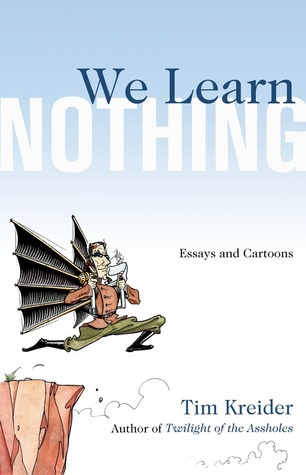
In his introductory essay in We Learn Nothing, "Reprieve," he writes of his near death experience: "Not for one passing moment did it occur to me to imagine that God Must Have Spared My Life for Some Purpose. Even if I'd been the type who was prone to such silly notions, I would've been rudely disabused of it by the heavy-handed coincidence of the Oklahoma City bombing occurring on the same day I spent in a coma. If there is some divine plan that requires my survival and the deaths of all those children in day care, I respectfully decline to participate. Not to turn up my nose at luck; it's better to be lucky than just about anything else in life. And if you're reading this now you're among the lucky too." It's beautiful and powerful not because it's so honest and earnest and sincere and all those other things I cannot seem to be; it's powerful because while he's expressing a personal anecdote and belief, he's belittling and minimizing the argument of miracles and blessings and the narcissism which causes people to believe an almighty omnipotent and eternal being somehow has a plan for little old them. It's the most elegant take-down I've ever seen and I don't watch wrestling.
In his essay, "Escape from Pony Island," (which is the first essay I ever heard him read out loud at the Hawthorne Powell's Books) he says, "Ken often said of himself that he was essentially libertarian in his outlook, but Harold and I suspected that, like many libertarians, he was an authoritarian at heart." See? He just says what we all know is true and he makes it effortless and if you're libertarian, you're not reading this sentence because you already dramatically shut your laptop closed in disgust and then looked off in the distance impersonating Jim from The Office except you don't have a camera crew to capture the moment.
I truly love Tim Kreider and I wish I were his friend. Mostly because he and his friends seem to do a lot of day drinking and people watching and take a lot of trips and don't seem to actually do anything laborious.
In his penultimate essay, Sister World, Tim Kreider looked me deep in the eyes and whispered, "You're missing a critical part of your brain." I don't mind that I'm missing them though because Tim expresses them well enough that I know I'm missing them. I don't know if the essay brought me to tears because it brings everybody to tears or because I was left broken and longing for the ability to dive into messy and potentially uncomfortable situations. Or maybe I was just happy to experience his feelings because there's no way I'd want more family. Ugh! Ptui! Those shows where people meet long lost family members seem like a nightmare to me! Oh! So maybe that's why I was crying! Because Kreider's family reunion was terrifying!
I'll leave you with one more example of Kreider's earnestness: "Once, over beers, I was clumsily trying to tell Amy how grateful I was that she and her sister had been so accepting of me, when they could as easily have been indifferent or jealous or hostile. She said simply, 'You're family.' I felt whatever's the opposite of heartbroken."
Twice in my life, I've read authors who caused me to throw out something I was writing because they simply had done it better in storytelling ways I didn't know were possible: Nick Hornby's High Fidelity and Mark Z. Danielewski's House of Leaves. I'm not pretending that I was writing those books exactly! But they took major elements and themes that I had been working on and made them stories whereas mine were half-assed, in-your-early-20s intellectual pap. Still, I didn't think, "I want to write like these guys," because it was their stories and not their way of writing with which I fell in love. But Tim Kreider, since the first time I heard him read one of his essays (and not when I first was introduced to his cartoons many years earlier by the Non-Certified Spouse), I truly envied. Kreider eloquently expresses tragically apparent parts of ourselves that have broken and may never be fixed. He does so in ways that leave the reader in tears born of pain and joy and the recognition that we all suffer the same tribulations. Reading a Kreider essay doesn't simply make me think, "This guy has lived!" We've all lived. What Kreider's essays make me think is, "This guy has lived and he's really thought a lot about that." It's impressive because not a lot of us do that.
The two things I'm most envious about Kreider are his humor and his earnestness. He sees things not how they really are but how he sees himself thinking they really are. What I mean to say, in a convoluted and terribly written way, is that he knows he's flawed and he knows he's biased and he points it out right up front and then he gets on with it with a shrug of the shoulders and a tilt of the head that says, "Yeah but what can you do?"
It's the earnestness of Kreider that I find important. It's the part of my self that I'm missing and I know I'm missing and, well, I just get on with it. If I can't be earnest at least I can be so cynical and full of bullshit that I can at least be honest from my duck blind. You can't tell I'm peppering you with earnestness and truth when it's mixed in with pure unadulterated B.S. and obviously flagrant exaggerations. But Tim Kreider doesn't need the camouflage and I love him for it.
In his introductory essay in We Learn Nothing, "Reprieve," he writes of his near death experience: "Not for one passing moment did it occur to me to imagine that God Must Have Spared My Life for Some Purpose. Even if I'd been the type who was prone to such silly notions, I would've been rudely disabused of it by the heavy-handed coincidence of the Oklahoma City bombing occurring on the same day I spent in a coma. If there is some divine plan that requires my survival and the deaths of all those children in day care, I respectfully decline to participate. Not to turn up my nose at luck; it's better to be lucky than just about anything else in life. And if you're reading this now you're among the lucky too." It's beautiful and powerful not because it's so honest and earnest and sincere and all those other things I cannot seem to be; it's powerful because while he's expressing a personal anecdote and belief, he's belittling and minimizing the argument of miracles and blessings and the narcissism which causes people to believe an almighty omnipotent and eternal being somehow has a plan for little old them. It's the most elegant take-down I've ever seen and I don't watch wrestling.
In his essay, "Escape from Pony Island," (which is the first essay I ever heard him read out loud at the Hawthorne Powell's Books) he says, "Ken often said of himself that he was essentially libertarian in his outlook, but Harold and I suspected that, like many libertarians, he was an authoritarian at heart." See? He just says what we all know is true and he makes it effortless and if you're libertarian, you're not reading this sentence because you already dramatically shut your laptop closed in disgust and then looked off in the distance impersonating Jim from The Office except you don't have a camera crew to capture the moment.
I truly love Tim Kreider and I wish I were his friend. Mostly because he and his friends seem to do a lot of day drinking and people watching and take a lot of trips and don't seem to actually do anything laborious.
In his penultimate essay, Sister World, Tim Kreider looked me deep in the eyes and whispered, "You're missing a critical part of your brain." I don't mind that I'm missing them though because Tim expresses them well enough that I know I'm missing them. I don't know if the essay brought me to tears because it brings everybody to tears or because I was left broken and longing for the ability to dive into messy and potentially uncomfortable situations. Or maybe I was just happy to experience his feelings because there's no way I'd want more family. Ugh! Ptui! Those shows where people meet long lost family members seem like a nightmare to me! Oh! So maybe that's why I was crying! Because Kreider's family reunion was terrifying!
I'll leave you with one more example of Kreider's earnestness: "Once, over beers, I was clumsily trying to tell Amy how grateful I was that she and her sister had been so accepting of me, when they could as easily have been indifferent or jealous or hostile. She said simply, 'You're family.' I felt whatever's the opposite of heartbroken."