Showing posts with label John Steinbeck. Show all posts

Thursday, August 21, 2025

The Red Pony by John Steinbeck (1937)


I can only assume that John Steinbeck hated people who loved ponies and horses. Why else would he give this book of short stories a name that has absolutely nothing to do with three of the four stories (or two of the three, depending on things I won't go into here) and nothing thematically to do with the first story? And what sadist chose that cover showing a healthy, bright red pony for the reader to fall in love with before even opening the book?! And then, knowing people are all, "Oh! Look! A story about a handsome Red Pony! I bet my kids will love it!", Steinbeck brutally destroys at least two horses in graphic detail! And hints at the death of another in a ritual suicide-murder pact by an old paisano!

I would suggest this book has Pig (the movie) vibes about it except that in that movie, the main thrust of the pathos comes from Nicholas Cage's loving friendship with the pig. I don't think Jody, the ten year old protagonist of this book, gives a shit about the Red Pony except how it raises his stature among his friends and how he feels more mature in the ownership of it. If you want more evidence that Jody doesn't care about the pony, you just have to read any other scene that involves Jody and an animal.

Now that I think about it and have hinted at the way he kills and tortures nearly every animal he comes across, this book might be about a budding Satanist! Is that why the pony is red? And, of course, that's why he plans on naming the replacement pony "Black Demon." If I had to guess, Jody follows the old man who stole the old horse out into the mountains and drains him of his blood which he secretly uses to enrich the soil around his shrine, the vibrant area around the water pump. It feels like an analogy of a holy place and while I think it is, it might be more "unholy."

But that's just me, a boring old animal lover who lives in a city and never has to think about the savagery of nature and the violent deaths which cause the end of most creatures. Jody's attitude comes more from his father Carl and his other, more likeable father Billy Buck. Death is a fact of life and while the adults try to teach Jody not to be cruel about it, he's still just a ten year old with no actual power. Most of his cruelty towards the animals comes when he's feeling most powerless against the adults, or the death of his horses. Except when he wants to murder all of the mice in the haystacks. Man, his joy and anticipation at that event just screams "serial killer."

In the end, the one act of premeditated and extreme violence is the only one Jody can't bring himself to act upon. You might think it's because he's growing up. But it's actually just another act of rebellion against his father. His father gives the go-ahead for murdering the mice. Around the same time, Jody's father embarrasses and maltreats Jody's grandfather. So Jody loses his enthusiasm for killing mice and decides he'd rather treat his grandfather well. Does this show Jody maturing or does it just show another manipulative aspect of Jody acting out his tiny rebellions in an effort to garner any kind of power on the ranch he's able?

Or, you know, does he plan on sacrificing his grandfather to his lord Satan? Probably 50-50 on which is his actual motivation.

Wednesday, August 20, 2025

The Pastures of Heaven by John Steinbeck (1932)


If The Pastures of Heaven were written today, it would be Atlanta. I mean, Atlanta has already been written today and Steinbeck probably couldn't have nailed the experience of Black America but if you squint your brain really tight and have read this book and have also watched Atlanta, you might be able to see what I'm trying to say. I suppose I could explain what I'm trying to say in a way that would, you know, explain what I'm trying to say instead of trying to be Internet Clever by using a pop culture analogy to do all of my brain's heavy lifting. At least I'm not asking ChatGKY to do my review for me! I wouldn't even do that for a joke because it's a dumb and tired joke that I bet people have done multiple times already on this site. I bet some of them weren't even joking!

Anyway, back to my "review", The Pastures of Heaven is one of those books of short stories where all the stories are connected by time, space, and the characters within. Like Atlanta (except when they go to Amsterdam. But that starts with an "A" so I think there's probably an essay about that and how the characters express themselves in an Old World and ostensibly white space but still in a city that begins with "A"). All of these short stories end somewhat tragically, except maybe the one where the sisters become prostitutes because that was hot.

The question then becomes, "Why do these stories all end tragically while they take place in the most beautiful, serene place in California (which means the most beautiful place in America, obvs! Is my Native Californian showing?!)?" I will attempt to answer that question even though I'm not a professor of Steinbeck although I've been inside Steinbeck's childhood home and rubbed my hand on his bronze bust in Monterey and also I went to a college with a massive Steinbeck Resource Center and osmosis is a verifiable thing so, you know, maybe I'm better than a professor of Steinbeck? Plus my grandmother remembers seeing the Okies come through the Bay Area so I even have some genetic memory of some of that stuff!

Throughout the book, many of the characters believe they or their family or the land they've chosen to live on are cursed. These curses are attributed to various causes but none of them quite suss out the actual problem. I'm not sure I have either but I've got some guesses based on the stories that bookend the main ten stories and also the energy I gathered by rubbing Steinbeck's bronze face while watching some cavorting otters. The curse might be described as a kind of Anti-Manifest Destiny. The Pastures of Heaven (which were previously called Las Pasturas del Cielo (which means they were probably called something else before that which hints at a place that has been conquered or taken by various invading peoples)) are a supreme natural place that tantalizes those who view it and encourages them to live in serene peace and beauty. Except civilized people cannot simply accept the place for what it is. They must bring the baggage of civilization to the land. In trying to tame it, just as the Spanish corporal and his men try to tame the Native Americans in the opening story, they destroy the beauty and vision that brought them to it.

Don't get me wrong! The Pastures of Heaven are never destroyed! The Pastures actually destroy the people who come to settle it, those people who bring their mental illness, their greed, their ambitions, and their need to force their vision on the land and subsequent generations. Too often, stories show how people and civilization come to a place and spoil it. But Steinbeck sees the long game. Nature always wins out. The ivy creeps up over abandoned houses. Crops go to weed. Animals wander off and go feral. Fire cleanses and reclaims.

By the final bookend story, we get a glimpse of a number of people too enmeshed in civilization to even truly consider trying their hand at living in The Pastures of Heaven which they look upon longingly and dream of what they'd do there and how they'd make it part of their dreams, only to re-board a tour bus and go back to the city.

On a non-plot/theme related note, Steinbeck's style shines in this his second published work. Several times we see hints of stories to come. Ma Joad is in this. Lennie is in this. Tortilla Flats has already begun to sprout in several of the stories here. Perhaps the whole foundation of East of Eden lies here. It's a marvelous work and, if you want, an easy, light, comedic (with tragedy!) read. You won't find an Earn, Darius, or Paper Boi in this although, I mean, you kind of will? Seriously! If Donald Glover told me this was an inspiration behind Atlanta, I'd probably say, "Yeah, I know, dude! Jeez! What do you think I am? Stupid?!"

Tuesday, August 19, 2025

Cup of Gold: A Life of Sir Henry Morgan, Buccaneer, with Occasional Reference to History by John Steinbeck (1929)


Even though I'd read all of John Steinbeck's fictional novels, I'd avoided this one until just this year because of the whole "reference to history" bit in the title. It's not that I don't like non-fiction (which this isn't but I'm stupid and easily deceived by my brain which reads words wrongly); I just tend more towards fiction. I would love to know more about actual events and people in history and the entirely well-deserved fall of the Roman Empire. But mostly I'd rather read about elves, super heroes, and paranormal tales of horror. Does that make me a piece of shit? Wait. Why would I even ask that? Do I hate myself?

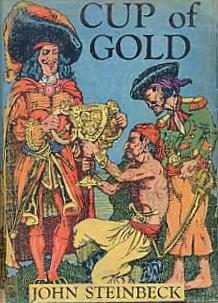
What I'm trying to say is that I'm a huge fan of Steinbeck but I avoided his first novel for all the above reasons and also that cover is fucking terrible, innit? Here's the thing though: it's probably better to have a firm understanding of Steinbeck and his writing before reading this book. Because the most interesting thing about it, I found, was seeing the beginnings of his evolution as a master writer of the Salinas Valley and Monterey Bay and characters making sacrifices to gain the things they desire. I only mention that because this is a story about a man leaving the old world for the new world and, well, quite a few of Steinbeck's works involve somebody from the East Coast pining for the freedom and beauty of the West Coast. It's also the story of a man (Henry Morgan!) whose ambition drives him to win his dreams but who cannot help feeling a constant sorrow for the things he's lost. He's a man never content with what he has gained. But it's that discontentment that drives him to be successful. Is he ultimately happy by the end? Almost certainly not. Would he have been happy if he'd stayed in the Old World and told the girl he thought he loved that he loved her and married and had children? Almost certainly not, especially since the girl he often holds in his mind as his true love is just a manifestation of the girl he wanted to be in love with, having never really gotten to know her at all.

In Henry's quest to find the thing that will fill the hole inside him that even he doesn't understand the shape of, he sacks Panama City. He does this not for the gold or the acclaim but for the legend of a woman, La Santa Roja. He believes she will be the one to finally satisfy his every desire but, in the end, discovers she's just a woman, an individual, who has her own wants and desires. She isn't a Helena to be Boxed upon the pedestal he sculpted for her. When Henry discovers she's become the lover of his right-hand man and best friend, he kills his friend and imprisons the La Santa Roja. Eventually he realizes she isn't what he had made her out to be and pouts off back to the Caribbean to marry his cousin. Some of you might be thinking, "Well, a happy ending then!" Gross. No! He lives out his life an unhappy and unfulfilled pirate legend.

It's been a few months since I finished reading this so I don't remember exactly how it ends. I think he's killed by a younger man who mirrors the ambition of his own youth. Maybe I'm making that part up! Anyway, that only matter if this were a synopsis of the story instead of a review and, so far, it has been because I've left out all the review bits! I'll get to those now.

Cup of Gold was published when Steinbeck was 27. I would think, "Wow! So young to understand the sacrifices people make for ambition and how, quite often, the actual passion of the ambitious soul is ambition for its own sake. The constant need to keep climbing higher, driving forward, continuing some form of perpetual movement toward a goal that, when reached, is often unsatisfying, not inherently but for the ambitious person because a goal reached is stasis and the ambitious hate nothing more than stasis." But then I think, "Thomas Pynchon was only ten years older than this when he wrote Gravity's Rainbow and holy heck how did somebody know so much about everything while also understanding the way ambitious people destroy the world simply to keep things moving while they gain more and more! Now that's a genius!" And then I think, "That's unfair! Steinbeck was working on a much more intimate level than Pynchon! Plus Steinbeck was writing pre-Hiroshima and Pynchon was writing post-Hiroshima so you can't hold Steinbeck's dirty farmer's feet to Pynchon's atomic fire! Not that Steinbeck was ever a farmer but you should understand my point, dumb dumb!" And then I'd punch myself in the stomach and grunt, "Don't call me dumb-dumb, doody head!"

Ultimately, I find the things Steinbeck understood at the ages he understood them relatable, probably because Steinbeck wasn't an uber-genius like Pynchon; he was just super smart like I am! I'm not a dumb-dumb doody head at all, no matter how often my brain screams insults at me. Another wise aspect of Steinbeck's first novel is how he portrays Henry's love for the women in his life. Mostly in that the women aren't really in his life at all; they exist exclusively in his head. And when he discovers that they're individuals with desires and ambitions of their own, often in direct contrast to his desires (which are mostly the desire for the woman to be the woman he wants them to be and to love him and subsume their entire identity into loving him), he loses interest. That's why the young girl he has a crush on back in Wales remains his one true love. Because he never had to actually know her.

This isn't a book with a happy ending. Steinbeck would later go on to write loads and loads of books without happy endings. He would eventually win the Nobel Prize for writing loads of books that don't end happily because that's life, man! Sometimes in life you get what you want and then you realize you don't want that exactly and want something more and you're never content with what you've gained but then other times you don't get what you want at all and wind up in a barn nursing a homeless man because you lost your baby from malnutrition and your brother is off raving in the wilderness being everywhere injustice rears its old white male head. I guess the best we can do is enjoy doing the things we're doing and not put a ton of pressure on ourselves to be happier or more content or better off. Also, we should always despise authority because read the thirteenth chapter of East of Eden already why don't you.