
Even though I'd read all of John Steinbeck's fictional novels, I'd avoided this one until just this year because of the whole "reference to history" bit in the title. It's not that I don't like non-fiction (which this isn't but I'm stupid and easily deceived by my brain which reads words wrongly); I just tend more towards fiction. I would love to know more about actual events and people in history and the entirely well-deserved fall of the Roman Empire. But mostly I'd rather read about elves, super heroes, and paranormal tales of horror. Does that make me a piece of shit? Wait. Why would I even ask that? Do I hate myself?
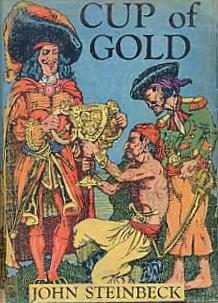
What I'm trying to say is that I'm a huge fan of Steinbeck but I avoided his first novel for all the above reasons and also that cover is fucking terrible, innit? Here's the thing though: it's probably better to have a firm understanding of Steinbeck and his writing before reading this book. Because the most interesting thing about it, I found, was seeing the beginnings of his evolution as a master writer of the Salinas Valley and Monterey Bay and characters making sacrifices to gain the things they desire. I only mention that because this is a story about a man leaving the old world for the new world and, well, quite a few of Steinbeck's works involve somebody from the East Coast pining for the freedom and beauty of the West Coast. It's also the story of a man (Henry Morgan!) whose ambition drives him to win his dreams but who cannot help feeling a constant sorrow for the things he's lost. He's a man never content with what he has gained. But it's that discontentment that drives him to be successful. Is he ultimately happy by the end? Almost certainly not. Would he have been happy if he'd stayed in the Old World and told the girl he thought he loved that he loved her and married and had children? Almost certainly not, especially since the girl he often holds in his mind as his true love is just a manifestation of the girl he wanted to be in love with, having never really gotten to know her at all.
In Henry's quest to find the thing that will fill the hole inside him that even he doesn't understand the shape of, he sacks Panama City. He does this not for the gold or the acclaim but for the legend of a woman, La Santa Roja. He believes she will be the one to finally satisfy his every desire but, in the end, discovers she's just a woman, an individual, who has her own wants and desires. She isn't a Helena to be Boxed upon the pedestal he sculpted for her. When Henry discovers she's become the lover of his right-hand man and best friend, he kills his friend and imprisons the La Santa Roja. Eventually he realizes she isn't what he had made her out to be and pouts off back to the Caribbean to marry his cousin. Some of you might be thinking, "Well, a happy ending then!" Gross. No! He lives out his life an unhappy and unfulfilled pirate legend.
It's been a few months since I finished reading this so I don't remember exactly how it ends. I think he's killed by a younger man who mirrors the ambition of his own youth. Maybe I'm making that part up! Anyway, that only matter if this were a synopsis of the story instead of a review and, so far, it has been because I've left out all the review bits! I'll get to those now.
Cup of Gold was published when Steinbeck was 27. I would think, "Wow! So young to understand the sacrifices people make for ambition and how, quite often, the actual passion of the ambitious soul is ambition for its own sake. The constant need to keep climbing higher, driving forward, continuing some form of perpetual movement toward a goal that, when reached, is often unsatisfying, not inherently but for the ambitious person because a goal reached is stasis and the ambitious hate nothing more than stasis." But then I think, "Thomas Pynchon was only ten years older than this when he wrote Gravity's Rainbow and holy heck how did somebody know so much about everything while also understanding the way ambitious people destroy the world simply to keep things moving while they gain more and more! Now that's a genius!" And then I think, "That's unfair! Steinbeck was working on a much more intimate level than Pynchon! Plus Steinbeck was writing pre-Hiroshima and Pynchon was writing post-Hiroshima so you can't hold Steinbeck's dirty farmer's feet to Pynchon's atomic fire! Not that Steinbeck was ever a farmer but you should understand my point, dumb dumb!" And then I'd punch myself in the stomach and grunt, "Don't call me dumb-dumb, doody head!"
Ultimately, I find the things Steinbeck understood at the ages he understood them relatable, probably because Steinbeck wasn't an uber-genius like Pynchon; he was just super smart like I am! I'm not a dumb-dumb doody head at all, no matter how often my brain screams insults at me. Another wise aspect of Steinbeck's first novel is how he portrays Henry's love for the women in his life. Mostly in that the women aren't really in his life at all; they exist exclusively in his head. And when he discovers that they're individuals with desires and ambitions of their own, often in direct contrast to his desires (which are mostly the desire for the woman to be the woman he wants them to be and to love him and subsume their entire identity into loving him), he loses interest. That's why the young girl he has a crush on back in Wales remains his one true love. Because he never had to actually know her.
This isn't a book with a happy ending. Steinbeck would later go on to write loads and loads of books without happy endings. He would eventually win the Nobel Prize for writing loads of books that don't end happily because that's life, man! Sometimes in life you get what you want and then you realize you don't want that exactly and want something more and you're never content with what you've gained but then other times you don't get what you want at all and wind up in a barn nursing a homeless man because you lost your baby from malnutrition and your brother is off raving in the wilderness being everywhere injustice rears its old white male head. I guess the best we can do is enjoy doing the things we're doing and not put a ton of pressure on ourselves to be happier or more content or better off. Also, we should always despise authority because read the thirteenth chapter of East of Eden already why don't you.
What I'm trying to say is that I'm a huge fan of Steinbeck but I avoided his first novel for all the above reasons and also that cover is fucking terrible, innit? Here's the thing though: it's probably better to have a firm understanding of Steinbeck and his writing before reading this book. Because the most interesting thing about it, I found, was seeing the beginnings of his evolution as a master writer of the Salinas Valley and Monterey Bay and characters making sacrifices to gain the things they desire. I only mention that because this is a story about a man leaving the old world for the new world and, well, quite a few of Steinbeck's works involve somebody from the East Coast pining for the freedom and beauty of the West Coast. It's also the story of a man (Henry Morgan!) whose ambition drives him to win his dreams but who cannot help feeling a constant sorrow for the things he's lost. He's a man never content with what he has gained. But it's that discontentment that drives him to be successful. Is he ultimately happy by the end? Almost certainly not. Would he have been happy if he'd stayed in the Old World and told the girl he thought he loved that he loved her and married and had children? Almost certainly not, especially since the girl he often holds in his mind as his true love is just a manifestation of the girl he wanted to be in love with, having never really gotten to know her at all.
In Henry's quest to find the thing that will fill the hole inside him that even he doesn't understand the shape of, he sacks Panama City. He does this not for the gold or the acclaim but for the legend of a woman, La Santa Roja. He believes she will be the one to finally satisfy his every desire but, in the end, discovers she's just a woman, an individual, who has her own wants and desires. She isn't a Helena to be Boxed upon the pedestal he sculpted for her. When Henry discovers she's become the lover of his right-hand man and best friend, he kills his friend and imprisons the La Santa Roja. Eventually he realizes she isn't what he had made her out to be and pouts off back to the Caribbean to marry his cousin. Some of you might be thinking, "Well, a happy ending then!" Gross. No! He lives out his life an unhappy and unfulfilled pirate legend.
It's been a few months since I finished reading this so I don't remember exactly how it ends. I think he's killed by a younger man who mirrors the ambition of his own youth. Maybe I'm making that part up! Anyway, that only matter if this were a synopsis of the story instead of a review and, so far, it has been because I've left out all the review bits! I'll get to those now.
Cup of Gold was published when Steinbeck was 27. I would think, "Wow! So young to understand the sacrifices people make for ambition and how, quite often, the actual passion of the ambitious soul is ambition for its own sake. The constant need to keep climbing higher, driving forward, continuing some form of perpetual movement toward a goal that, when reached, is often unsatisfying, not inherently but for the ambitious person because a goal reached is stasis and the ambitious hate nothing more than stasis." But then I think, "Thomas Pynchon was only ten years older than this when he wrote Gravity's Rainbow and holy heck how did somebody know so much about everything while also understanding the way ambitious people destroy the world simply to keep things moving while they gain more and more! Now that's a genius!" And then I think, "That's unfair! Steinbeck was working on a much more intimate level than Pynchon! Plus Steinbeck was writing pre-Hiroshima and Pynchon was writing post-Hiroshima so you can't hold Steinbeck's dirty farmer's feet to Pynchon's atomic fire! Not that Steinbeck was ever a farmer but you should understand my point, dumb dumb!" And then I'd punch myself in the stomach and grunt, "Don't call me dumb-dumb, doody head!"
Ultimately, I find the things Steinbeck understood at the ages he understood them relatable, probably because Steinbeck wasn't an uber-genius like Pynchon; he was just super smart like I am! I'm not a dumb-dumb doody head at all, no matter how often my brain screams insults at me. Another wise aspect of Steinbeck's first novel is how he portrays Henry's love for the women in his life. Mostly in that the women aren't really in his life at all; they exist exclusively in his head. And when he discovers that they're individuals with desires and ambitions of their own, often in direct contrast to his desires (which are mostly the desire for the woman to be the woman he wants them to be and to love him and subsume their entire identity into loving him), he loses interest. That's why the young girl he has a crush on back in Wales remains his one true love. Because he never had to actually know her.
This isn't a book with a happy ending. Steinbeck would later go on to write loads and loads of books without happy endings. He would eventually win the Nobel Prize for writing loads of books that don't end happily because that's life, man! Sometimes in life you get what you want and then you realize you don't want that exactly and want something more and you're never content with what you've gained but then other times you don't get what you want at all and wind up in a barn nursing a homeless man because you lost your baby from malnutrition and your brother is off raving in the wilderness being everywhere injustice rears its old white male head. I guess the best we can do is enjoy doing the things we're doing and not put a ton of pressure on ourselves to be happier or more content or better off. Also, we should always despise authority because read the thirteenth chapter of East of Eden already why don't you.

No comments:
Post a Comment