
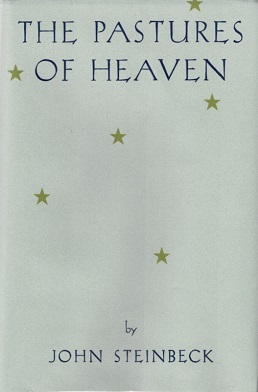
If The Pastures of Heaven were written today, it would be Atlanta. I mean, Atlanta has already been written today and Steinbeck probably couldn't have nailed the experience of Black America but if you squint your brain really tight and have read this book and have also watched Atlanta, you might be able to see what I'm trying to say. I suppose I could explain what I'm trying to say in a way that would, you know, explain what I'm trying to say instead of trying to be Internet Clever by using a pop culture analogy to do all of my brain's heavy lifting. At least I'm not asking ChatGKY to do my review for me! I wouldn't even do that for a joke because it's a dumb and tired joke that I bet people have done multiple times already on this site. I bet some of them weren't even joking!
Anyway, back to my "review", The Pastures of Heaven is one of those books of short stories where all the stories are connected by time, space, and the characters within. Like Atlanta (except when they go to Amsterdam. But that starts with an "A" so I think there's probably an essay about that and how the characters express themselves in an Old World and ostensibly white space but still in a city that begins with "A"). All of these short stories end somewhat tragically, except maybe the one where the sisters become prostitutes because that was hot.
The question then becomes, "Why do these stories all end tragically while they take place in the most beautiful, serene place in California (which means the most beautiful place in America, obvs! Is my Native Californian showing?!)?" I will attempt to answer that question even though I'm not a professor of Steinbeck although I've been inside Steinbeck's childhood home and rubbed my hand on his bronze bust in Monterey and also I went to a college with a massive Steinbeck Resource Center and osmosis is a verifiable thing so, you know, maybe I'm better than a professor of Steinbeck? Plus my grandmother remembers seeing the Okies come through the Bay Area so I even have some genetic memory of some of that stuff!
Throughout the book, many of the characters believe they or their family or the land they've chosen to live on are cursed. These curses are attributed to various causes but none of them quite suss out the actual problem. I'm not sure I have either but I've got some guesses based on the stories that bookend the main ten stories and also the energy I gathered by rubbing Steinbeck's bronze face while watching some cavorting otters. The curse might be described as a kind of Anti-Manifest Destiny. The Pastures of Heaven (which were previously called Las Pasturas del Cielo (which means they were probably called something else before that which hints at a place that has been conquered or taken by various invading peoples)) are a supreme natural place that tantalizes those who view it and encourages them to live in serene peace and beauty. Except civilized people cannot simply accept the place for what it is. They must bring the baggage of civilization to the land. In trying to tame it, just as the Spanish corporal and his men try to tame the Native Americans in the opening story, they destroy the beauty and vision that brought them to it.
Don't get me wrong! The Pastures of Heaven are never destroyed! The Pastures actually destroy the people who come to settle it, those people who bring their mental illness, their greed, their ambitions, and their need to force their vision on the land and subsequent generations. Too often, stories show how people and civilization come to a place and spoil it. But Steinbeck sees the long game. Nature always wins out. The ivy creeps up over abandoned houses. Crops go to weed. Animals wander off and go feral. Fire cleanses and reclaims.
By the final bookend story, we get a glimpse of a number of people too enmeshed in civilization to even truly consider trying their hand at living in The Pastures of Heaven which they look upon longingly and dream of what they'd do there and how they'd make it part of their dreams, only to re-board a tour bus and go back to the city.
On a non-plot/theme related note, Steinbeck's style shines in this his second published work. Several times we see hints of stories to come. Ma Joad is in this. Lennie is in this. Tortilla Flats has already begun to sprout in several of the stories here. Perhaps the whole foundation of East of Eden lies here. It's a marvelous work and, if you want, an easy, light, comedic (with tragedy!) read. You won't find an Earn, Darius, or Paper Boi in this although, I mean, you kind of will? Seriously! If Donald Glover told me this was an inspiration behind Atlanta, I'd probably say, "Yeah, I know, dude! Jeez! What do you think I am? Stupid?!"
Anyway, back to my "review", The Pastures of Heaven is one of those books of short stories where all the stories are connected by time, space, and the characters within. Like Atlanta (except when they go to Amsterdam. But that starts with an "A" so I think there's probably an essay about that and how the characters express themselves in an Old World and ostensibly white space but still in a city that begins with "A"). All of these short stories end somewhat tragically, except maybe the one where the sisters become prostitutes because that was hot.
The question then becomes, "Why do these stories all end tragically while they take place in the most beautiful, serene place in California (which means the most beautiful place in America, obvs! Is my Native Californian showing?!)?" I will attempt to answer that question even though I'm not a professor of Steinbeck although I've been inside Steinbeck's childhood home and rubbed my hand on his bronze bust in Monterey and also I went to a college with a massive Steinbeck Resource Center and osmosis is a verifiable thing so, you know, maybe I'm better than a professor of Steinbeck? Plus my grandmother remembers seeing the Okies come through the Bay Area so I even have some genetic memory of some of that stuff!
Throughout the book, many of the characters believe they or their family or the land they've chosen to live on are cursed. These curses are attributed to various causes but none of them quite suss out the actual problem. I'm not sure I have either but I've got some guesses based on the stories that bookend the main ten stories and also the energy I gathered by rubbing Steinbeck's bronze face while watching some cavorting otters. The curse might be described as a kind of Anti-Manifest Destiny. The Pastures of Heaven (which were previously called Las Pasturas del Cielo (which means they were probably called something else before that which hints at a place that has been conquered or taken by various invading peoples)) are a supreme natural place that tantalizes those who view it and encourages them to live in serene peace and beauty. Except civilized people cannot simply accept the place for what it is. They must bring the baggage of civilization to the land. In trying to tame it, just as the Spanish corporal and his men try to tame the Native Americans in the opening story, they destroy the beauty and vision that brought them to it.
Don't get me wrong! The Pastures of Heaven are never destroyed! The Pastures actually destroy the people who come to settle it, those people who bring their mental illness, their greed, their ambitions, and their need to force their vision on the land and subsequent generations. Too often, stories show how people and civilization come to a place and spoil it. But Steinbeck sees the long game. Nature always wins out. The ivy creeps up over abandoned houses. Crops go to weed. Animals wander off and go feral. Fire cleanses and reclaims.
By the final bookend story, we get a glimpse of a number of people too enmeshed in civilization to even truly consider trying their hand at living in The Pastures of Heaven which they look upon longingly and dream of what they'd do there and how they'd make it part of their dreams, only to re-board a tour bus and go back to the city.
On a non-plot/theme related note, Steinbeck's style shines in this his second published work. Several times we see hints of stories to come. Ma Joad is in this. Lennie is in this. Tortilla Flats has already begun to sprout in several of the stories here. Perhaps the whole foundation of East of Eden lies here. It's a marvelous work and, if you want, an easy, light, comedic (with tragedy!) read. You won't find an Earn, Darius, or Paper Boi in this although, I mean, you kind of will? Seriously! If Donald Glover told me this was an inspiration behind Atlanta, I'd probably say, "Yeah, I know, dude! Jeez! What do you think I am? Stupid?!"

Thank you so much for sharing about this book. Warm greetings from Montreal, Canada.
ReplyDelete