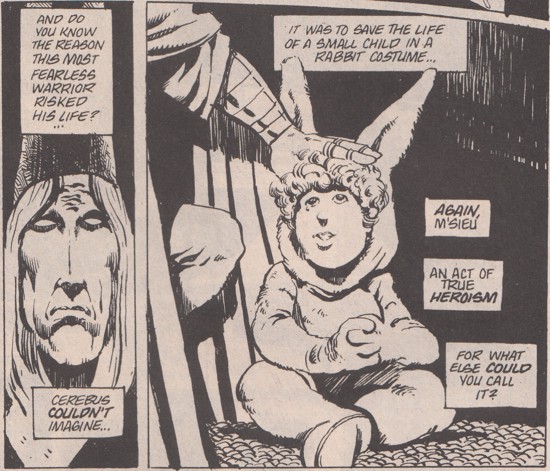
Tuesday, March 23, 2021

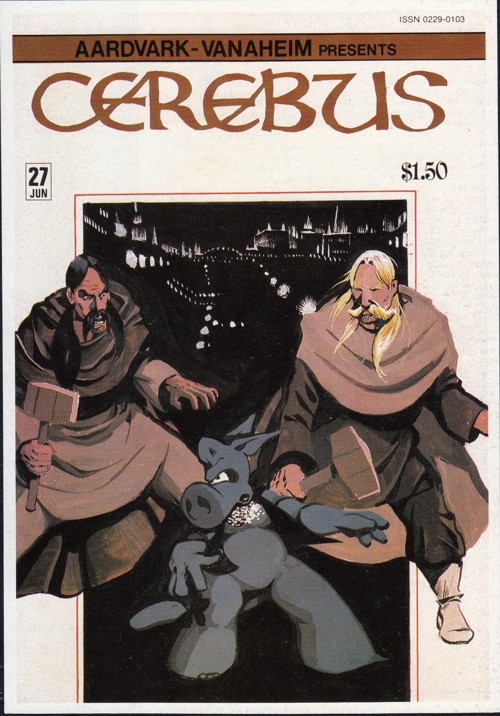
Cerebus #27 (1981)


In this issue, Cerebus probably gets called an "idjit."

In my early twenties, my girlfriend at the time became annoyed with my use of the word "idjit." I declared it was a real word and she denied it. I asked her if she saw it in print, would she agree it's a real word and she said yes. My plan was to get Mark Evanier to publish a letter from me in Groo that used the word idjit. She probably wouldn't have accepted that as proof and also Mark Evanier probably would have thrown me under the bus instead of going along with me because isn't that the kind of thing Mark Evanier would do to a person trying to win an argument against their supposed loved one? Anyway, before I could write that letter, I remembered that the McGrew brothers used the word idjit all the time. I had my proof! The conclusion of the story? She would not accept Cerebus as proof of the legitimacy of the word either! And that's why we broke up.

No, that isn't why. But the real reason probably wasn't much better. We were in our early twenties! She probably had all kinds of ambitions and big out-of-state college plans and I just wanted to replay Ultima IV in my mother's basement while going to a local state school. You can see how incompatible we were, what with her zest for life and my longing to live in a fantasy world created by some guy who seriously answered to the name Lord British. Also her inability to see how playing sealed deck Magic the Gathering after sex was romantic was a huge flaw in her personality.

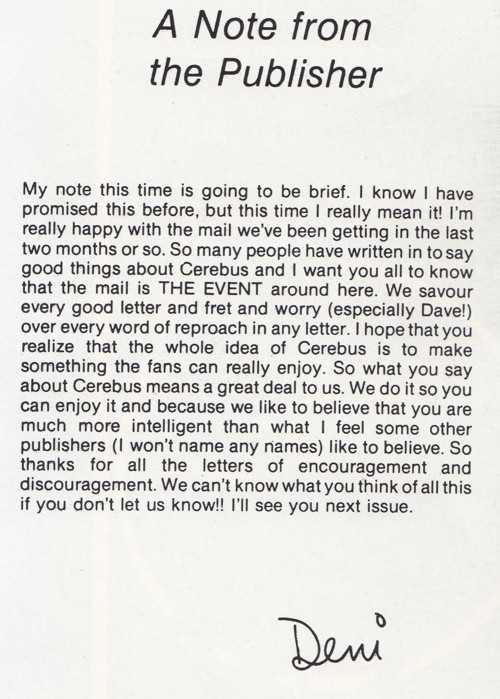
Deni's "A Note from the Publisher" gives some information on the Cerebus Fan Club and Newsletter as well as some other book Dave was going to publish later that year, Unique Stories. I think it was some kind of anthology book for independent writers and artists. Or maybe just artists and Dave was writing it? Apparently it wound up as a back-up feature which isn't surprising. Deni begins the Note saying how they didn't have time to do the newsletter or fan club and then ends the note saying they're going to publish another comic. Your readers can do math, Deni!

Replacing the Swords of Cerebus essay in this issue are sketches of the evolution of the McGrew brothers. Dave began by drawing them too cartoony then too realistic and finally the guys you see on the cover. Whatever Dave did to reach that point was perfect because they truly look incompetently threatening.

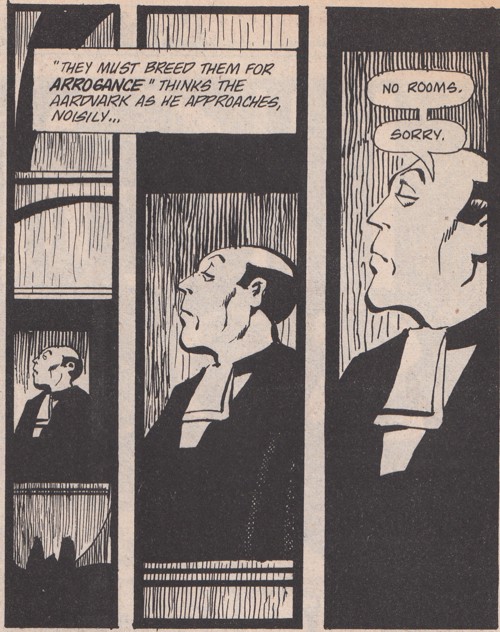
The first thing we learn in this issue is that there is a Lower Iest and a Greater Iest. So the classes get a nice physical barrier as a metaphor for how they're separated one from the other. Maybe it's also a metaphor for Cerebus moving into a position way above his stature. He begins at The Regency in Greater Iest but doesn't feel comfortable there so heads down to Lower Iest. But now he's no longer welcome there either! The local guards goad him back to Greater Iest and he, reluctantly, climbs the steps back up.

On his way back to the Regency, Cerebus is ambushed by the McGrew brothers, Dirty Fleagle and Dirty Drew. They're the two most low downiest rottenest scoundrels in all of Estarcion! Actually they're both just Yosemite Sam caricatures (which is really getting into some mirror facing mirror shit when you start caricaturing caricatures). They plan on kidnapping Cerebus and holding him for ransom, a plan that instantly goes in the bin as Cerebus easily beats them both up. They say "Ouchie!" a lot which proves how despicable and rotten and Yosemite Sam they are. But Cerebus likes their moxie and their idea! If he were kidnapped, he'd get some peace and quiet from the local guards trying to guard him and all the lobbyists trying to get to Lord Julius through him. Also he might be able to split the ransom with them.

Cerebus holes up in a tavern owned by a long time acquaintance and rewrites the McGrew ransom letter, signing it "The Eye of the Pyramid," the supposed rebellious group from Palnu that crashed the Festival of Petunias.
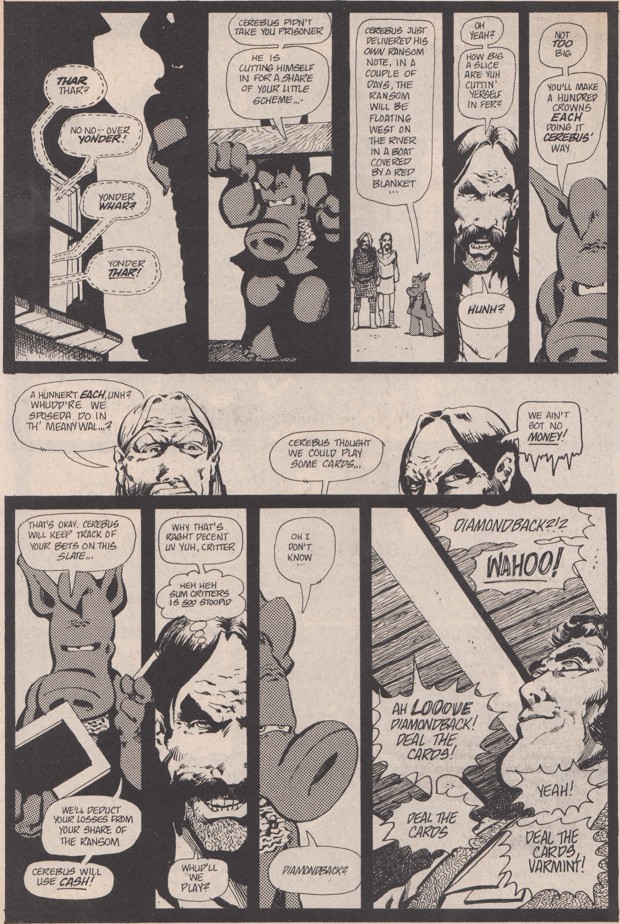

For readers as dumb as a McGrew brother, Cerebus explains the entire plan.

On the page following the scan from above, Dave Sim explains the rules of Diamondback. He doesn't do it within the story. He takes a moment to address the audience as himself, explaining how readers have been curious as to the rules of the game and how he was in the process of producing Diamondback decks for sale. Can this page be counted as one of the 6,000 pages of Cerebus? I think we have to rule it out. Did Dave account for that? Is Cerebus actually only 5,999 pages long?!

Cerebus spends a week playing Diamondback against the McGrews, turning them against each other, and just torturing them for the pure pleasure of it. When he hears the ransom has been delivered, he's gotten overconfident, thinking of these two animals as simpletons. He turns his back on them and they knock him unconscious, leaving him so they can go get the ransom themselves. Once again, Cerebus loses a fortune. Or maybe worse! Isn't he expected to repay this later in the series?!

Aardvark Comments is starting to fill up! It won't be long now before Dave Sim has ample opportunity to repeatedly piss off readers by answering their questions! It's still just barely two pages but I seem to remember it eventually growing to take up quite a bit of space at the back of each issue.

Cerebus #27 Rating: B+. Not a lot happens this issue but it's quite entertaining. One thing Dave is really good at is taking a few characters, locking them in a room together, and simply having a lot of wonderful dialogue fill up the pages. On the negative side, Cerebus never gets called an idjit. The McGrew brothers call each other idjit loads of times though!

Sunday, March 14, 2021

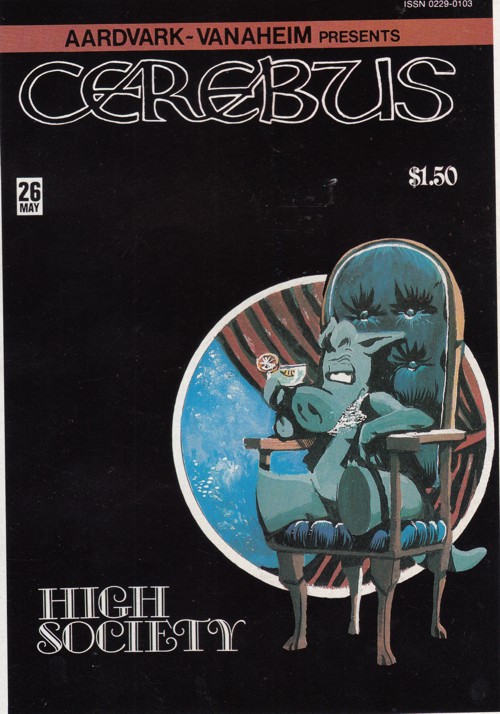
Cerebus #26 (1981)


Only forty more issues of furniture and curtains straight from Dave Sim's hand!

Dave Sim is my kind of artist. Imagine being hired to draw a comic book and being forced to draw everything in every scene. Now imagine owning the comic book and realizing about sixty issues in, "Hey! I can hire somebody to draw the stuff I don't like drawing!" I bet that was the main reason for the founding of Image Comics. I bet Todd McFarlane and Rob Liefeld were sitting around drawing capes and pouches and Liefeld was all, "Do you ever wish you could just stop drawing feet once and for all?" And McFarlane was all, "Just hide the feet behind the calf muscles." And Liefeld was all, "How the hell do you do that?" And then McFarlane showed him the picture of Spider-man he was working on where Spider-man looked like an M.C. Escher staircase. And then Liefeld was all, "How much time did you spend practicing drawing pretzels?" And then Erik Larsen, sitting nearby, was all, "Can you guys keep it down? I've got like 500 issues of Savage Dragon to plot out here!" Liefeld snorted and was all, "Is Jim Lee still out running chanting, 'Kirby. Kirby. Kirby'?" And Whilce Portacio was all, "Who am I? Why can't I remember who I am?!"

Ha ha! Man, Image Comics! What an adventure!

I don't know why I decided to bring up Gerhard when I'm only on Issue #26 and Gerhard doesn't appear until Issue #65. I think I was just surprised at how well Dave drew chairs and curtains. You sort of forget that he was pretty good at drawing scenery when he could be bothered. Another reason I probably brought up Gerhard is because one thing I remember about "High Society" was how much time Cerebus spends in a black void of a room with only the Regency Elf's boobs to light up the place.


I'm tired of telling you how bored these notes make me so here. Read it yourself.

Having run out of Swords of Cerebus essays, this Bi-weekly begins with a three page sketched out Howard the Duck story Dave wrote as a sample to possibly write Howard the Duck. He probably sketched three pictures too many because they just wanted him to write it. Here's Dave's story and a finished page of Howard the Duck art at A Moment of Cerebus.

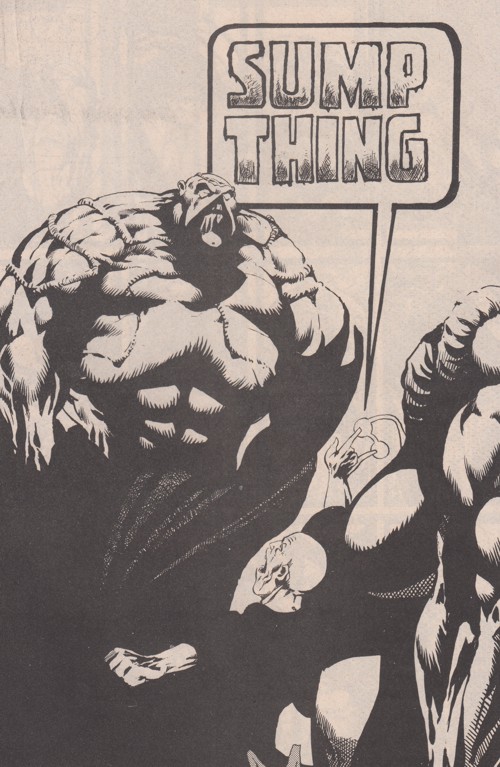
Cerebus has come to Iest to sell the last of his treasures given to him by an artist as reparations for his Sump Thing putting his penis through Professor X's chest on its way to Woman-thing's vagina. Apparently the last hotel left with any vacancies is the high-end Regency, known for its snooty customer service and sneering contempt for barbarians. And probably racist attitudes toward aardvarks. Unless that's speciesest. It's hard to tell how to categorize an anthropomorphic aardvark.


The clerk never even looks at him. He must be judging Cerebus on the smell of his wet fur.

Luckily Cerebus constantly refers to himself in the third person so that the desk clerk can learn that this mud-covered angry barbarian is a person called Cerebus who apparently has a room already reserved for him. The desk clerk becomes extremely accommodating when he hears the name which should make Cerebus wary that he's about to become, once again, pulled into somebody else's harebrained scheme.


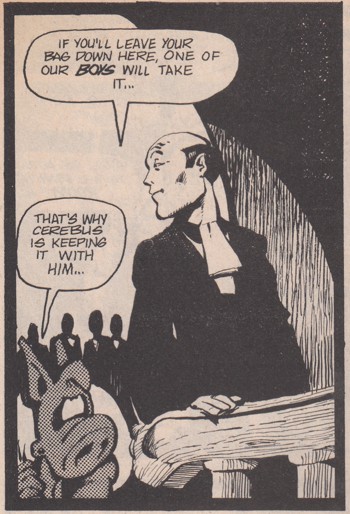
You know the clerk is thinking, "Why would anybody want to steal your sack full of dead squirrels and dirty loincloths?"

The clerk, not knowing that a wet Cerebus smells like a rotting whale stuffed with a rotting dolphin stuffed with a rotting tuna surrounded by Durian fruit, has drawn Cerebus a bath in his Regency suite. I imagine as soon as he slips in, the Regency will have to be evacuated, believing there to be some kind of chemical attack on the place.

Cerebus discovers that The Regency would like him to stay as their guest, meals included. He's grown suspicious but if it's free, he's willing to chance whatever shenanigans this all leads to.


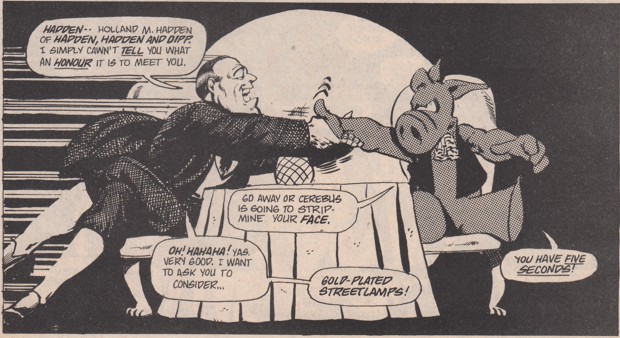
I scanned this picture because it's the beginning of the other shoe dropping. But also because I really love the line "Cerebus is going to strip mine your face."

Lobbyist after lobbyist arrives at Cerebus's table giving him cheques to simply remember them and their product. Eventually, Cerebus tries to get to the bottom of it. Why is he so popular and what position is he in to help these people? A man named Scorz explains the entire thing to him: he (and all the others) are trying to get government contracts for their product with Lord Julius of Palnu. And since Palnu is a convoluted bureaucracy built so as to get nothing done at great expense, nobody has been able to get their ideas to Lord Julius. But now everybody suddenly has access to the famous Cerebus the Aardvark, Lord Julius's Kitchen Staff Supervisor! They've all spent so much money trying to get to Lord Julius, what's a few hundred more gold crowns to be able to speak to what basically amounts to his right hand man?

Cerebus learns, while trying to get into a brawl, that he's completely under the city's protection, being a ranking diplomat from a southern state. Not being able to get into some violent fisticuffs puts Cerebus into a bad mood, even though he's now flush with cash and has access to all the free alcohol he wants. He's suddenly found himself in a new world where violence isn't the first resort. Up until now, Cerebus probably hated dealing with magic the most. Now he's about to learn politics is worse.

Aardark Comment includes one long letter with one long response from Dave. It might be essential reading for people used to "comic book continuity." Dave tries to explain his continuity and how it works. He's got a whole world developing here and it doesn't all revolve around Cerebus. Things happen when Cerebus is around and they continue to happen when Cerebus wanders off to find more gold and alcohol. But we see the majority of the world through Cerebus's eyes (and in those cases where we glimpse things happening of which Cerebus is not aware, they have direct impacts on Cerebus's life). So if Cerebus falls unconscious because he's drugged and then wakes up in a foreign city weeks later, how is the reader supposed to know what happened? We're in the same boat as Cerebus! If he doesn't know, why should we? It's almost as if Dave Sim is telling this reader, Fred Patten, that he's simply going to have to get used to not knowing all of the answers immediately. He's going to have to change his perspective from the Marvel/DC style of a "six issue story" that basically encapsulates everything you need to know within those six issues and open his mind to the idea of a "three hundred issue story" that encapsulates everything you need to know within those three hundred pages. You still won't know everything you want to know though! That's kind of how life works! We don't get all the answers so why would Cerebus? Or why would people observing Cerebus?! Get over it, Fred!

Cerebus #26 Rating: A. A nice story about Cerebus's transition from the barbarian world to the "civilized" world. Try as he might, Cerebus cannot satisfy his need for violence. It's a new world where conflicts play out differently. Oh, sure, there will be violence but it's called assassination now! And it's done by bodyguards and mercenaries! Even with all the money and alcohol coming his way, he's probably not going to stay satisfied for long. Time for Cerebus to start learning about true power.

Thursday, March 11, 2021

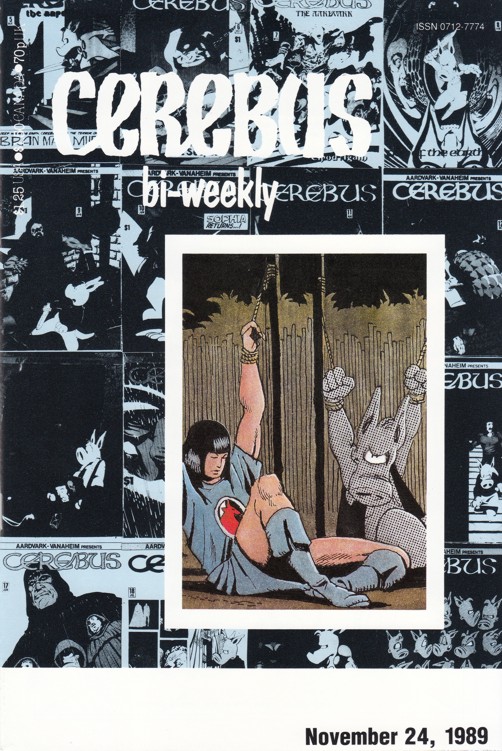
Cerebus Bi-weekly Special from November 24, 1989


This one isn't numbered because it contains stories that didn't appear in the monthly series.

Frank Thorne died a few days ago. Seeing as how much influence he had on the early days of Cerebus, I just thought I should acknowledge it. So, there you go. Acknowledged. I hope somebody cares enough to acknowledge my death this dispassionately some day.


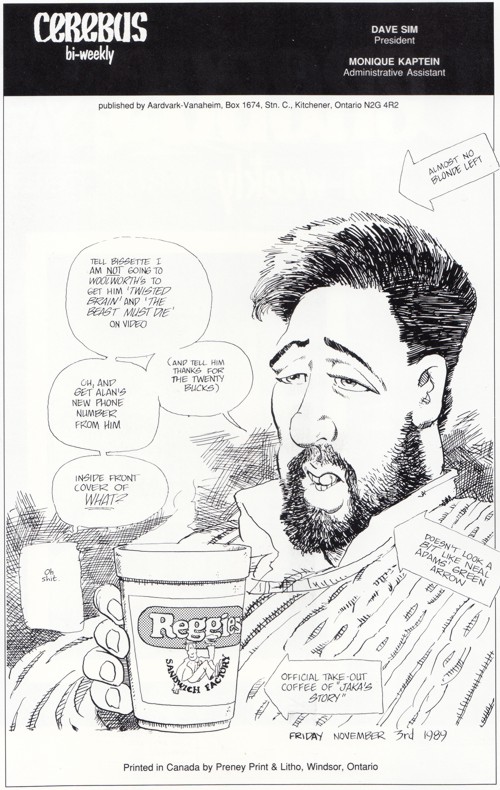
The inside cover of this issue. Rather than list the stories and where they were first published, we get a self-portrait of Dave Sim sipping coffee and wearing his sweater made out of small animal vaginas.

The first story is "Magiking" and it appeared in the pages of Swords of Cerebus Volume 4. I don't think I've ever read this because I only purchased the first three Swords of Cerebus volumes before I discovered the Cerebus phone books.

This story probably takes place around Cerebus #13, "Black Magiking." Necross the Mad was the evil magiking. This story is about the good one. Who may or may not be mad.

Cerebus wakes up falling onto a chessboard floating in space. A wizard that appears somewhat as crazy as Necross the Mad materializes and begins researching Aardvarks. Apparently they're not beasties but something else entirely. An aardvark is a magnifying lense to increase the power of magic. That's why so much weird magic crap happens around Cerebus. He's just going about his business of trying to get rich and drunk but not laid for some reason (maybe because Dave Sim wasn't trying to write Heavy Metal) when he stumbles into magic trouble. Will the series be more understandable with this knowledge? Not that it was hard to understand before. But some weird shit does go down around Cerebus. Now I can just chalk it up to "aardvark magic magnification powers."


This seems familiar. Maybe I have read it. Maybe in Cerebus Zero or Cerebus Jam or Cerebus GamJam I.

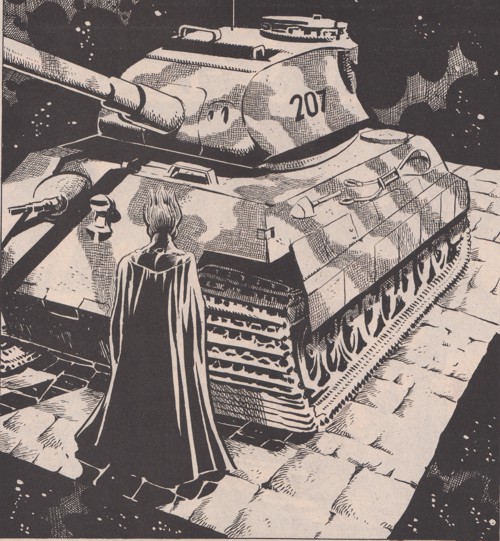
The next story is "Silverspoon" which appeared serialized in Comic Buyer's Guide. This story takes place between Cerebus #13 and Cerebus #14 as Cerebus travels from Lower Felda to Palnu with Lord Silverspoon, Lord Julius's son. I think it's a Prince Valiant parody but it's hard to say because Prince Valiant bored the shit out of me and even though I read it because I was a funny papers completionist, I was usually thinking of other things as I did.

This Prince Valiant parody was so spot on that I was completely bored and was thinking about Scarsdale Vibe from Against the Day the entire time.

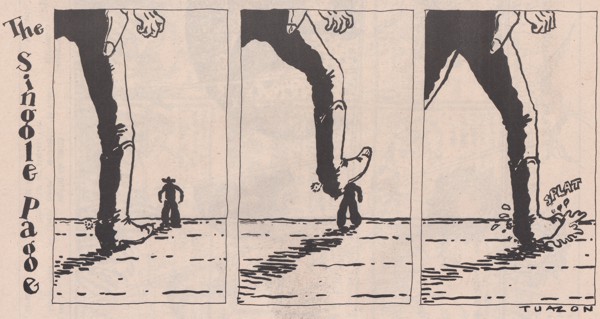
Without the Swords of Cerebus essay and the lack of letters pages, Dave had room for four pages of "The Single Page" this issue. I liked this one:


I'm not rating this issue because I don't know what to call it. Plus I wasn't expecting it. No wait, I will give it a short review: I would have been somewhat upset if I'd purchased this issue as part of the bi-weekly run, mostly because of the dumb Lord Silverspoon story. But since it was just thrown in extra on my eBay purchase of Cerebus Bi-weekly issues 1-25, I didn't mind it at all. It was a diversion. Is that compliment? No? Whatever.

Monday, March 8, 2021

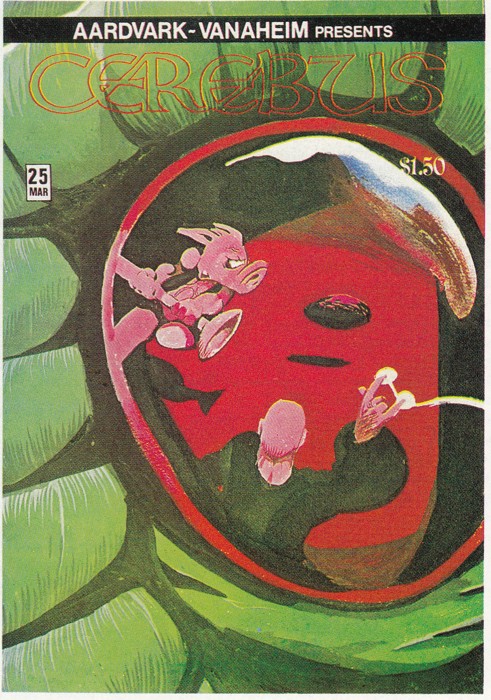
Cerebus #25 (1981)


Is "Giant-sized Woman-Thing" as funny as "Giant-sized Man-Thing"? What about "Giant-sized Child Thing"?

For those wondering, judging by the length of time between posts, if I'll keep doing these Cerebus "reviews" (inverted commas to represent that they are, at the most charitable of descriptions, negligibly reviews), don't worry (or do worry if you were wondering in the hopes I'd stop): I just purchased the "High Society" Bi-weekly issues on eBay. I've also got the "Church & State" bi-weekly issues but I think those only cover Volume One. I don't know what I'll do after that. If I have to, I'll resort to reading them online but I'd rather have a fungible copy in hand (while technically an unneeded adjective in this case, I need to get "fungible" and "non-fungible" into my vocabulary if I'm ever going to become an Internet hipster millionaire without any ethics at all (Goals!)). Maybe I should start reviewing the smell of each comic since that's a big part of the experience, especially buying the comics off of eBay.

For maybe the first time in 25 issues, Deni's "A Note from the Publisher" actually says something other than "You should read this issue!" or "We apologize for the late publication date" or "Dave may or may not have had a mental breakdown due to the pressures of self-publishing and taking too much LSD." Hmm, I wish "A Note from the Publisher" had ever been as interesting as I just made it out to be. But this one is like a mini-essay on Cerebus and being Canadian! She throws in some really good evidence like "If you read Cerebus carefully, you will see that he too is a survivor." That's to prove that he's Canadian because Canadians are survivors unlike all those other stupid nationalities that love to run over the edges of cliffs on any day of the week ending in "day." People usually say "any day of the week ending in 'y'" but I decided to make the saying even more stupid.

I'm usually pretty hard on Deni's "A Note from the Publisher" because it's boring information in the Bi-weekly format. I'm sure it was quite helpful in the early days of Cerebus to know about publishing delays and the other multiple independent publishing problems that caused concern. It might even be not boring and useful for readers who aren't cynical bastards like me. Maybe I should stop being such a dick and try to see the world through a more positive and rosy lens! Maybe I've already started because, as I said, this was Deni's best note yet! It made me stand up and yell, "Yay, Canada!" Although who doesn't daily stand up and yell "Yay, Canada!" simply as a thank you for the original Degrassi Junior High?

Dave Sim continues his essay from last issue about getting drunk with some Americans in Canada and going back to a hotel room with a loaded gun. The drunk friends don't really figure into the story. It's really a story about Dave and guns and Canada and mortality and John Lennon. It's his "this is where I was when I heard the news" story. And it almost feels like I can grasp a bit of Dave's eventual religious thinking in this story. At one point he does say, "Okay, God. I get the message. No gun." But that almost seems like the atheist's version of using God as a figure of speech. He may as well have said, "Okay, Universe. I get the message. No God." I mean "No gun." Anyway, there's definitely a thread of schizophrenic thinking which is maybe appropriate since he evokes "Strawberry Fields Forever" which evokes LSD (and I don't know the history of that song at all so I'm just speculating here having listened to it and loved it and loved LSD) which evokes schizophrenic thinking. What I mean to say is that he's receiving messages from the universe that he instantly applies to his current internal monologue, not as "Oh, I can use this experience to help me negotiate the logic of my current problem" but as "Oh, my internal monologue has affected the world surrounding me and caused it to reply in kind, to suggest to me answers to my current dilemma."

Is Dave Sim schizophrenic or schizoaffective? Probably not. But his manner of thinking displayed in both his fictional and personal writing definitely leaves some room for a reader to believe that interpretation. Just like I wouldn't claim he's a misogynist but I understand why so many people might reach that conclusion. If my blog were more famous, I'm sure I'd run the gamut of weird reader interpretations as well based on loads of things I've written in whimsical or facetious states of mind. A lot of what Dave Sim winds up writing in Cerebus could be interpreted as simply science fiction in a fantasy setting. He's just taking modern problems and ideas and exploding them to test how current modes of thinking might fall out under different societal pressures. A lot of what's coming up could be slapped with a Philip K. Dick credit and I don't think a lot of people would question it.


Still funny in a The Family Guy keep the joke going way too long kind of funny (which isn't really funny) or not? I guess not since the first choice I already declared not funny, I guess.

I think the Blank Page gag was good at three times. But I think Dave also needed the fourth just to make sure the gag had definitely run its course. And maybe it was funnier when buying this comic book every two weeks?! I may just be experiencing the timing of it incorrectly.

And on to the story!

Cerebus has decided to hang around with Professor Charles X. Claremont on his mission to summon the Apocalypse Beast (also known as Woman-Thing) to end the world. Professor X learned the spell to destroy the world from a book of children's fairy tales written by Suenteus Po. I can't quite remember what, ultimately, Suenteus Po's philosophical beliefs are. I believe the Suenteus Po Cerebus spoke with in his drug coma turns out not to be the real Po. That one was just one of many people pretending to be Po to live lives of drug-laced hedonistic pleasure. The actual Po plays chess or something and is an aardvark. He may or may not be a nihilist but this evidence that he created a spell to end the world suggests he might be. We'll discover all that later! For now, let's get back to this story which, I believe, ends in the first death by fucking in any comic book ever (unless Robert Crumb did it first. I would not be surprised. Probably some tiny main character crushed to death in the thick legs of some monstrous beauty).


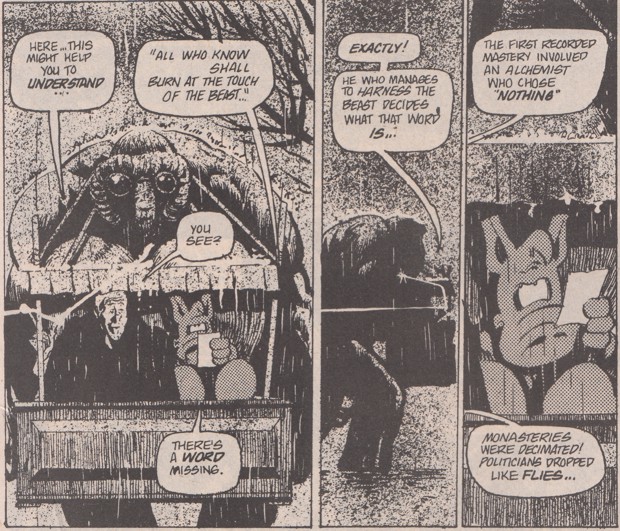
"Whatever knows fear burns at the touch of the Man-thing" was the slogan of Marvel's original creation.

Professor X explains that his Woman-thing isn't the first Apocalypse Beast. As he pointed out to Cerebus, the first one destroyed everybody who knew nothing. That's a pretty scary word to fill in because what's the cut off of knowing nothing?! Would my 7th grade report on glaciers be enough to keep me from burning?! Hmm, probably not because I copied it verbatim from an old encyclopedia.

One of the masters of the Apocalypse Beast chose the word "me" to finish the spell. That seems like a dick move. Professor X has chosen Marvel's word: fear. He figures it'll be a pretty good feedback loop to kill nearly everybody. First the fearful then those with fear induced by seeing the fearful killed and so on. I guess it's a good plan if your stupid good plan is for human genocide.

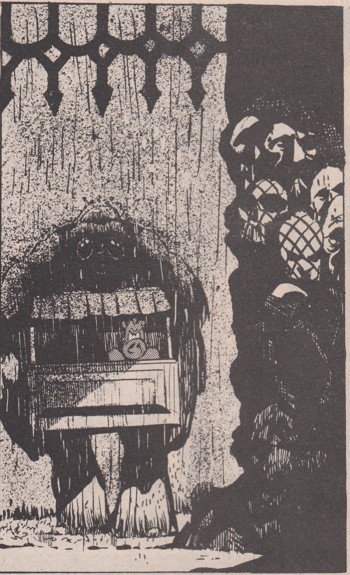
Professor X and Cerebus, on their way to destroy everybody, come across an enormous castle from the "Black Tower Dynasty." I'm not sure what that is but could it have something to do with a previous ascension?


The black rocks the castle is built upon contain faces much like the black tower that grows and launches Cerebus into his ascension.

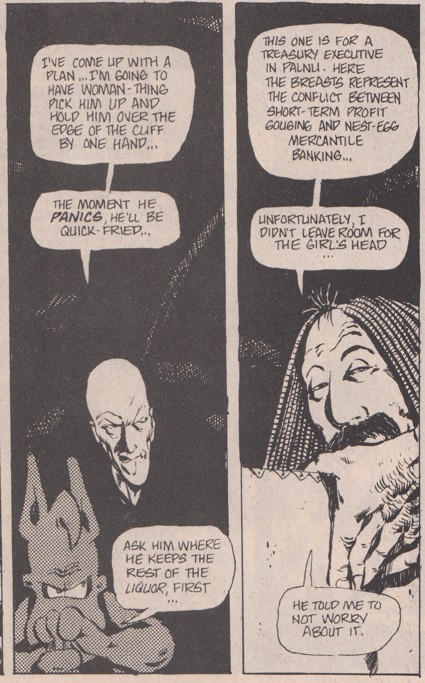
Professor X's plan to take over the tower is to lure the owner to Woman-thing which the sight of will frighten him so badly that he'll burn. Except the owner of the castle isn't afraid of Woman-thing at all. He's mesmerized by the workmanship and artistry. The owner of the castle is an artist and/or pornographer. Sure his paintings have loads of female nudity but they're in service to a greater message about humanity's struggle with its own existence!


Sim's jokes are a good gauge for reader maturity.

If you love the first 25 issues the best, you're a randy teenager enjoying all the boob jokes and violence. If you love the next 25 of "High Society," you're probably in college raging against the political system. If you find the next sixty "Church & State" issues the funniest, you're humor is balanced by having become dispossessed with the status quo meanings of life and the terrible ennui of religious dogma. If "Jaka's Story" is your favorite, you're showing definite signs of becoming a fully mature adult, mostly because you put up with all those stupid words with so many fewer pictures. If you find "Melmoth" funny, you've gone too far into "maturity" and entered "diagnoses psychosis." If you find "Mothers & Daughters" hilarious, you probably hate your mother. If you've been reading Cerebus since you were a randy teenager, by the time you get along to "Guys," you're probably going through a second childhood or a midlife crisis which makes "Guys" just as funny as you remember the first 25 issues being. Finding "Rick's Story" funny means you've never been successful at love and I pity you (although I'd never say that because saying "I pity you" to somebody's face is possibly the worst thing you can do. I'd rather look somebody in the eyes just before sliding a dagger into their belly). I've only read "Going Home," "Form and Void," "Latter Days," and "The Last Day" the one time so I can't remember what kind of sense of humor you need to find those funny. I think you need to love Hemingway, hate Fitzgerald, love the Three Stooges, and love/hate Woody Allen to get any laughs out of those. You might also find them super funny if you think women ruin everything. I'm not saying Dave is a misogynist, remember, but, hoo boy these last few stories don't help!

In one of the artist's paintings, Professor X recognizes Lord Roth-Sump's Thing. Ha ha. Get it? The Sump Thing? Swamp Thing?! Try to, I say, try to keep up!


Dave Sim understands he's writing for people who don't always get the first, subtle joke so he makes sure to bold face it later for them.

I don't know who would be reading Cerebus who didn't have a comprehensive knowledge of mainstream comic books but if those people existed, I'm sure they could get a little chuckle out of an Apocalypse Beast called a "Something."

After bringing Sump Thing to life, the two Apocalypse Beasts begin wrestling with each other with Professor X caught between them. Eventually they fuck and Professor X is little more than love juice. The artist feels so guilty about the death of Cerebus's friend that he gives Cerebus eight bags of gold and several other treasures. By the end of Issue #25, Cerebus is, once again, loaded. By the beginning of the next issue, you'd expect him to be drunk and broke again. But I think this time, he's drunk and living in the Regency Hotel in Iest.

Except I'm reading the Bi-weekly issues of Cerebus so there's a bonus issue first! We'll get to that next time.

The Single Page features an Eddie Campbell comic and some other person's work with ugly men and beautiful women. Unless the women aren't supposed to be beautiful and I'm just easily aroused. Um, engorged. Er, amused?

Cerebus #25 Rating: A. This issue is really good because it gets us one issue closer to the Regency Elf. It also features a person smashed between two monsters fucking. Not on panel, of course! This isn't Heavy Metal! It's also the end of what could be the First Age of Cerebus. These were his barbarian years, his wanderer years, his meeting a bunch of random characters, getting rich, and drinking away his loot years. For better or worse, Cerebus becomes a little more sophisticated in the upcoming issues.

Friday, March 5, 2021

I don't know how to do this anymore.

Friday, February 26, 2021

Gravity's Rainbow: Part XXIX.I

This section begins with a primer on plastics, a brief history leading up to Jamf's Imipolex G. I'm not a chemist so I don't understand the lingo but I've done enough chemistry so I get the gist. That's the fairly standard description of my intelligence! I can't explain anything to anybody in great detail (except maybe why Cerebus can't get pregnant) but I'll definitely understand any amount of detailed explanation of a subject with which you'd like to bore me. Here's an example of me reading this book:

Jamf at the time was working for a Swiss outfit called Psychochemie AG, originally known as the Grossli Chemical Corporation, *Me, yawning, nodding along, eyes glazing over* a spinoff from Sandoz (where, as every schoolchild knows, the legendary Dr. Hoffman made his important discovery). *me, eyes flashing open, grin on my face, nodding enthusiastically. "Yeah, yeah! Every schoolchild! Good old Albert Hoffman! My hero! Genius!"*

The primer also describes the links between all the petrochemical companies of the time. It's probably supposed to show how big business and corporations and the advancement of science (particularly plastics, in this case) had no loyalty to any nation. It was all about profits and advancements and more profits. One of the companies had an address at Schokoladestrasse which made me happy because I knew those words. I'm not bragging! Obviously everybody knows those words! It just made me happy! In the same way somebody in the book could have said "Ziegenstrasse" and I would have come in my pants.

This is all discovered by Slothrop as he researches Jamf and Imipolex G and the German blueprints for rockets and especially this one weird rocket that was built with a section composed of Imipolex G which seems to have been top secret: The "S-Gerät, 11/00000." While doing the research, he also comes up with "Proverbs for Paranoids, 3: If they can get you asking the wrong questions, they don't have to worry about the answers." Hmm, that may have been a proverb for paranoids in 1945 and also 1973 but I think it's just standard operating procedure for anybody with any money or power at this point. I don't think saying that makes me paranoid. I think it makes me observant.

During the days of researching, Slothrop discovers Tantivy has died. Or might have died. Basically, They want Slothrop to think he's dead so whether they sent him out to a dangerous mission to get killed or they just planted a story in the paper so Slothrop would read it, it hardly matters. Thinking Tantivy has not just died but was most likely killed by Them to get to Slothrop, Slothrop's path becomes clear. He's no longer content to sit in the Casino and study and sort of ignore that they're manipulating his life. It's time to head into The Zone and figure out what's going on.

He heads to Nice to find the address given to him by Waxwing, the address where he can get a new identity.

Just for the knife-edge, here in the Rue Rossini, there comes to Slothrop the best feeling dusk in a foreign city can bring: just where the sky's light balances the electric lamplight in the street, just before the first star, some promise of events without cause, surprises, a direction at right angles to every direction his life has been able to find up till now.

For Slothrop, that moment must be heaven. A promise of events without cause?! How does one so paranoid as Slothrop ever reach that stage? I guess upon arriving in a new city at dusk before he has a chance to see the strings, the facades, the seeming random coincidences that, upon slight reflection, prove themselves to be manipulations.

Slothrop arrives at the address given to him by Waxwing and winds up among a bunch of bohemian drifters and squatters. In a description of their shoes: . . . saddle-stitching in contrasting colors (such as orange on blue, and the perennial favorite, green on magenta. . . . What is it with magenta and green?! Did Pynchon suffer from some kind of PTSD derived from wearing bowling shoes?!

After a lot of paranoid delusions of conversations with people he thinks he knows but they're just wanderers and drunks, squatters and Johns, he gets his papers. He's now Ian Scuffling, war correspondent, and he's headed to Zurich.

Tuesday, February 16, 2021

Cerebus #24 (1981)


In this issue, the kids downstairs won't stop laughing loudly while Old Man Cerebus tries to sleep.

Only about thirty issues left containing "A Note from the Publisher" which I'll probably continue to ignore since they don't say anything I care about! This is an assumption based on Sim and Loubert's marriage ending in 1983 (the assumption that the note will only last around two more years and not the assumption that none of them will discuss anything I'm interested in. That's less assumption and more evidence-based research).


I did enjoy this bit from the "A Note from the Publisher" page though.

Dave Sim's Swords of Cerebus essay in this issue is a continuation from the last issue and continues on into the next issue. It ends at a dramatic place in a story he's telling about getting drunk with some dealers at a convention and one of them carrying around a loaded gun, leaving it on the dresser in the hotel room where they've landed at the end of the night to continue drinking. After the part of the story where Dave says, "Take the bullets out," the essay is left hanging to be concluded in the next issue. I suppose, due to the constraints of space, it had to be done. But imagine picking up this issue and having to wait two weeks to find out where the story goes. And then imagine, two weeks later, after you've mostly forgotten about the story, reading the continuation of the story from that point and thinking, "What the hell was happening with Sim and these guys?!"

I suppose all of that could have been avoided by simply buying the Swords of Cerebus volume this essay was in and reading it the way it was supposed to be read. But that's unrealistic! The reason these bi-weekly Cerebus issues exist is because the single issues, by 1989, were too hard to find and the Swords of Cerebus volumes were out of print, replaced by Sim's Cerebus phone books. I think I only have the first three Swords of Cerebus books because I purchased them so late that the phone books were already in print. But I managed to stumble on Swords of Cerebus first and picked them up, always having been curious about that aardvark (aardvard?) on the cover of all those comic books across the aisle from my precious Elfquest books down at Brian's Books in Santa Clara, California.

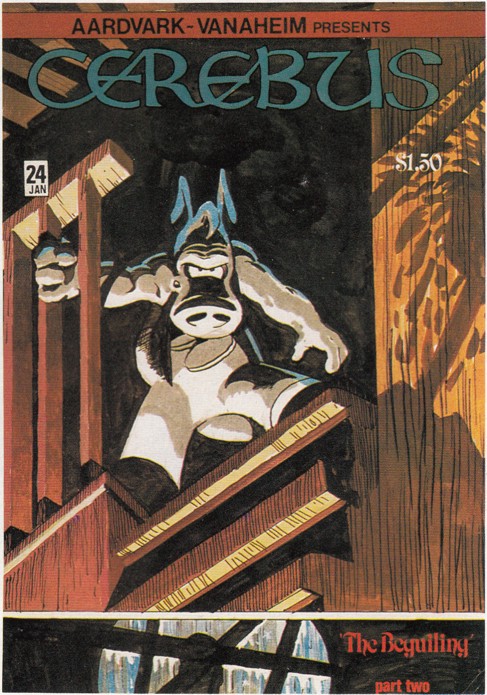
This issue is called "Swamp Sounds" and I hope that means Cerebus is going to have sex with some of the ladies at Madame Dufort's School for Horny Girls. Except I know that it means a Swamp Thing parody is in the works. Unless it's a Man-Thing parody. Does it matter?

The story begins with Cerebus sitting around playing card games and drinking whisky with the three young ladies at the school.


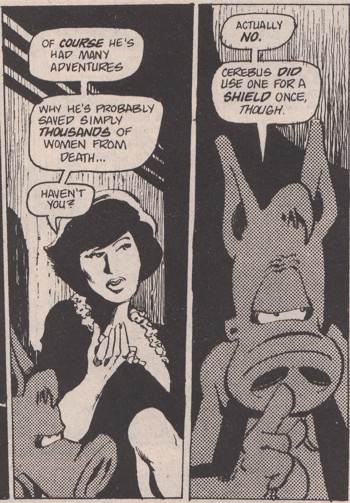
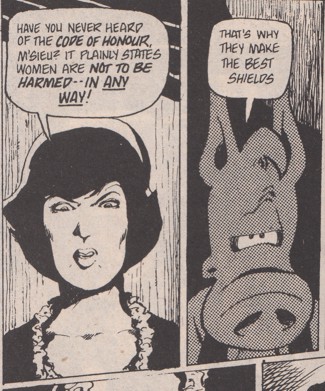
When I was in my early 20s, this was one of the funniest jokes I'd ever read in a comic book. I'm now 49 and, well, it still is.

Oh wait. I forgot the joke gets funnier.


Ah ha ha ha ha! What a scamp!

Cerebus and the girls have a discussion about heroism. Cerebus says it doesn't exist and prods them for examples of a true hero still living. Theresa tells a story they heard from Katrina's sister about their uncle. The story gives credit to Lord Julius for saving the Festival of Petunias, an act which, of course, was accomplished by Cerebus. But what's more interesting is that Katrina looks almost exactly like Jaka which means the sister who told the story was certainly Jaka. I'm not sure if Jaka brings up Katrina in any later stories, or if she's a character at all in "Jaka's Story." Seeing as how Lord Julius isn't really an "uncle" to any of them, it could be suggested that Katrina isn't really Jaka's sister. But, I mean, she looks just like her.


The second story was about Elrod and features this iconic re-imagining of Cerebus through Elrod's eyes.

Later that night, Cerebus realizes the "swamp sounds" are coming from inside the school. He investigates to find the girls in a trance around some magic table with Madame Dufort watching over them. But Dufort has removed the disguise and reveals himself to be the sorcerer, Charles X. Claremont! For the non-comic book initiated, he's a parody of Charles Xavier with the addition of the great X-men writer Chris Claremont's surname.

Charles decides to explicate the entire plot, revealing his machinations, plans, and goals while Cerebus sits patiently listening. The second most important part of the story is that a book of fables by the legendary Suenteus Po was actually a book of spells. One spell was to summon the Apocalypse Beast which is what Claremont has done (the most important part of the story!). He introduces it to Cerebus as Woman-Thing. Which spontaneously causes me to remember how Charles X. Claremont dies next issue. Ick.

Cerebus #24 Rating: B+. Apparently in my estimation, Dave Sim does better work when he's concentrating on the comic book parodies than when he's concentrating on obscure Clint Eastwood movies. Don't argue with me that The Beguiled which opened the year I was born and doesn't have as many horses and gunfights as you'd expect from an Eastwood movie isn't "obscure" just because you've seen it. Also, I don't want to get into an Internet argument where I might be wrong. So just shut up, okay?! But I bet we can agree that the Charles Xavier, School for Gifted Girls, and the Woman-Thing bits are way better than the whole beguiling thing from last issue, right?! Last issue would have been better if Cerebus had had sex with some human women. I would have been so grossed out by what that would have got started in my pants.