
Batman has the kinkiest parties.
The Cover
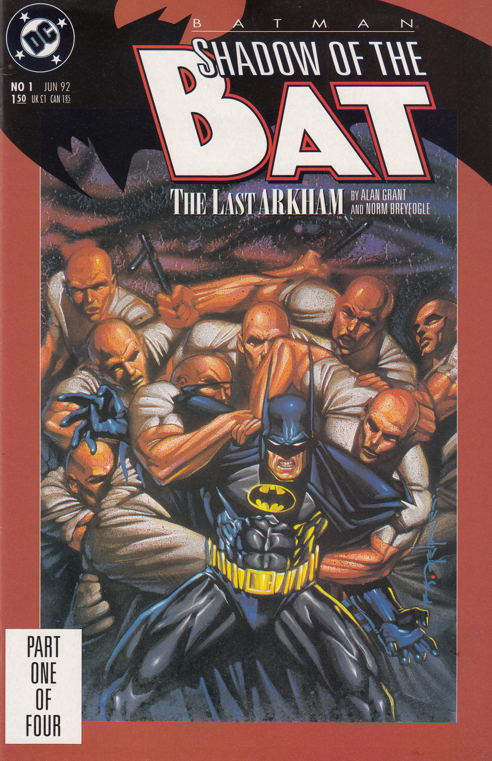
The cover's an eye-catching, gorgeous painted cover by Brian Stelfreeze and if I just glanced at it, I'd have gone on with the rest of my life unhindered by the petty nitpicking beast that lurks in my head. Instead, I had to notice that the Arkham guards (who, we can all agree, all just look like various aspects of Multi-Man ganging up on Batman) are using their billy clubs incorrectly. Unless — and I'm not being charitable here as I think it's a distinct possibility thought through by Stelfreeze — gripping the batons by the wrong end indicates how the guards are treating the inmates violently and inhumanely by smashing them with the short, protruding handle. Also Batman looks like he's taking a difficult dump.
The Title
What was the implied theme of this series based on the title Shadows of the Bat? I'm making a barely-considered assumption that the titles of the various Batman comic books directed the kinds of stories that would be told in them. Legends of the Dark Knight told stories out of linear continuity and overall context, highlighting some unspecified moment in Batman's life. Detective Comics actually considered the World's Greatest Detective aspect of Batman's character. Batman was all-encompassing and played out in present time, according to continuity. Penthouse Forums told the tales of Bruce Wayne's sordid love life. But what was Shadow of the Bat meant to indicate? Were the stories in this series meant to be Gotham tales, highlighting other people, places, or aspects of Gotham under the surveillance of Batman? That's the best theory I have being that Alan Grant begins with a four part story about Jeremiah Arkham and his renovated, new and improved asylum.
The Story
Alan Grant chooses to begin this series with a story about the sorely needed renovation of Arkham Asylum and the secret origin of the renovator, the newest member of the Arkham clan to run the joint, Jeremiah Arkham.
The cover's an eye-catching, gorgeous painted cover by Brian Stelfreeze and if I just glanced at it, I'd have gone on with the rest of my life unhindered by the petty nitpicking beast that lurks in my head. Instead, I had to notice that the Arkham guards (who, we can all agree, all just look like various aspects of Multi-Man ganging up on Batman) are using their billy clubs incorrectly. Unless — and I'm not being charitable here as I think it's a distinct possibility thought through by Stelfreeze — gripping the batons by the wrong end indicates how the guards are treating the inmates violently and inhumanely by smashing them with the short, protruding handle. Also Batman looks like he's taking a difficult dump.
The Title
What was the implied theme of this series based on the title Shadows of the Bat? I'm making a barely-considered assumption that the titles of the various Batman comic books directed the kinds of stories that would be told in them. Legends of the Dark Knight told stories out of linear continuity and overall context, highlighting some unspecified moment in Batman's life. Detective Comics actually considered the World's Greatest Detective aspect of Batman's character. Batman was all-encompassing and played out in present time, according to continuity. Penthouse Forums told the tales of Bruce Wayne's sordid love life. But what was Shadow of the Bat meant to indicate? Were the stories in this series meant to be Gotham tales, highlighting other people, places, or aspects of Gotham under the surveillance of Batman? That's the best theory I have being that Alan Grant begins with a four part story about Jeremiah Arkham and his renovated, new and improved asylum.
The Story
Alan Grant chooses to begin this series with a story about the sorely needed renovation of Arkham Asylum and the secret origin of the renovator, the newest member of the Arkham clan to run the joint, Jeremiah Arkham.
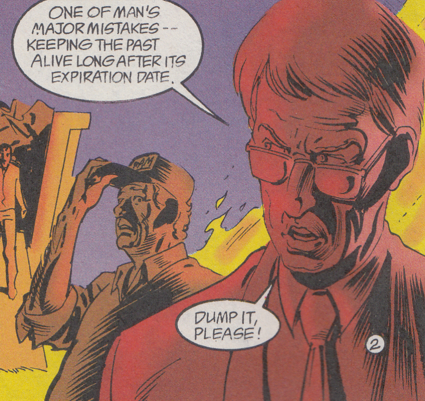
Not just a major mistake but the one most often committed. Over and over and over again.
Alan Grant tells us Jeremiah Arkham began life as an unambitious slacker. High-five to all my fellow unambitious slackers for the representation we were getting in 1992! Although Jeremiah eventually causes a mentally unstable person to kill themselves when Jeremiah instinctively knows the right thing to say and after that, he's all, "I've found my calling! Hurting the mentally ill!" I'm disappointed that I've never accidentally encountered the thing which would reveal my true calling to me unless it was that time I saw that feral cat fucking a raccoon and I popped a boner. I guess I just didn't have the wherewithal to see how that could become a career. Or maybe I just needed a daft uncle running a brothel for feral cats full of raccoon prostitutes to have recently died so that I could take it over. Because that's what happened with Jeremiah. He discovered his ability to "help" the mentally ill while also having an uncle who ran an insane asylum. So of course he had to take over when his uncle Amadeus died.
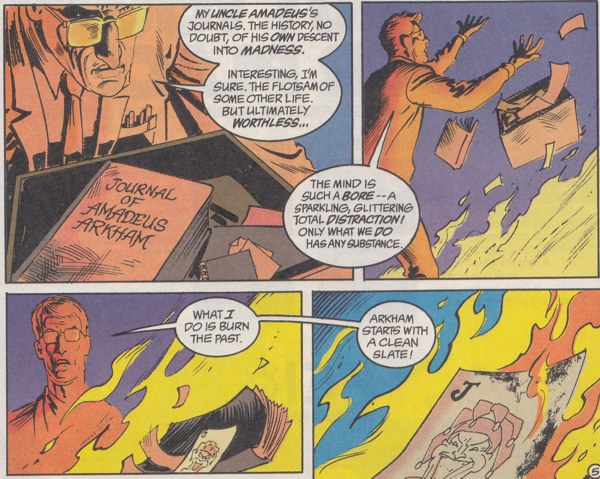
Alan Grant couldn't have wounded me worse than Arkham's dialogue in that second panel if he'd come to my house and smashed me directly in the balls with a 3 wood.
Jeremiah tears down Arkham to start over completely. Being that Jeremiah's family name is Arkham, Grant may be smashing us in the face with metaphor here. Jeremiah's own past burns beneath his now out-of-control need for control. He rebrands himself, hides his own past, and comes out shiny, clean, and more secure than he's ever been in his life. He is the proverbial new man and he's ready to start swinging some massive dick.
Also, Grant might just be speaking literally because he has an interesting story idea. A modern asylum for a modern Gotham! Jeremiah doesn't knock down the haunted house façade to put up a modern building. No, he keeps the historical look of the place. He doesn't want the change to be obvious to onlookers or new inmates. He wants them to be lured in by Arkham's quaintness and familiarity. What Jeremiah is mainly concerned with is renovating the cells and the security and the violent guards. Along with that, he makes a major change to the way inmates are treated. No more keeping them locked up just to keep them away from society for as long as it takes The Joker to cause a mass break-out. Instead, he takes an individual approach to each inmate to give them the care, medication, and experimental treatments that will allow them to one day be re-integrated into society. In other words, he tortures the fuck out of them in various imaginative ways.
Interrupting a series of vignettes serving as examples of how Jeremiah has convinced himself he's helping the inmates while he's really just deriving pleasure from novel treatments he's come up with that scare the shit out of the inmates (a particular case to drive the point home: Jonathan Crane, the man who's usually on the other side of causing fear, now trembling in his boots at Jeremiah's care), a scene showcasing Tim Drake doing Batman's job of keeping the peace and Nightwing taking some time away from the Titans to help out.
Also, Grant might just be speaking literally because he has an interesting story idea. A modern asylum for a modern Gotham! Jeremiah doesn't knock down the haunted house façade to put up a modern building. No, he keeps the historical look of the place. He doesn't want the change to be obvious to onlookers or new inmates. He wants them to be lured in by Arkham's quaintness and familiarity. What Jeremiah is mainly concerned with is renovating the cells and the security and the violent guards. Along with that, he makes a major change to the way inmates are treated. No more keeping them locked up just to keep them away from society for as long as it takes The Joker to cause a mass break-out. Instead, he takes an individual approach to each inmate to give them the care, medication, and experimental treatments that will allow them to one day be re-integrated into society. In other words, he tortures the fuck out of them in various imaginative ways.
Interrupting a series of vignettes serving as examples of how Jeremiah has convinced himself he's helping the inmates while he's really just deriving pleasure from novel treatments he's come up with that scare the shit out of the inmates (a particular case to drive the point home: Jonathan Crane, the man who's usually on the other side of causing fear, now trembling in his boots at Jeremiah's care), a scene showcasing Tim Drake doing Batman's job of keeping the peace and Nightwing taking some time away from the Titans to help out.
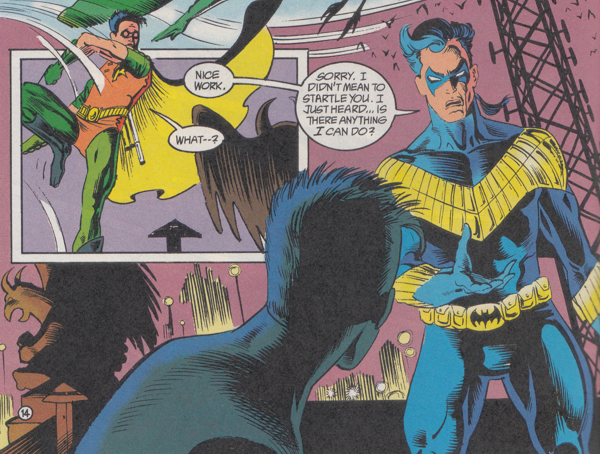
"Just heard"? Just heard about what?! What is happening?! Where is Batman?! But more importantly: what's up with the ponytail?
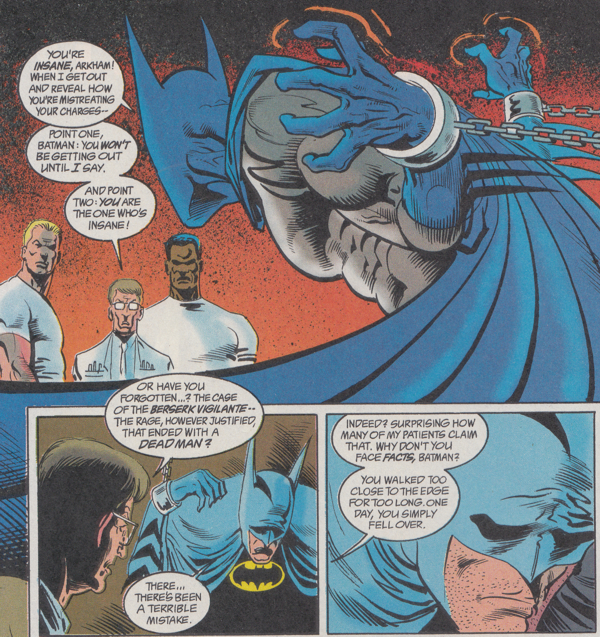
For now, that's the end of the conversation. But it isn't long before the reader learns that Batman has somehow become an inmate in Arkham. Not Bruce Wayne! No, no. Batman! After a brief conversation between Jeremiah and the soon-to-be super-scary new antagonist Zsasz, Grant reveals Batman, in full costume, chained to a cell in the asylum. Jeremiah accuses him of murder but you have to wonder, "How does a vigilante go through arrest, trial, sentencing, and imprisonment without ever taking off the mask?" Something is dreadfully wrong here. When Batman declares there's been a mistake, the reader understands that Batman has somehow been framed and captured by Jeremiah and his staff alone. Once again (the again being Talbot's recent story (though that was published several months later in 1992 than this story)), Gotham finds Batman missing!
My memory of this story's details have long decomposed in the moist, dank recesses of my mind but I feel like maybe Batman was in Arkham to help Jeremiah test the security when he found himself a prisoner. Maybe Arkham had a guard killed during the training and testing so that he could give himself an excuse for incarcerating a person whom Jeremiah finds is no different than his other captors. I mean patients. Or perhaps Batman was captured, overwhelmed by a bunch of bald-headed inmates, while investigating the claims that Jeremiah has resorted to torturing the inmates. I suppose we'll discover those little secrets in the second issue.
My memory of this story's details have long decomposed in the moist, dank recesses of my mind but I feel like maybe Batman was in Arkham to help Jeremiah test the security when he found himself a prisoner. Maybe Arkham had a guard killed during the training and testing so that he could give himself an excuse for incarcerating a person whom Jeremiah finds is no different than his other captors. I mean patients. Or perhaps Batman was captured, overwhelmed by a bunch of bald-headed inmates, while investigating the claims that Jeremiah has resorted to torturing the inmates. I suppose we'll discover those little secrets in the second issue.
This is a different kind of Gotham by Gaslight story.
Jeremiah saves his own life and the lives of his guards by not unmasking Batman. Obviously not because Batman would have to kill them but because Alan Grant would have to kill them to tie up the loose ends (again, see Bryan Talbot's "Mask" in Batman: Legends of the Dark Knight #39 and #40). Instead, Jeremiah hopes that once Batman has been cured of his antisocial behavior, he'll willingly drop the mask and walk out of Arkham a cured man. Hmm. Is it possible Alfred drugged Bruce and dragged him into Arkham for some therapy? He'd probably enjoy life much more if the little boy he's cared for for so long got some well-needed therapy.
The Ranking
Alan Grant lays out a sumptuous feast of story ideas in one of the better first issues of yet another Batman monthly. And I, currently re-reading Stephen King's Danse Macabre, sound like a total asshole with regards to my voice in the review of this comic. It's weird how fondly I remember this comic book (or at least this first story arc) and yet I only collected the first nine issues of this series that went for a 94 issues and seven years. Or is it? I'm constantly reminding myself that my younger self never really collected many Batman and Superman comics so I shouldn't be surprised that I'm quickly coming to an end of my Batman and Superman titles, titles I've concentrated on for the last few months. Unless I discover another one of my many short boxes full of old comics holds more Batman or Superman (I mean, the Death of Superman issue has to be somewhere with other Superman titles, right?), I'm nearly done with Supes and the Bat forever!
The Ranking
Alan Grant lays out a sumptuous feast of story ideas in one of the better first issues of yet another Batman monthly. And I, currently re-reading Stephen King's Danse Macabre, sound like a total asshole with regards to my voice in the review of this comic. It's weird how fondly I remember this comic book (or at least this first story arc) and yet I only collected the first nine issues of this series that went for a 94 issues and seven years. Or is it? I'm constantly reminding myself that my younger self never really collected many Batman and Superman comics so I shouldn't be surprised that I'm quickly coming to an end of my Batman and Superman titles, titles I've concentrated on for the last few months. Unless I discover another one of my many short boxes full of old comics holds more Batman or Superman (I mean, the Death of Superman issue has to be somewhere with other Superman titles, right?), I'm nearly done with Supes and the Bat forever!

No comments:
Post a Comment